

In 2026, a single subcontractor's safety oversight can trigger compound penalties exceeding $60,000 for your organisation, regardless of your own site performance. Relying on a "hope for the best" approach with third-party partners isn't just risky; it's a direct threat to your operational stability. We know that tracking compliance for a diverse, international workforce feels like an uphill battle, especially whilst language barriers and complex site rules collide. Effective contractor safety management training shouldn't be a bottleneck that slows down your operations, but rather a seamless gateway that empowers every worker to return home safely.
You likely want to move beyond paper-heavy inductions and manual spreadsheets that crumble under the scrutiny of a HSE or OSHA audit. This guide reveals how to implement a robust training programme that mitigates high-level risks, ensures strict legal compliance, and protects your hard-earned reputation. We'll walk you through the shift toward digital-first onboarding, the necessity of multi-language support for global teams, and how to maintain verifiable records that stand up to the most rigorous inspections. By the end, you'll have a clear roadmap to a safer, more efficient workplace where third-party incidents are a thing of the past.
Key Takeaways
- Learn how to align external partners with your organisational standards whilst meeting 2026 legal requirements for third-party safety.
- Discover why digital contractor safety management training is the most effective way to provide consistent, scalable onboarding for diverse workforces.
- Master the core components of a robust safety programme, including task-specific risk assessments and integrated Permit to Work systems.
- Simplify your compliance journey by digitising the pre-qualification process and creating verifiable audit trails for every contractor.
- Explore how video-led learning and multi-language support can eliminate communication gaps and build a stronger safety culture across global teams.
What is Contractor Safety Management Training?
At its core, contractor safety management training is a structured educational programme designed to align external partners with your organisation's specific safety protocols. It's more than just a box-ticking exercise; it's a vital alignment of standards that ensures every person on your site operates under the same protective umbrella. Under the Health and Safety at Work etc. Act 1974, host organisations carry a legal imperative to protect third-party workers. By 2026, the complexity of global supply chains and the speed of modern operations have made a digital-first approach to compliance essential. You can't rely on manual checks when dealing with rotating teams and high-risk environments.
It's vital to distinguish between general safety awareness and site-specific contractor inductions. Whilst a contractor might arrive with basic knowledge, they won't know your specific muster points, permit requirements, or hazard zones without targeted training. This process integrates into broader safety management systems to create a cohesive environment where risks are identified before work begins. Using accredited e-learning ensures that this foundational knowledge is consistent and verifiable across every tier of your supply chain.
The Legal and Financial Risks of Poor Management
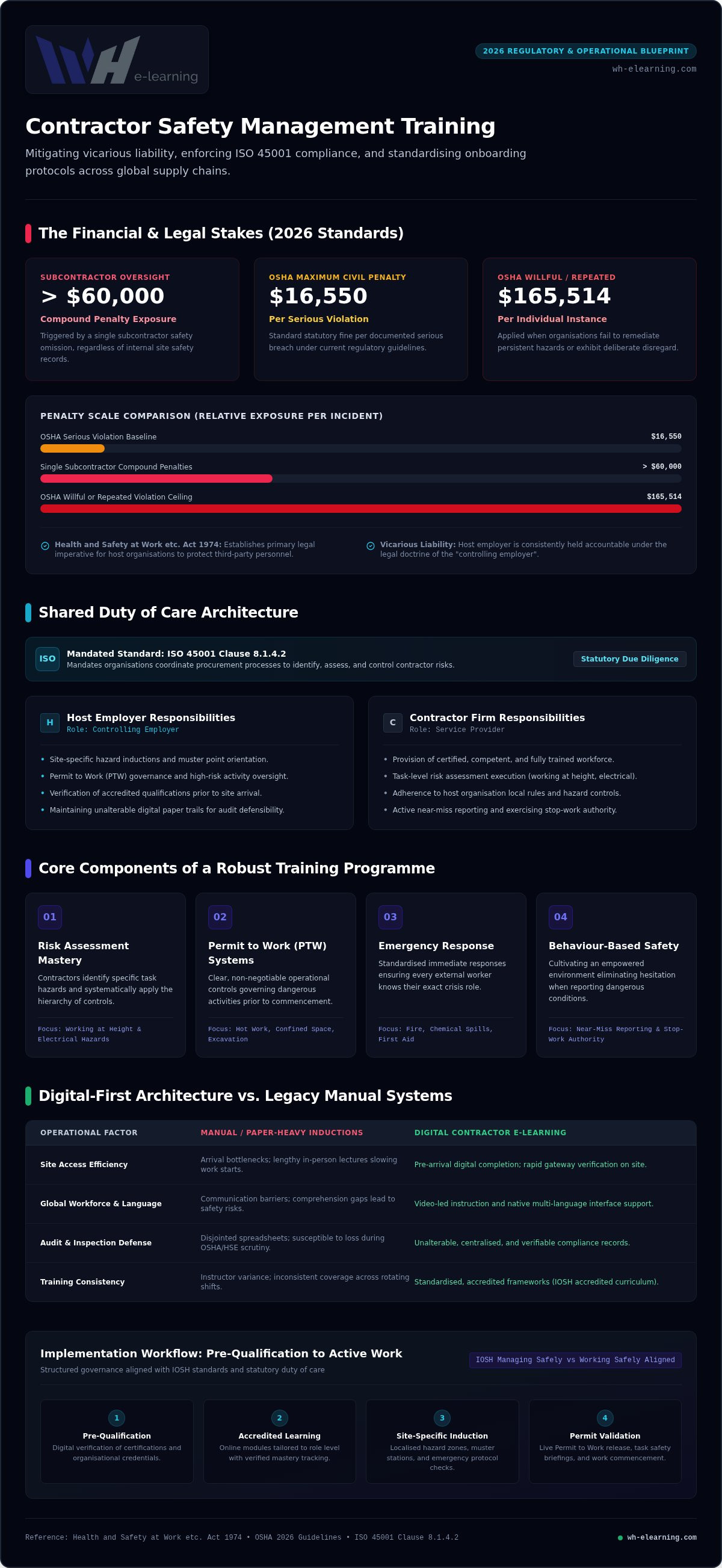
Ignoring contractor compliance opens your business to significant vicarious liability. If an incident occurs, the host employer is often held responsible as the "controlling employer." In 2026, OSHA maximum civil penalties for serious violations have reached $16,550, whilst willful or repeated violations can soar to $165,514 per instance. Beyond these direct fines, you face rising insurance premiums and legal fees that can cripple a project's budget. The reputational damage is equally severe. A single high-profile accident involving a contractor can erode brand value amongst stakeholders and make future procurement processes significantly more difficult.
Duty of Care: Host Employer vs. Contractor
Safety is a shared responsibility. Whilst the contractor firm must provide competent staff, the hiring organisation must ensure those staff understand the local environment. This shared model is reinforced by ISO 45001 Clause 8.1.4.2, which mandates that organisations coordinate their procurement processes to identify and control risks. Legal precedents show that "reasonable care" isn't just a suggestion; it's a requirement to verify qualifications before site commencement. Implementing accredited contractor safety management training provides an unalterable paper trail of due diligence. This record proves you've taken every practical step to ensure the safety of everyone on your site, protecting your business from claims of negligence.
Core Components of a Robust Training Programme
A high-quality contractor safety management training initiative does more than just list rules. It builds a foundation of competence that allows external teams to work alongside your permanent staff without friction. To achieve this, your programme should align with OSHA's recommended practices for safety and health programs, ensuring that hazard prevention is a collaborative effort. By 2026, the focus has shifted from mere attendance to verifiable mastery of key safety pillars.
Key pillars of a robust programme include:
- Risk Assessment Mastery: Contractors must be able to identify specific hazards related to their tasks, such as working at height or electrical risks, and apply the hierarchy of controls effectively.
- Permit to Work (PTW) Systems: Clear explanations of controls for high-risk activities like hot work, confined space entry, or excavations.
- Emergency Procedures: Standardised responses for fire, chemical spills, and first aid to ensure everyone knows their role during a crisis.
- Behaviour-Based Safety: Fostering a proactive culture where contractors feel empowered to report "near misses" and stop work if they perceive an unsafe condition.
Accredited Safety Frameworks (IOSH & Beyond)
Choosing the right accreditation is a critical decision for any safety leader. Understanding the difference between IOSH managing safely vs working safely helps you tailor the level of training to the contractor's specific responsibilities. IOSH standards provide a globally recognised benchmark that simplifies the verification of competence. Modern results come from video-based learning, which significantly improves knowledge retention compared to traditional, text-heavy slides. It's also vital that these modules are accessible on any device, allowing contractors to refresh their knowledge directly in the field.
Site-Specific vs. General Safety Knowledge
A successful onboarding journey balances broad occupational safety and health training course content with niche, site-specific hazards. Whilst general training covers the "why" of safety, your site induction covers the "where" and "how". Digital assessments play a pivotal role here, as they allow you to verify a contractor's understanding before they even step foot on your premises. If you're looking to streamline this process, you might explore our accredited modules to see how they fit into your existing workflow. By integrating site-specific risks into a digital framework, you ensure that contractor safety management training is both comprehensive and efficient.
Online vs. In-House: Which Training Format is Best?
Choosing the right delivery method for contractor safety management training often determines whether your compliance programme succeeds or stalls. Whilst some traditionalists argue for the prestige of the classroom, the reality of 2026 operations requires a more agile solution. For organisations managing large, rotating pools of subcontractors, the logistics of synchronising schedules for in-person sessions are nearly impossible. You need a system that moves at the speed of your business, not one that creates administrative friction.
The Logistics of Face-to-Face Training
In-house training sessions come with significant hidden costs that go beyond the specialist's day rate. You're paying for room hire, travel expenses, and, most importantly, lost operational hours as contractors sit in a classroom instead of working on-site. Scheduling these sessions often leads to site downtime or delays in project kick-offs because you're waiting for a trainer's availability. Face-to-face training remains essential for practical, hands-on skills such as fire extinguisher use or harness fitting. However, for foundational knowledge and site rules, it's often a cumbersome choice. Following HSE guidance on using contractors requires a level of oversight that is difficult to maintain with sporadic, manual inductions.
The Advantages of Digital E-Learning
Digital platforms offer a level of scalability that classroom training simply cannot match. Every contractor receives the exact same safety message, ensuring total consistency across your entire supply chain. This uniformity is vital for legal protection and operational clarity amongst diverse teams. E-learning allows contractors to complete their modules off-site before they even arrive, maximising their productivity from hour one. This flexibility is a game-changer for busy professionals who don't want to waste their first morning on-site in a lecture hall.
One of the most significant benefits of a digital approach is the ability to deploy multi-language e-learning courses. This ensures that language barriers don't compromise site safety or lead to misunderstandings of critical protocols. Automated dashboards track progress and expiry dates in real-time, providing an instant, verifiable audit trail that simplifies your administrative burden. By choosing a digital-first approach to contractor safety management training, you gain a cost-effective, flexible framework that grows with your project needs and keeps your workforce protected.
A Strategic Framework for Implementation
Successful contractor safety management training requires a lifecycle approach rather than a one-off event. It starts long before a contractor sets foot on your site and continues until the final invoice is settled. By treating safety as a procurement hurdle rather than an afterthought, you ensure only competent firms enter your supply chain. This framework helps you move from reactive site inductions to a proactive digital journey that protects everyone involved.
Step 1: Setting Compliance Standards
Your first task is to define the minimum safety certifications required for different contractor tiers. High-risk trades like scaffolding or electrical work will naturally require more intensive training than general site maintenance. Communicating these expectations early during the tender process prevents delays and ensures contractors budget for compliance from the start. The Safety Standard Minimum is the baseline for all third-party operations. By establishing this clear threshold, you remove ambiguity and set a professional tone for the entire partnership.
Step 2: Streamlining the Enrolment Process
Administrative friction is the primary reason for non-compliance. You can eliminate these bottlenecks by using bulk licensing to provide contractor firms with immediate access to training modules. Automated enrolment and instant certificate generation allow contractors to manage their own staff's progress without constant intervention from your team. This approach feels professional and encouraging, building trust with your partners whilst ensuring they meet your requirements. It's about creating a path of least resistance to safety excellence.
Step 3: Auditing and Reviewing Performance
Data is your most powerful tool for long-term safety. By analysing training records, you can identify high-risk teams or recurring knowledge gaps that might lead to incidents. Regular reviews ensure your business compliance e-learning remains relevant to evolving site hazards. Linking training completion to site access control systems, such as digital badges or turnstiles, provides a final, automated gatekeeper. Using comprehensive workplace safety training courses to refresh knowledge periodically keeps safety at the forefront of everyone's mind.
Ready to upgrade your compliance framework? You can view our complete guide to workplace safety courses to see how digital training can transform your contractor management today.
Elevating Global Safety with WH eLearning
WH eLearning understands that contractor safety management training is only effective if it's engaging and accessible. We've moved beyond the era of dull, text-heavy slides that workers simply click through to reach the end. Our video-based approach, accredited by IOSH, is engineered to boost retention and foster a genuine "safety-first" culture amongst your third-party workforce. By using specialist instructional design, we ensure that critical safety messages aren't just seen; they're understood and applied. It's about empowering your team with the knowledge they need to stay safe on any site.
One of the most significant challenges in 2026 is managing a diverse, international workforce. Language barriers shouldn't be the cause of a workplace incident. Our platform utilises machine translation into 25+ languages at no additional cost, ensuring that every contractor receives instructions in their primary tongue. For HR and H&S departments, this complexity is simplified through a centralised dashboard. You can monitor progress, verify certifications, and maintain an unalterable audit trail across your entire global operation from a single screen. This level of oversight provides the quiet confidence that your organisation is fully protected.
Accessible Learning for Every Contractor
Inclusivity is at the heart of our design. Every course includes closed captions to support different learning styles and noisy work environments. Because our platform is fully compatible with any device, contractors can complete their training on a smartphone, tablet, or laptop at their convenience. This seamless experience reflects your organisation's commitment to high standards. When you provide high-quality, translated resources, you send a clear message that the safety of every individual is a priority. It's a high-end experience that remains attainable for every member of your supply chain.
Scalable Solutions for Growing Organisations
Whether you're a local firm or a multinational enterprise, our licensing models adapt to your needs. You can choose individual enrolments for specific projects or corporate bulk access for larger workforces. Integrating these modules into your broader workplace compliance training strategy ensures a unified approach to safety across your business. We act as your reliable partner, removing the obstacles to growth whilst maintaining the highest accreditation standards. Our goal is to simplify your path to meeting professional standards, making safety management an asset rather than a burden.
Enrol your contractors today and secure your site compliance with WH eLearning.
Future-Proofing Your Contractor Compliance
Maintaining a safe worksite in 2026 demands a shift from static paperwork to dynamic, digital oversight. A robust contractor safety management training programme is no longer just a regulatory requirement; it's a strategic asset that protects your reputation and your people. By integrating accredited, video-led learning into your onboarding journey, you ensure that every worker, regardless of their native language, arrives on-site with the knowledge they need to operate safely and effectively.
WH eLearning provides the tools you need to manage this complexity with quiet confidence. Our platform offers over 100 accredited online courses and machine translation into 25+ languages, making it the ideal partner for growing organisations with diverse workforces. Video-based modules replace text-heavy slides to ensure higher engagement and verifiable knowledge retention. It's time to remove the administrative friction and empower your team to achieve professional excellence. Explore our accredited contractor safety courses today to simplify your path to compliance. We look forward to supporting your organisation's continued growth and safety success.
Frequently Asked Questions
Is contractor safety training legally required in the UK?
Contractor safety training is a legal requirement under the Health and Safety at Work etc. Act 1974 and the CDM Regulations 2015. These laws mandate that host employers ensure all workers possess the necessary skills, knowledge, and training to perform their tasks safely. Failing to provide adequate contractor safety management training can result in severe HSE fines and legal liability. It's your responsibility to verify that every third-party partner understands your site-specific risks.
How often should contractors undergo safety refresher training?
Most industry bodies recommend safety refresher training every three years to maintain high standards and account for regulatory changes. However, high-risk sectors often benefit from annual updates to keep critical protocols fresh. Regular intervals ensure that contractors don't become complacent with site-specific hazards or emerging safety technologies. You should also trigger new training whenever site conditions change significantly or following a near-miss incident to reinforce a proactive safety culture amongst your external workforce.
Can online safety training be used for high-risk contractor work?
Online e-learning is exceptionally effective for the theoretical foundations of high-risk work, such as understanding Permit to Work systems or hazard identification. It provides a consistent, verifiable baseline of knowledge before workers arrive on-site. Whilst practical tasks like equipment fitting require hands-on assessment, digital modules streamline the onboarding process. WH eLearning offers a blended approach, providing accredited online theory alongside specialist in-house face-to-face training for complex, practical requirements in high-risk environments.
What is the difference between a site induction and safety management training?
A site induction focuses on the specific geography and rules of a particular location, such as muster points and local first aid contacts. In contrast, safety management training is broader and competency-based, covering legal duties, risk assessment techniques, and hazard control strategies. Whilst an induction tells a contractor where to go, the training gives them the skills to work safely. Both are essential components of a robust contractor safety management training strategy to ensure total site compliance.
How do I track if a contractor has actually completed their training?
You can track progress effortlessly through the WH eLearning centralised dashboard, which provides real-time visibility into every contractor's status. The system generates unalterable digital certificates upon completion, creating a verifiable audit trail for HSE inspections. This automated approach eliminates the need for manual spreadsheets and paper records, which are prone to error. You'll receive instant alerts for expiring certifications, allowing you to maintain continuous compliance across your entire supply chain without administrative friction.
What languages are available for WH eLearning contractor courses?
WH eLearning provides machine translation for our entire course library into more than 25 different languages. This feature is vital for global organisations that manage diverse workforces where English might not be the primary language for every subcontractor. By offering safety instructions in a worker's native tongue, you significantly reduce the risk of misunderstandings and improve knowledge retention. This inclusive approach ensures that every person on your site stays protected, regardless of their background.
How does IOSH accreditation benefit my contractor management programme?
IOSH accreditation provides a globally recognised gold standard for safety, ensuring your training meets the highest pedagogical and technical benchmarks. By using IOSH-approved courses, you demonstrate a clear commitment to due diligence and international best practices. This accreditation simplifies the vetting process, as you can trust that contractors have been trained to a rigorous, industry-leading level. It builds professional credibility with stakeholders and provides a solid legal defence by proving you've prioritised high-quality safety education.
Can I purchase safety training for my contractors in bulk?
Yes, organisations can purchase training via our corporate training license fees, which provide bulk access to our library of over 100 courses. This model is ideal for businesses that need to train large or rotating contractor pools efficiently. Bulk licensing includes advanced administrative features for tracking progress and managing compliance at scale. It offers a cost-effective way to ensure your entire supply chain is aligned with your safety standards without the hassle of individual enrolments.


