

If you think the biggest risk to your business is a surprise inspection, you might be looking in the wrong direction. The real danger often lies in the hidden friction of outdated systems and disengaged teams. Most managers agree that overseeing workplace compliance training for a diverse or global workforce is a constant logistical headache. It's exhausting to track every individual certificate whilst fearing the legal fallout of a single missed module.
You deserve a training process that works as hard as you do. This guide reveals how to build a robust, accredited compliance programme that doesn't just tick boxes but actually protects your organisation and empowers your employees. We'll show you how to move away from fragmented systems toward a streamlined approach that delivers high engagement and ironclad proof of training. From leveraging multi-language support to mastering IOSH standards, you're about to discover a simplified path to professional excellence in 2026.
Key Takeaways
- Understand how to transition your workplace compliance training from a simple box-ticking exercise into a strategic asset that protects your reputation.
- Identify the four essential quadrants of a modern programme whilst using IOSH standards as your foundational safety benchmark.
- Evaluate whether online or in-person formats suit your organisation by analysing scalability and the engagement factor of video-based learning.
- Learn a practical two-step process to organise your strategy through a training needs analysis and targeted role mapping.
- Discover how to simplify global compliance management using multi-language course options and automated tracking features.
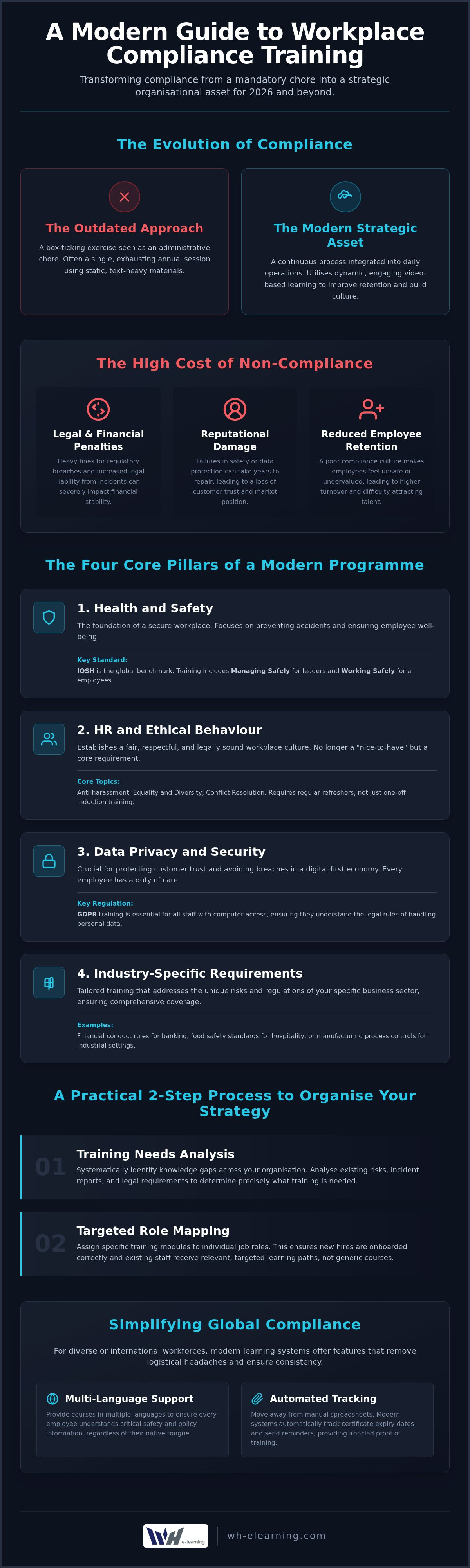
The Evolution of Workplace Compliance Training in 2026
Workplace compliance training is no longer just a hurdle to clear once a year. By 2026, forward-thinking organisations have rebranded these programmes as strategic assets rather than administrative chores. They recognise that a well-informed team is the strongest defence against operational risk. Understanding What is Compliance Training? starts with seeing it as a way to align individual actions with organisational values and legal standards. It's about building a culture where safety and ethics are instinctive.
The regulatory environment has shifted significantly recently. We now see a heightened focus on data privacy and mental health requirements. It isn't enough to simply mention these topics; they must be woven into the fabric of daily operations. Modern workplace compliance training reflects this by moving away from static, text-heavy PDFs. Companies are embracing dynamic, video-based learning that captures attention and improves retention. This shift supports "continuous compliance," a model where learning happens in bite-sized pieces throughout the year rather than in one exhausting annual session.
Why Compliance Matters More Than Ever
Investing in accredited training does more than just satisfy a legal requirement. It actively reduces legal liability and shields your organisation from the heavy fines that follow oversight. Beyond the balance sheet, it's a powerful tool for employee retention. People stay where they feel safe and where ethical behaviour is the norm. There's also a practical financial incentive; many insurers now look for proof of robust, accredited training before finalising corporate premiums. A proactive approach suggests a lower-risk profile, which can lead to more favourable terms.
The Cost of Non-Compliance
The fallout from a health and safety failure is rarely just financial. Reputational damage can take years to repair, whilst customer trust often evaporates instantly following a GDPR breach in our digital-first economy. The stakes are simply too high to leave things to chance. The compliance gap is the distance between your written policy and the actual daily behaviour of your employees. Closing that gap requires more than a signature; it requires a culture of genuine understanding. When employees don't understand the "why" behind a rule, they're far more likely to bypass it to save time.
The Core Pillars of a Modern Compliance Programme
Building an effective framework requires more than a random collection of courses. A modern programme stands on four essential quadrants: Health and Safety, HR and Ethics, Data Security, and Industry-Specific requirements. Each pillar supports a different aspect of your business, ensuring that no department is left exposed to risk. Diversity and inclusion training has also transitioned from a discretionary "nice-to-have" into a core compliance requirement. It's now a vital part of maintaining a fair and legally sound workplace.
Structuring your workplace compliance training around these pillars creates a cohesive strategy. This approach helps managers identify gaps in knowledge before they lead to incidents. It also simplifies the onboarding process for new hires, as you can map specific modules to their job roles from day one.
Health and Safety: The IOSH Standard
Safety is the foundation of any reputable organisation. IOSH is the global benchmark for safety management, offering two distinct paths. IOSH Managing Safely is designed for supervisors and managers who need to assess and control risks, whilst IOSH Working Safely provides essential grounding for employees at all levels. Accredited certificates carry significant weight with inspectors and auditors because they prove your team has met a rigorous, externally verified standard. Whilst UK businesses prioritise IOSH, global organisations often cross-reference these with OSHA training requirements to ensure international consistency. Choosing online IOSH courses is a practical way to keep hybrid teams aligned without the logistical burden of classroom sessions.
HR and Ethical Behaviour
Setting clear expectations for workplace behaviour is essential for a healthy culture. This pillar covers sensitive but critical topics like anti-harassment, equality and diversity, and conflict resolution. Training shouldn't be a one-off event during induction. Regular refreshers keep ethics at the forefront of the organisation, reminding staff of the standards they're expected to uphold. This proactive stance helps prevent toxic environments and reduces the likelihood of costly employment tribunals. You can explore a full range of these modules in our accredited training library.
Data Privacy and GDPR
Every employee with access to a computer now has a legal duty of care regarding data protection. GDPR training must go beyond the basic rules of handling files. Modern courses teach staff to recognise sophisticated phishing attempts and social engineering tactics that bypass traditional firewalls. Integrating data security into the daily routine ensures that privacy becomes a habit rather than a chore. Certified courses provide the necessary documentation to prove your organisation is meeting its legal obligations in an increasingly digital-first economy.
Evaluating Training Formats: Online vs. In-Person
Choosing the right delivery method is a balance between operational efficiency and educational impact. Traditional classroom models offer direct interaction, but they struggle to scale across a growing or global workforce. E-learning provides a solution to this by allowing you to deploy workplace compliance training to thousands of employees simultaneously. It removes the logistical burden of booking rooms and syncing schedules, making it the most cost-effective choice for modern businesses.
Engagement is the factor that determines your return on investment. Many legacy programmes rely on text-heavy slides that employees often click through without absorbing. Modern video-based courses change this dynamic by using visual storytelling to maintain focus. This approach leads to higher retention rates because it mirrors how professionals consume information in their daily lives. High-quality video content makes complex legal requirements feel accessible rather than intimidating.
There is a common misconception that online modules are less rigorous than face-to-face sessions. In reality, accredited online courses follow the same strict curricula as their classroom counterparts. They often include interactive assessments that ensure a student truly understands the material before they can progress. This provides a level of measurable data that is difficult to capture in a traditional lecture setting.
The Advantages of E-Learning for Compliance
Flexibility is perhaps the greatest benefit of digital training. Employees can learn at their own pace, pausing and resuming modules around their operational duties. This prevents the "information overload" that often occurs during day-long seminars. Consistency is equally vital; e-learning ensures every staff member receives the exact same message, regardless of their location. Accessibility features also make this format more inclusive. With support for over 25 languages and clear closed captions, you can ensure that every team member feels supported and included in the learning process.
When to Choose In-House Face-to-Face Training
Whilst digital formats excel at delivering broad knowledge, certain high-risk roles benefit from a hybrid approach. Some practical skills require hands-on assessment to ensure physical competence. Using industry specialists for in-house sessions allows you to tailor training to the specific hazards of your unique workplace. These sessions also offer social benefits, helping to build a shared safety culture through group discussion and collective problem-solving. This targeted use of face-to-face training ensures that your most specialised requirements are met with the highest level of detail.
How to Organise and Track Your Compliance Strategy
Moving from a reactive to a proactive model requires a clear, repeatable methodology. You can't rely on manual spreadsheets when managing the learning paths of a modern workforce. A structured approach ensures that your workplace compliance training remains effective, up to date, and easy to manage. Follow these five steps to build a strategy that scales with your organisation.
- Step 1: Conduct a thorough training needs analysis (TNA) across every department to identify specific knowledge gaps.
- Step 2: Map specific courses to individual job roles and legal requirements to ensure every employee receives relevant instruction.
- Step 3: Select an accredited provider that offers bulk licensing and administrative tools, ensuring your programme meets recognised standards.
- Step 4: Implement a robust tracking system to monitor progress and automatically flag upcoming expiry dates for certificates.
- Step 5: Review and update the programme annually to reflect legislative changes and internal shift in operational focus.
Identifying Your Organisation’s Training Needs
Start by differentiating between mandatory legal training and best-practice professional development. Whilst some courses are required by law for all staff, others may be specific to high-risk roles or individual career growth. Auditing current skill levels helps you avoid redundant training and keeps your team focused on new learning. Consult with department heads to identify specific operational risks that might not be visible from a high-level view. This collaborative approach ensures your workplace compliance training covers every possible vulnerability.
Monitoring Progress and Ensuring Accountability
Dashboards are the modern solution for maintaining a clear audit trail. They provide a real-time view of completion rates, allowing you to see exactly who has finished their modules and who requires a nudge. Automating reminders for course renewals is essential to avoid compliance lapses that could lead to legal repercussions. When an inspector visits, you can use this training data as undeniable evidence of your commitment to safety and ethics. This level of transparency builds trust with both regulators and your internal team.
Ready to simplify your administration? Explore our tracking features and bulk licensing options to streamline your entire compliance process.
WH eLearning: Simplifying Global Workplace Compliance
Managing global teams requires more than just a standard learning platform. It requires a partner that understands the nuances of international standards and the logistical challenges of diverse workforces. WH eLearning provides a library of over 100 accredited courses specifically tailored for the modern professional. This expansive collection ensures that your workplace compliance training is always comprehensive, legally sound, and easy to deploy across multiple territories.
We utilise a "Video-First" approach for a simple reason: it works. Instead of asking employees to click through static slides, we engage them with high-quality visual content that makes complex legal information stick. This method ensures higher retention rates and removes the boredom often associated with mandatory modules. Our platform supports both individual learners looking for specific certifications and enterprise-scale organisations needing a centralised hub for thousands of staff.
Accredited Content You Can Trust
Trust is built through recognised accreditation. Our IOSH Managing Safely and Working Safely certificates are respected badges of quality for your managers and staff. Every course in our HR and business compliance library is vetted by industry specialists to ensure accuracy. We provide continuous updates to every module, ensuring they reflect the legislative changes and expectations of 2026. This proactive approach gives you the quiet confidence that your organisation is always ahead of the curve and fully protected from risk.
Inclusive Learning for a Diverse Workforce
Global accessibility is a core feature of our service, not an afterthought. We break down language barriers by offering 25+ machine-translated languages and clear closed captions. This allows your workforce to access high-quality workplace compliance training in their native tongue, which is vital for ensuring that safety and ethical standards are fully understood across different cultures. Our platform is designed to be responsive, working seamlessly on any device. This means your employees can complete their training at a time and place that suits them best. We invite you to explore the WH eLearning course library and see how we can simplify your path to meeting professional standards.
Future-Proof Your Organisation's Compliance
Mastering workplace compliance training in 2026 requires a shift from reactive management to a proactive, strategic culture. We've explored how identifying core pillars like IOSH standards and data privacy protects your reputation whilst empowering your workforce. By choosing video-based e-learning over static slides, you ensure that vital safety and ethical messages actually resonate with your team. A centralised approach to tracking completion rates removes the friction of administration and keeps you ready for any audit.
As an IOSH Accredited Provider, WH eLearning is here to simplify your journey. Our platform offers multi-language support in over 25 languages and a dedicated admin dashboard to monitor progress in real time. This ensures every staff member, regardless of their location, receives the same high standard of instruction. It's time to replace the complexity of fragmented systems with a seamless, high-quality experience that facilitates long-term growth.
Browse our library of 100+ accredited compliance courses today and take the next step toward a safer, more ethical workplace. You're building more than just a compliant business; you're creating an environment where your employees can truly thrive.
Frequently Asked Questions
What is workplace compliance training and why is it necessary?
Workplace compliance training is a structured educational programme that informs employees about the laws, regulations, and internal policies that govern their specific roles. It is necessary because it serves as a primary defence against legal liability and operational risk. By ensuring every team member understands their obligations, you create a safer, more ethical environment that protects your organisation from heavy fines and reputational damage.
Is workplace compliance training legally required in the UK?
Yes, specific elements of compliance training are mandatory under various UK laws. For instance, the Health and Safety at Work Act 1974 requires employers to provide necessary information and instruction to ensure employee safety. Other requirements include GDPR for data handling and fire safety training. Failing to meet these standards can lead to severe legal penalties, making it essential to maintain an accredited training programme for your staff.
How often should staff complete compliance training refreshers?
The frequency of refreshers depends on the specific topic and your internal risk assessment. Whilst some certifications like IOSH suggest a three year renewal cycle, many organisations opt for annual updates for high stakes areas like data privacy or anti-harassment. Regular training ensures that safety protocols and legal requirements remain fresh in the minds of your workforce, preventing the compliance gap from widening over time as regulations evolve.
Can IOSH Managing Safely be completed entirely online?
Yes, IOSH Managing Safely can be completed entirely through our accredited online platform. This digital format provides the same rigorous curriculum and recognised certification as traditional classroom sessions but offers much greater flexibility. Employees can work through the modules at their own pace, making it an ideal solution for hybrid teams or managers who need to balance their professional development with busy daily operational duties.
What are the most common compliance training topics for small businesses?
Small businesses typically focus on core areas that carry the highest legal and operational risks. These often include health and safety basics, fire safety, and GDPR training. Additionally, modules covering equality and diversity, anti-bribery, and display screen equipment (DSE) are essential for building a professional foundation. Prioritising these workplace compliance training topics helps smaller teams meet their duty of care without requiring excessive administrative overhead or large budgets.
How does multi-language e-learning help with global compliance?
Multi-language e-learning ensures that every employee, regardless of their native tongue, fully understands the safety and ethical standards they must follow. WH eLearning provides machine-translated content in over 25 languages, which is vital for maintaining consistency across global territories. When staff can learn in their first language, retention rates improve and the likelihood of misunderstandings that lead to compliance breaches is significantly reduced across your international workforce.
What is the difference between accredited and non-accredited training?
Accredited training has been vetted and approved by an external professional body, such as IOSH, to ensure it meets high educational and industry standards. These courses provide a recognised certificate that carries weight with auditors and insurers. Non-accredited training is often developed internally for specific company procedures. Whilst internal courses are useful for onboarding, accredited modules are essential for proving your organisation meets national and international legal requirements.
Can I track my employees’ progress through the online courses?
Yes, our platform includes a comprehensive administrative dashboard designed for progress tracking. You can monitor completion rates in real time, see individual assessment scores, and download certificates for your records. The system can also automate reminders for upcoming renewals, ensuring that no team member falls behind. This level of visibility is crucial for maintaining an audit-ready programme and identifying any departments that might need additional support or resources.


