

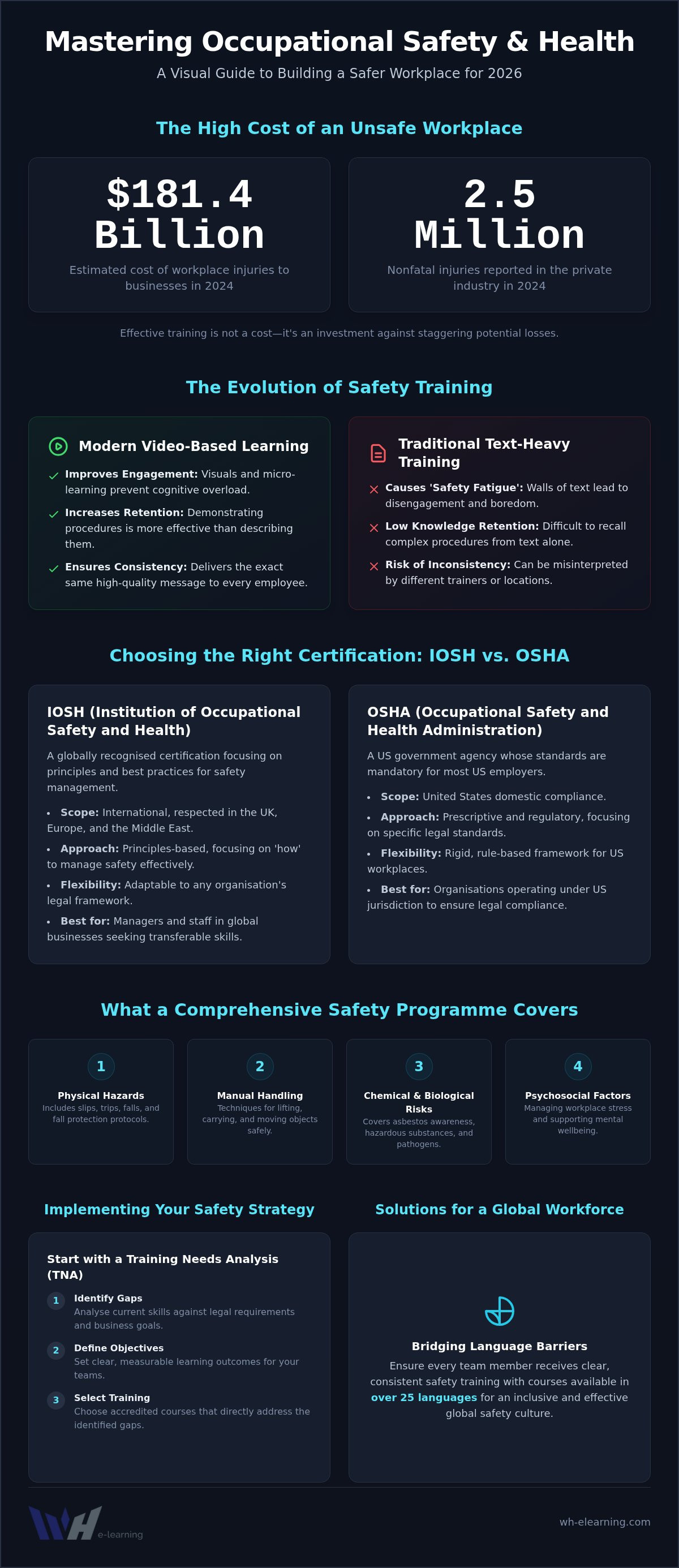
Did you know that workplace injuries cost businesses an estimated $181.4 billion in 2024? It's a staggering figure that highlights why an occupational safety and health training course is far more than just a regulatory hurdle. We recognise that managing safety requirements often feels like a complex puzzle, especially whilst trying to engage a remote or multi-language workforce. You've likely felt the frustration of dry, text-heavy modules that fail to resonate with your team, or the confusion of choosing between global standards like IOSH and OSHA.
This guide changes that. You'll master the essentials of workplace safety certification to protect your staff and ensure full legal compliance in 2026. We'll show you how to move beyond basic compliance to build a thriving safety culture. From identifying the perfect course for managers versus workers to securing accredited certificates like IOSH Managing Safely, we provide the clarity you need. We'll explore how modern, video-based learning simplifies training for global teams, making your path to a safer workplace both efficient and rewarding.
Key Takeaways
- Learn how an accredited occupational safety and health training course reduces workplace risks and ensures your organisation meets 2026 legal standards.
- Understand the critical differences between IOSH and OSHA certifications to select the most appropriate qualification for your managers and frontline staff.
- Discover why video-based modules significantly improve staff engagement and knowledge retention compared to traditional, text-heavy training programmes.
- Explore efficient ways to manage safety training across international teams using courses available in over 25 languages with inclusive features.
- Find out how to conduct a Training Needs Analysis to identify specific gaps and implement a robust safety strategy for your business.
What is an Occupational Safety and Health Training Course?
An occupational safety and health training course is a structured educational programme designed to identify, evaluate, and control workplace hazards. It provides a clear roadmap for teams to recognise dangers before they result in harm. If you're looking for a foundational definition, What is Occupational Safety and Health? provides an excellent starting point for understanding the global scope of this field. This training transforms safety from a vague concept into a practical management system that supports every level of a business.
The primary goal is the reduction of workplace injuries, illnesses, and fatalities whilst ensuring full legal compliance. With 2.5 million nonfatal injuries reported in private industry in 2024, the need for systematic training is undeniable. Core subjects typically include risk assessment techniques and hazard identification. You'll learn how to build safety management systems that protect your most valuable asset: your people. It isn't just about avoiding accidents; it's about creating an environment where employees feel secure and productive.
The Legal and Ethical Importance of Safety Training
Legal compliance is a significant driver for professional training. Whether you're meeting standards set by the HSE in the UK or OSHA in the United States, staying compliant is non-negotiable. However, the "Duty of Care" goes deeper than law. It's a moral commitment to staff wellbeing. From a business perspective, this investment is highly logical. It helps reduce insurance premiums and protects the company from the financial ruin of litigation and fines. Given that the total cost of work-related injuries reached $181.4 billion recently, the cost of training is a fraction of the potential loss.
Common Hazards Covered in a Standard Syllabus
A robust occupational safety and health training course covers a wide spectrum of risks. Physical hazards like manual handling, slips, trips, and falls are foundational. Since fall protection remains a frequently cited safety violation, these modules are critical for daily operations. You'll also explore chemical risks, such as asbestos awareness, and biological hazards. Modern syllabuses, such as updated IOSH programmes, now include psychosocial factors. These help managers identify stress and support mental health amongst their teams, alongside the safety implications of new technologies like AI and automation.
This training is essential for every level of an organisation. Entry-level workers gain the awareness needed to stay safe on the front line. Senior executives and business owners gain the strategic insight to lead a safety-first culture. It's a universal tool for professional growth and operational excellence that ensures everyone returns home safely at the end of the day.
Key Components of Effective Occupational Safety Training
Effective training isn't just a box-ticking exercise. It's a strategic investment in your team's behaviour. When selecting an occupational safety and health training course, accreditation is the first pillar of quality. Ensuring your programme is recognised by a reputable body like IOSH guarantees that the content meets rigorous international standards. Whilst some organisations look at OSHA training programs for US compliance, global businesses often seek the broad recognition and flexibility that IOSH provides.
Engagement is the second pillar. Traditional training often relies on endless slides of dense text, which leads to "safety fatigue." Modern solutions prioritise video-based content because it mirrors how we learn naturally. High-quality visuals demonstrate complex safety procedures in seconds, far more effectively than a thousand words could. Robust assessment follows this; testing ensures that knowledge isn't just seen, but retained and ready to be applied on the factory floor or in the office.
Why Video-Based E-Learning is the Modern Standard
Video-based learning has become the benchmark for professional development. It leverages visual learning to show exactly how to handle equipment or manage a hazard. This approach uses micro-learning, breaking complex topics into digestible three-to-five-minute chunks. This prevents cognitive overload and keeps your staff focused. Video ensures consistency across your entire organisation. Every employee receives the exact same high-quality message, which eliminates the risk of a local trainer misinterpreting a critical safety rule.
The Value of Multi-Language Training Support
A diverse workforce requires an inclusive approach to safety. If a worker doesn't fully understand the language of instruction, the training fails its primary purpose. Providing multi-language support ensures that non-native speakers grasp every nuance of critical safety instructions. This inclusivity isn't just ethical; it's a vital component of global compliance. By synchronising safety standards across international offices, you create a unified culture of protection. Choosing an accredited occupational safety and health training course with multi-language course translation across 25+ languages helps you reach every member of your team seamlessly.
Choosing the Right Certification: IOSH vs. OSHA
Selecting the most appropriate occupational safety and health training course depends largely on your geographic location and your specific professional role. For businesses operating within the United States, adhering to OSHA safety training requirements is a legal necessity. OSHA provides the specific legal framework required for US compliance, focusing on federal standards that every employer must follow. However, for organisations in the UK, Europe, and the Middle East, IOSH is widely considered the gold standard for safety excellence.
The Institution of Occupational Safety and Health (IOSH) is the world's largest professional health and safety membership body. Because its certifications are based on high-level management principles rather than just local laws, they carry significant weight internationally. This global recognition makes IOSH the preferred choice for multinational teams that need a consistent safety language across different borders. Choosing between these certifications isn't about which is "better" in a vacuum, but which aligns with your regulatory environment and your team's needs.
IOSH Managing Safely: The Essential Managerial Course
This course is specifically designed for supervisors, managers, and heads of departments. It empowers leaders to take responsibility for the safety of their teams without needing to become safety experts themselves. The curriculum focuses on practical actions that make a real difference in the workplace. Key modules include:
- Assessing risks: Learning how to identify hazards and evaluate the likelihood of harm.
- Controlling hazards: Understanding the hierarchy of controls to mitigate danger effectively.
- Measuring performance: Using data to check if safety management systems are actually working.
A unique feature of this course is the "Project" element. Delegates must apply their classroom knowledge to a real-world scenario within their own workplace, ensuring the training delivers immediate, tangible value to the organisation.
IOSH Working Safely: Ground-Level Safety Excellence
Whilst "Managing Safely" looks at the big picture, IOSH Working Safely is for every employee at any level. It provides the foundational knowledge required to work productively and safely in any organisation. This course focuses on personal responsibility, teaching staff how their individual behaviour impacts the safety of their colleagues. It's the perfect starting point for building a company-wide safety culture, as it strips away complex jargon and replaces it with clear, actionable hazard identification. For global teams, using an occupational safety and health training course like IOSH Working Safely ensures that every worker, regardless of their location, speaks the same language of safety.
How to Implement a Training Strategy for Your Organisation
Building a resilient safety culture requires a systematic implementation plan rather than a series of ad-hoc decisions. It starts with a comprehensive Training Needs Analysis (TNA). This process allows you to pinpoint exactly where your current safety knowledge falls short, ensuring your investment is precise. By identifying these gaps, you can select an occupational safety and health training course that directly addresses your unique industry risks. This ensures your team engages with content that is relevant to their daily tasks, which significantly improves retention and practical application.
Managing Compliance at Scale with Corporate Licensing
Centralised administration is the key to managing compliance at scale. Modern platforms allow you to assign modules to hundreds of staff members simultaneously, which is essential for large or remote workforces. This level of control simplifies the reporting and auditing process. You can generate detailed compliance reports in seconds, providing clear evidence for health and safety inspectors that your organisation meets every legal standard. Moving to a bulk licensing model is a highly efficient choice, as it ensures every employee is covered whilst providing better cost-efficiency than individual, per-person pricing.
Blending Online and In-House Training
A blended approach provides the most effective results for diverse teams. E-learning serves as the perfect theoretical foundation, allowing employees to complete modules without the need for expensive travel or time away from their roles. However, for high-risk activities that demand hands-on experience, In-House Face-to-Face Training provides the practical skill development that digital modules cannot replicate. By combining these two formats, you create a comprehensive learning loop. This strategy allows for annual refreshers that keep safety at the forefront of everyone's mind, ensuring your business remains compliant with the latest 2026 safety standards.
Finally, a robust tracking system is essential for maintaining long-term compliance. You need a clear overview of who has completed their training and whose certificates are nearing their expiry dates. Automated tracking removes the risk of human error and ensures you never miss a renewal deadline. This proactive approach transforms safety management from a stressful, reactive chore into a streamlined and predictable part of your corporate routine. If you are ready to simplify your compliance journey, explore our accredited occupational safety and health training course options today.
Modern Occupational Safety Solutions with WH eLearning
We've established that compliance is a strategic necessity, but the delivery of that training determines its success. WH eLearning provides a modern occupational safety and health training course that replaces dry, text-heavy slides with high-quality video content. These IOSH-accredited courses are designed to be genuinely engaging. This means your employees actually enjoy the learning process rather than just clicking through it. This shift in engagement is what builds a lasting safety culture and ensures that critical information is actually retained for the long term.
Our flexible corporate licensing models are built to grow alongside your business. You gain access to accredited certification that builds immediate trust with your clients, insurers, and regulators. This isn't just about meeting a legal minimum. It's about demonstrating a high-end commitment to excellence. We provide the administrative features you need to track staff progress in real-time, making the management of large workforces simple and transparent.
The WH eLearning Advantage: Engaging and Accredited
Our content is led by industry specialists who understand the practical realities of the workplace. We ensure every occupational safety and health training course is device-neutral. Your team can train on a mobile, tablet, or desktop anywhere in the world. This flexibility is vital for modern, remote workforces. We act as a reliable partner throughout your journey, offering a supportive partnership that includes:
- Expert-led content: Courses designed by safety specialists, not just software developers.
- Device neutrality: Seamless learning on any device, anywhere in the world.
- Scalable support: Reliable guidance from individual enrolments to global corporate rollouts.
Taking the Next Step Towards a Safer Workplace
2026 is the year to fully digitise and professionalise your safety training strategy. With regulatory updates like the OSHA HazCom alignment with GHS Revision 7 by 19 January 2026 and IOSH's increased focus on sustainability, having a modern platform is essential. We offer global accessibility with over 25 language options and closed captions for total inclusivity. You can start with a single course or secure a full library licence with ease. Explore our accredited health and safety training courses today to find the simplified path to full legal compliance and a safer work environment for everyone.
Securing Your Organisation's Future through Safety Excellence
Choosing the right occupational safety and health training course is a strategic investment that goes beyond simple legal checkboxes. You've seen how accredited IOSH courses provide the global standard needed to protect your team and your reputation. By moving away from dry, text-based modules and embracing engaging, video-led content, you ensure that safety knowledge actually sticks and transforms your workplace culture from the ground up.
As an IOSH Accredited Training Provider trusted by organisations globally, we specialise in video-based learning that delivers high engagement and impressive results. Whether you need to train a local team or manage a complex, multi-language rollout for a remote workforce, we provide the modern tools to make compliance effortless. We've simplified the path to professional standards so you can focus on what you do best: growing your business safely.
Ready to empower your staff and protect your operations in 2026? View our full range of accredited safety courses today. We're here to help you lead your team with quiet confidence and expert guidance.
Frequently Asked Questions
Is an online occupational safety and health training course as valid as a classroom-based one?
Yes, an online occupational safety and health training course is just as valid as a classroom session, provided it carries the same accreditation. IOSH recognises online learning as a formal route to certification. This allows your team to learn at their own pace without the disruption of travel or fixed schedules. The assessment process is just as rigorous, ensuring that learners meet the exact same high standards required in a traditional face-to-face setting.
Which course is better for my team: IOSH Working Safely or IOSH Managing Safely?
IOSH Managing Safely is designed for those with supervisory or managerial responsibilities, whilst IOSH Working Safely is the foundational level for every employee. If you're looking to empower department heads to assess risks and measure performance, the managerial course is the best fit. For a general workforce looking to improve their personal safety awareness and hazard identification, the Working Safely module provides the ideal starting point for a company-wide safety culture.
How long does it typically take to complete an online safety training course?
The time required depends on the specific level of the occupational safety and health training course you choose. A foundational course like IOSH Working Safely typically takes between six and eight hours to complete online. More comprehensive managerial courses generally require around 22 to 24 hours of study. Because these are delivered via e-learning, your staff can break this time into shorter, manageable sessions that fit around their daily work responsibilities.
Do these safety certificates expire, and how often should staff be retrained?
Whilst IOSH certificates don't officially expire, the industry standard is to provide refresher training every three years. This ensures that your team stays updated with the latest regulatory changes and safety best practices. Regular retraining prevents "safety fatigue" and ensures that hazard identification skills remain sharp. It's a proactive way to maintain a high-quality safety culture and demonstrate your ongoing commitment to staff wellbeing and legal compliance.
Can I train a global workforce in their native languages using WH eLearning?
Yes, you can certainly train a global workforce in their native languages using our platform. We offer courses in over 25 languages with closed captions to ensure total inclusivity for your international teams. This removes the barrier of language, ensuring that every worker fully understands critical safety instructions. It allows you to synchronise safety standards across global offices whilst providing a high-quality, consistent learning experience for everyone, regardless of their location.
What is the difference between IOSH and OSHA training?
The primary difference lies in their origins and legal status. IOSH is the world's largest professional body for health and safety, offering internationally recognised certifications based on high-level management principles. OSHA is a United States government agency that sets and enforces specific federal laws. Whilst OSHA is a legal requirement for US-based employers, IOSH is the preferred global standard for businesses seeking professional development and safety excellence across international borders.
Are there specific safety courses for high-risk industries like construction or asbestos handling?
Yes, there are numerous specialised courses tailored for high-risk environments. Beyond general awareness, you can access training for construction safety, asbestos handling, and COSHH compliance. These modules focus on the specific legal requirements and technical hazards unique to those sectors. Choosing a niche occupational safety and health training course ensures your staff are equipped with the precise knowledge needed to manage the high-risk factors they encounter in their specific daily roles.
How do I track if my employees have actually completed their safety training?
You can track progress effortlessly through centralised administrative features. Our platform provides a dashboard where managers can view real-time data on course enrolments, module progress, and final assessment scores. This system allows you to generate proof of compliance for health and safety inspectors in seconds. It also helps you identify any employees who might need additional support, ensuring that 100% of your workforce reaches the required standard of safety knowledge.


