

For many organisations, professional development feels like a tick-box exercise that drains resources without delivering real value. In the current regulatory environment, accreditation is the only metric that transforms your training from a sunk cost into a powerful legal and operational asset. You likely understand the frustration of rolling out corporate training courses for employees only to see engagement levels drop whilst the quiet fear of a failed audit lingers in the background. Managing a global workforce across multiple languages often creates inconsistent standards and a mountain of administrative stress.
You deserve a simpler path to compliance that your team actually enjoys. This article shows you exactly how to select and implement high-impact, accredited e-learning that ensures legal peace of mind whilst boosting completion rates through high-quality video content. We will provide a definitive 2026 checklist for building a robust training library. This guide covers everything from essential IOSH Managing Safely certifications to automated progress tracking, ensuring a seamless and audit-ready experience across your entire global organisation.
Key Takeaways
- Understand how to identify accredited training that satisfies your legal "Duty of Care" and ensures your organisation is always audit-ready.
- Discover why video-based corporate training courses for employees drive significantly higher engagement than traditional, text-heavy slide decks.
- Learn to standardise safety culture across global offices by leveraging multi-language course translations and centralised administrative dashboards.
- Optimise your professional development budget by utilising bulk licensing for essential certifications like IOSH Managing Safely.
- Master the hybrid approach by effectively integrating online theory with targeted in-house, face-to-face training sessions.
What Defines Accredited Corporate Training Courses for Employees?
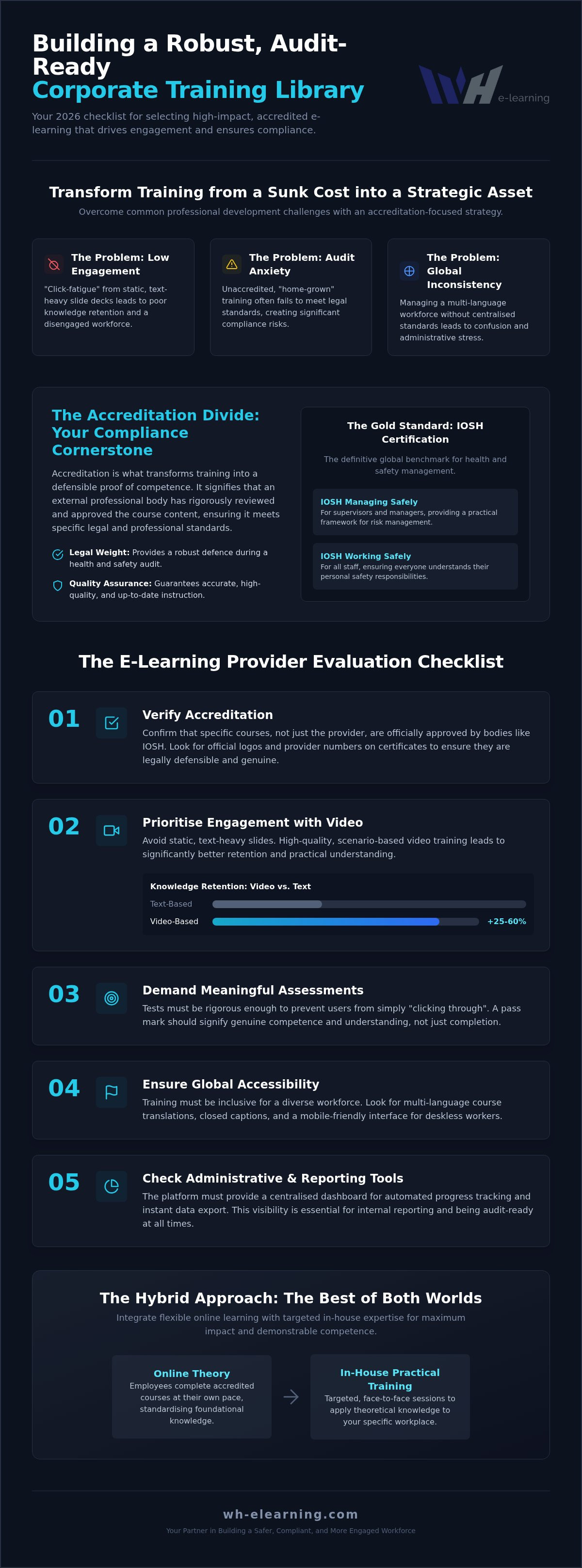
Accreditation is the dividing line between simple information sharing and a robust compliance strategy. When you select corporate training courses for employees, you aren't just buying digital content; you're investing in a verified standard of excellence. Accreditation means an external professional body, such as IOSH, has rigorously reviewed the course material to ensure it meets specific safety or professional requirements. This external validation gives your training programme its legal weight and ensures your team receives accurate, high-quality instruction.
In the eyes of a health and safety inspector, "home-grown" or unaccredited training often fails to meet the necessary standards during a compliance audit. By 2026, the global shift towards competency-based learning has made the choice of corporate training courses for employees even more vital. It's no longer enough for a worker to simply click through a deck. They must demonstrate a clear understanding of the material to satisfy your legal "Duty of Care." While broader corporate education covers many areas of professional growth, accredited training provides the specific, defensible proof of competence required in high-stakes environments.
The Gold Standard: IOSH Certification
IOSH Managing Safely stands as the definitive global benchmark for supervisors and managers across all sectors. It doesn't just teach rules. It provides a practical framework for managing risks and resources effectively. For front-line staff, IOSH Working Safely offers essential awareness that ensures every team member understands their personal responsibilities. For global organisations, these internationally recognised certificates provide a consistent language of safety. Whether your team is in London or Dubai, an IOSH certificate ensures everyone adheres to the same high standards, reducing the friction of managing international safety cultures.
Accreditation Bodies to Recognise
Identifying legitimate training is a critical skill for any HR or safety professional. You should always look for official logos and unique provider numbers on certificates to ensure they're genuine. It's also important to distinguish between CPD (Continuing Professional Development) and formal national accreditation. Whilst CPD is excellent for ongoing skills, it doesn't always carry the same regulatory weight as a course approved by a body like IOSH. Verifying these credentials helps you avoid "diploma mills" that offer worthless certificates. A reliable partner will always be transparent about their status and provide easy ways to verify student results for your audit records.
The Essential Checklist for Evaluating Corporate E-Learning Providers
Choosing a provider requires a shift in perspective. You aren't just buying a library; you're securing your organisation's compliance future. When evaluating corporate training courses for employees, start with a rigorous checklist that looks beyond the sales pitch. First, verify the accreditation of each specific module. A provider might hold general credentials, but individual courses like IOSH Managing Safely must be explicitly approved by the relevant body. This ensures the content remains legally defensible during an inspection.
Engagement is your next hurdle. Avoid providers who rely on static, text-heavy slides. These lead to "click-fatigue" and poor retention. Instead, look for video-based content that mirrors real-world scenarios. Meaningful assessments are equally vital. Tests should be rigorous enough to prevent "gaming" the system, ensuring that a pass mark actually signifies competence. Accessibility also matters. Your training must be inclusive, offering closed captions and multi-language options for a diverse workforce. Finally, administrative tools should allow you to export data instantly. This visibility is essential for audit readiness and internal reporting.
Content Quality and Employee Engagement
High-quality video training leads to 25-60% better retention than text-based alternatives. This isn't just a preference; it's a necessity for safety-critical roles where misunderstood instructions can lead to accidents. Scenario-based learning allows staff to practice decision-making in a risk-free environment, making the lessons stick. For your deskless or remote workers, a mobile-friendly interface ensures they can complete their training anywhere. You can explore a wide range of accredited video-based courses designed to meet these exact standards whilst keeping your team focused.
Administrative and Reporting Features
Effective administration reduces the burden on your HR team and ensures no one slips through the cracks. Real-time dashboards provide an instant overview of completion rates, whilst automated reminders nudge staff who haven't finished their modules. This level of automation is similar to the standards discussed by the U.S. Department of Labor regarding job training efficacy. Integration with your current HR systems ensures that every certificate is automatically logged. This creates a seamless paper trail for any future inspection, turning a complex management task into a simple, automated routine.
Managing Corporate Training for Global and Multi-Language Workforces
Operating across international borders introduces a unique set of challenges for compliance officers. When you deploy corporate training courses for employees in multiple regions, the risk of critical information being "lost in translation" becomes a significant legal liability. In high-hazard environments, a misunderstanding isn't just an administrative error; it's a safety hazard. Standardising your safety culture requires more than just sending the same document to every office. It demands a unified approach that ensures every staff member, regardless of their location, receives the same high standard of instruction and reaches the same level of competency.
Consistent certification is the backbone of a global compliance strategy. Whether an employee is based in a regional hub or a remote field office, their training should lead to a recognised standard that protects the organisation. By using centralised digital platforms, you can ensure that a supervisor in Singapore and a manager in London are both working towards the same accredited benchmarks. This eliminates the "compliance gaps" that often appear when regional offices are left to source their own, often unvetted, training materials. It's about creating a single source of truth for your entire global workforce.
Multi-Language Support as a Compliance Tool
Providing training in a learner’s native language is a powerful legal advantage. It demonstrates that you've taken every reasonable step to ensure your team understands their duties. WH eLearning addresses this by offering machine translation into 25+ languages, ensuring that complex safety concepts are accessible to everyone. Closed captions play a dual role here. They assist those with hearing impairments whilst also supporting workers who may be more comfortable reading the material in their second language. This level of inclusivity doesn't just boost engagement; it builds a more resilient and informed workforce.
Cultural Nuances in Global Safety Training
Adapting rigorous UK standards for a global audience requires a delicate balance. You must maintain the integrity of the accreditation whilst making the content relatable. Video is an essential tool in this process. It allows you to demonstrate universal safe behaviours that transcend language barriers, showing rather than just telling. Managing self-paced corporate training courses for employees across different time zones also removes the logistical nightmare of organising live sessions. Staff can learn at their own speed, in their own language, ensuring that the message is fully absorbed before they return to their daily tasks.
Scaling Your Strategy: Bulk Licensing and Corporate Training Progress Tracking
Scaling your professional development shouldn't mean increasing your administrative burden. When you move beyond purchasing individual corporate training courses for employees and adopt a bulk licensing model, you unlock significant operational efficiencies. This approach allows you to treat training as a scalable asset rather than a series of one-off expenses. By establishing a centralised training hub, you gain a high-level view of your organisation's compliance health whilst giving individual departments the autonomy to manage their own progress. It's a shift from reactive purchasing to strategic planning.
To achieve completion rates of 90% or higher, your onboarding process must be frictionless. Automated enrolments and clear deadlines help set expectations from day one, ensuring staff understand the importance of their modules. More importantly, the data generated by these platforms allows you to identify specific safety gaps before they become incidents. If a particular site consistently struggles with risk assessment modules, you can intervene with targeted support. This proactive use of data transforms your training records from a dormant archive into a live business intelligence tool that protects your people and your reputation.
The Benefits of Corporate Licensing
Bulk purchasing simplifies your procurement process by consolidating multiple invoices into a single, manageable agreement. This makes it much easier to allocate licenses across different departments or international sites as your team expands. A "pay-as-you-grow" model offers the flexibility needed for fast-moving businesses, ensuring you only pay for the corporate training courses for employees that you actually use. You can explore bulk licensing options to see how this streamlined approach can reduce your overheads and simplify your annual budgeting.
Audit Readiness and Compliance Reporting
Preparing for an HSE inspection is often a stressful period of gathering disparate records from various spreadsheets. A centralised system eliminates this friction by generating "Evidence of Training" reports at the touch of a button. You can automate certificate storage and set renewal alerts, so staff are notified months before their qualifications expire. This ensures you're always audit-ready without the need for manual tracking or last-minute panics. By monitoring these metrics, you can clearly demonstrate the ROI of your training investment to stakeholders, proving that safety and efficiency are two sides of the same coin.
The Hybrid Approach: Integrating Online Theory with In-House Training Expertise
While digital platforms offer unmatched efficiency, certain competencies require a physical presence to be fully mastered. The most effective corporate training courses for employees often form part of a blended learning strategy. This approach uses online modules to deliver the theoretical foundation, allowing staff to learn at their own pace before stepping into a practical environment. By front-loading the theory, you ensure that face-to-face time is spent on high-value activity rather than basic definitions. This mentor-led approach beats a simple software transaction by providing the context and feedback necessary for long-term professional growth.
A hybrid model creates a more resilient workforce by bridging the gap between digital knowledge and real-world application. It allows your organisation to maintain the high standards of accredited e-learning whilst ensuring that practical skills are tested under expert supervision. This is particularly vital for high-risk roles where a misunderstanding of theory can have serious consequences. By combining these two methods, you create a seamless path from initial awareness to verified competence.
Face-to-Face Training for Practical Skillsets
Some sectors simply cannot rely on screens alone. Fire safety, manual handling, and complex machinery operation require hands-on demonstrations to ensure true competency. Tailoring these in-house sessions to the specific hazards of your site makes the training more relevant and memorable for your team. A hybrid model allows you to combine digital certification with physical skill assessments, providing a comprehensive record of both knowledge and application. This method ensures that staff don't just know what to do; they know how to do it safely in their own unique working environment.
Partnering with WH eLearning for Total Compliance
Building a robust compliance strategy is easier with a partner who understands both the digital and physical worlds. You can access a library of over 100 accredited online courses, including essential health and safety modules that form the backbone of your training programme. By leveraging the face-to-face expertise of the WH Management Group, you can seamlessly integrate this digital theory with expert-led on-site training. This combination ensures your organisation meets every regulatory requirement whilst building a culture of genuine safety. You can explore our corporate training licences and accredited course library to start building your tailored hybrid programme today.
Building a Future-Ready Compliance Strategy
Transitioning from a reactive training model to a proactive compliance strategy is the most effective way to protect your business and your people. By prioritising accredited video content and leveraging multi-language support for your global workforce, you ensure that high standards are maintained across every site. A hybrid approach, combining digital theory with expert-led practical sessions, creates a deeper level of competence that simple software can't achieve alone.
Selecting the right corporate training courses for employees is an investment in your organisation's resilience and audit readiness. As an IOSH Accredited Training Provider with a library of over 100 professional courses, we help you simplify this process whilst ensuring total regulatory peace of mind. We take the friction out of professional development so you can focus on growth.
Secure your organisation’s compliance with WH eLearning bulk licences and gain access to our expert-led in-house training and support for 25+ languages. We're here to help you turn mandatory requirements into a seamless, high-impact asset for your entire team.
Frequently Asked Questions
What makes a corporate training course "accredited" in the UK?
Accreditation in the UK means the course has been reviewed and approved by an external professional body such as IOSH or a national awarding organisation. This process verifies that the training material is accurate, up-to-date, and meets specific regulatory standards. Unlike "in-house" certificates, accredited training provides a recognised benchmark of quality that is defensible during legal audits or health and safety inspections, ensuring your organisation meets its professional obligations.
How long do IOSH Managing Safely certificates remain valid for employees?
IOSH Managing Safely certificates do not have a formal expiry date, but it's industry best practice to refresh the training every three years. This ensures that managers and supervisors stay current with changes in legislation and safety management techniques. Keeping certifications up-to-date demonstrates a continued commitment to safety and helps maintain high standards of risk management across your entire organisation, reducing the likelihood of workplace incidents.
Can we use online safety courses for high-risk industries like construction?
You can certainly use online safety courses to deliver the essential theoretical knowledge required in high-risk sectors like construction. These modules cover vital topics such as risk assessment and hazard identification. However, for specific physical tasks like operating heavy machinery or scaffolding, you should combine digital learning with practical, face-to-face assessments to ensure full competency and meet all legal safety requirements for your specific site.
What are the benefits of video-based e-learning over traditional slides?
Video-based e-learning offers significantly higher engagement levels than traditional, text-heavy slides by using visual storytelling to explain complex safety concepts. Research suggests that video content can improve knowledge retention by 25% to 60%. This medium allows staff to see real-world scenarios in action, making the lessons more relatable and reducing the "click-fatigue" often associated with older, less interactive training formats that fail to hold a learner's attention.
How do I track if my employees have actually completed their compliance training?
Tracking is most effective through an administrative dashboard that provides real-time visibility into completion rates. These systems allow you to monitor the progress of corporate training courses for employees across different departments or global sites. You can generate instant reports for audit readiness and set up automated reminders to nudge staff who haven't finished their assigned modules before the deadline, ensuring no one slips through the cracks.
Is it possible to get accredited safety courses in multiple languages?
Yes, it's possible to access accredited safety training in over 25 languages through advanced machine translation and closed captioning. This ensures that every member of your global workforce can learn in their native tongue, which is a significant legal advantage. Providing multi-language support reduces the risk of critical safety information being misunderstood and helps standardise your organisation's safety culture across international borders, regardless of where your team is based.
What is the difference between a single course enrolment and a corporate licence?
A single enrolment is a one-off purchase for an individual learner, whereas a corporate licence provides a bulk allocation of training seats for larger teams. Licences are typically more cost-effective and offer greater flexibility for scaling your corporate training courses for employees as the business grows. They also simplify the procurement process by consolidating multiple training requirements into a single, manageable agreement that provides better oversight for HR managers.
Do online safety courses meet the requirements of the HSE?
Online safety courses meet HSE requirements provided they are "suitable and sufficient" for the risks involved in the work. Using accredited courses from a recognised provider helps demonstrate that you've met this standard. The HSE accepts e-learning as a valid method of training, especially when it's combined with practical instruction for tasks that require physical skills or specific on-site hazard awareness that cannot be replicated digitally.


