

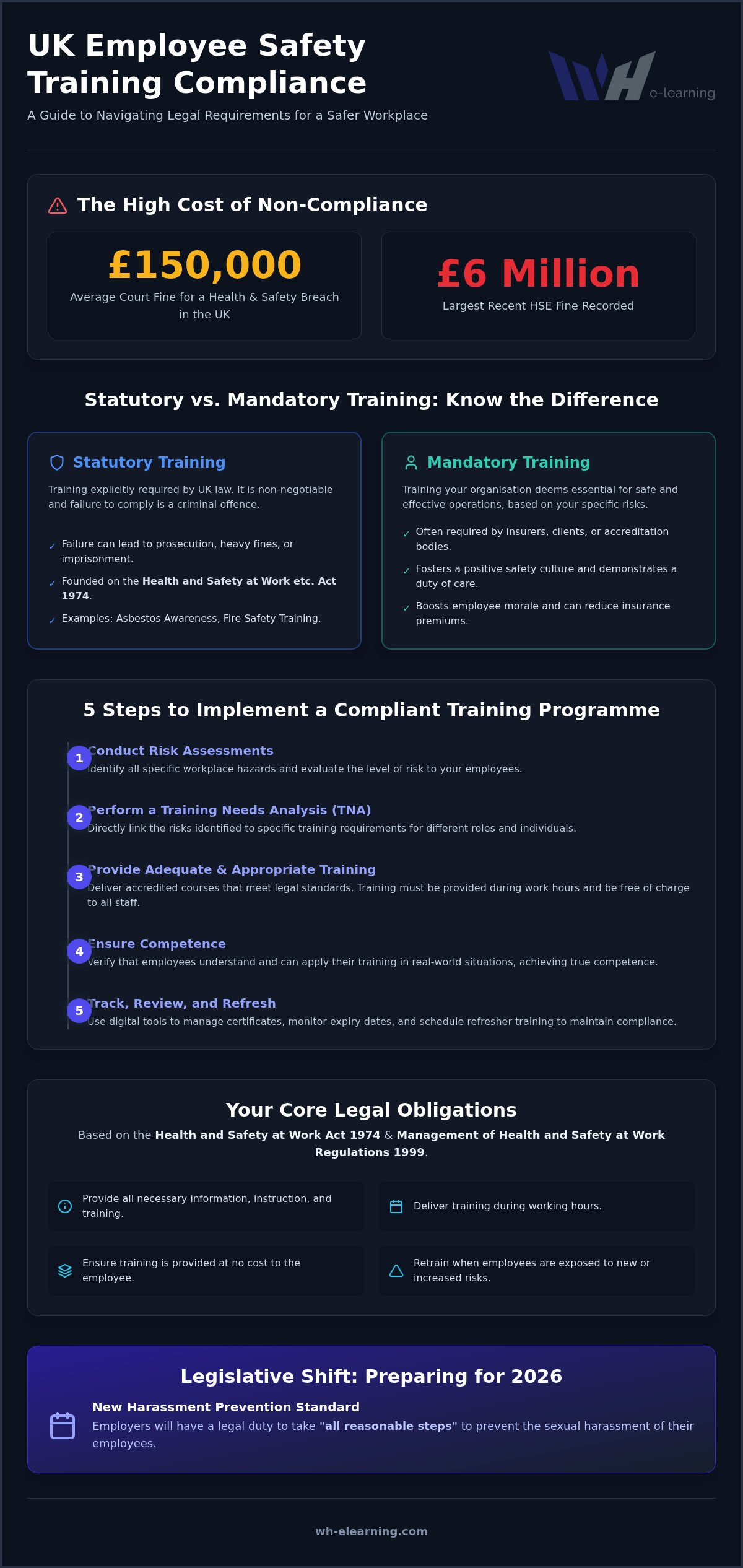
Did you know that the average court fine for a health and safety breach in the UK has reached £150,000? With the largest HSE fine recently hitting £6 million, staying on top of the legal requirements for employee safety training UK isn't just about ticking boxes; it's about protecting your team and your reputation. We understand that it's easy to feel overwhelmed by confusing HSE jargon or the constant struggle of tracking expiring certificates across a busy workforce. Traditional off-site training centres often add more stress with high costs and lost productivity.
You can transform this complex burden into a streamlined, digital process that offers total peace of mind. We'll show you how to build a robust, accredited training programme that reduces accidents and keeps you fully compliant. This guide explores the critical legislative shifts for 2026, including the new "all reasonable steps" standard for harassment prevention, and provides a clear roadmap for modernising your safety culture and administrative systems.
Key Takeaways
- Distinguish between statutory duties and internal mandatory training to ensure your compliance budget is spent effectively.
- Master the legal requirements for employee safety training UK by understanding your core obligations under the Health and Safety at Work Act 1974.
- Identify the "Universal Five" essential courses that form the foundation of a legally robust safety culture for any British business.
- Streamline your implementation process by linking a Training Needs Analysis directly to your organisational risk assessments.
- Leverage digital tools and centralised dashboards to remove the administrative burden of tracking staff certificates and expiry dates.
The UK Legal Framework: Statutory vs Mandatory Training
Understanding the difference between statutory and mandatory training is the first step toward building a compliant workforce. While people often use these terms interchangeably, they serve different functions within your business. Statutory training is instruction explicitly required by law. If you don't provide it, you're breaking the law. Mandatory training, however, refers to the courses your organisation or insurers decide are essential for your specific operations. Distinguishing between the two allows you to prioritise your budget, ensuring you meet legal requirements for employee safety training UK without overspending on unnecessary extras.
Defining Statutory Training Requirements
Statutory training is non-negotiable. Failure to provide this level of instruction can lead to severe criminal prosecution, heavy fines, or even imprisonment for directors. The primary foundation for these obligations is the Health and Safety at Work etc. Act 1974, which places a general duty on employers to provide whatever information and training is necessary to ensure the health and safety of their staff. Specific regulations also mandate training for high-risk activities. For example, Asbestos Awareness training is a legal must for anyone likely to disturb the substance, whilst Fire Safety training is required for all employees under the Regulatory Reform (Fire Safety) Order 2005.
The Health and Safety Executive (HSE) focuses heavily on the concept of "competence". They define this as a combination of training, skills, experience, and knowledge that allows a person to perform a task safely. It's not just about sitting through a presentation; it's about ensuring your team truly understands the legal requirements for employee safety training UK and can apply them in real-world scenarios.
The Role of Mandatory Internal Policies
Mandatory training might not always be a direct legal requirement, but it's often just as vital for your business's health. Many insurance providers insist on specific safety certifications before they'll offer coverage or lower your premiums. Additionally, you might find that specific client contracts demand your team holds certain accredited qualifications before you're allowed on-site. Beyond these external pressures, internal policies foster a positive safety culture. When you invest in training that goes beyond the bare minimum, you're demonstrating a genuine duty of care. This proactive approach improves employee behaviour, boosts morale, and shows your team that their well-being is a priority, not just a line item in a compliance report.
Core Legislation: The Health and Safety at Work Act 1974
The Health and Safety at Work Act 1974 remains the primary piece of legislation you need to master. Section 2 of the Act explicitly requires employers to provide "such information, instruction, training and supervision as is necessary" to ensure the health and safety of their employees. This isn't a vague recommendation; it's a fundamental pillar of the legal requirements for employee safety training UK. To comply, you must apply the "So Far As Is Reasonably Practicable" (SFAIRP) principle. This involves weighing the level of risk against the trouble, time, and money needed to control it.
Building on this foundation, the Management of Health and Safety at Work Regulations 1999 clarify your duties further. These regulations demand that you provide safety training during recruitment, when employees are exposed to new or increased risks, or when you introduce new equipment or technology. Crucially, the law states that this training must take place during working hours and must not be at the expense of the employee. Providing accredited health and safety training courses online is often the most efficient way to meet these obligations without disrupting your daily operations.
The Employer’s Duty of Care
Duty of Care is a non-delegable legal obligation that rests squarely on your shoulders as an employer. You cannot outsource the legal responsibility for your team's safety to a third party. Compliance requires you to provide "adequate" training based on the specific risks identified in your workplace risk assessments, ensuring you meet the legal requirements for employee safety training UK for every role. For more detail on how to structure this, you should consult the HSE's guidance on health and safety training. Remember that training must always be provided free of charge to all staff members, regardless of their contract type or seniority.
Employee Responsibilities and Cooperation
Safety is a shared journey, and the law reflects this through Section 7 of the Act. Employees have a legal duty to take reasonable care of their own health and safety, as well as the safety of others who might be affected by their actions. This includes a strict requirement to cooperate with you so that you can meet your legal duties. Staff must follow the safety training provided and use any safety equipment correctly. Employees who choose to ignore established safety protocols or skip mandatory training sessions can face serious legal consequences, including personal fines or criminal prosecution in extreme cases. Encouraging this cooperation is easier when the training is engaging and accessible, turning a legal necessity into a collective commitment to a safer workplace.
Essential Training Checklist: Meeting Your Statutory Obligations
Meeting the legal requirements for employee safety training UK involves more than a generic induction. You must provide targeted instruction that addresses the specific hazards your team faces daily. Whilst the Health and Safety at Work etc. Act 1974 sets the broad framework, certain "Universal Five" courses form the backbone of a compliant programme. These typically include Fire Safety, Manual Handling, Display Screen Equipment (DSE), Slips and Trips, and Basic First Aid. For organisations with diverse teams, ensuring this information is understood is a critical hurdle. Providing training in a staff member's native tongue is often the only way to guarantee true competence; our courses are translated into over 25 languages to ensure no one is left behind.
Addressing physical risks is equally vital for your bottom line. Handling, lifting, and carrying accounted for 17% of all non-fatal workplace injuries in 2024/25. By implementing robust Manual Handling training, you don't just tick a compliance box; you actively reduce the risk of musculoskeletal disorders and the high costs associated with staff absenteeism. This proactive approach ensures your business remains productive whilst fulfilling its duty of care.
General Safety Training for All Staff
Fire Safety training is a foundational requirement. All employees must understand emergency evacuation procedures and the location of fire-fighting equipment. Best practice suggests this should be refreshed annually to keep procedures fresh in the mind. DSE training is another essential, especially for hybrid or remote teams. If an employee uses a computer or laptop for more than an hour a day, you're legally required to assess their workstation and provide training to prevent strain. Finally, whilst not every staff member needs to be a qualified first aider, everyone should have basic awareness and know who the "Appointed Person" is to manage an emergency situation.
Industry-Specific Legal Requirements
Beyond general awareness, many sectors face high-risk environments that demand specialised knowledge. COSHH training is vital for any role involving hazardous substances, from industrial chemicals to everyday cleaning products. For tradespeople or maintenance staff, Asbestos Awareness is a life-saving statutory requirement before they begin work on older buildings. To manage these complex legal requirements for employee safety training UK effectively, supervisors and managers require a higher level of accreditation. Enrolling leadership in an IOSH Managing Safely course provides them with the practical tools to conduct risk assessments and drive safety performance from the top down.
How to Implement a Compliant Training Programme in 5 Steps
Transitioning from understanding the law to active implementation doesn't have to be a bureaucratic nightmare. By following a structured approach, you can ensure your business meets the legal requirements for employee safety training UK whilst building a culture of genuine safety. The process begins with a clear strategy that aligns your training modules with the actual hazards present in your workplace.
- Step 1: Conduct a Training Needs Analysis (TNA). Link this directly to your latest risk assessment to identify exactly who needs what.
- Step 2: Select an accredited platform. Choose video-based content for higher engagement levels compared to static text.
- Step 3: Organise your workforce. Group staff by risk levels; for instance, warehouse teams require different instruction than office-based staff.
- Step 4: Roll out the programme. Set firm deadlines for completion to prevent compliance gaps from widening.
- Step 5: Measure your success. Look beyond pass marks; evaluate behavioural changes and look for a reduction in workplace incidents.
Conducting an Effective Training Needs Analysis
A successful TNA maps individual job roles to specific hazard profiles. It's not enough to give everyone the same generic handbook. You should review your "near-miss" reports from the past twelve months to see where training might have prevented a close call. We recommend involving your staff in this process; they're the ones on the front line and often identify hidden safety gaps that a desk-based audit might miss. This collaborative approach ensures your training is relevant and respected by the people who need it most.
Ensuring Inclusivity and Accessibility
Inclusivity isn't just a corporate goal; it's a legal necessity. You're required to provide safety instruction in a language the worker fully understands. If a staff member doesn't grasp the nuances of a fire drill because of a language barrier, you haven't met the legal requirements for employee safety training UK. Video-based e-learning with closed captions provides vital support for hearing-impaired staff, making the content accessible to everyone. Using multi-language translation ensures your safety standards remain consistent across every site, regardless of your team's background. To get started with a platform that supports your entire workforce, explore our accredited health and safety training courses today.
Simplifying Compliance with WH eLearning’s Digital Tools
Meeting the legal requirements for employee safety training UK shouldn't involve a mountain of paperwork or complex manual spreadsheets. Modern businesses need a solution that scales with them whilst providing absolute clarity on their compliance status. WH eLearning provides this through a modern, digital approach that replaces administrative headaches with streamlined oversight. By using corporate licensing, you can manage your entire workforce's development from a single point of contact, ensuring that every team member receives the exact instruction their role demands.
Digital training offers a level of flexibility that traditional classroom sessions simply cannot match. Your employees can access over 100 accredited, video-based courses on any device, allowing them to fit essential learning around their daily responsibilities. This accessibility ensures that remote or field-based teams remain just as compliant as those in the office, removing the logistical barriers that often lead to training gaps.
Real-Time Compliance Tracking
Our centralised administrative dashboard provides a powerful bird's-eye view of your organisation's safety health. You can monitor progress in real time, quickly identifying any staff members who haven't yet started their assigned modules. This level of transparency is vital for maintaining high standards and ensuring no one falls behind. Automated reminders take the pressure off your HR team by notifying employees when their certificates are due for renewal, preventing accidental lapses in compliance.
When an HSE inspector calls, having an instant digital audit trail is invaluable. Digital records and instant certifications provide undeniable proof that you've fulfilled your legal requirements for employee safety training UK. You can generate comprehensive reports in seconds, demonstrating a proactive and well-managed safety culture that satisfies even the most rigorous external audit.
Measuring the ROI of Modern Safety Training
Investing in high-quality training delivers a measurable return that goes far beyond simple box-ticking. There is a direct correlation between high training completion rates and a reduction in RIDDOR (Reporting of Injuries, Diseases and Dangerous Occurrences Regulations) incidents. When employees are engaged, they're safer. Our video-based learning is designed for higher engagement, helping your team retain vital information much more effectively than they would through static, text-heavy modules. This improved knowledge retention leads to better safety behaviour on the shop floor, fewer accidents, and significantly lower associated costs for your business. Explore our accredited safety library today and see how easy compliance can be.
Future-Proof Your Workplace Safety Standards
Meeting the legal requirements for employee safety training UK doesn't have to be a source of administrative stress. You've seen how a clear understanding of the 1974 Act, combined with a structured five-step implementation plan, can transform your compliance from a burden into a strategic asset. By prioritising accredited, video-based learning, you ensure that your team isn't just ticking boxes but is actually gaining the competence needed to stay safe on the job.
Managing these requirements becomes effortless when you have the right digital partner. As an IOSH Accredited Training Provider, we help you remove friction through real-time tracking and automated renewals. Our multi-language support with 25+ translations ensures that every worker, regardless of their background, receives the highest standard of instruction. It's time to replace outdated manual systems with a modern, scalable approach that protects both your people and your reputation. Browse our library of 100+ accredited safety courses to start building a more resilient workforce today. You've got the knowledge; now take the final step toward total peace of mind.
Frequently Asked Questions
Is online workplace safety training legally valid in the UK?
Yes, online training is fully recognised by the Health and Safety Executive (HSE) as a valid method of instruction. As long as the content is high-quality, relevant, and accredited, it satisfies the legal requirements for employee safety training UK. Digital courses often provide better consistency than classroom sessions, ensuring every staff member receives the same standard of information regardless of their location or the time of day they complete the module.
How often should employees undergo health and safety refresher training?
There is no single legal timeframe for all topics, but established best practices exist. Fire safety awareness should be refreshed annually, whilst manual handling and food hygiene training are typically updated every three years. You must also provide refresher training if roles, equipment, or legislation change. Regular updates ensure that safety knowledge remains fresh and that your organisation stays compliant with evolving industry standards and regulatory expectations.
What is the difference between IOSH Managing Safely and Working Safely?
IOSH Managing Safely is designed for supervisors and managers, focusing on risk assessments and safety leadership. In contrast, IOSH Working Safely is an introductory course for employees at any level, covering basic hazard awareness and personal responsibility. Both courses are essential for meeting the legal requirements for employee safety training UK, but they target different roles within your organisational hierarchy to ensure comprehensive safety oversight across the whole business.
Does the law require safety training to be provided in an employee’s native language?
The law requires that workers clearly understand the health and safety information they receive. If an employee has a limited grasp of English, you are legally obligated to provide training in a format or language they can comprehend. Failing to do so means you haven't met your duty of care. Our platform supports this by offering translations in over 25 languages, ensuring your safety protocols are understood by your entire workforce.
Are employers required to pay for safety training in the UK?
Yes, employers must provide all health and safety training free of charge to their staff. According to the Health and Safety at Work etc. Act 1974, this training must also take place during the employee's normal working hours. You can't ask staff to pay for their own safety certifications or expect them to complete mandatory modules in their own time without compensation, as this would be a breach of statutory regulations.
What happens if a UK business fails to provide statutory safety training?
Failure to provide statutory training can lead to severe criminal prosecution and heavy financial penalties. The average court fine for a health and safety breach in the UK is currently £150,000, with extreme cases reaching millions of pounds. Beyond legal costs, you risk higher accident rates, increased insurance premiums, and significant damage to your professional reputation. Proactive training is always a more cost-effective investment than the fallout from a preventable workplace incident.
Can I track the training progress of a large team using WH eLearning?
Absolutely, our centralised administrative dashboard is built specifically for managing large-scale workforces. You can monitor individual progress, identify who hasn't started their modules, and generate real-time compliance reports for audits. This system removes the manual effort of tracking spreadsheets and provides automated reminders for certificate renewals. It's a scalable solution that ensures your administrative oversight remains robust as your business grows and your team expands.
Is video-based training more effective than traditional classroom sessions?
Video-based learning often results in higher engagement and better knowledge retention compared to traditional classroom settings or text-heavy modules. It provides a consistent standard of information that employees can digest at their own pace, which is particularly beneficial for complex safety procedures. Digital delivery also eliminates the high costs and logistical challenges of off-site training centres, making it a more efficient and accessible way to maintain high safety standards across your organisation.


