

Could your choice of health and safety training actually be hindering your team's productivity instead of protecting it? It's a common frustration for HR managers to invest in a programme only to realise the content is either too advanced for frontline staff or too basic for supervisors. Understanding the distinction between IOSH managing safely vs working safely is essential to avoid wasting your training budget and losing staff to unnecessary downtime. You likely feel the pressure to maintain high standards without stalling daily operations, especially when managing diverse teams across different regions.
We're here to help you make an informed decision with total confidence. This definitive 2026 guide breaks down the exact differences between these two essential certifications, ensuring you choose the right level for every role. We will preview the specific learning outcomes, examine the impact of the latest IOSH system upgrades, and show you how to deliver accredited training in multiple languages. By the end of this article, you'll have a clear roadmap for achieving seamless compliance and a safer, more empowered workforce.
Key Takeaways
- Distinguish between the strategic focus of Managing Safely and the foundational safety principles of Working Safely to assign the correct training to the right roles.
- Compare the distinct assessment styles of IOSH managing safely vs working safely to prepare your team for their specific certification requirements.
- Discover how video-based training and 25+ language translations can improve engagement and inclusivity for your global workforce.
- Learn how to utilise bulk licensing to streamline compliance tracking and minimise administrative disruption to your daily operations.
Understanding the Core Differences Between IOSH Managing and Working Safely
The Institution of Occupational Safety and Health (IOSH) stands as the world's largest professional health and safety membership body. Because they set the global standard for workplace protection, their certifications carry significant weight in any industry. Both the Managing Safely and Working Safely courses aim to transform workplace safety culture, but they approach this goal from opposite ends of the organisational structure. Practicality is at the heart of these programmes. They're designed to be applied immediately, helping businesses reduce accidents and improve staff morale through clear, actionable standards.
Deciding on IOSH managing safely vs working safely isn't just about ticking a box. It's about ensuring that everyone from the warehouse floor to the boardroom speaks the same safety language. Whilst the specific content varies, both paths lead to an internationally recognised certificate that proves your commitment to a secure working environment. You can generally categorise the choice based on the level of authority within your team:
- Managing Safely: Designed for those with direct responsibility for others, including supervisors and directors.
- Working Safely: Intended for every employee, providing a foundational understanding of personal safety.
The Strategic Distinction: Accountability vs Awareness
The primary difference lies in the level of responsibility expected from the learner. Managing Safely targets those who oversee others. It equips leaders with the tools to implement safety policies and deeply understand the legal framework surrounding workplace protection. Managers need to see the "big picture," focusing on risk assessment and performance measurement to drive long-term change. In contrast, Working Safely provides essential awareness for every employee. It focuses on the "on-the-ground" daily actions, training workers to identify immediate hazards in their specific environment. This ensures that whilst managers lead the safety culture, workers actively live it through safe behaviour.
Course Duration and Commitment
Time is a precious resource for any business. The IOSH Managing Safely programme typically requires a three-day commitment. This reflects the comprehensive nature of the seven modules covered, which include everything from investigating incidents to understanding your specific responsibilities. Working Safely is much more concise, usually completed in a single day. It distils vital information into four punchy modules that don't overwhelm the learner. If you choose an online format, this flexibility increases. Online learning allows your staff to progress through the content over several weeks, fitting their studies around existing shifts. This approach minimises disruption whilst ensuring that every team member receives the specific training their role demands.
IOSH Managing Safely: The Gold Standard for Supervisors and Leaders
Leading a team requires more than technical skill; it demands a proactive approach to risk. IOSH Managing Safely serves as the benchmark for supervisors and directors across every sector. Unlike the entry-level awareness provided in the Working Safely course, this programme empowers leaders to manage risks effectively. When comparing IOSH managing safely vs working safely, the distinction is clear: one is about awareness, whilst the other is about accountability. Aligning with global standards for worker health, this course ensures that leaders don't just follow rules but actively champion a safer environment.
Core Modules of the Managing Safely Programme
The syllabus covers seven core modules designed for immediate practical application. Leaders learn how to assess and control risks, which is their primary tool for daily safety management. It also clarifies what the law requires of leaders, ensuring they understand their legal responsibilities. By learning to investigate incidents, managers can identify root causes and prevent mistakes from recurring. The course also teaches how to measure performance through auditing and proactive monitoring. This move from reactive to proactive management is what defines a modern leader. With some providers reporting a 99% pass rate, the course is accessible yet rigorous enough to ensure genuine competence.
Certification isn't just about sitting through a presentation. Candidates must complete a dual assessment. First, a multi-format test evaluates theoretical knowledge. Second, a practical risk assessment project requires learners to apply what they've learned to their actual workplace. This project is vital because it proves the manager can identify hazards and implement controls in a real-world setting. It turns theoretical knowledge into a tangible safety improvement for your organisation.
Why This Course is Essential for Organisational Compliance
Effective management training builds a safety-first culture where employees feel valued and protected. Beyond the human element, the business benefits are substantial. Maintaining an accredited workforce enhances your reputation and opens doors to new tender opportunities that require proven safety standards. There's also a significant long-term ROI to consider. Reducing workplace accidents leads to lower insurance premiums and avoids the high costs of litigation. Deciding between IOSH managing safely vs working safely often comes down to the level of influence a staff member has on your company's safety policy. If you're ready to upskill your leadership team, you can explore our IOSH Managing Safely Online course to get started today.
IOSH Working Safely: Essential Foundations for Every Employee
Every member of staff, regardless of their seniority or sector, plays a vital role in maintaining a secure workplace. Whilst the leadership course focuses on strategic oversight, IOSH Working Safely provides the practical tools every individual needs to protect themselves and their colleagues. It's a foundational programme that simplifies complex safety concepts into manageable, everyday actions. When evaluating IOSH managing safely vs working safely, it's helpful to view this course as the essential baseline for safety awareness across your entire organisation.
Building a Safety-First Mindset
The curriculum is delivered through four focused modules that strip away unnecessary jargon. Learners begin by defining hazards and risks, moving quickly into identifying common workplace threats such as slips, trips, and fire safety. This isn't just about theory. The course emphasises how individual behaviour directly impacts the safety performance of the whole team. A key update for 2026 includes an introduction to sustainable workplace practices, reflecting the growing importance of environmental protection alongside physical safety.
Assessments are designed to be supportive rather than daunting. Staff complete a straightforward multiple-choice test and a practical hazard-spotting exercise. This hands-on approach ensures that the knowledge isn't just memorised but can be applied the moment they return to their workstation. It builds a culture where safety is everyone's responsibility, not just a task for the supervisor. It's important to remember that this is a foundation course, not a management qualification, so the focus remains firmly on immediate personal and peer protection.
The Gateway to Further Safety Certification
For many workers, this certificate is more than just a piece of paper; it's a professional milestone. Holding an accredited IOSH certificate often boosts a worker's pride and confidence in their role. Crucially, the IOSH Working Safely certificate is widely recognised as a suitable qualification for those applying for certain CSCS cards, such as the Labourer (Green) card, when combined with the relevant health and safety environment test. This makes it a vital "passport" for anyone working in or visiting construction environments.
Choosing the right path in the IOSH managing safely vs working safely debate ensures that workers aren't overwhelmed by management-level legalities they don't yet need. Instead, they receive targeted training that prepares them for more advanced certifications as their careers progress. It provides the perfect stepping stone for those who may eventually move into supervisory roles and require the more strategic Managing Safely qualification in the future.
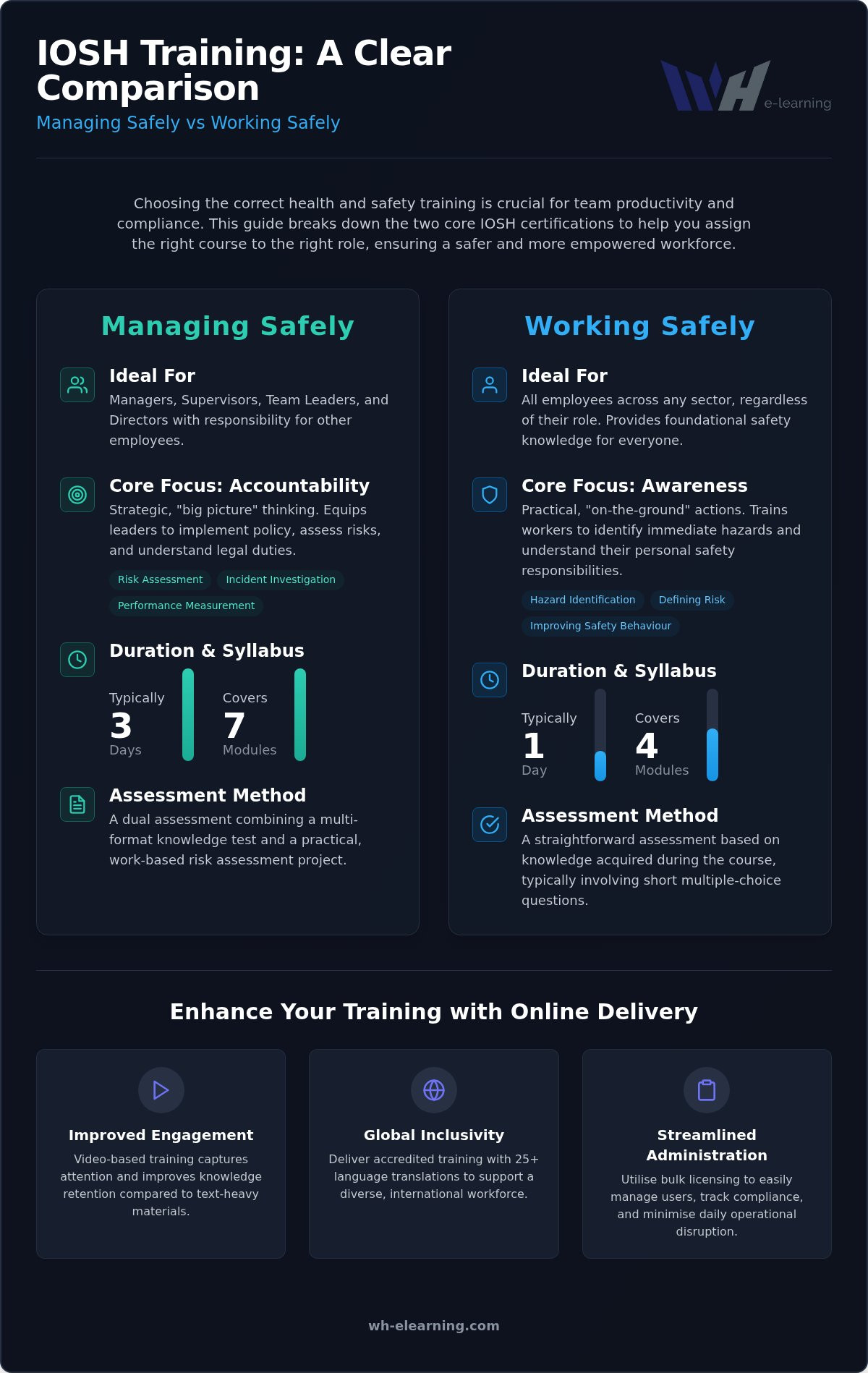
Side-by-Side Comparison: Which IOSH Course Does Your Team Need?
Selecting the right level of training is a strategic decision that affects both your safety culture and your bottom line. When weighing up IOSH managing safely vs working safely, the choice usually depends on the specific duties of your staff members. Whilst both courses provide a high standard of accredited certification, they serve different operational purposes. A manager needs to know how to lead a safety programme, whereas a frontline worker needs to know how to follow one without putting themselves or others at risk.
The assessment styles reflect this difference in responsibility. Managing Safely requires a dual approach; candidates must pass a multi-format test and complete a practical risk assessment project in their own workplace. This ensures they can actually apply management principles. Working Safely is more streamlined, consisting of a multiple-choice test and a hazard-spotting exercise. This practical focus makes it accessible for staff who need to stay sharp on the floor without getting bogged down in the complex legal frameworks that supervisors must master.
The IOSH Decision Matrix for HR and Training Managers
To avoid the common pitfall of over-training, it's best to follow a tiered framework. If your goal is to empower a staff member to conduct risk assessments, investigate incidents, or measure team performance, Managing Safely is the only appropriate choice. However, if you simply need your workforce to understand hazards and follow safety instructions, Working Safely is the more efficient and cost-effective route. Putting entry-level staff on a management-level course can lead to frustration and a lack of engagement because the content isn't relevant to their daily tasks.
We recommend a "mix and match" strategy for a full workforce overhaul. You might train your department heads and supervisors on the Managing Safely course whilst putting the rest of the team through Working Safely. This creates a cohesive environment where every person understands their specific role in the company's safety success.
Assessing the Impact on Your Business Operations
Managing staff downtime is often the biggest hurdle for training managers. A traditional classroom-based Managing Safely course takes three days, whilst Working Safely takes one. By opting for online delivery, you can significantly reduce this impact. Online training allows your team to complete modules in short bursts during quieter periods, ensuring that productivity remains steady. Beyond internal benefits, these certifications act as a visible badge of quality for your clients and stakeholders. Showing that your entire team is IOSH-certified can be a deciding factor during competitive tender processes. If you're ready to organise your team's development, you can view our full range of accredited health and safety training courses to find the perfect fit.
Why Choose WH eLearning for Your IOSH Online Training?
Selecting the right course in the IOSH managing safely vs working safely debate is only half the battle. The next step is finding a training partner that understands the practical pressures of a modern, global business. WH eLearning provides a seamless, video-first experience that replaces dull, text-heavy slides with high-quality content designed for maximum retention. Whether your staff are accessing training from a desktop in the office or a tablet on a remote site, our platform offers any-device access. This ensures learning fits around their schedule, not the other way around. Our goal is to reduce the friction of professional development, replacing it with a feeling of empowerment and ease.
The WH eLearning Advantage: Accessibility and Engagement
Safety is a universal requirement, but language shouldn't be a barrier to understanding. We offer machine translation into 25+ languages, alongside clear closed captions, making our IOSH courses inclusive for diverse, international teams. This ensures that every worker, regardless of their native tongue, can fully grasp the essential safety principles required for their role. Video-based learning is proven to increase engagement; it helps workers visualise hazards and management strategies more effectively than text alone. This modern approach leads to better safety outcomes on the ground. Once you've secured your IOSH certifications, you can explore our full library of 100+ compliance courses to build a comprehensive, high-standard training programme for your entire organisation.
Streamlining Corporate Safety Compliance
Managing a large-scale safety rollout shouldn't be an administrative nightmare. Our corporate licensing model gives you access to a dedicated dashboard where HR and safety managers can track progress at a glance. You'll see exactly who has started, who is mid-way through, and who has successfully passed their assessments. This real-time data is invaluable for audit trails and internal reporting. Bulk enrollment makes it simple to onboard hundreds of employees simultaneously, ensuring your organisation meets its legal obligations without unnecessary delays. This level of oversight provides quiet confidence that your workforce is protected and your business remains compliant. We act as a reliable partner in your development, providing a simplified path to meeting global safety standards.
Organise your team’s IOSH training with a WH eLearning corporate licence today and experience a more efficient way to manage workplace safety.
Secure Your Organisational Future with Targeted Training
Deciding on IOSH managing safely vs working safely ensures that your training investment matches the specific responsibilities of your team. Managers require strategic oversight. Frontline staff need practical hazard awareness. This distinction is the key to building a robust safety culture that doesn't stall your daily operations.
We're proud to be an accredited IOSH Training Provider, offering video-based learning that makes safety content truly stick. Our corporate licensing simplifies team management. You get a clear view of compliance through a single dashboard. This streamlined approach allows you to focus on growth whilst we handle the complexities of certification.
View our IOSH Managing Safely and Working Safely online courses to find the perfect fit for your organisation. We're ready to help you create a safer, more empowered workplace today.
Frequently Asked Questions
Is IOSH Managing Safely higher than Working Safely?
Yes, Managing Safely is a more advanced qualification designed specifically for those with supervisory or management responsibilities. Whilst Working Safely provides a foundational awareness of hazards for all employees, Managing Safely delves into risk management strategies and legal accountability. Choosing between IOSH managing safely vs working safely depends on whether the learner needs to oversee the safety of others or simply manage their own actions.
Can I take the IOSH Working Safely course online?
Yes, you can complete the IOSH Working Safely course via online learning. This format provides the same accredited certification as classroom training but offers greater flexibility for busy professionals. Online delivery allows staff to progress through video-based modules at their own pace. This approach significantly reduces the impact on daily business operations whilst maintaining high training standards and engagement levels.
How long does an IOSH certificate last in the UK?
IOSH certificates don't officially expire, but it's best practice to refresh your training every three years. Many industries and insurance providers require up-to-date evidence of competence to ensure safety knowledge remains current. Staying refreshed helps managers and workers adapt to new legislative changes, such as the 2026 fire safety regulations for high-rise buildings, which require more detailed risk assessments.
Is IOSH Working Safely equivalent to a Level 2 qualification?
Yes, the IOSH Working Safely course is widely recognised as being equivalent to a Level 2 health and safety qualification. It provides a solid foundation in workplace safety principles and is a popular choice for induction training. This level of certification proves that an employee understands their personal responsibilities and can identify common workplace hazards, such as slips, trips, or fire risks, effectively.
What happens if I fail the IOSH Managing Safely assessment?
If you fail the assessment, most training providers allow you to retake the test or resubmit the practical risk assessment project. You should check the specific resit policy of your provider, as there may be a small administrative fee. High pass rates, often reported around 99%, suggest that most learners succeed when they engage fully with the video-based modules and practical exercises provided.
Does IOSH Working Safely count towards a CSCS Green Card?
Yes, the IOSH Working Safely certificate is an approved qualification for the CSCS Labourer (Green) Card. To obtain the card, you must also pass the CITB Health, Safety and Environment test. This makes the course a vital professional passport for anyone needing access to construction sites, providing a recognised and respected alternative to other introductory safety certifications in the sector.
Can I upgrade from Working Safely to Managing Safely later?
You can certainly progress to Managing Safely after completing the Working Safely course. Whilst Working Safely is an excellent starting point, it isn't a mandatory prerequisite for the management-level certification. Many professionals start with the foundation course to build confidence before moving into roles that require the strategic risk management skills taught in the more comprehensive three-day Managing Safely programme.
Are WH eLearning’s IOSH courses fully accredited?
Yes, all IOSH courses provided by WH eLearning are fully accredited by the Institution of Occupational Safety and Health. Our training follows the official syllabus and results in the same internationally recognised certificate as a traditional classroom course. We use engaging video content and machine translation into 25+ languages to ensure your global team receives high-quality training that simplifies the path to compliance.


