

Did you know that a single serious safety violation can now result in fines reaching $15,625 per incident? For many leaders, the weight of personal liability for workplace accidents is a constant source of stress that sits alongside the daily pressure to perform. Accessing high-quality health and safety training for managers is the most effective way to resolve this tension between meeting strict safety requirements and keeping your team's productivity on track. It's a common challenge, especially when you're trying to decide which accreditation is most relevant to your organisation.
This guide is designed to simplify your path to compliance. By investing in the right training, you can protect your team, safeguard your career, and drive operational efficiency all at once. We'll clarify your legal Duty of Care and show you how a flexible, accredited training solution can fit seamlessly around your busy schedule. You'll discover how moving from reactive fixes to proactive leadership not only reduces absenteeism but also builds a more resilient, motivated workforce.
Key Takeaways
- Learn the critical distinction between basic safety awareness and the strategic leadership required to manage workplace risks effectively.
- Understand your legal obligations under the Health and Safety at Work Act 1974 to protect your team and shield yourself from personal liability.
- Discover how to select the most relevant health and safety training for managers by evaluating accreditations like IOSH against your specific industry hazards.
- Compare the flexibility of video-based e-learning with the impact of in-house sessions to find a solution that fits your busy operational schedule.
- Explore how modern, multi-language digital platforms can streamline compliance tracking and foster a proactive safety culture across your entire organisation.
Understanding Health and Safety Training for Managers: More Than Just Compliance
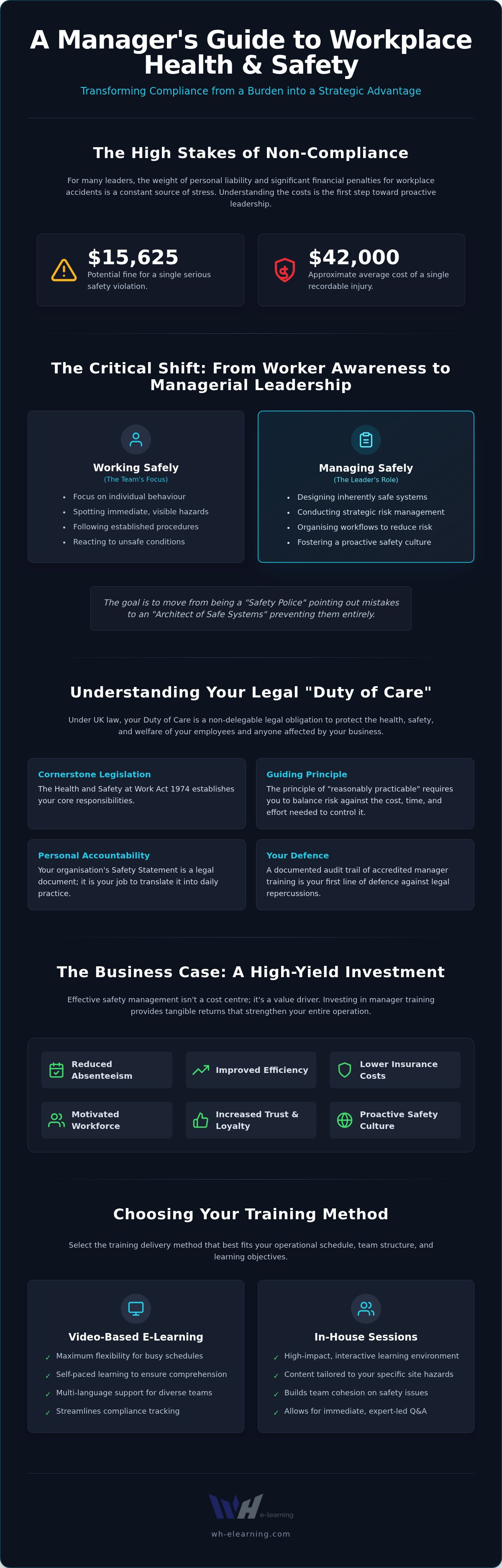
Effective health and safety training for managers is far more than a legal hurdle. It's a strategic leadership tool. Whilst frontline staff focus on immediate hazards, managers must look at the bigger picture. This is the core difference between "Working Safely" and "Managing Safely". One is about individual behaviour, whilst the other is about leadership, accountability, and the design of safe systems. It's the difference between spotting a trip hazard and designing a workspace where trips don't happen.
Managers who embrace this training move away from being "safety police" who merely point out mistakes. Instead, they become architects of safe systems. They organise workflows that naturally reduce risk, ensuring that safety is built into the job rather than bolted on as an afterthought. This shift from policing to organising is what transforms a reactive workplace into a high-performing, safety-conscious environment.
The Definition of Managerial Safety Responsibility
Under UK law, your "Duty of Care" is a non-delegable legal obligation to protect the health, safety, and welfare of your employees and anyone else affected by your business. This responsibility is governed by the principle of being "reasonably practicable", which means you must balance the level of risk against the cost, time, and effort required to control it. Mastering Occupational safety and health principles allows you to move beyond simple hazard identification. You'll learn to implement strategic risk management, looking at root causes rather than just surface-level symptoms. This high-level perspective is what sets health and safety training for managers apart from basic staff inductions.
Why Leadership Training Trumps Basic Awareness
Basic awareness keeps people safe in the moment, but leadership training transforms the entire department. A manager's attitude towards safety sets the tone for the whole team. When you demonstrate competence and take safety seriously, you foster a culture where safety is a shared value rather than a burden. This "vibe" is infectious; it encourages employees to take ownership of their own safety and report issues before they become accidents.
The financial impact of this competence is significant. With the average cost of a single recordable injury sitting at approximately $42,000, competent management is your best defence against litigation and rising insurance premiums. Beyond cost-saving, investing in health and safety training for managers enables you to use leading indicators, such as near-miss reporting and safety observations, to make informed business decisions. This proactive approach doesn't just prevent accidents. It improves operational efficiency, reduces absenteeism, and ensures your team feels valued and protected in their daily roles.
The Legal, Moral, and Financial Case for Managerial Training
Managing safety isn't just about avoiding trouble. It's about building a sustainable business. The Health and Safety at Work Act 1974 remains the cornerstone of UK legislation, placing a clear duty on you to protect your workforce. The Health and Safety Executive (HSE) enforces these standards with rigour, and they don't just look at the company; they look at the individuals in charge. Beyond the law, there's a powerful moral argument. Ensuring every team member returns home safely is a fundamental leadership responsibility that builds trust and loyalty amongst your staff. A proactive approach transforms safety from a burden into a shared value.
Legal Obligations and the Cost of Failure
The penalties for failing to meet your obligations are heavy. Fines for serious violations can reach $15,625 per incident, and the cost of negligence is often far higher than the cost of prevention. You're the bridge between the company's Safety Statement and its daily reality. This document outlines how risks are managed, and it's your job to ensure those words translate into action. Maintaining a transparent audit trail is essential for your protection. If an incident occurs, having documented evidence of health and safety training for managers is your first line of defence against legal repercussions and potential custodial sentences.
The Business Case: ROI of a Safe Workplace
Safety is a high-yield investment. Effective training reduces the hidden costs of poor safety, such as sick pay, temporary staff cover, and the lost time associated with accident investigations. With the average cost of a single recordable injury sitting at approximately $42,000, prevention is clearly the more profitable path. When you prioritise safety, you see a direct drop in employee absenteeism and turnover. People stay where they feel looked after. A robust safety record also boosts your brand's reputation, making you a more attractive partner during contract tendering.
Whilst OSHA's training guidelines offer a respected international framework, local diligence is equally rewarding. In the UK, demonstrating a commitment to accredited training can lead to a measurable reduction in your annual insurance premiums. Employee safety participation is now a key performance indicator for 74% of organisations in 2026, overtaking traditional lagging metrics. To start protecting your business and your team, consider our accredited health and safety training courses that fit around your management schedule.
Comparing Training Methods: Online E-Learning vs In-House Sessions
Choosing the right delivery method for health and safety training for managers often depends on your organisational structure and specific risk profile. Whilst traditional classroom sessions were once the standard, modern digital solutions offer a level of flexibility that better suits the pace of contemporary management. Finding the balance between efficiency and depth is key. Data from 2026 shows that 92% of companies now conduct some form of mandatory training online, reflecting a significant shift towards digital-first strategies.
Online learning isn't just about convenience; it's about effectiveness. Research indicates that e-learning can improve knowledge retention rates to 25-60%, a stark contrast to the single-digit retention often seen in traditional face-to-face settings. This improved retention is vital when managers are tasked with implementing complex safety protocols across their teams. Using a device-agnostic platform ensures that leaders can access this vital information on the move, whether they're on a shop floor or at a remote site.
When to Choose Online E-Learning
Digital platforms are the superior choice for global teams that require consistent messaging across different regions. When your workforce is spread across multiple sites, online health and safety training for managers ensures every leader receives the same high standard of instruction. Modern platforms support machine translation into 25+ languages, removing communication barriers that might otherwise compromise safety standards.
This method allows managers to learn at their own pace, fitting modules around their daily operational demands without the need for travel. For HR and compliance officers, the ability to track progress via a central dashboard is invaluable. It provides a real-time audit trail, making it easy to identify who has completed their certification and who needs a nudge. This level of oversight is rarely achievable with paper-based classroom records.
The Value of Face-to-Face Specialist Training
In-house, specialist-led training still holds a critical place, particularly in high-risk sectors such as construction or heavy manufacturing. When practical, hands-on skills are required, such as manual handling techniques or fire safety drills, the physical presence of an expert is irreplaceable. These sessions allow for industry-specific tailoring, addressing the unique hazards of a particular site or piece of machinery.
A blended approach often yields the best results for NIOSH workforce development. You can use e-learning to cover the theoretical principles and then follow up with targeted in-person sessions for practical application. This strategy maximises your budget by using bulk corporate licensing for the theory, whilst reserving individual classroom seats for high-impact, hands-on training. It ensures your managers are not just compliant, but truly competent in their specific environments.
How to Choose the Right Health and Safety Course for Your Managers
Selecting the most effective health and safety training for managers requires a tailored approach that aligns with your specific operational risks. Start by identifying the primary hazards in your environment, whether they involve office-based ergonomics or high-risk industrial machinery. Accreditation is your benchmark for quality. Look for courses validated by bodies like IOSH or NEBOSH to ensure the content meets rigorous industry standards. For diverse or global teams, accessibility is equally vital. Choosing a platform that supports multi-language translation and works across any device ensures that every leader, regardless of location, can engage with the material fully.
Assessment formats also vary significantly between providers. Some courses rely on theoretical exams, whilst others utilise practical projects that allow managers to apply their new skills directly to their own workplace. Finally, consider the long-term administrative burden. A high-quality training solution should offer robust tracking and reporting features, allowing HR teams to monitor compliance status and renew certifications with minimal friction. This oversight is essential for maintaining a clear audit trail that protects both the individual and the business.
IOSH Managing Safely: The Industry Gold Standard
For the majority of UK leaders, IOSH Managing Safely is the preferred choice. It's designed to provide a comprehensive overview of safety responsibilities without requiring the deep technical expertise of a full-time safety officer. The course covers essential modules including risk assessment, hazard control, and incident investigation. By earning this internationally recognised safety certificate, managers gain the confidence to lead their teams effectively whilst ensuring the business remains on the right side of the law. It's a practical, high-impact solution for busy professionals.
Beyond the Basics: Specialist Compliance Training
A single course rarely covers every niche requirement. Depending on your industry, you may need to supplement core leadership training with specialist modules for Fire Safety, Asbestos Awareness, or GDPR compliance. There's also a growing trend towards mental health awareness in the workplace. In 2026, OSHA introduced mandatory mental health and wellness training components, reflecting a broader shift towards holistic employee well-being. Building a bespoke training library tailored to your organisation’s unique risk profile is the most efficient way to maintain a truly proactive safety culture.
Ready to streamline your team's development and ensure total compliance? Explore our full range of accredited health and safety training for managers to find the perfect fit for your organisation.
Scaling Safety Culture with WH eLearning Solutions
Scaling a safety culture across a large organisation requires more than just good intentions. It needs a robust, scalable system that removes friction and encourages participation. WH eLearning provides a comprehensive library of over 100 accredited workplace courses, designed specifically to meet the high standards of modern business. By offering high-quality health and safety training for managers, we empower leaders to take control of their department's compliance without sacrificing their daily productivity. Our video-based learning is accessible on any device. This means a manager can complete a module on a tablet during a site visit or on a laptop between meetings. This flexibility is crucial for high-performing teams where time is the most valuable resource.
Global Reach with Multi-Language Support
Building a safe workplace shouldn't be limited by language barriers. Our platform uses advanced machine translation to support over 25 languages, ensuring that safety protocols are understood by everyone, regardless of their native tongue. Closed captions further enhance accessibility, making the content inclusive for all employees. This consistency is vital for international offices where maintaining a single, high standard of safety is often a significant challenge. By providing inclusive e-learning, you foster a culture where every team member feels valued and protected. It ensures that your safety "vibe" remains consistent across every border and every department.
Simplifying Compliance Management
The administrative burden of tracking training for hundreds of employees can be overwhelming for even the most organised leader. Our corporate licences are designed to solve this problem. They provide managers and HR professionals with a central dashboard to monitor progress in real-time. You can see at a glance who has completed their health and safety training for managers and who requires a reminder. The platform's administrative features allow you to pull a detailed compliance report in seconds, providing instant evidence for any internal or external audit. This level of automation turns a complex task into a simple, background process that supports your long-term growth.
Ready to elevate your organisation's standards and protect your most valuable assets? Organise your team’s safety training with a WH eLearning Corporate Licence and experience a more streamlined path to professional excellence.
Empower Your Leadership with Proactive Safety Standards
Transitioning from a reactive mindset to a proactive leadership approach is the key to building a resilient organisation. By mastering health and safety training for managers, you secure your team's welfare whilst safeguarding yourself against personal legal liability. We've explored how the right accreditation transforms compliance from a burden into a strategic advantage, ensuring every employee returns home safely whilst your business remains productive.
Modern tools make this transition simpler than ever. WH eLearning provides accredited video-based courses that fit into your busy day on any device. Our platform supports 25+ languages and offers robust administrative tracking features to take the guesswork out of your next audit. It's time to move beyond the fear of liability and start driving operational efficiency through expert knowledge.
Take the first step towards a more confident, compliant, and productive workplace today. Explore our IOSH Managing Safely and Compliance Courses and discover how easy professional growth can be.
Frequently Asked Questions
Is health and safety training for managers a legal requirement in the UK?
Yes, providing health and safety training for managers is a legal necessity under the Health and Safety at Work Act 1974. The Management of Health and Safety at Work Regulations 1999 specifically requires employers to provide adequate training to ensure staff are competent. This ensures leaders have the skills to identify risks and implement safe systems. Failing to meet these standards leaves the organisation vulnerable to HSE intervention and legal penalties.
How long does an IOSH Managing Safely online course typically take to complete?
An IOSH Managing Safely online course typically requires approximately 22 hours of study time. The beauty of digital delivery is that you don't have to finish it in one sitting. You can break the modules into manageable chunks that fit around your daily operational responsibilities. Most managers find they can comfortably complete the full curriculum and the final assessment over a period of two to three weeks.
What is the difference between IOSH and NEBOSH for managers?
The primary difference lies in the depth of technical knowledge and the intended career path. IOSH Managing Safely is designed for managers in any sector who need to oversee safety as part of their broader role. NEBOSH is generally more intensive and aimed at those pursuing a career as a dedicated health and safety professional. For most leadership roles, IOSH provides the perfect balance of practical application and legal compliance.
How often should managers refresh their health and safety training?
Industry best practice suggests that managers should refresh their training every three years. Whilst certificates don't always have a hard expiry date, regular updates ensure your knowledge remains current with evolving legislation and safety technologies. For example, 74% of organisations now prioritise safety participation as a key metric for 2026. Frequent refreshing helps you stay ahead of these shifting industry trends and maintains a high standard of protection for your team.
Can I take health and safety training for managers entirely online?
Yes, you can complete health and safety training for managers entirely online through accredited e-learning platforms. Modern courses use video-based instruction and digital assessments to provide the same level of certification as traditional classroom sessions. This format is particularly effective for busy professionals, as online learning can improve knowledge retention rates to between 25% and 60%. It offers a flexible way to meet your legal duties without leaving your desk.
What happens if a manager fails to provide adequate health and safety training?
Failing to provide adequate training can lead to severe consequences, including personal criminal liability for the manager involved. The Health and Safety Executive (HSE) has the power to issue substantial fines, which can reach $15,625 for serious violations. Beyond the financial impact, inadequate training often results in higher accident rates and increased absenteeism. It also leaves the business exposed to costly civil litigation and permanent reputational damage amongst clients and partners.
How much does health and safety training for managers cost?
The cost varies depending on the delivery method and the level of accreditation required. Online self-paced courses are typically the most cost-effective option for organisations, whilst in-person classroom sessions usually command a higher fee due to travel and instructor costs. Many businesses opt for corporate licensing models to train multiple managers at a lower per-head rate. You should check with your provider for specific volume-based options that suit your budget.
Does health and safety training for managers include mental health awareness?
Modern health and safety courses increasingly integrate mental health and wellness into their core curriculum. As of 2026, OSHA has introduced mandatory mental health training components for employers to provide. This shift recognises that psychological safety is just as important as physical protection in the modern workplace. Effective manager training now covers how to spot signs of stress and burnout, ensuring a more holistic approach to team welfare and long-term productivity.


