

What if the greatest risk to your workplace safety isn't a lack of knowledge, but an outdated method of delivering it? Relying solely on traditional classroom sessions often creates unnecessary friction, especially when you're trying to organise online safety training across multiple sites without breaking the budget. You likely feel the constant pressure of keeping up with shifting regulations whilst trying to maintain productivity and ensure every staff member is properly protected.
Switching to digital education is the most effective way to turn these logistical challenges into a strategic advantage. It moves beyond simple tick-box exercises to create a streamlined, verifiable system that empowers your entire workforce. This article reveals how online safety training reduces your operational costs, ensures every employee is accounted for with digital certificates, and builds a proactive safety culture. Discover the practical ways you can simplify compliance and reduce workplace incidents through flexible, video-based learning.
Key Takeaways
- Understand why digital platforms are now the standard for protecting hybrid teams so you don't fall behind modern safety requirements.
- Discover how online safety training slashes your overheads whilst allowing you to scale education across your entire workforce instantly.
- Recognise the value of IOSH-accredited courses and why third-party validation is vital for your legal compliance and audit readiness.
- Follow a practical roadmap to identify your organisation's specific skill gaps and select the most effective course mix for every role.
- Learn how administrative tracking and multi-language support simplify compliance management for complex, multi-site operations.
Why Online Safety Training is Essential in 2026
The way we work has undergone a permanent transformation. With hybrid and remote models now firmly established, the old model of gathering everyone in a single room for a day-long seminar is no longer practical. Modern businesses require online safety training that fits into a busy schedule rather than disrupting it. This shift reflects a broader move towards "just-in-time" learning, where staff access vital information exactly when they need it, rather than sitting through "just-in-case" sessions that they might forget by the following week.
Safety is no longer just about physical hazards. A comprehensive approach now includes Security Education, Training, and Awareness (SETA) to protect digital assets alongside physical wellbeing. As regulatory bodies increase their scrutiny, the cost of non-compliance has never been higher. Digital platforms provide the agility needed to respond to these changes instantly, ensuring your team is always protected and your business remains resilient.
Meeting Modern Compliance Standards
Maintaining high standards across a distributed workforce is a significant challenge. Digital platforms ensure that every employee receives identical, high-quality instruction regardless of their location. Content stays current with the latest legislation, removing the risk of using outdated materials. These systems also simplify the audit process. Instead of hunting through filing cabinets for paper records, you can produce verifiable digital reports in seconds, ensuring your organisation remains audit-ready at all times.
The Problem with Traditional Classroom Training
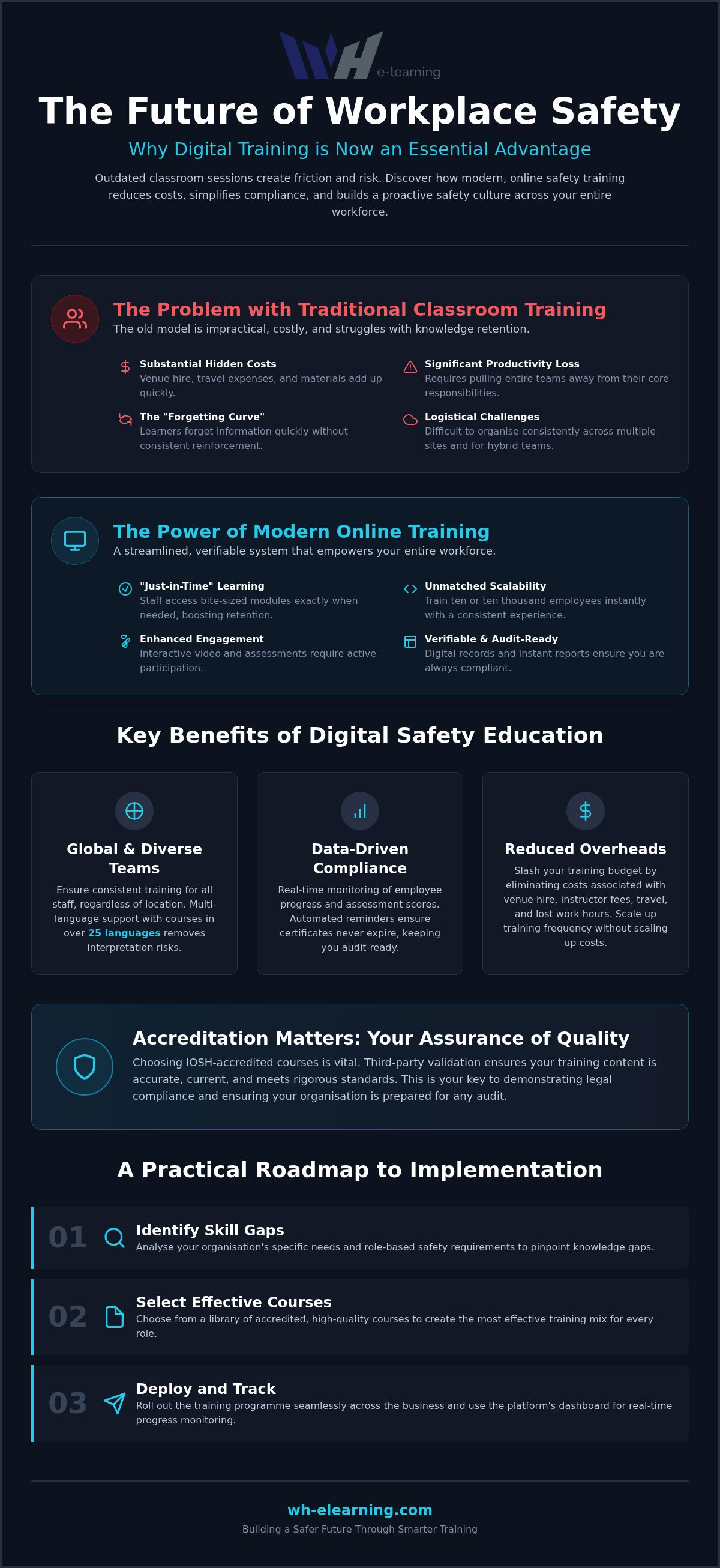
Face-to-face sessions carry substantial hidden costs that go far beyond the trainer's fee. You have to account for venue hire, travel expenses, and the collective loss of productivity whilst an entire team is offline. There is also the issue of the "forgetting curve". Research suggests that without reinforcement, learners forget a large portion of new information almost immediately. Online safety training solves this by providing bite-sized, repeatable modules that staff can revisit to keep their knowledge fresh. Organising logistics for multi-site operations becomes a thing of the past when your training programme is accessible from any device.
Key Benefits of Digital Safety Education for Your Business
Adopting a digital-first approach to health and safety transforms a necessary requirement into a competitive advantage. The most immediate impact is unmatched scalability. Whether you need to train ten new starters in a local office or ten thousand employees across a global network, online safety training provides a consistent experience without the logistical nightmare of booking multiple venues. This scalability allows you to increase the frequency of learning whilst simultaneously reducing your overall training spend.
Engagement levels often drop in traditional lecture-style sessions. Digital platforms counter this by using high-quality video content and interactive assessments that require active participation. This method respects the user's time by allowing them to learn at their own pace, which leads to better retention and more positive safety behaviours. Understanding the broader Digital safety benefits helps leaders recognise that this isn't just about moving a PDF online; it's about creating a dynamic learning environment.
Scalability for Global and Diverse Teams
A major hurdle for international organisations is ensuring that safety protocols are understood by every staff member, regardless of their native tongue. Modern digital solutions solve this through multi-language translation. By providing courses in over 25 languages, you remove the risk of misinterpretation that often occurs with live translators. Including closed captions further improves accessibility, ensuring your messaging remains inclusive and consistent across every department and international office. This level of clarity is essential for building a unified safety culture.
Data-Driven Compliance Tracking
Managing compliance through spreadsheets is prone to error and incredibly time-consuming. Digital systems offer real-time monitoring of employee progress and assessment scores, giving you a clear view of your organisation's safety health at a glance. Automated reminders take the pressure off HR teams by notifying staff when refresher training or certificate renewals are due. If an inspector arrives, you can generate instant, verifiable reports to prove your compliance. This level of administrative tracking makes managing your online safety training a seamless part of your daily routine rather than a source of stress. You can explore a wide range of Health and Safety Training Courses to see how easily these tools integrate into your existing workflow.
Accreditation Matters: Choosing Quality Online Safety Courses
Not all online safety training is created equal. In an industry where compliance is non-negotiable, accreditation acts as a vital seal of quality. It ensures that the content you provide your staff meets rigorous standards set by independent industry experts. This third-party validation is crucial for your legal standing. If a workplace incident occurs, you must be able to prove that your employees received instruction recognised by professional bodies rather than unverified, low-quality materials.
High-quality courses also offer Continuing Professional Development (CPD) points. These benefit your staff by helping them document their career progress whilst ensuring your organisation stays ahead of shifting industry trends. It's essential to avoid "certificate mills" that promise fast results without any real educational substance. These unverified providers might seem cost-effective initially, but they offer zero legal protection and fail to foster a genuine safety culture. Investing in verified education is a long-term commitment to your team's wellbeing.
The Value of IOSH Certification
IOSH is the world’s leading professional body for safety and health, offering a framework that is respected across the globe. Whilst many training providers focus on regional standards, IOSH provides a universal language of safety that is perfect for modern, international workplaces. Their courses are designed to be practical and high-impact. For example:
- IOSH Managing Safely Online: This provides managers and supervisors with the essential tools to handle health and safety within their teams effectively.
- IOSH Working Safely Online: This empowers the frontline workforce by focusing on the core essentials of workplace hazards and personal responsibility.
Choosing these accredited pathways ensures that your staff learn from a curriculum that has been tested and proven across diverse industries. It turns a simple training requirement into a professional milestone for your employees.
Video-Based vs. Text-Based E-Learning
The delivery method of your online safety training significantly dictates how much information your staff actually retain. Text-heavy modules often lead to "click-through fatigue," where users simply skim the content to reach the end. In contrast, video-based learning is far more engaging. It allows expert instructors to demonstrate complex safety procedures visually, which makes the information much easier to digest and remember.
Expert-led instruction brings a human element to digital modules, making the guidance feel more authoritative and supportive. When you combine these videos with interactive quizzes, you reinforce positive safety behaviours in real-time. These assessments force learners to apply what they've just seen, ensuring they aren't just passing a test, but are truly prepared to handle real-world challenges on the shop floor or in the office.
How to Implement an Online Safety Training Programme
Implementing an online safety training programme requires more than just a software purchase. It starts with a thorough training needs analysis (TNA) to pinpoint where your organisation is most vulnerable. By mapping out specific skill gaps, you ensure your budget is spent where it makes the most impact. This process involves looking at different job roles and selecting a bespoke mix of courses. For example, your supervisors might require IOSH Managing Safely, whilst frontline staff benefit from more targeted, hazard-specific modules.
Setting clear expectations from the start is vital. Establish firm deadlines for course completion and integrate these modules into your existing onboarding process. This ensures new starters are protected from their very first day on the job. When safety is part of the initial welcome, it becomes a core value rather than a secondary thought. It sets a standard of professional behaviour that staff will carry throughout their tenure.
Step 1: Audit and Selection
Begin by identifying high-risk areas that require immediate certification, such as fire safety or hazardous substances. You'll need to decide between individual enrolments for small teams or corporate licenses for larger organisations. Corporate licenses often offer superior administrative tracking, making it easier to manage hundreds of learners at once. Ensure your chosen platform is fully responsive so staff can access training on tablets or smartphones during downtime. This flexibility removes the excuse of "not having a desk" and ensures everyone stays compliant regardless of their work environment.
Step 2: Engagement and Rollout
Successful implementation depends on employee buy-in. Communicate the "why" behind the shift to digital education, emphasising that it's designed to keep them safe and reduce workplace friction. Designating a "Safety Champion" within each department can help lead the transition and provide peer support. These champions act as a bridge between management and the workforce, answering practical questions and encouraging progress amongst their peers.
To ensure high completion rates, provide dedicated time during work hours for staff to finish their modules. This shows that the organisation values their development and takes their safety seriously. It prevents training from becoming a burden that staff have to "fit in" around their primary duties. If you're ready to streamline your compliance, you can explore our administrative tracking features to see how easy it is to manage your rollout.
Building a Safer Future with WH eLearning
WH eLearning stands apart by offering a comprehensive suite of over 100 accredited workplace courses. This extensive library allows you to tailor your training environment to the specific needs of your business, integrating essential health and safety with broader HR and business compliance modules. By centralising these requirements, you reduce administrative friction and ensure a unified standard of professional behaviour across your entire organisation. It's about more than just ticking boxes; it's about creating a culture where every staff member feels valued and protected.
Whilst digital education offers unparalleled flexibility, we understand that some high-risk environments still benefit from a blended approach. That's why we offer both online safety training and in-house face-to-face sessions, giving you the freedom to choose the delivery method that best suits your team's practical needs. This commitment to versatile, high-quality instruction ensures that no employee is left behind, regardless of their role or location. Our multi-language support, covering over 25 languages, further breaks down barriers to ensure that safety messaging is clear and accessible for everyone.
Your Partner in Workplace Compliance
Our specialists act as an extension of your team, providing the expert guidance needed to hit your organisational training goals. The administrative dashboard is designed for simplicity, allowing managers to track progress, verify certificates, and manage renewals without needing a background in IT. This transparency empowers you to make data-driven decisions about your workforce development. WH eLearning is a global provider of accredited safety training that empowers businesses to meet their legal obligations with ease. We focus on removing obstacles so you can focus on growth.
Ready to Transform Your Training?
Moving your safety culture forward requires a reliable partner who values your time and investment. Our library includes industry-leading IOSH Managing Safely and Working Safely courses, alongside specialised modules for various sectors. If you're managing a large workforce across multiple sites, our team is available to discuss bespoke bulk licensing and corporate solutions tailored to your specific scale and industry requirements.
Taking the first step towards a more efficient compliance system is straightforward. You can browse our full range of online safety training options to find the perfect fit for your current requirements. We're here to help you build a safer, more compliant workplace for the long term. Enrol in your first online safety course today with WH eLearning.
Empower Your Workforce Through Digital Learning
Transitioning to digital education is no longer just an alternative; it's a strategic move that protects your most valuable asset: your people. By embracing online safety training, you replace outdated, high-friction methods with a streamlined system that scales effortlessly across your whole organisation. You've seen how digital platforms provide verifiable compliance, reduced operational costs, and the flexibility to train staff in their native tongue. These tools don't just tick boxes; they build a foundation for long-term professional growth and workplace resilience.
Choosing an accredited IOSH provider ensures your team receives the highest standard of instruction. With over 100 expert-led courses and multi-language support for global teams, WH eLearning is your reliable partner in meeting complex standards with ease. We're here to remove the obstacles to your success and help you maintain a safer, more productive environment. Take the next step in building a proactive safety culture and browse our full library of accredited online safety training today. It's time to make workplace safety a seamless, empowering part of your daily routine.
Frequently Asked Questions
Is online safety training legally recognised by the HSE in the UK?
Yes, the Health and Safety Executive (HSE) recognises e-learning as a valid delivery method for health and safety training. The key requirement is that the training is effective, easy to understand, and relevant to the specific risks in your workplace. Using an accredited provider ensures your online safety training meets these high standards, providing your business with the necessary legal protection and proof of compliance during inspections.
How long does a typical online safety course take to complete?
Course length varies significantly depending on the subject's depth. Basic awareness modules, such as manual handling or fire safety, typically take between 30 and 60 minutes to complete. In contrast, more comprehensive qualifications like IOSH Managing Safely require approximately 22 hours of study. The benefit of digital learning is that staff can break these sessions into smaller, manageable chunks that fit around their daily tasks.
Can IOSH Managing Safely be completed entirely online?
You can complete the entire IOSH Managing Safely qualification through a digital platform. This includes all the interactive learning modules, the final multiple-choice assessment, and the practical risk assessment project. There is no requirement to attend a physical classroom, making it an ideal solution for busy managers who need to balance their professional development with their existing workplace responsibilities and production schedules.
What happens if an employee fails the online assessment?
If an employee doesn't pass their assessment on the first attempt, they're usually given the opportunity to retake it. Most high-quality platforms allow learners to revisit specific modules to refresh their knowledge before trying the test again. This supportive approach ensures that the staff member fully understands the safety protocols rather than just memorising answers, which leads to safer long-term behaviour on the shop floor.
Do online safety certificates expire, and how are they renewed?
Most safety certificates have a recommended validity period, typically lasting three years. Whilst the knowledge remains valuable, industry regulations and best practices often change over time. You can easily renew these credentials by enrolling staff in shorter refresher courses. These modules focus on the latest legislative updates and core safety principles, ensuring your team's skills remain sharp and your business stays compliant with current standards.
Can I track the progress of my entire team through one dashboard?
You can certainly track your entire workforce through a single administrative dashboard. This feature allows managers to monitor individual progress, view assessment scores, and identify any staff members who are overdue for their training. Automated notifications help you stay on top of renewals without manual tracking, making it much easier to manage compliance across multiple sites, different departments, or international offices.
Is video-based training better than traditional classroom learning?
Video-based online safety training often outperforms traditional classroom settings in terms of consistency and engagement. Every learner receives the exact same high-quality instruction, which isn't always guaranteed with different live trainers. Video content is also more visually stimulating, which helps with knowledge retention. Since learners can pause and rewind, they can absorb complex information at a pace that suits their individual learning style.
How much does it cost to implement online safety training for a business?
The total investment for digital training depends on your organisation's size and the specific mix of courses required. Generally, it's significantly more affordable than face-to-face sessions because you eliminate costs for travel, venue hire, and external trainers. Many providers offer corporate licenses or bulk enrolment discounts, which provide even better value for larger teams. You should check with your provider for a tailored quote.


