

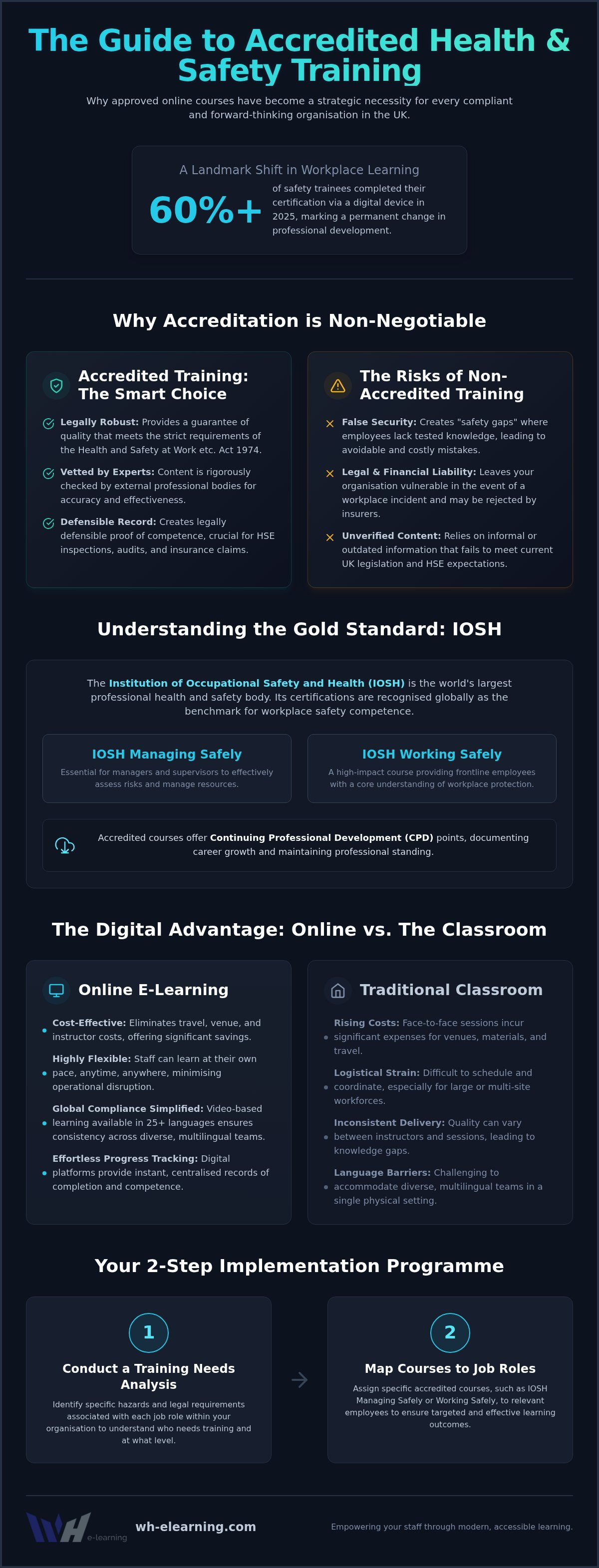
In 2025, over 60% of safety trainees completed their certification through a digital device, marking a permanent shift in how we approach workplace protection. As we move into 2026, the demand for accredited health and safety training online has transitioned from a modern convenience to a strategic necessity for every compliant business. You've likely felt the pressure of rising costs for traditional face-to-face sessions or the logistical strain of managing a diverse, multilingual workforce across multiple sites.
It's natural to worry about meeting strict HSE regulations whilst trying to keep your team engaged and productive. This guide provides the clarity you need to select and implement high-quality training that ensures both employee wellbeing and total legal compliance. We will explore the leading accreditation bodies, show you how to simplify progress tracking, and explain how to secure legally robust certification for your organisation without the traditional friction of old-school methods. By the end of this article, you'll have a clear path to empowering your staff through modern, accessible learning.
Key Takeaways
- Understand why training vetted by external professional bodies is the only way to ensure your organisation meets the strict requirements of the Health and Safety at Work etc. Act 1974.
- Identify the most respected certifications from global leaders like IOSH to ensure your staff earn valuable CPD points whilst building genuine competence.
- Learn why accredited health and safety training online has become the gold standard for cost-effective, flexible learning that outperforms traditional classroom settings.
- Follow a clear, two-step implementation plan to conduct a training needs analysis and map specific courses to individual job roles.
- Discover how to simplify global compliance and progress tracking through high-quality, video-based learning available in over 25 languages.
Why Accredited Health and Safety Training is Essential
Accreditation isn't just a badge on a certificate; it's a guarantee of quality and legal robustness. In simple terms, accredited training refers to courses that have been rigorously vetted and approved by external professional bodies. These organisations ensure that the content is accurate, the teaching methods are effective, and the assessments truly measure a learner's competence. Choosing accredited health and safety training online ensures your team receives information that meets these high industry standards, rather than relying on unverified advice.
Under the Health and Safety at Work etc. Act 1974, employers have a clear legal duty to provide "such information, instruction, training and supervision as is necessary" to ensure the health and safety of their employees. This requirement is a cornerstone of Occupational safety and health in the UK. Whilst the law doesn't always specify the exact course you must take, it does demand that the training is "adequate." Accreditation serves as the gold standard for proving that adequacy during a legal review or an insurance claim.
The Health and Safety Executive (HSE) sets the expectations for workplace safety across Britain. They expect employers to go beyond simple "awareness" and move towards verified competence. While an informal "toolbox talk" or a basic awareness video has its place, it rarely provides the legally defensible proof of training that a formal, accredited certificate offers. Accredited courses involve structured learning and formal assessment, which creates a reliable record of what an employee actually knows and can do.
The Consequences of Non-Accredited Training
Choosing non-accredited materials often creates a false sense of security. If a workplace incident occurs, an organisation must demonstrate that it provided high-quality instruction. Relying on unvetted videos or informal handouts can leave you vulnerable to significant legal liability. These "safety gaps" occur when employees haven't been tested on their knowledge, leading to avoidable mistakes. There's also a clear financial risk; many insurers won't recognise non-accredited training, potentially forcing you to pay for the same courses twice to meet their requirements.
How Accreditation Protects Your Organisation
Building a safety culture around accredited health and safety training online provides a simplified path to compliance. It ensures a standardised level of knowledge across your entire workforce, regardless of where they are located. Because accreditation bodies require regular content updates, you can trust that your team is learning the most current UK legislation. This proactive approach builds a defensible safety record that is essential for passing audits and satisfying HSE inspections. It transforms safety from a tick-box exercise into a reliable asset for professional growth.
Understanding Key Accreditation Bodies: IOSH and Beyond
Accreditation acts as the bridge between simple information and legally defensible competence. It's vital to distinguish between "recognised" training and "accredited" training. While many courses are recognised by industry groups, true accreditation means an external professional body has audited the content to ensure it's pedagogically sound. This ensures the learning isn't just a series of slides, but a structured educational experience designed for maximum knowledge retention. When you invest in accredited health and safety training online, you're buying a product that has been tested against high educational and technical standards.
Most of these high-tier courses also offer Continuing Professional Development (CPD) points. These points are essential for modern professionals who need to document their ongoing growth and maintain their standing within professional organisations. By choosing accredited paths, you ensure that every hour your staff spends learning contributes directly to their career progression and your company's safety culture.
IOSH: The Benchmark for Workplace Safety
The Institution of Occupational Safety and Health (IOSH) is the world's largest professional health and safety body. Their certifications are widely regarded as the gold standard in the UK and internationally. For managers and supervisors, the IOSH Managing Safely course is indispensable. It provides the practical tools needed to manage risks and resources effectively. For frontline employees, IOSH Working Safely offers a high-impact grounding in the essentials of workplace protection. UK employers favour these certifications because they provide a universal language of safety that is easily understood across different departments and sites.
Recognising Other Industry-Specific Standards
Beyond IOSH, other bodies play a critical role in specific sectors. The CPD Certification Service provides a framework for general compliance training, ensuring that materials are accurate and up-to-date. High-risk industries, such as construction or healthcare, often require specialist accreditation for topics like Asbestos Awareness or Clinical Governance. Whilst IOSH leads in the UK, organisations with global footprints might also reference OSHA-authorized online training providers to understand how standards translate across different jurisdictions.
Always verify a provider's status before committing your budget. Reputable trainers will clearly display their accreditation seals and provide membership numbers that you can check directly with the awarding body. If you're looking for a simple way to access a wide range of these verified standards, you can explore the accredited course library at WH eLearning. This ensures your team receives high-quality instruction without the administrative burden of vetting multiple individual providers.
The Shift to Online: Why E-Learning is Outperforming the Classroom
The transition from physical classrooms to digital platforms isn't just a trend; it's a direct response to the need for greater operational efficiency. Traditional classroom sessions often require fixed dates and expensive travel, which can disrupt daily schedules and stall productivity. Choosing accredited health and safety training online allows your team to complete their certification without leaving their workstations. This flexibility ensures that safety never becomes a secondary priority due to scheduling conflicts or logistical hurdles.
Beyond convenience, the financial benefits of digital delivery are substantial. Online platforms eliminate the overhead of venue hire and external instructor fees, making high-quality instruction cost-effective for large or geographically dispersed workforces. Data suggests that online learning can improve knowledge retention rates to between 25% and 60%, a significant leap over the single-digit retention often seen in traditional face-to-face seminars. Leading research into NIOSH training and workforce development programs confirms that evidence-based digital instruction is a powerful tool for building a safer, more competent workforce.
The Power of Video-Based Learning
Video content transforms passive reading into an active, engaging experience. It increases learner engagement by providing clear, visual demonstrations of physical hazards that text-only slides simply can't replicate. Seeing a hazard in a real-world scenario helps employees recognise similar risks in their own immediate environment. This visual approach caters to diverse learning styles, making complex safety concepts more accessible and easier to recall during a workplace incident.
Accessibility and Multi-Language Support
Workplace safety is most effective when it's communicated in an employee's primary language. Providing training in a native tongue reduces the risk of dangerous misunderstandings that could lead to accidents. Modern e-learning platforms now use machine translation and closed captions to offer inclusive learning in over 25 languages. This ensures that every staff member, regardless of their background, receives the same high standard of instruction. Mobile-friendly designs also allow for training "in the flow of work," letting employees access vital information on any device exactly when they need it.
Finally, digital tracking simplifies the administrative burden on HR and safety managers. Instead of manually filing paper certificates, you can monitor progress through a central dashboard. This provides a streamlined way to track employee progress and ensures your organisation maintains a legally robust record of compliance at all times.
How to Implement an Effective Online Training Programme
A successful rollout begins with a clear strategy. By following these five steps, you can ensure your transition to accredited health and safety training online is both efficient and legally sound:
- Conduct a training needs analysis (TNA): Identify specific knowledge gaps by reviewing past incidents and current job descriptions. This ensures you aren't wasting resources on irrelevant content.
- Select accredited courses: Match the training precisely with individual job roles. A warehouse operative requires a different safety grounding than an office-based manager.
- Choose a centralised platform: Use a system that provides a single source of truth for all training data. This removes the friction of managing multiple spreadsheets.
- Set clear study windows: Give employees dedicated time during their working hours to complete their modules. This demonstrates that the organisation values their professional growth.
- Finalise and file: Review progress weekly and ensure all digital certificates are stored in a way that is easily accessible for future HSE inspections.
Choosing the Right Training Provider
When evaluating potential partners, look for a library that covers more than just basic health and safety. A comprehensive provider should also offer HR and business compliance courses, allowing you to manage all professional requirements through a single portal. Always check for the official "accredited" logo from bodies like IOSH to ensure that your accredited health and safety training online meets high educational and pedagogical standards. The user interface should be modern, clean, and intuitive. If the platform is difficult to navigate, your team's engagement will inevitably drop, making it significantly harder to maintain a consistent safety culture across the business.
Tracking and Reporting for Compliance
Manual tracking is a significant risk for any growing business. Automated reminders for expiring certificates are essential to prevent compliance lapses before they happen. These notifications allow you to plan for refresher training well in advance, avoiding the stress of last-minute scrambles. Admin dashboards provide a real-time overview of your team's status, allowing you to prove training completion to auditors at the click of a button. For organisations with a global or multilingual workforce, the ability to manage these records centrally is a major advantage. If you're ready to simplify your path to compliance, you can set up your corporate training account today to access bulk licensing and advanced reporting tools.
WH eLearning: Simplifying Your Path to Compliance
WH eLearning serves as your dedicated partner in navigating the complex world of professional standards. We provide a streamlined library of over 100 video-based courses designed to remove the traditional complexity from workplace safety. Whether you require IOSH Working Safely Online for your frontline team or IOSH Managing Safely Online for your leadership, our platform delivers high-quality content that is both engaging and legally robust. By centralising your accredited health and safety training online, you reduce administrative friction and ensure a consistent standard of excellence across your entire organisation.
Managing a global workforce requires a training solution that transcends borders. Our platform supports over 25 languages through sophisticated translation, ensuring that every employee understands their safety responsibilities in their primary tongue. This inclusive approach significantly reduces the risk of accidents caused by language barriers and demonstrates a genuine commitment to staff wellbeing. It provides a simplified path to global compliance that traditional, single-language providers cannot match.
Expert-Led Content for Real-World Results
Specialists from across the safety industry develop our courses to ensure they reflect the latest standards and practical realities. We focus on building genuine competence rather than just ticking boxes, blending essential theoretical knowledge with actionable skills that employees can apply immediately. Whilst our digital platform remains the primary choice for most modern businesses, we also offer in-house face-to-face training for organisations with specific hybrid requirements. This flexibility allows you to tailor your training strategy to the unique needs of your workforce and physical site locations.
Seamless Integration for Organisations
Implementing a large-scale programme for accredited health and safety training online shouldn't be a drain on your time or budget. Our corporate licensing options allow you to scale your training efforts quickly whilst significantly reducing per-user costs. Every course features closed captions and an accessible, mobile-friendly interface, ensuring that all staff members can learn effectively regardless of their specific needs or location. This commitment to accessibility makes us a reliable partner for businesses looking for a long-term investment in their people. You can Explore our accredited health and safety course library today to see how we can simplify your compliance journey and empower your team to work more safely.
Empower Your Workforce with Modern Safety Standards
Securing your organisation's future requires a proactive approach to compliance that balances legal necessity with operational ease. By prioritising accredited health and safety training online, you move beyond basic awareness and build a culture of verified competence. This transition reduces the risk of costly incidents and ensures your safety records remain robust during any inspection. Modern e-learning removes the traditional barriers of language and location, providing a simplified path to growth for every member of your team.
As an IOSH Accredited Training Provider, WH eLearning offers over 100 professional compliance courses designed for maximum engagement. Our video-based learning supports 25+ languages, making it the ideal solution for diverse workforces seeking high-quality, accessible instruction. You can Browse Our Accredited Health and Safety Courses today to find the perfect fit for your organisation's unique needs. Take the next step in your professional development journey with a partner committed to your long-term success.
Frequently Asked Questions
Is online health and safety training legally recognised in the UK?
Online health and safety training is fully recognised in the UK, provided it meets the "adequacy" standard required by the Health and Safety at Work etc. Act 1974. The Health and Safety Executive (HSE) acknowledges e-learning as a flexible and effective way to deliver essential instruction. To ensure your accredited health and safety training online remains legally defensible, you should verify that the content is regularly updated to reflect current UK legislation and industry best practices.
What is the difference between IOSH and NEBOSH online courses?
IOSH and NEBOSH courses serve different professional needs within an organisation. IOSH certifications, such as Managing Safely, provide practical tools for general managers and supervisors to handle daily risks effectively. In contrast, NEBOSH qualifications are more technical and academic, typically designed for those seeking a dedicated career as a health and safety professional. Both are highly respected but IOSH is often the preferred choice for broader workforce compliance.
How long does an accredited health and safety certificate last?
Most accredited health and safety certificates are valid for three years before a refresher course is recommended. This timeline ensures that your staff's knowledge remains fresh and aligned with any regulatory changes. However, certain high-risk specialisms, such as Asbestos Awareness, often require annual updates to maintain compliance. Always check the specific requirements of the awarding body to ensure your organisation's safety records stay up to date and legally robust.
Can I train my entire team at once with an online platform?
You can absolutely train your entire team simultaneously using a modern online platform. Corporate licensing allows you to enrol hundreds of employees across different sites, ensuring everyone receives a consistent standard of instruction. Admin dashboards simplify the process by letting you track progress and download certificates from a central location. This scalable approach is significantly more efficient than trying to coordinate multiple classroom sessions for a large or geographically dispersed workforce.
Do online safety courses include an assessment or exam?
Every accredited course includes a formal assessment or exam to verify that the learner has understood the material. This is a core requirement for accredited health and safety training online, as it provides the proof of competence needed for legal compliance. These assessments are typically conducted at the end of the modules and consist of multiple-choice questions or practical hazard-spotting exercises. Passing this test is essential to earning a recognised certificate.
How do I verify if an online course is properly accredited?
You can verify a course's accreditation by checking for the official seal of an awarding body, such as IOSH or the CPD Certification Service. Reputable providers will always display their membership or centre number clearly on their website. You can then cross-reference this number directly on the awarding body's official database. If a provider cannot provide a verifiable link to their accreditation status, the training may not be legally recognised for compliance audits.
Are these courses available in languages other than English?
Many high-quality online courses are available in multiple languages to support a diverse workforce. For instance, WH eLearning provides training in over 25 languages through machine translation and closed captions. This ensures that every employee, regardless of their native tongue, can fully grasp critical safety concepts. Providing training in an employee's primary language isn't just about inclusivity; it's a vital step in reducing the risk of accidents caused by simple misunderstandings.
What happens if an employee fails the online assessment?
If an employee fails an assessment, they're usually given the opportunity to review the course material and retake the test. Most digital platforms allow for multiple attempts, though some accredited bodies may limit the number of retakes before a full course restart is required. This supportive structure encourages learning and ensures that staff don't receive a certificate until they've demonstrated a genuine understanding of the safety principles required for their role.


