

Safety training isn't just a legal obligation; it's a strategic investment in your organisation's future performance. You likely already know the stress of keeping up with HSE regulations or the frustration of seeing staff roll their eyes at uninspired presentations. It's difficult to balance the need for rigorous compliance with the desire to keep your team engaged and productive. Finding the right workplace safety training courses shouldn't feel like a chore that drains your resources or creates friction within your diverse workforce.
This guide empowers you to master the essentials of safety training to ensure legal compliance and protect your workforce as we move into 2026. We'll show you how to transform mandatory sessions into high-impact learning experiences that build a genuine safety culture. You'll discover a clear roadmap for essential training, including accredited options like IOSH Managing Safely and IOSH Working Safely. We also explore streamlined ways to track compliance across multi-lingual teams, ensuring every employee stays safe and every leader stays confident.
Key Takeaways
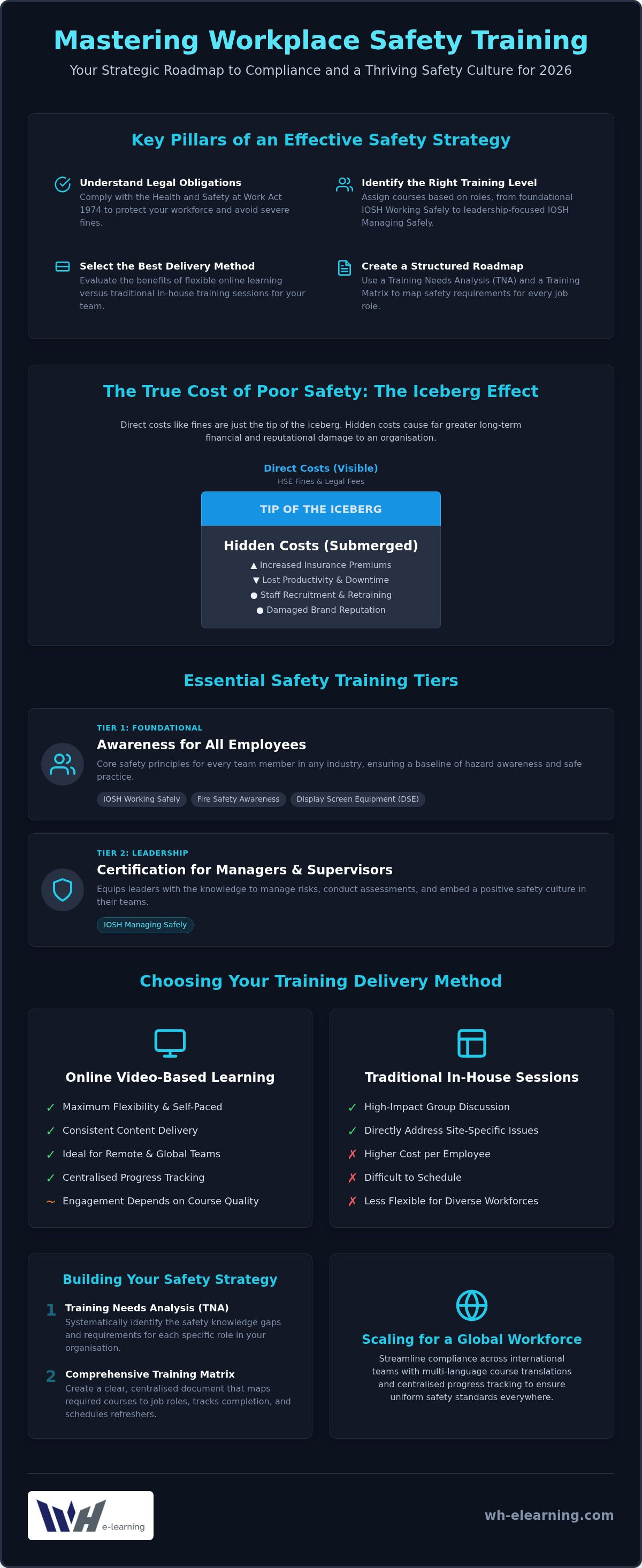
- Understand your legal obligations under the Health and Safety at Work Act 1974 to protect your workforce and avoid costly fines.
- Identify the right level of training for your team, from foundational IOSH Working Safely to leadership-focused IOSH Managing Safely.
- Evaluate the best delivery methods for workplace safety training courses, comparing the flexibility of online video-based learning with traditional in-house sessions.
- Create a structured safety roadmap by using a Training Needs Analysis (TNA) and a comprehensive Training Matrix for every job role.
- Streamline compliance for global workforces with multi-language course translation and centralised progress tracking.
The Fundamentals of Workplace Safety Training and Compliance
Effective workplace safety training courses provide more than just a tick-box exercise for HR departments. They represent a systematic framework designed to identify hazards, assess risks, and implement reduction strategies before harm occurs. Understanding the Fundamentals of Occupational Safety and Health is essential for any leader looking to build a resilient organisation that values its people. By integrating these principles, you create a foundation where safety becomes a shared responsibility rather than a top-down instruction.
In the UK, the primary legal driver is the Health and Safety at Work Act 1974. This legislation places a "duty of care" on employers to ensure the health, safety, and welfare of all employees as far as is reasonably practicable. Compliance isn't optional. Failure to meet these standards invites severe HSE fines and legal repercussions that can devastate a company's reputation. Beyond the law, there's a clear distinction between mandatory compliance and best-practice professional development. While mandatory training keeps you legal, best-practice courses drive high-performance cultures and operational excellence.
Poor safety standards carry a heavy financial weight. Direct costs like fines are the tip of the iceberg. The hidden costs, such as rising insurance premiums, lost productivity during accident investigations, and the expense of recruiting replacement staff, often cause more long-term damage. Choosing the right workplace safety training courses is a proactive way to safeguard your balance sheet and your people at the same time.
Why Safety Training is a Strategic Priority
Your workforce is your most valuable asset, and protecting them is vital for business continuity. Reducing accidents and ill health directly lowers the friction that slows down operations. A robust safety record also boosts your brand reputation amongst clients, investors, and potential recruits. High-calibre talent prioritises workplaces that demonstrate a genuine commitment to employee well-being and professional growth. When safety is treated as a priority, it signals that the organisation is stable, responsible, and forward-thinking.
The Core Objectives of a Safety Programme
A successful safety programme establishes a common language for risk across the entire organisation. When everyone understands the same terminology, communication improves and errors decrease. It's essential that every employee understands their individual duty of care, empowering them to take ownership of their workspace. This builds a proactive "reporting culture" where staff feel confident flagging near-misses. By identifying these issues early, you can stop accidents before they happen, moving your business from a reactive stance to one of preventative excellence.
Essential Safety Training Courses: From Foundation to Management
Organising your training budget requires a clear hierarchy to ensure every pound is spent effectively. You can't give every staff member the same content; a warehouse operative needs different insights than a department head. Broadly, workplace safety training courses fall into three distinct tiers: foundational awareness, leadership certification, and specialist modules. These occupational safety and health training courses form the bedrock of your compliance strategy. While global firms often reference the OSHA Outreach Training Program for their US operations, UK and international teams typically rely on IOSH standards. Deciding between IOSH Managing Safely vs Working Safely is often the first step in mapping out your team's development path.
Foundational Awareness for All Employees
Every employee needs a baseline understanding of hazards to keep themselves and their colleagues safe. IOSH Working Safely serves as the gold standard for this level. It's an essential entry-level certificate that applies to any industry, from construction to retail. You should also implement Fire Safety Awareness training so staff understand evacuation protocols and the correct use of extinguishers. Additionally, Display Screen Equipment (DSE) training is vital for both office and remote workers. It's a simple, effective way to prevent long-term musculoskeletal strain and improve daily comfort.
Management and Leadership Certification
Leaders require a deeper level of knowledge to oversee team safety and meet legal responsibilities. IOSH Managing Safely equips supervisors with the practical tools to manage risks and conduct investigations effectively. IOSH is the world’s largest health and safety membership body. Beyond general management, your leaders should undertake specific Risk Assessment Training. This ensures they can conduct and document valid assessments that stand up to regulatory scrutiny. If you're looking to upskill your leadership team quickly, you might consider our IOSH Managing Safely Online course for maximum flexibility.
Specialist Courses for High-Risk Environments
High-risk tasks demand targeted expertise to prevent serious incidents. Manual Handling training is a priority for any role involving physical lifting, as it teaches techniques that prevent debilitating injuries. In the construction and maintenance sectors, Asbestos Awareness is a legal necessity for anyone likely to disturb the fabric of older buildings. Finally, COSHH training ensures your team can safely manage hazardous substances, from industrial chemicals to everyday cleaning products. By matching these specialist modules to specific job roles, you ensure your workplace safety training courses provide maximum protection where it's needed most.
Online vs In-House Learning: Selecting the Best Delivery Method
Choosing the right delivery method for your workplace safety training courses is a pivotal decision that impacts both your budget and your team's ability to retain information. While some organisations still rely solely on traditional classroom settings, modern leaders are increasingly adopting business compliance e-learning to manage large, diverse workforces. This shift isn't just about convenience; it's about efficiency. Digital platforms allow you to deploy training instantly across multiple sites, ensuring that everyone from the warehouse floor to the head office receives the same high-quality instruction without the logistical headache of travel and venue hire.
Video-based learning has emerged as a particularly effective tool for improving information retention. Unlike static text or lengthy slide decks, video content captures attention and makes complex safety concepts easier to visualise. By seeing a procedure performed correctly on screen, employees can better translate that knowledge to their own daily tasks. This visual approach is a cornerstone of Building a Strong Safety Culture, as it helps create a shared understanding of what "safe" looks like in practice. However, a truly comprehensive strategy often involves "Blended Learning", which combines the speed of digital modules with the hands-on depth of physical sessions.
The Advantages of Digital E-Learning
Digital training offers unparalleled flexibility, allowing staff to complete modules at their own pace during natural lulls in the working day. This reduces operational downtime significantly. It also guarantees consistency; every learner interacts with the same accredited message, removing the risk of "trainer variance" where different instructors might emphasise different points. Scalability is perhaps the greatest benefit for growing firms. Whether you need to train 10 or 10,000 employees, the effort required remains the same, making it the most cost-effective way to maintain high standards across a global team.
When to Choose In-House Face-to-Face Sessions
Despite the rise of digital tools, face-to-face training remains indispensable for certain practical skill assessments. Tasks like first aid, fire warden duties, or the operation of complex heavy machinery require physical demonstration and real-time feedback from an expert. In-house sessions are also ideal for highly bespoke training that addresses site-specific hazards that a general course might miss. Finally, senior executive workshops often benefit from the interactive, high-level discussion that only a physical room can facilitate, helping to align leadership on long-term safety goals.
Building a Robust Safety Training Strategy for Your Organisation
A strategy provides the bridge between having a policy and having a safe workplace. It's not enough to simply purchase workplace safety training courses; you must deploy them with precision. The first step is conducting a Training Needs Analysis (TNA). This process uses your existing risk assessments to identify exactly where knowledge gaps exist. By starting with the data, you ensure your training budget addresses the most critical risks first. Once you've identified the needs, you can source accredited content that aligns with the latest workplace compliance training standards, ensuring your organisation remains on the right side of the law.
Creating Your Training Matrix
A Training Matrix is your roadmap for organisational safety. It allows you to map specific workplace safety training courses to individual job roles, ensuring no one is over-trained or under-protected. To build an effective matrix, consider these three categories:
- Mandatory Training: Essential for all staff, such as Fire Safety or IOSH Working Safely.
- Role-Specific Training: Targeted modules like COSHH for cleaners or Manual Handling for warehouse teams.
- Elective Training: Professional development courses that enhance your overall safety culture.
Organise your staff into logical groups, such as Office, Industrial, and Management, to simplify the rollout. It's also vital to set clear frequencies for refresher courses. Whether it's an annual update or a triennial recertification, having these dates pre-set prevents compliance lapses before they occur.
Tracking Progress and Maintaining Compliance Records
Implementation is only half the battle; you also need to prove that training took place. Utilising a modern LMS dashboard allows you to monitor completion rates in real-time across your entire organisation. This visibility is crucial for identifying departments that might be falling behind. Digital certification provides a permanent, easily accessible audit trail, offering vital legal protection during HSE inspections. Beyond mere tracking, a robust system encourages a "self-serve" learning culture. When employees can see their own progress and access certificates, they take greater ownership of their professional development. Ready to streamline your strategy? Discover how our dashboard simplifies compliance tracking for teams of all sizes.
Scaling Global Safety Excellence with WH eLearning
Scaling safety excellence across multiple sites or international borders requires a partner who understands the complexity of modern compliance. WH eLearning provides a robust library of over 100 accredited, video-based workplace safety training courses. These modules aren't mere slide decks; they're high-engagement resources designed to empower your staff and reduce the friction of professional requirements. By positioning WH eLearning as your long-term partner, you gain a streamlined path to meeting professional standards. This relationship focuses on your team's long-term growth and safety rather than a simple transaction, ensuring you stay ahead of regulatory changes in 2026 and beyond.
Corporate licensing further simplifies the administrative burden for multi-site organisations. Instead of managing dozens of individual invoices or disparate training providers, you can consolidate your requirements into a single, manageable agreement. This clarity allows you to focus on what matters most: building a high-performance safety culture that protects your balance sheet and your people. WH eLearning acts as a catalyst for professional growth, providing the tools you need to remove obstacles and meet high standards with quiet confidence.
Training a Diverse and Global Workforce
Inclusive learning is a strategic necessity for any forward-thinking organisation. We specialise in multi-language support, using machine translation to deliver training in 25+ languages. This ensures that every team member, regardless of their native tongue, can master critical safety protocols without the risk of misinterpretation. Our platform also caters to neurodiverse employees through closed captions and accessible design, making the learning experience attainable for everyone. Standardising safety protocols across international borders whilst respecting local nuances becomes a seamless process. You'll create a unified culture where every employee feels heard, valued, and protected.
Scalable Solutions for Every Business Size
Whether you're a sole trader or an enterprise-level organisation, we offer solutions that fit your specific scale. Small businesses can access individual courses to meet immediate needs, whilst larger firms benefit from bulk licensing and advanced administrative tools. Our centralised dashboard allows you to track compliance for global teams in real-time, removing the manual effort of managing complex spreadsheets. If your operations require physical demonstrations, our expert-led in-house face-to-face training complements your digital curriculum perfectly. This balanced approach ensures your workplace safety training courses provide a simplified, high-quality experience for every learner in your organisation.
Future-Proof Your Organisation Through Strategic Safety Training
Building a high-performance safety culture is a continuous journey that moves beyond simply ticking legal boxes. By conducting a thorough Training Needs Analysis and implementing a robust Training Matrix, you transform safety from a requirement into a strategic advantage. You now have the roadmap to select the most effective delivery methods, ensuring that your workplace safety training courses drive real behavioural change across your entire organisation. This proactive approach reduces the friction of compliance and fosters a genuine sense of duty amongst your staff.
As you scale your operations, remember that consistency and engagement are your greatest allies. Our library features over 100 courses accredited by IOSH and other leading industry bodies, all delivered through high-impact video-based learning for maximum retention. With machine translation support for 25+ languages, you can ensure every member of your global team receives the same high-standard message. Explore our library of over 100 accredited workplace safety training courses today to streamline your compliance and protect your most valuable assets. We're here to help you turn safety into a seamless part of your daily professional growth.
Frequently Asked Questions
Is safety training mandatory for all employees in the UK?
Yes, providing health and safety training is a legal requirement for every UK employer. Under the Health and Safety at Work Act 1974, you must provide sufficient information and instruction to ensure the welfare of your staff. This applies regardless of the size of your business or the industry you operate in. Failing to meet these standards leaves you vulnerable to HSE intervention and potential prosecution, so it's vital to keep your records updated.
How often should staff undergo refresher safety training courses?
Most industry professionals recommend refreshing workplace safety training courses every one to three years to maintain high standards. High-risk activities, such as manual handling or fire warden duties, often require annual updates to ensure techniques remain fresh. Lower-risk office environments might opt for a three-year cycle. Setting these frequencies within your Training Matrix prevents compliance gaps and ensures your team remains confident in their ability to handle hazards effectively.
What is the difference between IOSH and OSHA training standards?
The main difference lies in jurisdiction and approach. IOSH is a UK-based professional body that provides globally recognised training standards, such as Managing Safely. OSHA is a US government agency that sets and enforces specific American federal regulations. Whilst both aim to reduce workplace accidents, UK companies and international firms operating outside the US typically prioritise IOSH accreditation to ensure they meet the specific requirements of the Health and Safety Executive (HSE).
Can I complete all my workplace safety training online?
You can complete a significant portion of your safety curriculum through digital platforms. Theory-based modules like Asbestos Awareness, COSHH, and IOSH Managing Safely are perfectly suited for online delivery. However, certain practical skills still require a face-to-face element. First aid and specialised machinery operation usually demand physical demonstrations to ensure competency. A blended approach allows you to handle the bulk of your training online whilst reserving classroom time for essential practical assessments.
What are the consequences of failing to provide adequate safety training?
The repercussions of inadequate training are both financial and reputational. You could face substantial fines from the HSE, alongside rising insurance premiums and potential civil lawsuits from injured parties. Beyond the balance sheet, a poor safety record damages employee trust and makes it harder to recruit top talent. It also leads to increased downtime and lost productivity, as accidents inevitably disrupt your daily operations and lower the morale of the entire workforce.
How do I choose the right safety course for my specific industry?
Choosing the right workplace safety training courses starts with your formal Risk Assessment. This document highlights the specific hazards your team faces daily. For example, a retail business should prioritise fire safety and manual handling, whilst a chemical plant requires deep COSHH training. Matching your course selection to these identified risks ensures your training budget is spent effectively and your staff receive the most relevant, high-impact information for their specific roles.
Are online safety certificates recognised by insurance providers and the HSE?
Yes, online certificates are widely accepted by both the HSE and insurance providers, provided the training is accredited by a reputable body. Digital records are often preferred because they offer an easily accessible, timestamped audit trail that proves your commitment to compliance. When you use accredited, video-based learning, you demonstrate that you've provided high-quality instruction that meets recognised industry standards, which can help lower your liability and simplify your annual insurance renewals.
How long does a typical online safety course take to complete?
Completion times vary based on the depth of the subject. Comprehensive certifications like IOSH Working Safely typically take between six and eight hours to finish. In contrast, smaller awareness modules, such as Fire Safety or DSE training, are often completed in 30 to 90 minutes. This flexibility allows your staff to fit learning around their existing schedules, reducing operational downtime whilst ensuring they gain the critical knowledge required to stay safe on the job.


