

If your team is still clicking through endless text-heavy slides, are they actually learning how to stay safe, or are they simply learning how to reach the final slide? It's a frustrating reality for many safety managers who find that traditional methods often lead to low engagement. You likely agree that video-based health and safety training should be more than just a passive experience. Yet, finding a way to engage a multi-lingual workforce without the soaring costs of face-to-face sessions remains a significant hurdle for most growing businesses.
Modern video solutions are transforming this landscape by turning compliance into an interactive, high-retention experience. We'll show you how these advancements make it the most effective way to protect your staff and meet your legal obligations in 2026. This article explores how scalable, high-quality video content improves safety compliance and boosts course completion rates. We'll also look at how seamless translation and mobile accessibility ensure your training works for every employee, regardless of their location or language, whilst keeping your overheads low.
Key Takeaways
- Understand how multi-sensory learning reduces cognitive load and improves hazard recognition compared to traditional, text-heavy slides.
- Discover why microlearning and bite-sized video content are essential for maintaining high engagement levels amongst modern professionals.
- Learn how to implement video-based health and safety training that supports a multilingual workforce through automated translation in over 25 languages.
- Identify the steps to audit your safety culture and select accredited courses, such as IOSH, to ensure your team meets international compliance standards.
- Explore how scalable e-learning solutions can reduce the logistical costs of face-to-face training whilst significantly improving course completion rates.
The Evolution of Video-Based Health and Safety Training
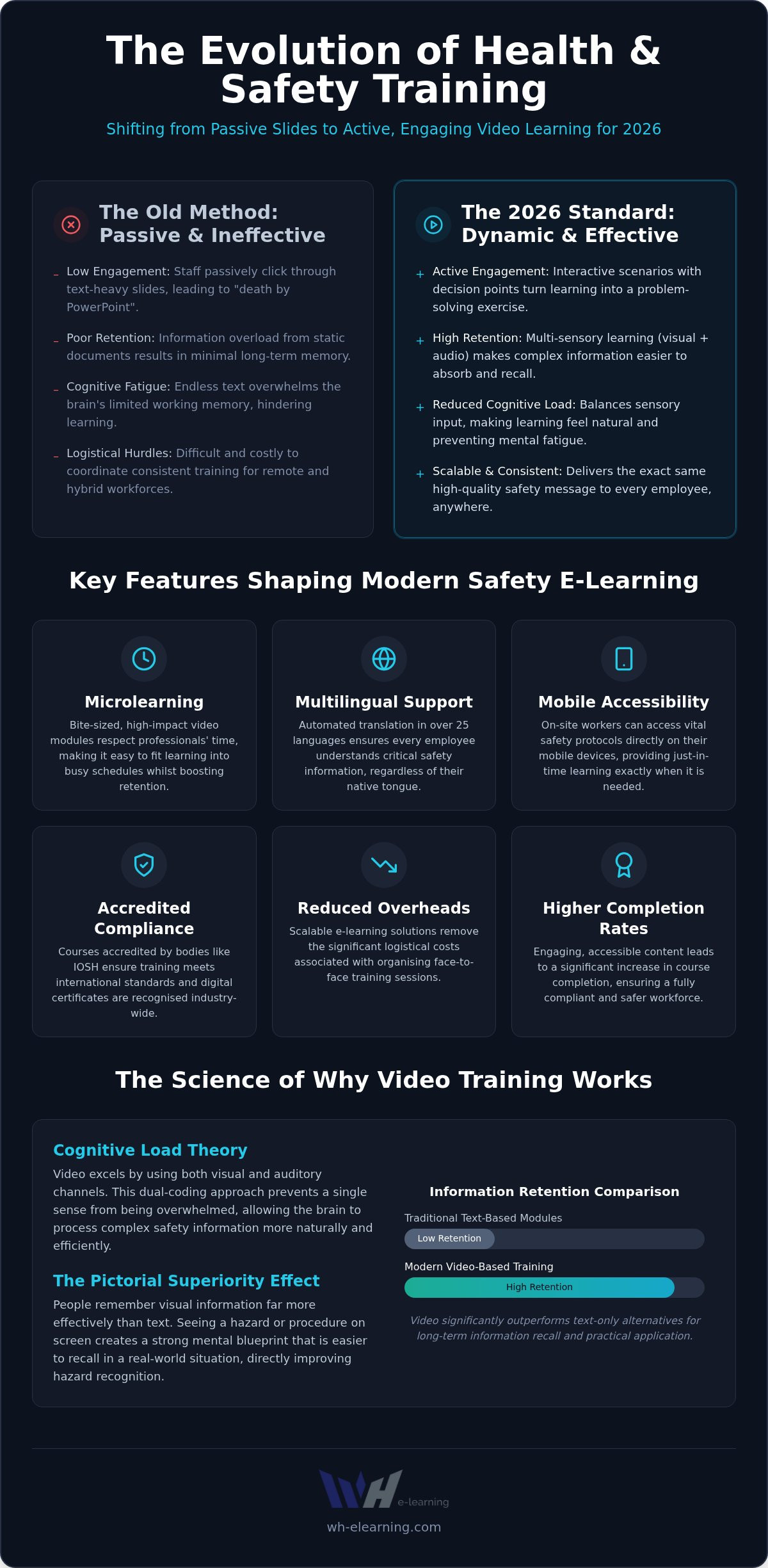
Modern video-based health and safety training represents a shift from static, paper-based documents to a dynamic, multi-sensory e-learning approach. It combines visual storytelling with audio narration to help employees retain critical information more effectively. Looking back at the early 2010s, many professionals remember the "death by PowerPoint" era. Those sessions often involved long, text-heavy slides that failed to capture attention or change behaviour. In 2026, the standard is defined by high-production value and interactive elements that keep learners focused from start to finish.
The evolution of safety training has moved us toward a more sophisticated model that prioritises the user experience. It's no longer about just watching a film; it's about experiencing scenarios that mirror real-world risks. This modern approach ensures that on-site workers can access vital safety protocols directly on their mobile devices, exactly when they need them. Accreditation from bodies like IOSH remains the gold standard, providing the necessary validation that a digital certificate carries the same weight as traditional classroom learning. This shift empowers workers, giving them the confidence that their training is recognised across the industry.
From Passive Observation to Active Engagement
Today's training environments don't let the learner sit back and switch off. By 2026, video modules have integrated decision-making points where the viewer must choose the correct course of action to proceed. This active participation transforms the learning process into a problem-solving exercise. Instead of hour-long films, we now see concise, high-impact modules that respect the professional's time. These bite-sized segments are a core part of effective workplace compliance training, ensuring that safety concepts are reinforced without causing cognitive fatigue. This format makes it easier for staff to fit learning into their busy schedules whilst maintaining high levels of retention.
Why 2026 is the Year of Video Compliance
The rise of remote and hybrid work has made traditional, centralised training sessions difficult to coordinate. Organisations now require a way to deliver consistent, high-quality instruction across multiple geographic sites simultaneously. video-based health and safety training provides this consistency. It ensures every team member, whether in a London office or on a remote construction site, receives the exact same safety message. This scalability is a primary driver behind the growth of business compliance e-learning. By removing the logistical barriers of face-to-face sessions, companies can maintain a safer environment whilst focusing on their core growth and development.
The Science of Why Video-Based Training Works
Understanding the why behind effective video-based health and safety training requires looking at how the human brain processes information. Cognitive Load Theory suggests that our working memory has a limited capacity. Video excels by balancing auditory and visual channels, preventing any single sense from becoming overwhelmed. This dual-coding approach ensures that learners absorb complex safety protocols without feeling fatigued. It makes the learning process feel natural rather than forced, allowing for a deeper understanding of the material.
The Pictorial Superiority Effect is another critical factor in retention. People are far more likely to remember a visual image than a written word. When a worker sees a specific hazard on screen, they develop a mental blueprint that is much easier to recall on the factory floor. This visual focus is a key part of modern safety e-learning trends, as it directly improves hazard recognition. By using storytelling to frame these visuals, safety rules become memorable narratives rather than just a list of restrictions.
Visual Learning and Information Retention
Retention rates for video-based modules typically outperform text-only alternatives. Video allows for the demonstration of "how-to" tasks in a way that static diagrams simply cannot replicate. Seeing a specialist correctly fit a harness or use a fire extinguisher provides a clear, unambiguous example for the viewer. High-quality production is vital here. It establishes authority and ensures the learner takes the content seriously. When the video looks professional, the message feels essential and carries more weight amongst the workforce.
Modifying Behaviour Through Realistic Scenarios
Video has the unique ability to simulate high-risk environments safely. It allows workers to see the consequences of poor decisions without any real-world danger. This builds empathy and shifts risk perception by showing how accidents affect both individuals and their teams. There is a strong psychological link between observing safe behaviour on screen and mimicking it in person. This is why many organisations choose comprehensive occupational safety and health training courses that use cinematic storytelling to drive home the message. If you're looking to upgrade your current programme, you might want to explore our library of specialist-led video courses to see this science in action.
Key Trends Shaping Modern Safety E-Learning
Technology is quickly reshaping video-based health and safety training to meet modern learner expectations. One of the most significant changes is the move towards microlearning. Instead of overwhelming staff with long sessions, businesses now favour 2 to 5 minute "burst" videos. These high-impact segments focus on a single safety concept; they're perfect for workers who need to refresh their knowledge between tasks without disrupting their day. This bite-sized approach respects the learner's time and ensures that focus remains sharp throughout the entire module.
Accessibility has also become a non-negotiable standard. Modern training platforms now prioritise screen-reader compatibility and standardised closed captions. This ensures that every employee, including those with hearing or visual impairments, has equal access to life-saving information. By removing these obstacles, companies create a more inclusive safety culture that protects everyone. These advancements aren't just about compliance; they're about building a more supportive and professional workplace for all.
The Rise of Inclusive, Global Training
Managing a diverse workforce requires a training solution that speaks everyone's language. Modern platforms now offer machine translation in over 25 languages, effectively breaking down communication barriers. This inclusivity ensures that every team member receives the same high standard of instruction, regardless of their native tongue. Closed captions are essential here, too. They support non-native speakers and allow for learning in noisy environments where audio might be difficult to hear. This approach is particularly valuable for those undertaking the IOSH Managing Safely online course, where clarity and precision are vital for passing assessments.
Interactive Video vs. Traditional E-Learning
The days of passive viewing are ending. Interactive video introduces gamification elements that transform safety training into an engaging activity. By using interactive hotspots, learners can identify hazards directly on screen during playback. This hands-on approach reinforces the visual learning principles discussed earlier. It forces the brain to actively scan for risks rather than just waiting for the next slide. For managers, the data benefits are immense. You can track exactly where learners pause or struggle. This allows you to identify common knowledge gaps across your entire organisation, providing a level of insight that was simply impossible with traditional, linear e-learning formats.
Organising a Successful Video Training Strategy
Implementing a robust video-based health and safety training strategy begins with a thorough audit of your current workplace culture. You need to identify high-risk knowledge gaps before selecting content. Are your site workers struggling with manual handling, or do your office managers need a better grasp of risk assessments? Once you've mapped these needs, you can build a curriculum that addresses specific hazards rather than applying a one-size-fits-all approach. This targeted method ensures your investment translates into real-world safety improvements.
Visibility is the next priority for any safety manager. You should establish a centralised hub to track staff training progress online. This allows you to monitor completion rates in real-time and ensure that no one falls behind on their mandatory compliance. Beyond tracking, it's vital to incorporate feedback loops. Ask your team if the videos are clear and helpful. This interaction ensures the training resonates with the workforce and allows you to refine the programme over time. Regulations evolve; you must review and refresh your training annually to remain compliant with the latest standards.
Choosing the Right Accredited Courses
Selecting the correct level of instruction is essential for meeting legal duties. Awareness-level training provides a foundation for general staff, whilst certificate-level courses offer the deeper technical knowledge required by supervisors and managers. IOSH accreditation is widely considered the "gold standard" for workplace safety because it ensures the content is technically accurate and pedagogically sound. IOSH accreditation is a globally recognised mark of excellence. By choosing these accredited paths, you give your team credentials that are respected across every industry.
Managing Bulk Training for Organisations
For larger teams, corporate licensing offers a cost-effective way to scale your safety culture. Bulk licensing allows you to provide high-quality video-based health and safety training to hundreds of employees without the logistical nightmare of organising multiple physical sessions. Integrating these modules into your existing onboarding process ensures that every new hire starts their first day with a clear understanding of your safety expectations. For more detailed procurement tips, you can refer to our corporate health and safety training buyer’s guide. If you're ready to simplify your compliance and protect your workforce, browse our full library of accredited courses to find the right fit for your organisation.
Why WH eLearning is the Preferred Partner for Video Training
Choosing a provider for video-based health and safety training is about more than just buying a course; it's about finding a reliable partner for your organisation's long-term growth. WH eLearning offers a comprehensive library of over 100 specialist-led video courses designed to meet the highest industry standards. We understand that modern businesses need flexibility. That's why our platform allows your team to learn on any device, at any time, and in their preferred language. By offering machine translation into over 25 languages, we ensure that your safety message is never lost in translation. This removes the traditional obstacles to compliance and makes high-quality education attainable for everyone.
We don't just provide digital solutions. We also offer in-house face-to-face training for those times when hands-on instruction is preferred. This unique combination ensures you have the right tools for every scenario, whether you're training a single new hire or an entire global department. Our goal is to reduce the friction of compliance, replacing it with a sense of empowerment and ease for your staff. It's a sophisticated but approachable way to meet your professional obligations whilst investing in your people. We position ourselves as a facilitator of your growth, providing a simplified path to meeting and exceeding safety standards.
Specialist-Led Content You Can Trust
Our courses are created by industry experts from the WH Management Group; they aren't just actors reading from a script. This ensures that every lesson is grounded in real-world experience and technical accuracy. Upon completion, learners receive a digital certification that serves as a verifiable record of their achievement. You can trust that the high standards we maintain across our accredited courses reflect our commitment to your team's safety. This expert-led approach builds confidence amongst your workers, ensuring they take their training seriously and apply it correctly on the job.
Scalable Solutions for Every Business Size
Our platform scales with your needs. You can choose individual per-course enrolment or opt for bulk corporate licensing to achieve significant cost savings. Our administrative features provide you with a clear overview of employee progress, making it easy to manage compliance across different departments or geographic sites. This level of oversight ensures that your training strategy remains on track and fully auditable at all times. It's an efficient way to manage a large workforce without the administrative burden of manual tracking. Explore our accredited health and safety training library today and see how we can simplify your workplace compliance whilst protecting your most valuable asset.
Future-Proof Your Workplace Safety Today
Transforming your compliance strategy is no longer a complex hurdle; it's a streamlined path to professional growth and team empowerment. You've seen how video-based health and safety training leverages cognitive science to improve retention whilst microlearning fits seamlessly into the modern workday. By prioritising accessibility through multi-language support and mobile-first delivery, you ensure every team member stays protected. This modern approach replaces the friction of traditional training with a high-quality, engaging experience that staff actually value.
Choosing a partner that understands these 2026 trends is essential for maintaining your high standards. With over 100 specialist-led courses, IOSH accreditation, and support for 25+ languages, WH eLearning provides the scalable solutions your business needs to thrive. We're here to help you move beyond passive slides and embrace a more interactive, reliable future for your safety culture. You can simplify your path to meeting professional requirements and focus on your long-term success with confidence.
Ready to elevate your standards? Browse our full range of video-based health and safety courses and start building a safer, more compliant workforce today.
Frequently Asked Questions
Is video-based health and safety training as effective as classroom learning?
Yes, modern studies into cognitive load suggest that digital video modules are just as effective as classroom learning, often providing superior consistency. Whilst face-to-face sessions rely on the individual trainer's performance, video ensures every employee receives the exact same high-quality instruction. The multi-sensory approach improves retention by balancing auditory and visual channels, helping staff to recognise hazards and recall safety protocols more efficiently in real-world scenarios across your workplace.
Can I use video training to meet my legal health and safety obligations?
Yes, you can use digital courses to meet your legal duties as long as the content is technically accurate and kept up to date. Employers have a duty to provide sufficient information and instruction to ensure the safety of their staff. Using accredited video modules allows you to demonstrate compliance through verifiable digital records. It's an efficient way to ensure your team understands the risks associated with their specific roles and the controls required.
Are WH eLearning courses accredited by recognised bodies?
Yes, our core courses are accredited by respected bodies such as IOSH, including the Managing Safely and Working Safely certificates. This accreditation confirms that our video-based health and safety training meets rigorous international standards for quality and technical accuracy. When your employees complete these modules, they receive a recognised certificate that validates their knowledge. This provides peace of mind for both the employer and the worker, ensuring that the training is credible and professional.
How do I track if my employees have actually watched the videos?
You can track progress through our centralised administrative dashboard, which provides real-time data on employee engagement. This system allows you to see exactly who has started a course, how far they've progressed, and when they've completed their final assessment. These tracking features are essential for corporate compliance audits, as they provide a clear, timestamped record of all training activity. It removes the guesswork and administrative burden of manual spreadsheets or paper records.
Can I get health and safety training videos in different languages?
Yes, our platform features machine translation into over 25 languages to support a diverse and global workforce. This ensures that non-native speakers can access life-saving information in their primary language, reducing the risk of misunderstandings on the job. We also include closed captions on our videos, which is particularly helpful for learning in noisy environments. Providing training in multiple languages is a practical way to foster an inclusive safety culture across all your sites.
What happens if an employee fails the assessment after the video?
If an employee fails an assessment, they can typically review the video content and retake the test. This approach encourages a mastery style of learning, where the focus is on understanding the material rather than just passing a one-off exam. Our system provides immediate feedback, helping the learner identify specific areas where their knowledge may be lacking. It's a supportive process designed to empower your team and ensure they grasp the safety concepts before moving on.
Do video-based courses work on mobile phones and tablets?
Yes, all our courses are fully responsive and designed to work seamlessly on mobile phones, tablets, and desktop computers. This flexibility is vital for on-site workers who may not have access to a traditional office desk. Staff can complete their video-based health and safety training during natural breaks or whilst travelling, making it much easier to integrate learning into their daily routine. It's a modern solution that respects your team's time and removes barriers to completion.
How often should video-based safety training be refreshed?
We generally recommend reviewing and refreshing your safety training annually to stay aligned with the latest regulatory changes and industry best practices. Some high-risk roles may require more frequent updates, whilst other certificates have specific renewal periods set by accrediting bodies like IOSH. Keeping your training current ensures that safety remains a top priority and that your team doesn't become complacent. Regular refreshes help reinforce safe behaviours and introduce new protocols as your business grows.


