

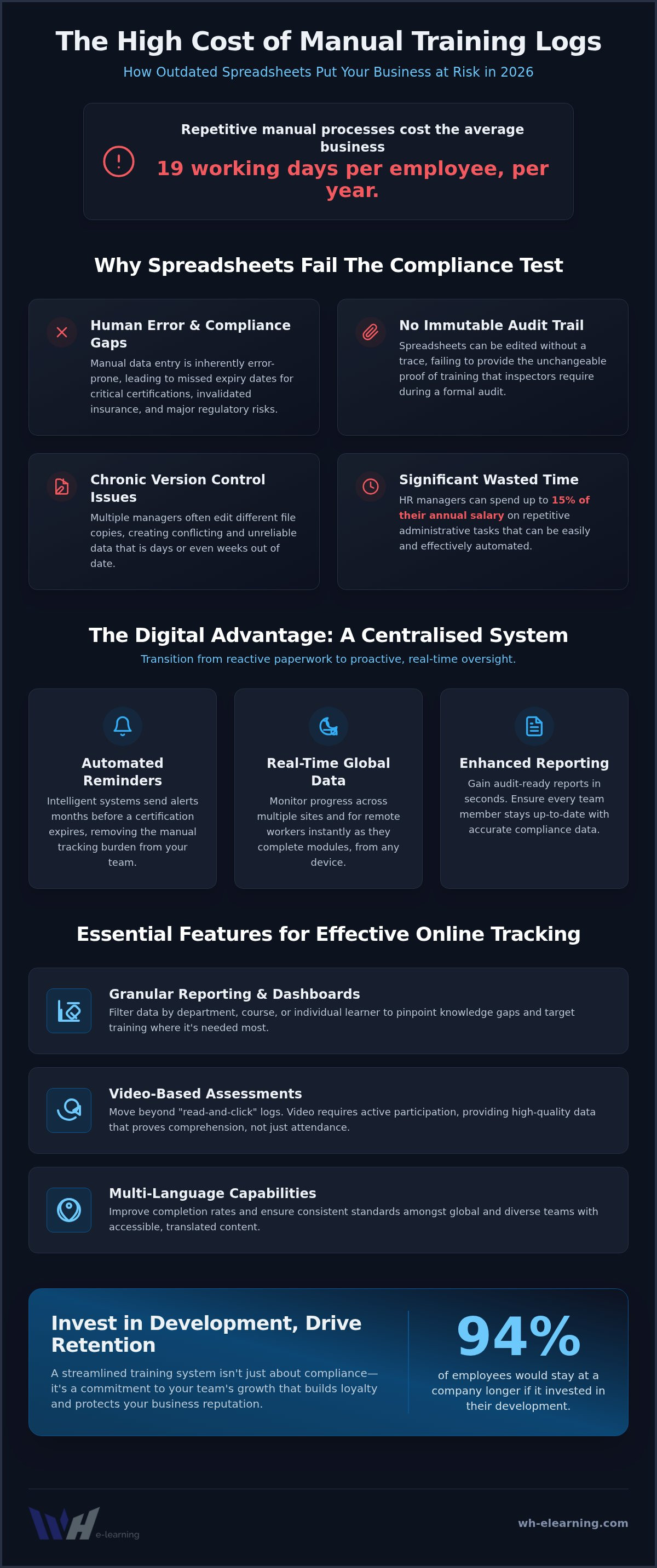
Did you know that repetitive manual processes cost the average business approximately 19 working days per year per employee? For many managers, a significant portion of this time is swallowed by the struggle to track staff training progress online using outdated, error-prone spreadsheets. It's a frustrating cycle of chasing individual staff members for updates and manually checking expiry dates, often leading to a sense of dread whenever an audit looms on the horizon.
We believe that monitoring professional growth should empower your team, not drain your resources. Since 94% of employees would stay at a company longer if it invested in their development, the ability to organise and view this data clearly is vital for retention. In this 2026 guide, you'll discover how to replace messy paperwork with streamlined online tracking that offers real-time visibility and automatic alerts. We will explore how modern administrative dashboards and video-based learning can improve compliance rates and provide audit-ready reports in seconds, ensuring your records remain accurate and accessible.
Key Takeaways
- Identify the critical risks of manual "spreadsheet fatigue" and learn how to transition to a centralised digital system that ensures total compliance.
- Discover the essential administrative features required to track staff training progress online with granular reporting for departments and individual learners.
- Implement a five-step framework to organise your training data, focusing on maintaining high standards of data integrity from the initial setup phase.
- Improve completion rates amongst global teams by utilising multi-language translations and video-based assessments designed for modern professionals.
- Streamline your workflow with automated dashboards that provide real-time visibility and audit-ready reports, replacing hours of manual admin with a few simple clicks.
The Hidden Risks of Manual Training Logs in 2026
To track staff training progress online effectively, you need more than just a digital version of a paper log. A modern tracking system is a centralised digital environment that monitors the entire learner journey, from initial enrolment to final certification. Whilst many businesses still rely on manual spreadsheets, this approach creates "spreadsheet fatigue" that leaves your organisation vulnerable to human error and critical compliance gaps. These gaps aren't just administrative inconveniences; they're significant liabilities.
Manual records often result in missed expiry dates for mandatory health and safety certifications, such as IOSH Managing Safely. If a staff member's certification lapses without notice, your business insurance could be invalidated and your regulatory standing with authorities might be compromised. The cost of these errors is steep. Research indicates that HR managers can spend up to 15% of their annual salaries on repetitive administrative tasks that are easily automated. Transitioning to a digital approach removes this burden and provides a clear, real-time view of your team's readiness.
Why Spreadsheets Fail the Compliance Test
Spreadsheets were never designed to be robust compliance tools. They suffer from chronic version control issues where multiple managers might edit different copies of the same file, leading to conflicting data. There is also a dangerous lag between a staff member completing a course and the record being updated. This delay means your data is often days or weeks out of date when you need it most. It's a reactive way to manage a proactive requirement.
Perhaps most importantly, spreadsheets lack an immutable audit trail. Inspectors require proof of when training occurred and who verified it. A standard document can be edited without leaving a trace, which makes it difficult to defend during a formal audit. To manage this complexity, most modern organisations use a Learning Management System (LMS) to provide a secure, unchangeable record of all activity. This ensures that your training programme remains transparent and legally defensible at all times.
The Benefits of Moving Your Tracker Online
Transitioning to a digital system removes the friction from professional development. By choosing to track staff training progress online, you ensure that data is centralised and accessible from any device, anywhere in the world. This visibility allows directors to see the compliance health of the entire company at a glance, rather than digging through folders or email chains.
- Automated Reminders: Intelligent systems send alerts months before a certification expires, removing the manual tracking burden from HR teams.
- Real-Time Data: Managers can monitor progress across multiple sites or for remote workers instantly as they complete their modules.
- Enhanced Reporting: You gain improved accuracy for reporting on workplace compliance training, ensuring every team member stays up to date.
Moving away from manual logs isn't just about saving time. It's about building a reliable foundation for your safety culture that protects both your employees and your business reputation. It replaces the stress of the unknown with the confidence of total visibility.
Essential Features for Tracking Staff Progress Effectively
To track staff training progress online successfully, managers need tools that offer more than a simple "completed" status. Modern administrative dashboards provide deep insights into how learners engage with content. Video-based assessments are particularly valuable here. Unlike "read-and-click" logs that can be easily skimmed or bypassed, video assessments require active participation and visual confirmation of understanding. This provides high-quality data that proves actual comprehension rather than just attendance, which is vital for maintaining high safety standards.
Efficiency relies on granular reporting. You should be able to filter data by department, specific course, or individual learner. This level of detail aligns with official training reporting requirements, which emphasise the need for precise record-keeping to ensure organisational readiness. By identifying exactly where knowledge gaps exist, you can target interventions where they're needed most, ensuring that your training budget is spent effectively. If you're ready to upgrade your oversight, you can explore our administrative dashboard features to see how they simplify this process.
Real-Time Dashboards and Visual Reporting
Real-time tracking is the instantaneous synchronisation of learner activity with administrative logs. This means that the moment a staff member finishes a module, your dashboard updates. Visual charts and heatmaps help you identify "compliance laggards" at a glance, allowing for quick follow-ups before deadlines pass. These reports are easily exportable into various formats, providing ready-made documentation for board-level presentations or sudden health and safety audits. This eliminates the frantic last-minute scramble for data that often occurs with manual systems.
Accreditation and Certification Management
Tracking progress is especially critical for high-stakes accredited courses where legal compliance is non-negotiable. For instance, when comparing IOSH managing safely vs working safely, managers must ensure the right level of training is assigned and completed by the correct personnel. Automated systems handle the generation and secure storage of these digital certificates, saving hours of manual filing and distribution. They also manage refresher training cycles by flagging upcoming expiry dates well in advance. This ensures your workforce remains fully qualified without any gaps in certification, protecting both the individual and the business.
How to Organise Your Online Training Progress Tracker
Moving from a manual spreadsheet to a digital system requires a structured approach to ensure no data is lost during the transition. To track staff training progress online effectively, you must treat the setup phase as the foundation of your compliance strategy. A successful migration follows a clear five-step framework: auditing requirements, selecting the platform, migrating historical data, onboarding users, and establishing a regular reporting rhythm. This journey isn't just about moving names; it's about establishing a system that remains accurate and scalable as your team grows.
Step 1: Audit Your Current Training Requirements
Begin by mapping out the specific needs of every role within your business. Differentiate between mandatory certifications, such as health and safety, and optional professional development courses. You need to identify existing certification dates for every employee to ensure they migrate correctly into your new system. Without this initial audit, you risk missing critical refresher training cycles. Determine the exact frequency required for each course, as this allows the software to trigger alerts at the correct intervals, preventing any lapse in compliance.
Step 2: Choosing and Setting Up Your Platform
Select a platform that prioritises administrative ease and clear visibility. Look for providers that offer business compliance e-learning with built-in management tools. Once you have selected your platform, organise your users into groups that mirror your company structure, such as by department or site location. This categorisation is vital for generating meaningful reports. Set up automated email notifications for both enrolment and upcoming deadlines. This shifts the responsibility from the manager to the system, ensuring staff are informed without the need for manual intervention.
Data integrity is paramount during the migration phase. If the initial upload contains errors or outdated information, your reporting will be flawed from the start. Beyond simple department groupings, consider categorising staff by risk profile. For example, frontline workers may require more frequent safety updates than office-based staff. This targeted approach ensures that high-risk areas receive the oversight they deserve and that resources are allocated where they're needed most.
Finally, encourage a culture of "self-service" within your organisation. When staff can log in to view their own progress and download their certificates, they take greater ownership of their professional development. This transparency reduces the administrative burden on HR teams and fosters a culture of accountability. It transforms training from a top-down requirement into a shared journey of growth and safety.
Advanced Tracking for Global and Diverse Teams
Managing a global workforce requires a sophisticated approach to oversight. When you track staff training progress online across different time zones and cultural backgrounds, a one-size-fits-all method often fails. Language barriers and differing accessibility needs can skew completion data, making it difficult to assess your true compliance status. Advanced tracking systems solve this by providing a unified view that accounts for these variables, ensuring that every employee, regardless of location, receives the same high standard of instruction.
Modern organisations are increasingly turning to technology to solve these hurdles. According to recent industry data, organisations using AI-powered personalisation report a 57% increase in learning efficiency. This efficiency is only possible when you have the data to back it up. By monitoring how different demographics interact with your content, you can refine your delivery methods to suit a diverse range of learning styles and professional requirements.
Inclusive Tracking with Multi-language Support
Retention rates improve significantly when staff engage with material in their native language. By utilising machine translation into 25+ languages, you can monitor how diverse teams progress through their modules without the friction of a language barrier. It's equally vital to track the use of accessibility features such as closed captions. This data provides proof that you are meeting essential standards and supporting employees with different auditory or visual needs. Reporting on global compliance status becomes a seamless task when your dashboard automatically aggregates data from every region into a single, translated overview.
Integrating In-House and Online Data
Achieving a "single source of truth" is the ultimate goal for any training manager. Whilst online modules are highly efficient, many businesses still require corporate health and safety training delivered through face-to-face sessions. A robust system allows you to log these manual sessions alongside digital progress logs, preventing data silos. This integration allows you to calculate a unified compliance score for the entire organisation. Whether a staff member is completing a remote DSE assessment or attending an in-house workshop, their progress should remain visible in one central location.
Monitoring these diverse training streams helps identify specific regional trends or accessibility gaps that might otherwise go unnoticed. For example, you might find that certain departments have higher completion rates when using mobile-first platforms, whilst others prefer desktop-based assessments. Having this data at your fingertips allows you to refine your strategy and provide a more supportive learning experience. If you need to support a multi-lingual team, you can request a demo of our course translation services to bridge the communication gap today.
Simplify Your Progress Tracking with WH eLearning
The WH eLearning administrative dashboard is designed specifically to remove the friction of traditional compliance management. It allows you to track staff training progress online with total precision, replacing guesswork with data-driven insights. With access to a library of over 100 accredited courses, including IOSH Managing Safely and various HR compliance modules, you can deploy training across your entire organisation in minutes. Our bulk licensing model ensures that as your team grows, your ability to monitor their development remains simple and scalable.
By utilising video-based learning, we solve the common problem of low engagement. Traditional text-heavy courses are often "clicked through" without real comprehension, which makes tracking their effectiveness nearly impossible. Our video assessments require active participation, providing you with high-quality data that proves your team has actually understood the material. This makes the tracking process more meaningful and ensures that your compliance records reflect genuine workplace safety.
Empower Your Managers with Better Data
Manual administrative tasks are a significant drain on company resources. Research shows that repetitive manual processes cost businesses approximately 19 working days per year per employee. For HR professionals, this burden is even heavier, with some spending up to 15% of their annual salary on tasks that could be easily automated. Our platform is designed to reclaim this lost time by automating the most tedious aspects of training oversight.
You gain total peace of mind with audit-ready, digital certification that is stored securely and updated in real time. Rather than spending hours preparing for an inspection, you can generate comprehensive reports in seconds. These reports are fully customised to fit your specific business structure, whether you need to view data by individual site, department, or specific risk profile. This level of clarity allows your managers to focus on growth rather than paperwork.
Get Started with Seamless Online Tracking
Transitioning to a modern system shouldn't be a complex project. You can enrol your team today and see immediate progress reflected on your dashboard. Every course in our library is built on accredited content that auditors and regulatory bodies trust, ensuring your organisation meets the highest professional standards. By choosing a partner that prioritises both learner experience and administrative efficiency, you build a safer, more compliant workplace for everyone.
Ready to streamline your compliance journey? View our course library and tracking features here to discover how easy professional development can be.
Take Control of Your Compliance Journey
Transitioning away from manual logs is the most effective way to protect your business and empower your staff. By choosing to track staff training progress online, you replace the anxiety of upcoming audits with the confidence of real-time visibility. You've seen how centralised data and automated alerts can eliminate "spreadsheet fatigue" whilst ensuring that critical health and safety certifications never lapse. This shift doesn't just save time; it builds a more resilient and informed workforce.
As an accredited IOSH provider with a library of 100+ workplace courses and global multi-language support, we are here to help you scale your professional development with ease. Simplify your compliance today with WH eLearning bulk licensing and transform your administrative burden into a streamlined success story. Your team's growth is the foundation of your company's future. Start building a proactive safety culture today that values progress as much as performance. It's time to make compliance the easiest part of your day.
Frequently Asked Questions
What is the best way to track staff training progress online?
The most effective approach involves using a dedicated administrative dashboard that provides real-time synchronisation between the learner and the manager. This digital environment eliminates the manual lag found in traditional methods. By choosing to track staff training progress online, you ensure that every module completed is instantly logged, providing a transparent view of organisational readiness without the need for constant follow-up emails or manual data entry.
Can I track both online and face-to-face training in one place?
Yes, a robust tracking system acts as a single source of truth for all learning activities. You can manually upload attendance records from in-house workshops alongside automated digital data. This integrated view allows you to maintain a comprehensive compliance score that reflects both classroom-based and e-learning achievements. Having all records in one centralised location simplifies the reporting process and provides a holistic view of your team's professional development.
How do I ensure my training records are audit-ready for health and safety inspectors?
Maintaining audit-ready records requires a system that generates immutable logs of all activity. You should look for platforms that produce digital certificates with unique verification codes that inspectors can validate. These records must be easily retrievable and securely stored to prevent unauthorised editing. By moving away from manual logs, you provide a clear, chronological history of training that demonstrates a proactive approach to workplace safety and regulatory compliance.
Is it possible to automate reminders for staff who haven’t finished their training?
Automation is a standard feature in modern tracking platforms, allowing you to set specific triggers based on deadlines or enrolment dates. The system automatically identifies individuals who have not completed their assigned modules and sends periodic email nudges. This reduces the time managers spend chasing staff and ensures that compliance gaps are closed promptly. You can customise the frequency of these alerts to maintain momentum without overwhelming your team with notifications.
What features should I look for in a corporate training licence?
A comprehensive corporate training licence should offer bulk enrolment capabilities and granular reporting tools. It is essential to choose a plan that provides an administrative dashboard for real-time monitoring of multiple departments. Look for features such as automated certification generation and support for video assessments. These tools make it easier to track staff training progress online whilst reducing the overall administrative workload for your management team.
How does tracking training progress help with employee retention?
Effective tracking demonstrates a clear commitment to an employee's career path and safety. When staff see that their professional growth is being organised and recorded, they feel more invested in the company's long-term goals. Providing a portal where they can view their own achievements fosters a sense of accountability and pride. This transparency reduces frustration and shows that the business values their time and effort, leading to higher levels of job satisfaction.
Can I track progress for staff who speak different languages?
Advanced platforms facilitate tracking for a diverse workforce by offering multi-language course translation and closed captions. You can monitor the progress of international teams in their native language, which significantly improves comprehension and completion rates. The administrative dashboard then aggregates this information into a single, unified report. This allows you to assess global compliance status without needing to translate individual records or manage separate tracking systems for different regions.
Is it difficult to move from a spreadsheet to an online tracking system?
Transitioning is straightforward when using a platform designed for bulk data migration. You can typically upload your existing staff lists and historical training dates via a simple file import. Once the initial data is in place, the system automates the transition by mapping users to their required courses. This move eliminates the risks associated with manual version control and provides a more reliable foundation for your future training and development strategy.


