

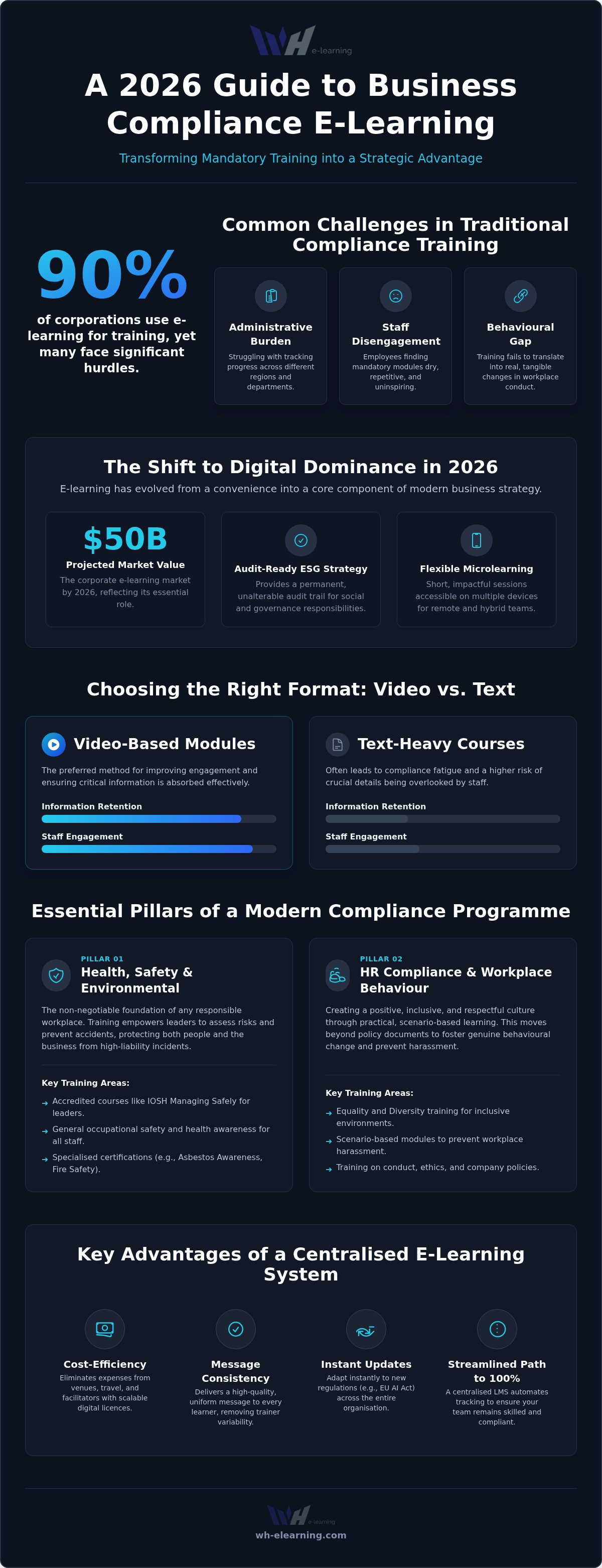
90% of corporations now use e-learning for training, yet many still struggle to bridge the gap between ticking a box and actually changing workplace behaviour. You're likely all too familiar with the administrative headache of tracking progress across different regions or the frustration of seeing staff disengage with dry, mandatory modules. It's a common challenge for leaders who want to ensure safety and standards without draining their team's productivity or focus.
This 2026 guide shows you how to transform business compliance e-learning from a repetitive burden into a strategic advantage that reduces liability and fosters a genuine culture of excellence. We'll explore how to automate your tracking processes, navigate complex international regulations like the new EU AI Act, and deliver accredited, multi-language content that your employees actually find accessible and engaging. Discover a streamlined path to 100% compliance that protects your business whilst empowering your people to grow.
Key Takeaways
- Learn how to move beyond basic box-ticking and use digital training to build a safer, more professional workplace culture.
- Discover why video-based modules outperform text-heavy courses by improving information retention and reducing compliance fatigue amongst staff.
- Explore strategies for implementing business compliance e-learning across multiple regions whilst maintaining 100% audit-readiness through automation.
- Identify the essential pillars of a modern programme, from accredited IOSH safety standards to critical HR and conduct training.
- Find out how a centralised Learning Management System can eliminate administrative burdens and ensure your team remains skilled and compliant.
Defining Business Compliance E-Learning in the Modern Workplace
Business compliance e-learning is a digital approach to delivering mandatory training on laws, regulations, and company policies. It has evolved from a simple "tick-box" exercise into a sophisticated tool for organisational health. In 2026, the corporate e-learning market is projected to reach a value of $50 billion, reflecting how essential these digital platforms have become for the modern enterprise. This shift isn't just about convenience; it's about creating a culture where standards are understood and respected by every team member, regardless of their location.
Modern compliance is now a core component of ESG (Environmental, Social, and Governance) strategies. Investors and stakeholders look for concrete evidence that a company manages its social and governance responsibilities effectively. By using digital platforms, businesses can provide a permanent, unalterable audit trail. Digital certification offers regulators time-stamped proof that every employee has completed their required training, reducing the risk of heavy fines and reputational damage.
The Shift to Digital Compliance in 2026
The rise of remote and hybrid work has made traditional classroom settings nearly impossible to coordinate for global teams. Staff need the flexibility to learn on multiple devices, whether they're in a home office or commuting. This has accelerated the move towards microlearning. These short, impactful sessions focus on one specific topic at a time, which significantly improves information retention compared to long, exhausting seminars. It's a method that respects the professional's time whilst ensuring they grasp complex regulatory requirements.
Business compliance e-learning is a digital framework that mitigates corporate risk and empowers employees through accessible, high-quality training on essential legal and ethical standards.
Why E-Learning is Essential for Modern Risk Management
Human error remains a primary cause of compliance failures. E-learning removes the inconsistency of face-to-face trainers by delivering a uniform message to every learner. This high-quality delivery ensures that no critical safety or legal point is missed. Organisations also benefit from immense cost-efficiency. When you compare bulk digital licences to the expenses of hiring venues, paying for travel, and employing external facilitators, the savings are substantial. It allows for a more frequent training rhythm without breaking the budget.
Keeping content current is another vital advantage. Regulations change rapidly in a post-Brexit and increasingly globalised market. When new laws like the EU AI Act are introduced, digital modules can be updated instantly across the entire organisation. You don't have to wait months to re-train your staff. They get the latest information exactly when they need it, ensuring your business remains protected and ahead of the curve.
The Essential Pillars of Digital Compliance Training
A resilient organisation is built on more than just good intentions; it requires a structured framework of knowledge. Effective business compliance e-learning addresses four core areas that protect your reputation and your people. These pillars ensure that every team member understands their responsibilities, from the warehouse floor to the boardroom. When training is delivered consistently, it moves from being a legal requirement to a vital part of your operational excellence.
Health, Safety, and Environmental Standards
Physical safety remains the non-negotiable foundation of any workplace. For supervisors and managers, accredited courses like IOSH Managing Safely are considered the gold standard. This training empowers leaders to assess risks and implement practical controls that prevent accidents. For broader staff engagement, an occupational safety and health training course provides the essential risk awareness needed to maintain a safe environment. High-risk sectors often require additional specialised certifications, such as asbestos awareness or fire safety, to meet specific legal obligations and protect against high-liability incidents.
HR Compliance and Workplace Behaviour
Creating a positive culture goes beyond policy documents. Equality and diversity training serves as a practical tool for building inclusive environments where everyone can thrive. Digital modules that use scenario-based learning are particularly effective at preventing workplace harassment, as they allow staff to navigate realistic challenges in a safe, controlled setting. This approach ensures that behaviour changes for the better rather than just meeting a minimum standard. For those looking to implement these programmes effectively, our guide on mastering workplace compliance offers a strategic roadmap for the coming year.
Data protection and financial integrity form the final two pillars. With new provisions of the EU AI Act taking effect in 2026, AI literacy has become a legal necessity for many organisations operating within the EU. Staff must understand the risks and limitations of these technologies to ensure responsible use. GDPR remains a priority, but it's now coupled with robust cybersecurity training to defend against increasingly sophisticated threats. Similarly, anti-money laundering (AML) and anti-bribery protocols are vital for any firm engaged in international trade. These courses ensure your business maintains financial integrity whilst navigating complex global markets. If you're ready to strengthen your organisation's foundations, you can view our accredited training options to find the right fit for your team.
Video-Based vs Text-Heavy Learning: Choosing the Right Format
The way you deliver information determines how well your team retains it. Many organisations still rely on text-heavy modules that lead to "compliance fatigue", where staff become overwhelmed by dense blocks of regulatory jargon. This results in lower completion rates and, more dangerously, a lack of genuine understanding. In contrast, video-based business compliance e-learning leverages visual storytelling to simplify complex topics and keep learners focused on the core message.
High-quality production is essential to maintain professional authority. When training looks and feels premium, employees take the requirements more seriously. It isn't just about the visuals; it's about the psychological impact of seeing a scenario play out. Interactive assessments and checkpoints ensure that learners don't just "click through" the session. These elements force engagement, requiring the user to apply what they've seen before they can progress.
The Case for Video-Based Learning
Video allows you to present real-world scenarios that make abstract laws feel practical and relevant to a worker's daily routine. It's also a vital tool for accessibility. For staff with neurodivergent needs or different learning styles, visual and auditory cues are often much easier to process than long-form text. Studies show that video-based training increases information retention by up to 60% compared to text-only alternatives, making it a far more reliable investment for long-term risk mitigation.
Custom vs Off-the-Shelf Training Modules
Deciding between custom and off-the-shelf content depends on your specific organisational goals. Off-the-shelf accredited courses are excellent for speed and cost-efficiency, especially for universal standards like IOSH safety certifications. They're ready to deploy and meet all legal requirements immediately. However, customisation plays a vital role when you need to align training with specific internal company policies or unique operational risks.
Most successful organisations use a blended approach. They utilise high-quality, off-the-shelf modules for general business compliance e-learning whilst adding bespoke elements for their unique culture. This balance ensures you meet every legal standard without losing the personal touch that makes training feel authentic to your workforce.
How to Organise a Global Compliance Training Strategy
Scaling a compliance programme across multiple territories is a significant logistical challenge. It requires a centralised approach that balances local legal requirements with a unified corporate standard. To begin, you must assess the specific training needs of different departments and regions. A warehouse team in the UK will face different risks compared to a remote-based sales force in Singapore. By categorising these needs early, you can ensure that business compliance e-learning is relevant and impactful for every employee.
Scaling Training for a Global Workforce
Effective global training depends on accessibility and linguistic accuracy. WH eLearning provides multi-language support in over 25 languages, ensuring that your international teams can learn in their native tongue. This isn't just about translation; it's about inclusion. Providing closed captions and high-quality translation options allows you to reach a diverse workforce with different learning preferences. Maintaining a core corporate standard across these regions ensures that your company values and safety protocols remain consistent, even whilst adapting to local regulations.
Tracking Progress and Maintaining Audit Readiness
Automation is the key to managing the administrative burden of a large-scale rollout. A robust Learning Management System (LMS) allows you to automate enrolment based on an employee's start date or role. This ensures that no one is missed during the onboarding process. To maintain 100% compliance, you should set a clear cadence for refresher training. Automated reminders are essential for prompting staff who haven't yet completed their mandatory modules, removing the need for manual follow-ups by HR teams.
Administrative dashboards provide a real-time view of your organisation's compliance health. You can identify gaps instantly and address them before they become a liability. When an internal audit or a regulatory inspection occurs, these systems allow you to generate instant reports that prove your commitment to safety and standards. This level of transparency transforms compliance from a stressful administrative task into a streamlined, reliable process. If you want to simplify your global rollout, explore our multi-language course translation services to support your international teams effectively.
Ultimately, a successful strategy creates a culture where training is seen as a benefit. When employees understand that these courses are designed to protect their safety and professional integrity, engagement naturally increases. By providing high-quality, accessible content, you demonstrate a long-term investment in your workforce's development, fostering a workplace amongst staff where standards are upheld with pride.
WH eLearning: Accredited Training for a Skilled Workforce
Choosing the right partner for business compliance e-learning is a decision that impacts your organisation's safety, culture, and legal standing. WH eLearning provides a comprehensive solution through a library of over 100 video-based courses. These modules cover essential areas including HR, health and safety, and general business skills. By combining theoretical knowledge with practical workplace application, the content ensures that your team doesn't just learn the rules but understands how to apply them in their daily roles.
Our approach focuses on quality and reliability. Every course is delivered by industry specialists who bring real-world expertise to the screen. This specialist-led content maintains a high level of professional authority, helping your staff feel supported and empowered throughout their development. Whether you require individual enrolments for a small team or bulk corporate access for a global workforce, our flexible licensing models adapt to your specific needs.
Accredited Courses and Industry Specialisms
Accreditation is the hallmark of trustworthy training. We specialise in IOSH safety certifications, which are recognised by international industry bodies as the gold standard for workplace safety. For decision-makers, choosing between different levels of training is simplified by our IOSH Managing Safely vs Working Safely comparison guide. This resource helps you identify whether your staff need foundational awareness or the advanced risk management skills required for supervisory roles.
Upon successful completion, learners receive digital certificates that provide an immediate and permanent record of their achievement. These certifications are vital for maintaining an audit-ready status and demonstrating your commitment to high standards. Accessing this specialist knowledge across HR and safety sectors allows you to build a versatile, skilled workforce that is prepared for the challenges of a modern business environment.
Multilingual Support for Inclusive Learning
Inclusive learning is a priority for any organisation with a diverse or international presence. WH eLearning supports over 25 languages, ensuring that no employee is left behind due to a language barrier. This capability allows you to deploy consistent, high-quality training across international borders using a single, streamlined platform. It removes the friction of managing multiple providers in different regions, providing a unified experience for every member of your team.
The ease of multi-device access means your staff can engage with their training whenever and wherever it suits them. This flexibility, combined with our robust administrative tracking features, makes it simpler than ever to reach 100% compliance. You can explore our full course library and start your compliance journey today, knowing you have a reliable partner invested in your long-term success.
Future-Proofing Your Organisation Through Strategic Training
Transitioning your training to a digital framework is more than a technical upgrade; it's a commitment to long-term resilience. By prioritising business compliance e-learning, you replace administrative friction with automated, audit-ready systems that protect your business from evolving risks. You've seen how video-based content significantly improves retention compared to text-heavy modules, ensuring that your team actually understands and applies critical safety and conduct standards.
Scaling this across global borders is now simpler than ever with support for over 25 languages and specialist-led content. As an accredited IOSH training provider, we are here to help you build a workforce that is not just compliant, but truly skilled and empowered. It's time to transform your mandatory requirements into a competitive edge that fosters a positive workplace culture and reduces corporate liability.
Browse our library of over 100 accredited compliance courses to find the perfect fit for your team. We look forward to supporting your professional growth and helping you maintain the highest standards of excellence with ease.
Frequently Asked Questions
Is business compliance e-learning legally recognised in the UK?
Yes. UK health and safety legislation, such as the Health and Safety at Work etc. Act 1974, requires employers to provide adequate information, instruction, and training. E-learning is an accepted method for meeting these legal duties. It provides a consistent standard of training and a clear digital audit trail that demonstrates your commitment to regulatory standards during inspections or audits, ensuring your organisation remains fully protected and compliant.
How often do employees need to retake compliance training?
The frequency depends on specific regulations and your internal risk assessments. Most industry standards suggest a refresher every one to three years to ensure knowledge remains current. For example, IOSH certificates don't technically expire, but the organisation recommends a refresher every three years to maintain high safety standards. Regular updates are essential to address new legal requirements, such as the 2026 provisions of the EU AI Act.
Can I track the progress of my entire team on one platform?
Yes, our platform includes comprehensive administrative dashboards designed for real-time oversight. You can monitor enrolment, track individual progress, and identify any compliance gaps across your entire organisation from a single location. This centralised approach removes the administrative burden of manual tracking and ensures you're always ready for an audit. Automated reminders can also be set to prompt staff who haven't yet completed their mandatory modules.
What is the difference between accredited and non-accredited compliance courses?
Accredited courses are reviewed and approved by external professional bodies, such as IOSH, ensuring they meet rigorous industry standards. These certifications carry international recognition and provide a higher level of professional authority. Non-accredited courses are often used for internal policy training or general awareness. Whilst both are valuable, business compliance e-learning that is accredited offers greater protection against liability and demonstrates a verified level of competency to regulators.
Are your e-learning courses available in different languages for global teams?
Yes, we provide multi-language support in over 25 languages to ensure your global workforce is never left behind. This allows you to deploy the same high-quality training across international borders, ensuring every employee understands their responsibilities in their native tongue. Providing inclusive business compliance e-learning in multiple languages helps maintain a unified corporate standard whilst respecting the diverse needs of your team, regardless of their geographical location.
Can IOSH Managing Safely be completed entirely online?
Yes, IOSH Managing Safely Online is designed for complete digital delivery. You can access the video-based modules on multiple devices, allowing you to learn at a pace that suits your schedule. The course includes interactive elements and a final assessment, all conducted within the platform. Once you pass, you receive an accredited certificate that is identical in value to the one earned in a traditional classroom setting, but with far greater flexibility.
What happens if an employee fails the online compliance assessment?
If an employee doesn't pass their assessment, they can typically review the course material and attempt the test again. Our platform identifies specific areas where they may have struggled, allowing for targeted revision. This supportive approach ensures that the goal remains genuine understanding rather than just passing a test. It empowers staff to master the content at their own speed, reducing the friction often associated with mandatory professional requirements.
Do you offer bulk discounts for corporate training licences?
Yes, we provide flexible licensing options tailored to the size and needs of your organisation. Whether you need to enrol a small department or secure bulk access for thousands of employees across several regions, we can arrange a solution that fits. This approach allows you to scale your training efficiently whilst maintaining high standards. Please contact our team directly to discuss your specific requirements and find the most efficient path for your rollout.


