

Could a simple "tick-box" exercise actually be putting your organisation at greater risk of a legal claim? Many leaders recognise that protecting their staff is a priority, but they often struggle to find workplace harassment training online that resonates with a modern, diverse workforce. It's frustrating when compliance feels like a hurdle rather than a help, especially when you're managing remote teams or navigating different languages. You want more than just a certificate; you want a culture where respect is the default and every employee feels safe.
We understand that your time is valuable and your legal obligations are serious. This guide provides a clear roadmap for implementing effective, accredited training that moves beyond litigation avoidance to foster genuine inclusivity. You'll learn how video-based content and seamless multi-language translation can bridge the gap between "boring" compliance and meaningful changes in behaviour. We'll also show you how to maintain a bulletproof audit trail, ensuring your organisation remains protected whilst your team thrives in a more supportive environment.
Key Takeaways
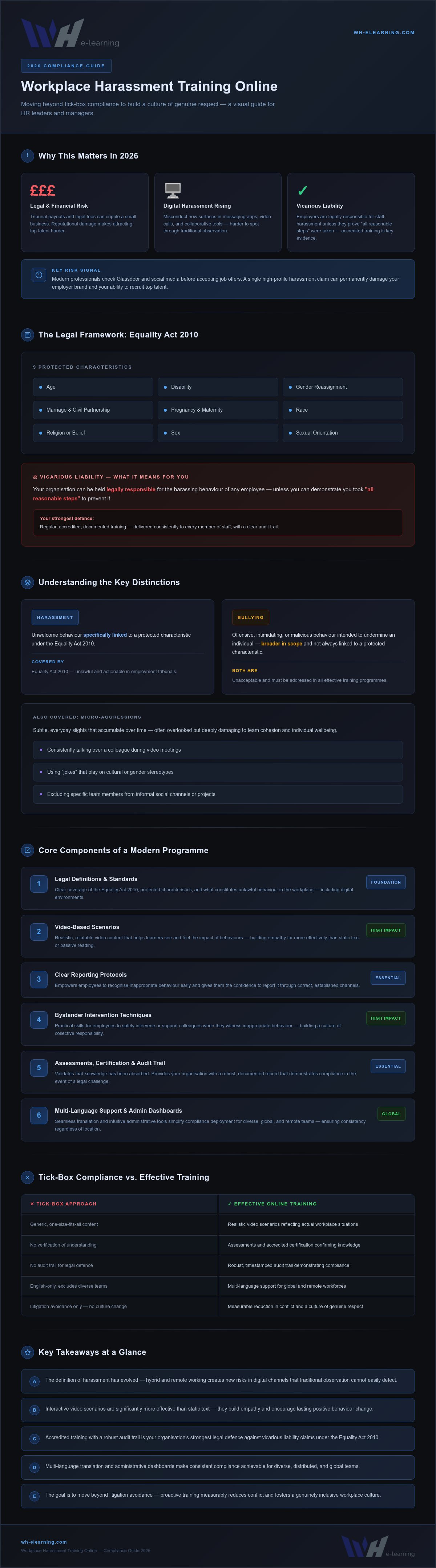
- Understand how the definition of harassment has evolved to address the specific risks found within hybrid and remote working models.
- Discover why interactive video scenarios are more effective than traditional text for building empathy and encouraging positive behaviour.
- Learn how to deploy workplace harassment training online that provides a robust audit trail whilst meeting the highest accreditation standards.
- Explore the benefits of using multi-language translation and administrative dashboards to simplify compliance for diverse, global teams.
- Identify the transition from basic litigation avoidance to a proactive culture that measurably reduces workplace conflict and fosters inclusivity.
Defining Workplace Harassment: Why Online Training is Essential in 2026
Workplace harassment is defined as any unwelcome behaviour related to a protected characteristic that violates a person's dignity or creates an intimidating, hostile, degrading, humiliating, or offensive environment. In 2026, the boundaries of the workplace have shifted. Harassment no longer only happens by the water cooler; it frequently migrates to digital spaces. With the rise of hybrid and permanent remote roles, inappropriate conduct often surfaces in instant messaging apps, video calls, and collaborative software. This digital shift makes it harder for managers to spot red flags through traditional observation alone.
A toxic culture is a significant liability. Beyond the immediate emotional toll on staff, the financial and reputational costs are immense. Legal fees and tribunal payouts can cripple a small business, whilst a single high-profile claim can permanently damage a brand's ability to attract top talent. Modern professionals check Glassdoor and social media before accepting offers; they won't join an organisation with a known history of conflict. Implementing workplace harassment training online allows you to deploy a consistent, high-quality standard of behaviour across your entire team, regardless of where they're logged in. It's the only scalable way to ensure every employee receives the same level of protection and education.
The Legal Framework: Equality Act 2010 and Global Standards
The Equality Act 2010 is the foundation of UK workplace law. It protects individuals from discrimination and harassment based on nine protected characteristics: age, disability, gender reassignment, marriage and civil partnership, pregnancy and maternity, race, religion or belief, sex, and sexual orientation. Employers must understand the concept of vicarious liability. This means your organisation can be held legally responsible for the harassing behaviour of an employee unless you can prove you took "all reasonable steps" to prevent it. Providing regular, accredited training is the most effective way to demonstrate that you've prioritised staff safety. For global teams, aligning with these standards ensures a uniform level of respect that meets or exceeds most international compliance requirements.
The Difference Between Bullying and Harassment
It's vital to distinguish between general bullying and unlawful harassment. Harassment is specifically linked to the protected characteristics mentioned in the Equality Act. Bullying is broader and involves offensive, intimidating, or malicious behaviour intended to undermine an individual. Both are unacceptable, and your training should cover both to ensure a truly respectful culture. Modern courses must also address micro-aggressions, which are subtle, everyday slights that can build up over time. Examples include:
- Consistently talking over a colleague in video meetings.
- Using "jokes" that play on cultural or gender stereotypes.
- Excluding specific team members from informal social channels or projects.
By investing in workplace compliance training, you provide your team with a clear set of professional standards. This empowers employees to recognise inappropriate behaviour early and gives them the confidence to report it through the correct channels.
Core Components of a Modern Harassment Prevention Programme
Building a culture of respect requires more than a generic presentation or a simple "agree to terms" tick-box. Effective workplace harassment training online must be comprehensive, engaging, and reflective of the actual challenges your staff face daily. A modern programme should include modules that cover not just the legal definitions, but also the practical application of these rules. Essential components include clear reporting protocols, bystander intervention techniques, and a deep dive into the impact of micro-aggressions on team cohesion.
Static text often fails to capture the emotional nuance and complexity of human interaction. This is why video-based scenarios are a non-negotiable part of high-quality training. By watching realistic interactions, learners can see and feel the impact of certain behaviours, which builds empathy far more effectively than reading a list of prohibitions. Assessments and certification play a vital role too; they validate that the knowledge has been absorbed whilst providing your organisation with a clear audit trail. By selecting high-quality workplace harassment training online, you ensure that your team remains compliant and your records are always up to date.
Role-Specific Training: Employees vs Managers
Managers carry a unique set of responsibilities in the workplace. Their training must focus on spotting early warning signs of exclusion or hostility and knowing how to intervene before a situation escalates. They need to understand how to handle disclosures with sensitivity whilst following formal procedures. Employees, conversely, need absolute clarity on their rights and the specific steps to take if they witness or experience harassment. Modern training also emphasises bystander intervention. This empowers colleagues to speak up safely, creating a self-correcting culture where inappropriate behaviour is challenged by the group rather than ignored.
Accessibility and Inclusivity in E-Learning
Inclusivity starts with the training platform itself. Features like closed captions and screen-reader compatibility ensure that every employee can access the content regardless of their physical abilities. For organisations with a diverse or international footprint, multi-language course translation is essential for ensuring that key messages aren't lost. Utilising machine translation into 25+ languages allows you to roll out a consistent standard of conduct across global borders, making sure every team member feels included. If you want to streamline your compliance further, exploring a library of accredited HR and Business Compliance Courses is a sensible next step for your development strategy.
Evaluating Online vs In-House Harassment Training: A Comparison for HR
Choosing the right delivery method for your team depends on your organisation's size, budget, and specific risk profile. For large-scale organisations, the cost-effectiveness of e-learning is difficult to beat. It eliminates the logistical headache of coordinating travel and accommodation for trainers, whilst significantly reducing the time staff spend away from their core roles. Instead of losing a full day to a workshop, employees can complete their modules in focused, manageable bursts.
Consistency is another critical factor. When you use workplace harassment training online, you guarantee that every single employee receives the exact same accredited information. Live training sessions, whilst valuable, are prone to variability. A trainer's delivery might change depending on the time of day, the group's energy, or their own personal bias. Digital platforms remove this inconsistency, ensuring your professional standards remain uniform across every department and global office. For high-risk sectors, a hybrid approach often provides the best of both worlds, using digital modules for broad compliance and live sessions for senior leadership.
The Benefits of Scalable E-Learning
HR teams often find that digital platforms simplify wider professional development. It's incredibly easy to bundle different requirements together; for instance, you can roll out GDPR compliance training alongside your harassment modules to create a comprehensive onboarding package. Because these courses are mobile-responsive, staff can access them anytime and anywhere, which is perfect for remote or hybrid teams. This flexibility removes the friction of scheduling, allowing new starters to begin their compliance journey on day one without waiting for a scheduled group session.
When to Opt for In-House Specialist Sessions
There are times when a deeper, more nuanced conversation is necessary. In industries like construction or healthcare, specific workplace dynamics might require a specialist's touch to navigate complex social interactions. Deep-dive workshops allow for real-time Q&A and peer-to-peer discussion that can be highly effective for culture-shifting initiatives. WH eLearning understands this need for flexibility, which is why we provide In-House Face-to-Face Training to supplement our digital library. This ensures your organisation has access to industry specialists when a bespoke, personal approach is the most effective way to address sensitive or high-stakes cultural issues.
How to Organise and Launch Online Harassment Training Successfully
Successful implementation starts with a structured plan rather than a rushed rollout. To begin, conduct a thorough training needs analysis. This helps you identify specific knowledge gaps amongst different departments or seniority levels. Once you understand your requirements, select a provider that offers high-quality, video-based content and multi-language support. Choosing the right workplace harassment training online ensures your team remains engaged from the first module.
Communication is your most powerful tool for driving engagement. Instead of simply assigning a task, explain the "why" behind the training. Frame it as a commitment to employee safety and professional growth rather than a mandatory tick-box exercise. After the launch, use administrative dashboards to monitor progress in real-time. This allows you to support individuals who may be struggling or remind those who haven't started. Finally, ensure you review and refresh the content annually. Standards for 2026 are higher than ever, and keeping your materials current is essential for long-term compliance.
Tracking Progress and Documenting Compliance
Maintaining a clear audit trail is vital for legal protection. If a claim ever reaches a tribunal, being able to prove that every employee completed their training provides a robust defence for the organisation. Digital certificates offer immediate, verifiable proof of completion for every individual. For larger organisations, bulk licensing features make it simple to manage thousands of learners across multiple locations. You can track completion rates at a glance, ensuring that no one slips through the net whilst maintaining the high standards required by the WH Management Group.
Overcoming Common Implementation Hurdles
Training fatigue is a real challenge for busy professionals. You can combat this by choosing varied, video-rich content that feels fresh and relevant. For staff without fixed desk access, such as those in retail or field roles, mobile-responsive platforms are non-negotiable. They allow team members to learn during quiet periods or whilst on the move. It's also helpful to integrate this with broader Equality & Diversity training. This provides a holistic foundation for respectful behaviour, making the specific harassment prevention modules feel like a natural extension of your company values. To simplify your organisation's path to compliance, browse our library of accredited online courses and find the right fit for your team.
Scaling Global Compliance with WH eLearning Training Solutions
Managing a single office is one thing; coordinating professional standards across multiple continents requires a sophisticated partner. WH eLearning acts as a central hub for your global compliance strategy. With a library of over 100 accredited courses, we provide a holistic approach to HR development that goes far beyond basic legal requirements. This extensive range allows you to address everything from safety to high-level ethics within the same ecosystem. By centralising your workplace harassment training online, you reduce the administrative friction typically associated with multi-national operations. It ensures a seamless experience for every learner, regardless of their location.
Our platform is designed to scale with your business. Whether you're a growing SME or a large corporate entity, the administrative dashboard provides the visibility you need to manage bulk licenses effectively. You can track completion rates, manage renewals, and ensure that every department remains compliant with the high standards set by the WH Management Group. This level of control is essential for HR directors who need to provide clear evidence of their organisation's commitment to a safe and respectful working environment.
Why 25+ Languages Change the Game for Global Teams
Compliance shouldn't be hindered by a language barrier. When employees learn about sensitive topics like harassment in their native language, they're more likely to absorb the nuances of the content. It demonstrates that the organisation values their inclusion and respects their background. Our platform uses machine translation to offer courses in 25+ languages, ensuring your core values are communicated clearly to everyone. This feature removes the risk of misinterpretation that often occurs with generic, English-only programmes. You can manage this entire process through a single administrative dashboard, which simplifies the task of overseeing a diverse, global workforce.
- Remove language barriers to ensure deep comprehension of policy.
- Demonstrate a commitment to inclusivity for international staff.
- Maintain a single point of truth for global compliance data.
- Reduce the cost and complexity of manual course translations.
Your Next Steps Toward a Safer Workplace
Building a respectful culture is a continuous journey that requires the right tools. We invite you to explore our corporate licensing options, which are designed to provide maximum value for larger teams whilst maintaining rigorous standards. You can trial our video-based modules to experience the high production quality and engaging scenarios firsthand. This allows you to see how the content will land with your staff before committing to a full rollout. If you have unique organisational challenges, our team is available to provide specialist support for bespoke requirements or hybrid delivery models. Take the first step toward a more inclusive environment by browsing our full range of HR and business compliance courses today.
Future-Proof Your Workplace Culture Today
Building a respectful culture isn't just about meeting a legal requirement; it's about creating a space where every individual can thrive. We've explored how modern harassment now extends into digital channels and why video-based scenarios are essential for building genuine empathy amongst your team. By implementing high-quality workplace harassment training online, you protect your organisation from liability whilst fostering an environment of psychological safety.
Our platform simplifies this transition with a library of over 100 accredited courses, trusted by global organisations to maintain the highest professional standards. With multi-language support in 25+ tongues and robust administrative tracking, you can manage global compliance with total confidence. It's time to move beyond simple tick-box exercises and invest in a solution that delivers measurable results. Explore our Accredited Workplace Harassment Courses and take the first step toward a more inclusive future. We're ready to partner with you in your organisation's development.
Frequently Asked Questions
Is workplace harassment training mandatory in the UK for 2026?
Yes, under the Worker Protection (Amendment of Equality Act 2010) Act 2023, employers have a proactive duty to prevent sexual harassment. Whilst the law doesn't explicitly name a specific training course, providing regular education is the primary way to prove "reasonable steps" were taken. Organisations that fail to demonstrate this proactive approach face increased compensation payouts in tribunals. It's now a legal necessity for any organisation committed to safety and compliance.
How often should employees refresh their harassment prevention training?
Most industry experts and legal advisors recommend refreshing this training annually to ensure compliance with the latest standards. Regular updates prevent knowledge fade and keep professional standards at the forefront of your team's mind. For high-growth organisations or those with high staff turnover, you might consider more frequent touchpoints. Annual reviews allow you to integrate new case studies or address specific cultural shifts within your organisation's hybrid working model.
Can online training really change workplace behaviour?
High-quality workplace harassment training online changes behaviour by using realistic, video-based scenarios that build empathy and emotional intelligence. Unlike static text, these interactive modules allow staff to see the impact of their actions on others. When training includes bystander intervention techniques, it empowers the entire workforce to challenge inappropriate conduct safely. This collective accountability is what transforms a tick-box exercise into a genuine, measurable shift in your company culture.
What is the difference between sexual harassment and general workplace harassment?
Sexual harassment is specifically defined as unwelcome conduct of a sexual nature that violates dignity or creates a hostile environment. General workplace harassment covers similar inappropriate behaviour but is linked to other protected characteristics like race, age, or disability. Both are unlawful under the Equality Act 2010. Effective training programmes must address both types to ensure every employee feels protected against all forms of discriminatory or offensive behaviour amongst the team.
How do I track if my employees have actually completed their training?
You can monitor every learner's progress in real-time using our administrative dashboards. These tools allow HR managers to see exactly who has started, who is mid-way through, and who has successfully completed their modules. You can also automate reminders for those who haven't finished, ensuring no one slips through the net. This tracking provides a robust audit trail that is essential for demonstrating legal compliance during internal audits or tribunal proceedings.
What languages are WH eLearning courses available in?
Our courses are available in over 25 machine-translated languages to support your global workforce. This feature ensures that every team member can learn in their native tongue, which significantly improves comprehension and engagement levels. Languages include French, German, Spanish, Polish, and many others. By removing the language barrier, you ensure that your organisation's professional standards are understood and respected across every international office and remote location you manage.
Does online training provide a valid certificate for legal compliance?
Yes, every course in our library provides a digital certificate upon successful completion. These certificates serve as verifiable proof that your employees have received accredited workplace harassment training online. Maintaining these records is a critical part of your "reasonable steps" defence under UK law. In the event of a legal claim, these documents provide the evidence needed to show that your organisation prioritises staff safety and professional conduct at all levels.
How long does a typical online harassment training course take to complete?
Most of our HR and business compliance modules are designed to be completed in approximately 45 to 60 minutes. We've structured the content into manageable sections, allowing staff to learn in focused bursts without disrupting their entire working day. This brisk pace is ideal for busy professionals who need high-quality information delivered efficiently. Because the platform is mobile-responsive, employees can even complete their training whilst on the move or during quiet periods.


