

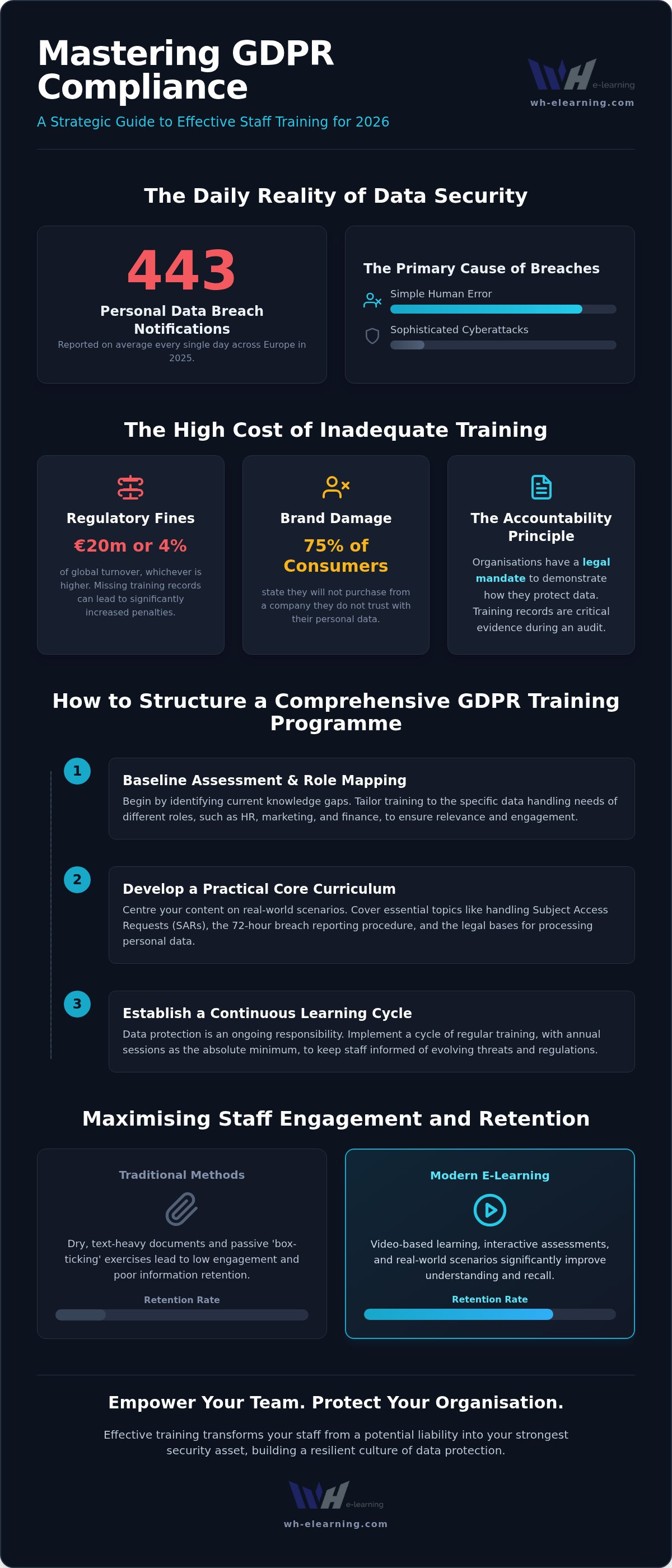
With an average of 443 personal data breach notifications reported every single day in 2025, the margin for error in your office has never been thinner. It's a sobering reality that most of these incidents stem from simple human mistakes rather than sophisticated cyberattacks. You likely already know that effective GDPR compliance training is your best line of defence, yet many organisations still struggle with dry, overly complex materials that fail to resonate with staff.
It's frustrating when you're responsible for data security but can't easily track who has finished their mandatory sessions or if they've truly grasped the essentials. We understand that you need a solution that reduces the risk of ICO fines without adding to your administrative burden. This guide offers a comprehensive look at structuring and delivering a training programme that your team will actually value.
We'll explore how to simplify your reporting for audits, use video-led learning to boost retention, and create a fully compliant workforce. By the end, you'll have a clear roadmap to making data protection a seamless, empowering part of your professional culture.
Key Takeaways
- Understand why the Accountability Principle makes gdpr compliance training a legal necessity for your entire team in 2026.
- Learn how to structure a tiered training programme that addresses the specific data handling needs of different employee roles.
- Discover why video-based learning and interactive assessments significantly improve information retention compared to traditional methods.
- Explore how to use administrative tracking features to simplify compliance reporting for audits and board meetings.
- Gain practical strategies for building a culture of data security that reduces the risk of costly breaches and regulatory fines.
Understanding the Role of GDPR Compliance Training in 2026
In 2026, data protection is no longer just a box-ticking exercise. It's a core pillar of business resilience. Effective gdpr compliance training serves as your primary shield against the rising tide of daily breaches. The General Data Protection Regulation (GDPR) remains the global gold standard, but the regulatory environment has grown more complex with the full enforcement of the EU AI Act in August 2026. This shift means your team must now understand how data privacy intersects with automated systems and AI tools.
The "Accountability Principle" is the driving force behind this necessity. It's a legal mandate that requires your organisation to demonstrate exactly how you're protecting personal data. If you can't produce robust training records during an audit, you're already in breach of this principle. Human error remains a significant risk, contributing to many of the 443 daily breach notifications reported across Europe in 2025. Proper training transforms your staff from a potential vulnerability into your strongest security asset.
Why Awareness is Your Strongest Security Control
Building a data-first culture means moving beyond passive compliance. Every employee needs to recognise that data security is a fundamental part of their daily routine, not just a task for the IT department. High-risk areas such as HR, marketing, and finance require specialised knowledge because they handle sensitive identifiers constantly. Investing in comprehensive workplace compliance training ensures that your team stays ahead of evolving threats. It's about empowering people to spot a phishing attempt or a misdirected email before any damage occurs.
The Legal Consequences of Inadequate Training
When the Information Commissioner’s Office (ICO) investigates a breach, they'll scrutinise your training logs immediately. If records are missing, incomplete, or outdated, it signals a lack of due diligence. This negligence often leads to significantly higher penalties. Beyond the maximum fines of €20 million or 4% of global turnover, the damage to your brand reputation is often permanent. Research shows that 75% of consumers won't buy from a company they don't trust with their data. Whilst the organisation usually carries the financial liability, individual responsibility is also a factor under current laws, making consistent education vital for everyone.
How to Structure a Comprehensive GDPR Training Programme
Organising effective gdpr compliance training for a diverse team requires a strategic framework that respects your employees' time whilst addressing their specific responsibilities. A generic, one-size-fits-all approach often leads to disengagement and missed nuances. To build a programme that truly sticks, you must move beyond basic definitions and focus on how data protection principles apply to daily workplace tasks. This ensures that every staff member feels empowered to make secure decisions without second-guessing the regulations.
Step 1: Baseline Assessment and Role Mapping
You can't fix knowledge gaps if you haven't identified them. Start by evaluating current staff awareness to ensure your training isn't redundant for some whilst being too advanced for others. Role mapping is essential here; a marketing manager needs to understand consent for digital tracking, whereas a receptionist must focus on physical visitor logs and telephone security. Referencing a foundational Introduction to GDPR helps establish a consistent baseline across all departments before moving into these role-specific requirements.
Step 2: Selecting the Core Curriculum
Your curriculum should centre on the practical application of data subjects' rights and the legal bases for processing. It's vital to include real-world scenarios, such as how to handle a Subject Access Request (SAR) or the correct procedure for reporting a potential breach within the 72-hour window. For teams managing internal personnel records, integrating HR compliance training online is a critical step. This ensures that sensitive employee data is handled with the same level of care as external customer information, protecting the organisation from internal vulnerabilities.
Step 3: Establishing a Continuous Learning Cycle
Data protection standards don't stand still, and neither should your training. Annual sessions are the bare minimum for maintaining compliance, but "compliance fatigue" can set in if the material feels repetitive. Use micro-learning—short, focused bursts of information—to keep security at the forefront of staff behaviour throughout the year. Automating reminders for course renewals ensures that no one falls behind, which is a key feature of the accredited online courses we provide to help simplify your administrative workload.
By tailoring your training to reflect actual workplace tasks, you transform abstract legal requirements into practical skills. This structured approach not only satisfies the ICO's demand for accountability but also builds a resilient culture where data security is a shared priority. When staff understand the "why" behind the rules, they're much more likely to follow them consistently.
Evaluating Training Methods: Online E-Learning vs In-House Sessions
Selecting the right delivery method is just as important as the content itself. Digital platforms offer a level of scalability that traditional classrooms simply can't match. For a workforce spread across different regions or working from home, synchronising a single training day is a logistical nightmare that often leads to low attendance. Online modules allow every staff member to complete their gdpr compliance training without disrupting their core duties. This digital approach ensures a high standard of consistency; every employee receives the exact same expert information, regardless of their location or department.
Video-based learning is particularly effective for modern professionals. It caters to both visual and auditory learners, making complex legal concepts much easier to digest. By seeing real-world scenarios play out on screen, employees can better anticipate how to handle data in their specific roles. This method is far more engaging than scrolling through dense blocks of text, leading to better long-term retention and a more confident workforce.
The Advantages of Digital E-Learning
Digital platforms provide the flexibility remote and hybrid teams need to thrive. Staff can learn at their own pace, pausing to review difficult sections or completing modules during quieter periods of the week. This autonomy reduces the friction often associated with mandatory professional requirements. Another major benefit is the instant digital certification provided upon completion. This offers immediate, verifiable proof of compliance that you can easily file for future audits or board reports, removing the administrative burden of manual record-keeping.
When to Use In-House Specialist Training
Whilst e-learning is perfect for the general workforce, some roles require a deeper level of engagement. Board members and IT security leads often benefit from specialist in-house sessions. These face-to-face workshops allow for deep-dives into complex data architecture and the development of bespoke organisational policies. It's an opportunity to combine digital theory with practical implementation strategies tailored specifically to your business. This hybrid approach ensures that leadership is fully aligned with the technical realities of data protection.
Analysing cost-effectiveness is also vital for any growing organisation. Individual enrolments are often ideal for onboarding new hires throughout the year. However, corporate bulk licensing typically offers much better value for larger teams. This approach allows you to secure high-quality, accredited training at a predictable cost, making it easier to manage your compliance budget whilst ensuring every team member is fully protected. Choosing the right mix of digital and in-person sessions creates a robust, multi-layered defence for your organisation’s data.
Best Practices for Maximising Staff Engagement and Retention
Engagement is the bridge between completing a course and actually changing workplace behaviour. If your team views gdpr compliance training as a chore, they'll likely forget the core principles as soon as they close the browser. High-quality, video-based content is a game-changer here, as visual learning can increase information retention by up to 50% compared to traditional text-heavy slides. By combining visual storytelling with interactive assessments, you can validate that employees haven't just watched the material but have truly understood how to apply it.
Gamification and visible progress tracking also play a vital role in keeping momentum high. When staff can see their progress bar moving or earn digital certificates, it creates a sense of accomplishment. This friendly nudge encourages timely completion without the need for constant manual chasing from the HR department. It transforms a mandatory requirement into a rewarding professional development milestone.
Inclusive Learning: Multi-language and Accessible Content
True compliance requires every single team member to be on the same page. This means your platform must be accessible to everyone, including non-desk-based staff who might need to learn on a mobile device during a shift. Providing closed captions is essential for inclusivity, ensuring that all learners can follow the material regardless of their environment or hearing ability.
For organisations with a global presence, language should never be a barrier to security. We utilize machine translation to support over 25 languages, allowing your international teams to engage with gdpr compliance training in their native tongue. This leads to deeper comprehension and reduces the risk of dangerous misunderstandings that often occur when translating complex legal requirements. You can explore our multi-language course translation services to see how we simplify global rollouts for our partners.
Combating Boredom with Practical Scenarios
Ditch the dense "legal-speak" and focus on relatable workplace behaviour. Employees are far more likely to remember a rule if it's presented through a "What would you do?" quiz based on a situation they might actually face, like a lost company phone or a suspicious email from a "client". Explaining the "Why" is equally important. When staff understand that data protection also benefits them as individuals by protecting their own personal privacy, they're much more likely to take organisational security seriously. This shift from fear-based compliance to value-based awareness is what builds a truly resilient and empowered culture.
Implementing Your Compliance Strategy with WH eLearning
Putting a robust data protection strategy into practice shouldn't be a source of stress for your leadership team. WH eLearning provides the tools you need to move from policy to performance with ease. By accessing our accredited library of over 100 workplace training courses, you can ensure your gdpr compliance training is both legally sound and professionally delivered. Our platform is designed to remove the friction of manual management, allowing you to focus on your core business goals whilst we handle the complexities of regulatory education.
One of the most significant hurdles in maintaining a compliant workforce is the administrative burden of record-keeping. Our corporate administrative features solve this by providing a centralised dashboard to track every employee’s progress in real-time. You'll no longer need to chase staff with emails or manage messy spreadsheets. Instead, you can generate instant reports for board meetings or official audits, providing verifiable proof of certification with a single click. This level of transparency is essential for meeting the GDPR’s accountability requirements and protecting your organisation from potential ICO investigations.
Scalable Solutions for Every Business
We understand that every organisation has unique requirements, which is why our solutions are built to scale. Whether you're a small business looking for single-course enrolments for new hires or a global enterprise requiring full-scale corporate licensing, we have a model that fits. Onboarding is straightforward and efficient; you can get your entire team started in just a few minutes. This rapid deployment ensures that there are no gaps in your compliance coverage, even during periods of high growth or staff turnover. We've simplified the process so that high-quality training is accessible to everyone, regardless of technical expertise.
Your Partner in Long-Term Compliance
Compliance isn't a one-off event; it's a continuous commitment to safety and standards. As regulations evolve, so does our content. We provide ongoing updates to ensure your gdpr compliance training remains accurate and effective in the face of new legal challenges. Beyond data protection, we offer expert support across a wide range of sectors, helping you integrate GDPR modules with other essential safety training requirements. This holistic approach ensures your team is protected on all fronts.
Taking the next step is simple. By choosing a partner that values ease of use and expert guidance, you’re investing in your organisation's future resilience. You can set up your first GDPR compliance training module today and begin building a more secure, empowered, and fully compliant workforce.
Building a Future-Proof Culture of Data Privacy
Organising effective gdpr compliance training is a strategic investment in your organisation's long-term resilience. We've explored how role-specific mapping and video-led learning transform dry regulations into practical workplace skills. By prioritising engagement and using administrative tools to track progress, you ensure that accountability becomes a natural part of your team's daily routine. This proactive approach doesn't just reduce the risk of fines; it builds lasting trust with your clients and partners.
Our platform simplifies this journey by offering accredited video-based learning that's already used by organisations globally. With support for over 25 languages, we help you empower every team member, regardless of their location or department. You can explore our accredited GDPR compliance training courses today to start streamlining your reporting and securing your data. We're here to be your reliable partner in professional growth, making complex requirements feel straightforward and attainable. Your path to a fully compliant workforce starts with a single, expert-guided step.
Frequently Asked Questions
Is GDPR compliance training mandatory for all employees?
Yes, providing gdpr compliance training is a legal necessity for all staff who handle personal data as part of their role. Under the Accountability Principle, your organisation must be able to demonstrate that employees understand their data protection obligations. Whilst the law doesn't specify a "one-size-fits-all" course, failing to train staff is often viewed as negligence by the ICO. This requirement ensures every team member can identify and mitigate data risks effectively.
How often should staff undergo GDPR refresher training?
Annual refresher training is the industry standard for maintaining high security levels amongst your workforce. Since data protection laws and cyber threats evolve quickly, yearly updates ensure staff don't fall into complacent habits. Regular sessions are also vital for incorporating new regulations, such as the intersection of AI governance and privacy standards in 2026. Consistent training cycles help your organisation stay resilient whilst proving to regulators that you take data security seriously.
What should be included in a basic GDPR training course?
A comprehensive course must cover the seven core data protection principles, the legal bases for processing data, and the specific rights of data subjects. It's essential to include practical modules on identifying personal data and the strict 72-hour window for reporting breaches. Effective gdpr compliance training also addresses physical security, such as "clean desk" policies, and digital safety, like recognising phishing attempts, to ensure a well-rounded defence against common human errors.
Can online GDPR training be used as legal proof of compliance?
Yes, online training serves as excellent legal proof of compliance when it includes timestamped completion records and digital certificates. During an ICO investigation or a third-party audit, these administrative logs demonstrate that your organisation has taken proactive steps to educate its workforce. Accredited platforms provide the "paper trail" needed to satisfy the Accountability Principle, showing exactly when each employee passed their assessment and which version of the regulation they studied.
How long does a typical GDPR compliance course take to complete?
Most foundational courses are designed to be completed within 45 to 90 minutes. This duration is long enough to cover essential legal requirements without causing learner fatigue. High-quality e-learning platforms often use a modular structure, allowing staff to finish the training in one sitting or break it into smaller sessions. This flexibility is particularly helpful for busy professionals who need to balance their mandatory compliance tasks with their daily operational responsibilities.
Is UK GDPR training different from the EU GDPR requirements?
UK GDPR and EU GDPR share the same core principles, definitions, and enforcement mechanisms. However, the UK version is domestic legislation that applies specifically to organisations operating within the United Kingdom. Whilst the fundamental rules for handling personal data remain aligned, gdpr compliance training should reflect the correct regulatory body relevant to your business location. For global organisations, it's best to use training that addresses the shared standards to ensure consistent behaviour.
What happens if an employee fails their GDPR assessment?
If an employee fails their assessment, it's a sign that they haven't fully grasped the material and require further review. Most accredited platforms allow staff to retake the quiz immediately or after revisiting specific sections. The goal isn't to penalise but to ensure every team member reaches a safe level of understanding. Managers can use these results to identify individuals who might need extra support or face-to-face guidance in high-risk departments.
How do I track training progress for a large team of remote workers?
A centralised administrative dashboard is the most efficient way to track progress for remote or hybrid teams. These tools allow you to see exactly who has started, paused, or completed their modules in real-time. You can also set up automated reminders to nudge employees who haven't finished their sessions, removing the need for manual chasing. This automated approach simplifies reporting for board meetings and ensures that your entire workforce remains compliant regardless of their location.


