

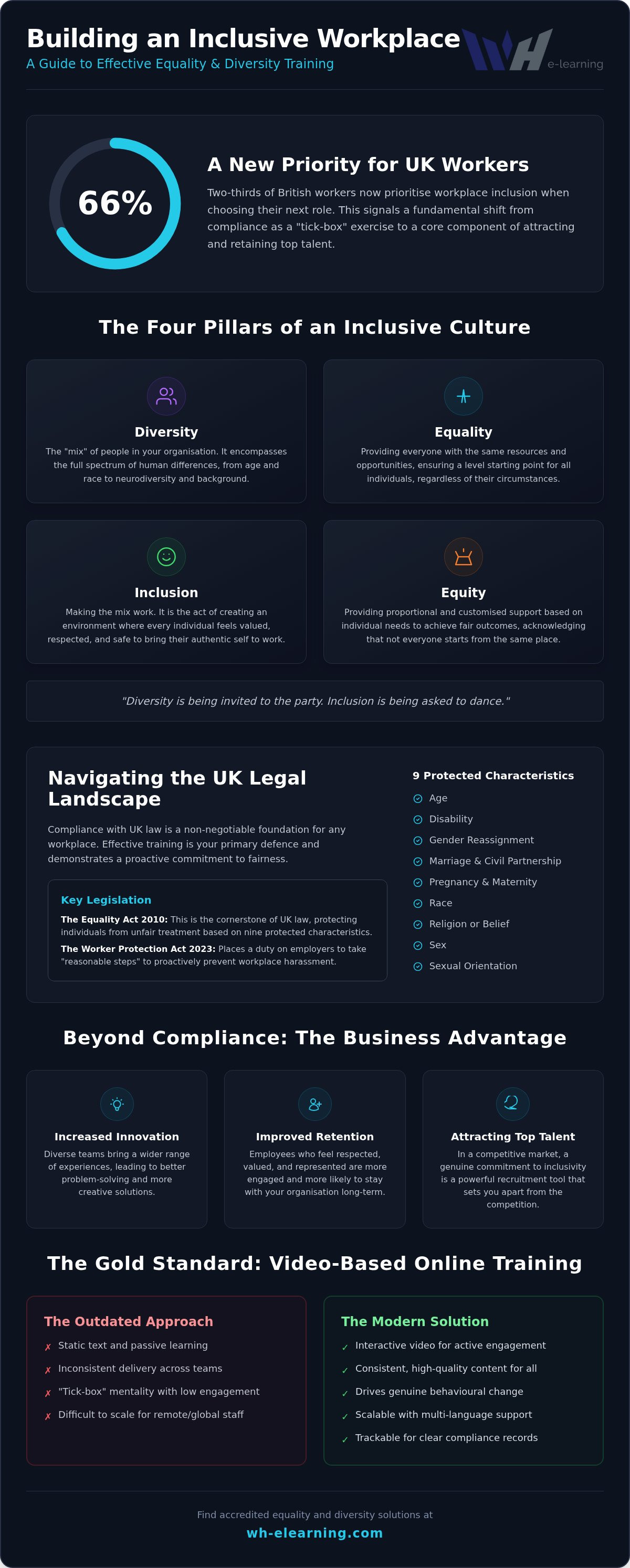
Did you know that 66% of British workers now prioritise workplace inclusion when choosing their next career move? It's a clear signal that diversity isn't just a legal requirement but a vital part of attracting and retaining top talent. You've likely felt the frustration of "tick-box" sessions that fail to change daily behaviour or struggle to reach your remote teams. Implementing high-quality equality and diversity training online shouldn't feel like an administrative burden; it's an opportunity to strengthen your organisation's core values. This guide will show you how to build a truly inclusive workplace culture whilst meeting every legal standard through smart, scalable training strategies.
We'll dive into the latest 2026 updates to the Equality Act Code of Practice and the "reasonable steps" duty under the Worker Protection Act. You'll also discover how to manage training for a global workforce using multi-language support to ensure every employee feels valued. From legal compliance to measurable culture change, we provide the roadmap you need for a more productive and equitable future.
Key Takeaways
- Align your workplace with current UK legislation by mastering the nuances of the Equality Act 2010 and the latest 2026 Code of Practice.
- Move beyond awareness to action by understanding the critical differences between equality, diversity, inclusion, and equity (EDIE).
- Improve engagement and retention across global teams by utilising high-quality equality and diversity training online that replaces static text with interactive video content.
- Streamline your compliance strategy with a clear framework for identifying knowledge gaps and selecting accredited, multi-language courses for your workforce.
Understanding Equality and Diversity Training in the Modern Workplace
Equality and diversity training is a systematic education process designed to ensure every member of an organisation understands how to treat others fairly. It isn't just about learning definitions; it's about fostering an environment where different perspectives are valued and respected. By implementing equality and diversity training online, businesses can provide a consistent baseline of knowledge across entire teams, regardless of their location. This Diversity training overview highlights how these programmes have evolved from simple seminars into comprehensive digital experiences that drive real behavioural change.
Modern organisations are moving away from the old "tick-box" approach to compliance. In the past, training was often seen as a hurdle to clear once a year. Today, the focus has shifted toward building a genuine culture of inclusion. This means moving beyond passive listening to active engagement, where employees understand how their actions impact the collective atmosphere. Effective training helps prevent harmful behaviours like discrimination, harassment, and victimisation by setting clear expectations from day one.
The Legal Framework: Why Compliance Matters
The Equality Act 2010 remains the cornerstone of UK workplace law. It protects individuals from unfair treatment based on nine specific characteristics: age, disability, gender reassignment, marriage and civil partnership, pregnancy and maternity, race, religion or belief, sex, and sexual orientation. Understanding these is vital for any manager or HR professional to ensure fair treatment across the employee lifecycle.
Compliance isn't just a moral duty; it's a legal safeguard. Under the principle of "vicarious liability", an employer can be held responsible for the discriminatory actions of their employees unless they can prove they took "all reasonable steps" to prevent it. Providing robust workplace compliance training is a primary way to demonstrate this due diligence. This is particularly relevant given the Worker Protection Act 2023, which requires proactive measures to prevent harassment. Using equality and diversity training online allows you to track completion and ensure every staff member is up to date with these evolving legal requirements.
Beyond the Law: The Business Case for Diversity
While the law provides the floor, a strong business case provides the ceiling for growth. Diverse teams bring a wider range of experiences to the table, which directly leads to better decision-making and increased innovation. When people feel they belong, they're more likely to contribute their best ideas and collaborate effectively.
Inclusion also plays a massive role in employee retention. High turnover is expensive and disruptive. Employees stay longer in workplaces where they feel respected and represented. Additionally, demonstrating a clear commitment to social responsibility makes your organisation more attractive to top-tier talent. In a competitive market, a reputation for being an inclusive employer is a powerful recruitment tool that goes beyond the basic requirements of the law.
The Core Pillars: Equality, Diversity, Inclusion, and Equity Explained
Building a robust workplace starts with understanding the four pillars of EDIE. While these terms are often grouped together, they represent distinct concepts that work in harmony. Diversity is effectively the "mix" of people in your workforce, encompassing everything from age and ethnicity to neurodiversity. Inclusion, however, is what makes that mix work. It's the act of creating an environment where every individual feels safe to bring their authentic self to work. Equality and diversity training online provides the framework needed to turn these abstract concepts into daily habits.
Think of it this way: diversity is being invited to the party, whilst inclusion is being asked to dance. Without inclusion, diversity is merely a statistic. High-quality training helps teams bridge this gap by providing practical scenarios that illustrate how to move from mere presence to active participation. When employees understand the "why" behind these pillars, they're more likely to embrace them as part of their professional growth.
Equality vs Equity: Providing the Right Support
Equality and equity are frequently used interchangeably, yet they serve very different purposes. Equality focuses on providing everyone with the exact same resources or opportunities. Equity, on the other hand, focuses on proportional support based on individual needs to ensure everyone can reach the same outcome.
Consider the bicycle analogy. Equality is giving everyone the same standard-sized bike. This works for some, but it's useless for a child or a very tall person. Equity is providing a bike that fits each person's specific height. In a professional setting, this might look like offering flexible hours for a working parent or screen-reading software for a visually impaired colleague. Managers who undergo HR compliance training online are better equipped to identify where these equity adjustments are needed to support a high-performing team.
Inclusion: The Key to Unlocking Diversity
An inclusive culture relies heavily on psychological safety. This is the belief that one can speak up with ideas, questions, or mistakes without fear of being punished or humiliated. Common barriers like unconscious bias often hinder this process, leading to "groupthink" where only dominant voices are heard. Training helps employees recognise these biases and provides strategies to mitigate their impact on recruitment and daily collaboration.
Research into the effectiveness of diversity programs suggests that training works best when it isn't framed as a corrective measure but as a leadership skill. Senior leaders must model inclusive behaviour by actively seeking out diverse viewpoints and acknowledging their own biases. When inclusion is woven into the daily routine, it transforms the workplace. By prioritising equality and diversity training online, you provide your staff with the tools to build a culture where everyone can thrive. You can explore our accredited courses to find the right fit for your organisation.
Why Video-Based Online Training is the Gold Standard for Compliance
Video-based e-learning has transformed how organisations approach professional development. Traditional text-based modules often lead to disengagement, but equality and diversity training online captures attention through dynamic visuals and clear narratives. This format ensures that the message remains consistent, whether an employee is in a London office or working remotely from home. It's a reliable way to deliver high-quality content that meets legal standards whilst remaining accessible to everyone. By moving away from static slides, you create a learning experience that feels modern and relevant to a 2026 workforce.
Digital assessments provide the final piece of the compliance puzzle. They offer measurable proof of learning, which is essential for auditing purposes. Unlike informal sessions, these online modules track progress and completion automatically. This data gives you quiet confidence that your organisation is meeting its legal obligations under the UK Equality Act 2010. It simplifies the administrative burden, allowing HR teams to focus on culture rather than chasing spreadsheets.
Engagement and Retention Through Visual Learning
Adult learners generally process visual information much more effectively than dense blocks of text. Video leverages this by using storytelling to humanise complex topics like unconscious bias or workplace harassment. Instead of reading a list of rules, staff see real-world scenarios play out, which helps them understand the impact of their behaviour. This approach significantly reduces "training fatigue" and makes the learning stick. By using concise, high-quality video content, you respect your employees' time while ensuring they actually absorb the material.
Scalability for Global Organisations
Managing a diverse workforce requires tools that scale across borders. Our platform supports machine translation into more than 25 languages, ensuring that language barriers don't hinder your progress. This is vital for maintaining a unified culture in a global organisation. Closed captions further improve accessibility for staff with hearing impairments or those who prefer to learn in a quiet environment. Bulk licensing makes it simple to ensure every employee receives the same high standard of training, providing a seamless and high-quality experience for everyone. It's an efficient way to remove obstacles and foster a truly inclusive environment where every voice is heard.
Organising an Effective Equality and Diversity Programme
Implementing a successful initiative requires a structured approach that goes beyond simply ticking a box. Your first step is to conduct a thorough training needs analysis. This identifies specific knowledge gaps within your team, ensuring your investment is targeted where it matters most. Once you understand these needs, select accredited courses that align with UK standards and your specific organisational values. By utilising equality and diversity training online, you can offer a consistent, high-quality learning experience that is easy to scale as your company grows.
The rollout phase is where many programmes falter without clear direction. Set firm deadlines and ensure senior leadership actively champions the training. When staff see directors prioritising these modules, they're more likely to engage deeply with the content. Use digital assessments to verify understanding and track progress automatically. This data is invaluable for auditing and proves your commitment to a fair workplace. Finally, set a schedule to review and refresh the programme. With legal requirements like the 2026 Code of Practice evolving, staying current is essential for long-term compliance. You can view our full range of accredited compliance courses to start building your roadmap today.
Setting Clear Objectives and Metrics
Define what success looks like for your organisation from the outset. While completion rates are a useful metric, they don't tell the whole story. Use pulse surveys to measure shifts in employee perception and the overall "feeling" of the workplace culture. Are people more comfortable speaking up? Is there a measurable decrease in reported grievances? Aligning these goals with other areas of professional development, such as gdpr compliance training, creates a holistic approach to workplace standards. Both disciplines emphasise the importance of treating personal data and individual identities with the highest level of care.
Encouraging Long-Term Behaviour Change
True inclusion isn't achieved through a single annual session; it requires a commitment to continuous learning. Provide "nudge" content or short refresher modules throughout the year to keep key principles fresh. This prevents the "forgetting curve" and ensures that inclusive behaviour becomes a daily habit. Integrate these principles into your core business processes, especially recruitment and performance reviews. When diversity and equality are woven into the fabric of your daily operations, they stop being a requirement and start being a competitive advantage. This steady progress mirrors the reliable growth of a healthy, modern business.
WH eLearning: Accredited Equality and Diversity Solutions
WH eLearning offers a comprehensive library of over 100 accredited workplace courses, designed to simplify your compliance journey. Our equality and diversity training online uses a professional, video-based format that replaces dry, text-heavy slides with engaging visual storytelling. This approach isn't just about entertainment; it's about driving genuine behaviour change by making the content relatable and easy to digest. By using corporate licensing, you can easily track employee progress and verify that every member of your team has reached the required standard.
Managing a global or multi-lingual workforce often presents unique challenges that traditional providers overlook. We've addressed this by providing machine translation into more than 25 languages. This ensures that language isn't a barrier to inclusion, allowing every staff member to engage with the training in their preferred tongue. It's a scalable solution that maintains a high standard of education across diverse geographical locations, ensuring your organisational values are understood by everyone, everywhere.
Supportive Training for Every Device
Flexibility is at the heart of our platform. Our training is fully accessible on mobile, tablet, and desktop, allowing your team to learn at a time that suits them. We've included closed captions on all our videos to support inclusive learning and ensure accessibility for all staff members. Whether you're managing a handful of individual accounts or a large-scale corporate enrolment, our system simplifies the process, removing the administrative friction often associated with bulk training.
Expert-Led Content You Can Trust
Accreditation is more than just a label; it's a mark of quality that demonstrates your commitment to professional standards. When you choose our HR and business compliance courses, you're partnering with an expert guide invested in your organisation's long-term growth. We act as a reliable partner, providing the tools you need to build a productive, inclusive culture whilst meeting every legal requirement with confidence. Explore our equality and diversity training online today to see how we can help your team thrive.
Building a Future-Ready Inclusive Workplace
Creating an equitable environment is a continuous journey that extends far beyond meeting legal requirements. Understanding the nuances between equality and equity, alongside the implementation of the 2026 Code of Practice, forms the foundation of a modern organisation. By prioritising engagement through video-based content and supporting a global workforce with multi-language features, you move from simple compliance to a genuine culture of belonging. This shift doesn't just protect your business; it empowers every employee to contribute their best work.
Success relies on a structured approach, from initial needs analysis to consistent progress tracking. Our platform provides the tools you need to manage this process seamlessly across any device. With over 100 accredited courses and support for 25+ languages, we're here to be your reliable partner in professional growth. Empower your team with accredited equality and diversity training online today to secure a more productive and respectful future for your entire workforce. It's time to turn your inclusion goals into a measurable reality with quiet confidence.
Frequently Asked Questions
Is equality and diversity training mandatory for UK businesses?
Strictly speaking, there isn't a single law that makes this training a standalone requirement for every business. However, it's essential for meeting the "reasonable steps" defence under the Equality Act 2010. Providing equality and diversity training online helps employers demonstrate they've taken proactive measures to prevent discrimination. This is particularly vital under the Worker Protection Act 2023, which mandates preventative action against sexual harassment. Failing to train staff leaves your organisation vulnerable to vicarious liability.
How often should employees complete equality and diversity training?
Most organisations refresh their training every one to two years to keep pace with legislative updates and cultural shifts. A biennial cycle ensures that staff remain aware of their responsibilities whilst integrating new developments like the 2026 Code of Practice. Regular refreshers prevent knowledge from stagnating and reinforce a culture of inclusion. If your organisation undergoes significant structural changes or large recruitment drives, more frequent sessions might be necessary to maintain high professional standards.
What topics should be included in an online diversity course?
A comprehensive course should cover the nine protected characteristics, unconscious bias, and the difference between equality and equity. It's also vital to include modules on inclusive language, microaggressions, and how to report harassment. Effective equality and diversity training online uses real-world scenarios to illustrate these concepts clearly. Including sections on the 2026 legal updates ensures your team understands the modern regulatory environment and their specific role within a productive, fair workplace.
Can online training really change workplace behaviour?
Yes, provided the content is engaging and evidence-based. Video-based learning is particularly effective because it uses storytelling to build empathy and illustrate the impact of inclusive actions. When training is practical rather than just theoretical, employees are more likely to apply what they've learned to their daily interactions. Combining digital modules with clear leadership support ensures that the principles of equality become a lived experience rather than just a "tick-box" compliance exercise.
How do I track if my employees have completed their training?
Corporate accounts on professional e-learning platforms provide automated tracking and reporting features. You can monitor individual progress, see assessment scores, and download completion certificates for your records. This centralised data is essential for auditing purposes and provides clear evidence of compliance during inspections or legal reviews. It removes the manual burden from HR teams, allowing you to manage large-scale training programmes with minimal administrative effort and quiet confidence.
What are the nine protected characteristics under the Equality Act 2010?
The Act protects individuals from discrimination based on nine specific traits. These include:
- Age
- Disability
- Gender reassignment
- Marriage and civil partnership
- Pregnancy and maternity
- Race
- Religion or belief
- Sex
- Sexual orientation
Understanding these categories is the first step toward building a legally compliant and respectful workplace culture. Ensuring your team can identify these characteristics helps prevent accidental bias and fosters a more inclusive environment.
Is multi-language support available for global teams?
Yes, our platform offers machine translation into more than 25 languages to support diverse, international workforces. This feature ensures that every employee can engage with the material in their native tongue, improving both comprehension and retention. Multi-language support removes the barriers that often prevent non-English speakers from fully participating in inclusion initiatives. It's a scalable way to ensure that your organisational values are consistently communicated across every geographical location you operate in.
How long does a typical online equality and diversity course take?
Most accredited online modules are designed to be completed in 45 to 60 minutes. This duration is long enough to cover essential legal frameworks and behavioural strategies without causing learner fatigue. Because the training is self-paced, employees can pause and resume as their schedule allows. This flexibility makes it easier to integrate professional development into a busy working day, ensuring high completion rates without disrupting your core business operations.


