

Your health and safety strategy should be a powerful business asset, not a source of constant administrative dread. It's perfectly natural to feel overwhelmed when trying to identify the truly essential health and safety courses for the workplace, especially with the threat of non-compliance penalties hanging over your daily operations. You deserve a training programme that protects your people without boring them to tears with outdated, slide-based presentations that offer little real-world value.
This 2026 buyer's guide simplifies the process of selecting the most effective accredited training to ensure full legal compliance and genuine workforce protection. You'll discover a clear list of must-have certifications, from IOSH Managing Safely to specialised industry modules, alongside a streamlined approach to purchasing and deploying these courses. Our guide ensures you receive recognised certificates that satisfy inspectors whilst fostering a culture of genuine safety and professional growth. We'll move from the broad requirements of your industry to the specific, practical applications that make your workplace safer and more efficient.
Key Takeaways
- Understand your legal duty of care and how to meet 2026 compliance standards through a clear, structured training strategy.
- Identify the essential health and safety courses for the workplace that provide the necessary foundation for all new starters and existing staff.
- Clarify the distinctions between IOSH Managing Safely and Working Safely to ensure your team leaders and employees receive the correct level of accredited instruction.
- Learn how to transition from dull, slide-based training to engaging video-led e-learning that improves knowledge retention and staff participation.
- Discover how to simplify compliance tracking and global deployment using accessible, multi-language course options and bulk licensing.
Understanding Your Legal Obligations for Workplace Safety in 2026
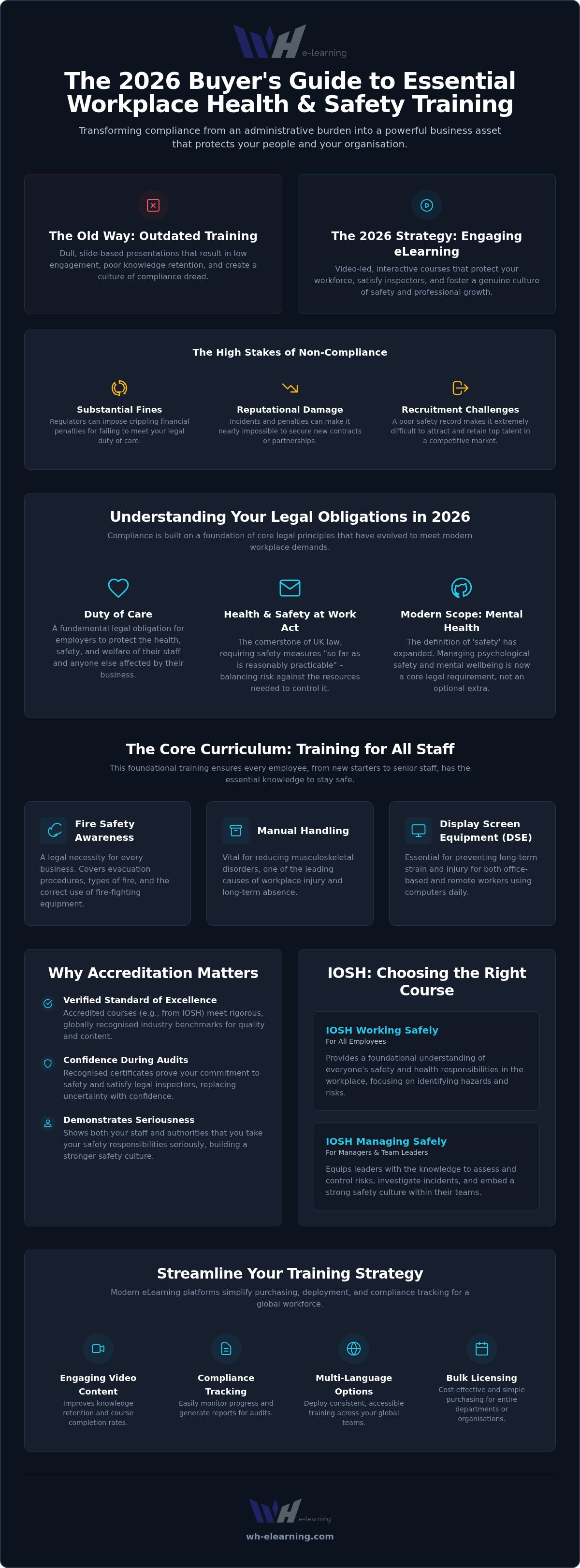
Legal compliance in 2026 is no longer about just avoiding accidents; it's about proactively building a resilient culture. At its heart lies the "Duty of Care." This is a legal obligation for employers to protect the health, safety, and welfare of their staff and anyone else affected by their business activities. If you fail to meet these standards, the consequences are severe. Regulators can impose substantial fines that cripple small businesses, whilst the resulting reputational damage can make it nearly impossible to recruit top talent or secure new contracts.
Integrating Occupational safety and health principles into your daily operations is the only way to mitigate these risks. Identifying and implementing the right essential health and safety courses for the workplace ensures your team isn't just aware of hazards but is actively trained to manage them. This proactive approach transforms safety from a administrative burden into a core business value.
The Core Legislation: Beyond the Basics
The Health and Safety at Work Act 1974 remains the primary piece of legislation you need to know. Whilst it's decades old, its flexibility allows it to cover modern challenges. The most critical concept for any manager is "so far as is reasonably practicable." This means you don't have to eliminate every single risk at any cost; instead, you must balance the risk against the resources required to fix it. It's a pragmatic approach that allows businesses to operate safely without being stifled by impossible demands.
In recent years, the definition of safety has expanded. Regulations now place significant emphasis on psychological safety. Managing mental health at work is now a core legal requirement, not an optional extra. Your training strategy must reflect this shift to ensure you're protecting the whole person, not just their physical body. Modern essential health and safety courses for the workplace now frequently include modules on stress management and wellbeing to address these evolving standards.
Why Accreditation Matters for Your Organisation
It's easy to find cheap "awareness" training, but this often fails to satisfy legal inspectors during an audit. Accredited certification provides a verified standard of excellence that proves your commitment to safety. Organisations like IOSH set the global benchmark for what high-quality training looks like. When you choose accredited courses, you gain peace of mind that your training meets rigorous industry standards and will be recognised by authorities.
For those looking to deepen their approach, Mastering Workplace Compliance offers a strategic roadmap for the coming year. Using accredited training demonstrates to both your staff and the authorities that you take your responsibilities seriously. It replaces uncertainty with confidence, ensuring your workforce is protected by the best possible standards.
The Core Curriculum: Essential Health and Safety Courses Every Business Needs
Identifying the right mix of training shouldn't be a guessing game. Every business, regardless of size or sector, needs a baseline of essential health and safety courses for the workplace. This core curriculum ensures that new starters are protected from day one and that established teams maintain high standards. Research into NSC workplace safety training programs shows how structured learning paths significantly reduce incident rates. Moving away from static slides to video-based learning is a game-changer; it captures attention and ensures critical safety protocols actually stick.
Foundational Safety Training for All Staff
Three areas form the bedrock of any safe workplace. First, Fire Safety Awareness is a legal necessity. Every employee must understand evacuation routes and how to use fire-fighting equipment correctly. Second, Manual Handling training is vital for reducing musculoskeletal disorders, which are a leading cause of workplace injury. Finally, with the rise of hybrid working, Display Screen Equipment (DSE) training is essential. It prevents long-term strain for office and remote workers alike. For a deeper dive into this specific requirement, check our DSE Assessment Training Online guide.
Specialised Compliance for High-Risk Roles
Some roles carry specific hazards that require deeper technical knowledge. Asbestos Awareness is a non-negotiable requirement for anyone involved in building maintenance or renovation, given the hidden dangers in older structures. Similarly, COSHH (Control of Substances Hazardous to Health) training is crucial for managing chemical risks, ensuring that hazardous materials are stored and handled safely. Empowering your staff through Risk Assessment Training is also a smart move. It allows them to identify hazards before they lead to accidents, turning your team into proactive safety advocates.
Knowledge fades over time, so regular refresher training is a cornerstone of compliance. Setting a schedule for annual or biennial updates keeps safety at the forefront of everyone's mind. If you're looking to streamline this process, exploring a comprehensive range of Health and Safety Training Courses can help you manage these requirements with ease. It's about creating a seamless path to compliance that supports your business growth.
Comparing IOSH Managing Safely vs Working Safely for Your Team
Choosing between different certifications can feel complex, but IOSH simplifies the training landscape. As the world's leading professional body for safety and health, IOSH provides a gold standard that's recognised across all global sectors. It's a common misconception that these courses are only for construction or heavy industry. In reality, they're designed to be universally applicable, whether you operate in retail, healthcare, or corporate finance. These programmes move beyond industry-specific jargon to focus on the core principles of protection and prevention that keep every business running smoothly.
Both courses are designed to reduce workplace incidents, but they differ significantly in their depth and target audience. Selecting the right one depends on an individual's level of responsibility and their role in your safety strategy. Integrating these into your list of essential health and safety courses for the workplace ensures that every member of your team has a level of knowledge appropriate to their daily tasks. They aren't just box-ticking exercises; they're investments in your company's long-term resilience and professional growth.
IOSH Working Safely: The Employee Standard
This course is designed for every employee at any level in any organisation. It provides a vital grounding in why safety matters and how an individual's actions affect their colleagues. Participants learn to identify common hazards and contribute to the overall safety of their team through practical, relatable examples. It's a high-impact programme that results in a globally recognised credential. By completing IOSH Working Safely Online, your staff gain the confidence to identify risks and suggest improvements, making it one of the most essential health and safety courses for the workplace for entry-level training.
IOSH Managing Safely: The Supervisor Requirement
For those in leadership roles, IOSH Managing Safely is the definitive choice. This course is significantly deeper than the employee version, covering the practical tools managers need to assess risks, investigate incidents, and measure safety performance. It's about moving from reactive fixes to a proactive safety culture where managers lead by example. Leaders learn how to integrate safety into their daily management routines without it becoming a bottleneck. This course empowers supervisors to take ownership of their team's welfare, ensuring legal duties are met whilst improving overall operational efficiency.
While both courses are vital, they serve different strategic purposes within your organisation. To see a detailed breakdown of the differences in depth, assessment methods, and duration, read our IOSH Managing Safely vs Working Safely comparison guide. Understanding these distinctions helps you allocate your training budget effectively and ensures every team member has the right level of knowledge to stay safe and compliant.
How to Organise and Implement a Workplace Training Strategy
Implementing a robust training strategy is about more than just buying a few modules; it's about creating a sustainable system that scales with your growth. For modern, busy teams, e-learning has emerged as the clear winner over traditional in-house sessions. It eliminates the logistical headache of coordinating schedules and hiring physical venues. By selecting the right essential health and safety courses for the workplace, you can provide consistent, high-quality instruction regardless of where your staff are located. Inclusive features like closed captions and machine translation for multi-national workforces ensure that safety knowledge is accessible to everyone, amongst your global team, regardless of their first language or learning preferences.
Step 1: Audit and Identify Gaps
Start by conducting a thorough training needs analysis. Review all existing certificates and flag any upcoming expiry dates to avoid a compliance gap. You should consult with department heads to understand the specific risks associated with different sites or roles. This allows you to determine exactly which staff require foundational awareness and which require management-level training. A clear audit ensures you aren't wasting budget on unnecessary courses whilst ensuring no critical safety area is overlooked.
Step 2: Choose the Right Delivery Platform
The quality of your platform directly impacts staff engagement. Avoid dry, text-heavy modules that employees simply click through without reading. Instead, prioritise video-based content that demonstrates real-world scenarios. Mobile compatibility is also a must-have in 2026, allowing your team to learn whilst on the move or during quiet periods. From an administrative perspective, ensure the provider offers robust progress tracking. This feature is indispensable for compliance audits, providing instant proof that your team has completed their required training.
Step 3: Deploy and Monitor Progress
Once you've identified your needs, use bulk licensing to simplify the rollout. This approach significantly reduces costs and removes the administrative burden of individual registrations. Set clear deadlines for course completion to maintain momentum and ensure your organisation remains compliant. Finally, download and store digital certificates in a central location. Having these documents ready for inspection at a moment's notice gives you the quiet confidence that your business is fully protected.
Ready to streamline your compliance? You can browse our full range of health and safety training courses to start building your strategy today.
Standout Safety Courses: Top Picks from the WH eLearning Collection
Selecting the right essential health and safety courses for the workplace is about finding a partner that values your time as much as your compliance. At WH eLearning, we've replaced the dry, slide-based training of the past with a high-quality, video-led experience that actually engages your staff. Our platform is designed to be accessible for everyone, featuring clear closed captions and intuitive navigation that works seamlessly on any device. Whether you're a small business or a global enterprise, our diverse library of over 100 courses provides a simplified path to meeting professional standards.
The IOSH Suite: Professional Excellence
As the flagship of our collection, IOSH Managing Safely Online empowers your leaders to take full ownership of their team's welfare. It provides the practical tools needed to assess risks and measure performance with quiet confidence. For the broader workforce, our IOSH Working Safely Online course ensures every employee understands their role in maintaining a secure environment. These accredited certificates are more than just paper; they're a recognised mark of excellence that satisfies inspectors and builds a culture of safety across all sectors.
Essential Compliance Short Courses
Beyond the leadership suite, our short courses provide the daily protection your business requires. Fire Safety and Manual Handling are the essential duo for every new hire, ensuring they can work safely from their first hour on the job. In 2026, Mental Health Awareness has become a vital addition to modern workplace wellbeing, helping teams manage stress and support one another effectively. For those in more specialised roles, our accredited Asbestos Awareness training is a non-negotiable requirement for trades and maintenance staff, providing life-saving knowledge in a concise, digestible format.
Why Choose WH eLearning for Your Team?
We believe that training should be inclusive and effortless for every user. Our collection of essential health and safety courses for the workplace is designed to remove obstacles and encourage professional growth across your entire organisation. With support for over 25 languages, you can deploy consistent training to a global workforce whilst ensuring every individual learns in the language they understand best. The platform is built for modern professionals who need to find information quickly and keep their skills sharp without navigating through dense blocks of text.
Empower your workforce and secure your compliance today. You can browse the full Health & Safety collection today to find the perfect training solution for your team's development.
Future-Proof Your Workplace Safety Strategy
Building a resilient and compliant workplace doesn't have to be an overwhelming administrative burden. You've seen how identifying the most essential health and safety courses for the workplace protects your team whilst satisfying the strictest legal inspections. By moving away from static, text-heavy training and embracing engaging video-led learning, you empower your staff to take genuine ownership of their daily wellbeing. This proactive approach transforms safety from a mandatory box-ticking exercise into a core pillar of your company culture.
As an accredited IOSH training provider with a library of over 100 specialist workplace courses, we're here to be your modern partner in professional growth. Our platform simplifies global deployment through machine translation into 25+ languages, ensuring every member of your team receives high-quality instruction in their preferred language. You can easily track progress and manage bulk licences through our intuitive interface, removing the friction from your compliance routine.
Take the final step towards a safer, more efficient business environment today. Explore the Essential Health & Safety Course Collection and discover how simple and effective your training strategy can become. You're making a vital investment in your workforce that will pay dividends for years to come.
Frequently Asked Questions
What are the 5 most essential health and safety courses for employees?
The five most essential health and safety courses for the workplace generally include Fire Safety Awareness, Manual Handling, Display Screen Equipment (DSE), IOSH Working Safely, and First Aid at Work. These foundational programmes address the most common risks found in modern offices and industrial settings alike. By prioritising these specific modules, you ensure your staff possess the practical knowledge required to maintain a secure environment and meet basic legal compliance standards from their first day.
Is IOSH Managing Safely a legal requirement in the UK?
No, IOSH Managing Safely is not a specific legal requirement, but it is a widely recognised way to meet your legal duties under the Health and Safety at Work Act 1974. The law requires managers to be competent in identifying and controlling risks. This accredited course provides the definitive evidence of that competence. It is often requested by insurance companies and clients as proof that your leadership team can manage safety effectively and proactively.
How often do employees need to refresh their health and safety training?
Most industry bodies recommend refreshing health and safety training every three years, though certain high-risk roles may require annual updates. Regular refreshers are vital because safety regulations and best practices evolve over time. Keeping your team’s knowledge current ensures that safety remains a priority and that skills don't fade. Setting a consistent schedule for these updates helps you maintain continuous compliance and prevents a culture of complacency from developing amongst your workforce.
Can I buy health and safety courses in bulk for my whole company?
Yes, you can purchase essential health and safety courses for the workplace in bulk through our corporate licensing options. This approach is highly efficient for organisations looking to train large teams simultaneously whilst reducing the administrative burden. Bulk licensing typically offers better value and allows HR managers to deploy training across multiple departments with ease. You can centrally manage registrations and monitor completion rates through a single, streamlined dashboard designed for business efficiency.
Are online health and safety certificates as valid as classroom ones?
Yes, online certificates carry the same legal weight as those earned in a physical classroom, provided they are issued by an accredited body like IOSH. Modern e-learning platforms use rigorous assessments and video-based learning to ensure the same high standards of instruction. Inspectors and regulatory authorities recognise these digital credentials as valid proof of training. They offer the added benefit of being easily stored and retrieved during a compliance audit or site inspection.
What is the difference between IOSH and OSHA training?
The primary difference lies in their geographical focus and regulatory origins. IOSH is a UK-based global professional body that sets high standards for safety training worldwide. OSHA is a US government agency that enforces federal safety laws within the United States. Whilst both aim to reduce workplace injuries, IOSH qualifications are generally preferred for businesses operating in the UK and international markets outside the US because they align with British and international safety standards.
How long does it take to complete an online health and safety course?
Completion times vary depending on the depth of the specific module. Short awareness courses, such as Fire Safety or Manual Handling, typically take between 45 and 90 minutes to complete. More comprehensive certifications like IOSH Managing Safely Online require approximately 20 to 24 hours of study time. The benefit of e-learning is that staff can progress at their own pace, breaking the content into manageable sessions that fit around their existing daily responsibilities.
Do your courses support staff who do not speak English as their first language?
Yes, our training programmes are designed to be inclusive and accessible to a diverse global workforce. We offer machine translation for our course content into over 25 different languages, ensuring that every employee can learn in the language they understand best. Additionally, closed captions are provided to support different learning preferences and accessibility needs. This inclusive approach ensures that critical safety information is never lost in translation, regardless of your team's linguistic background.


