

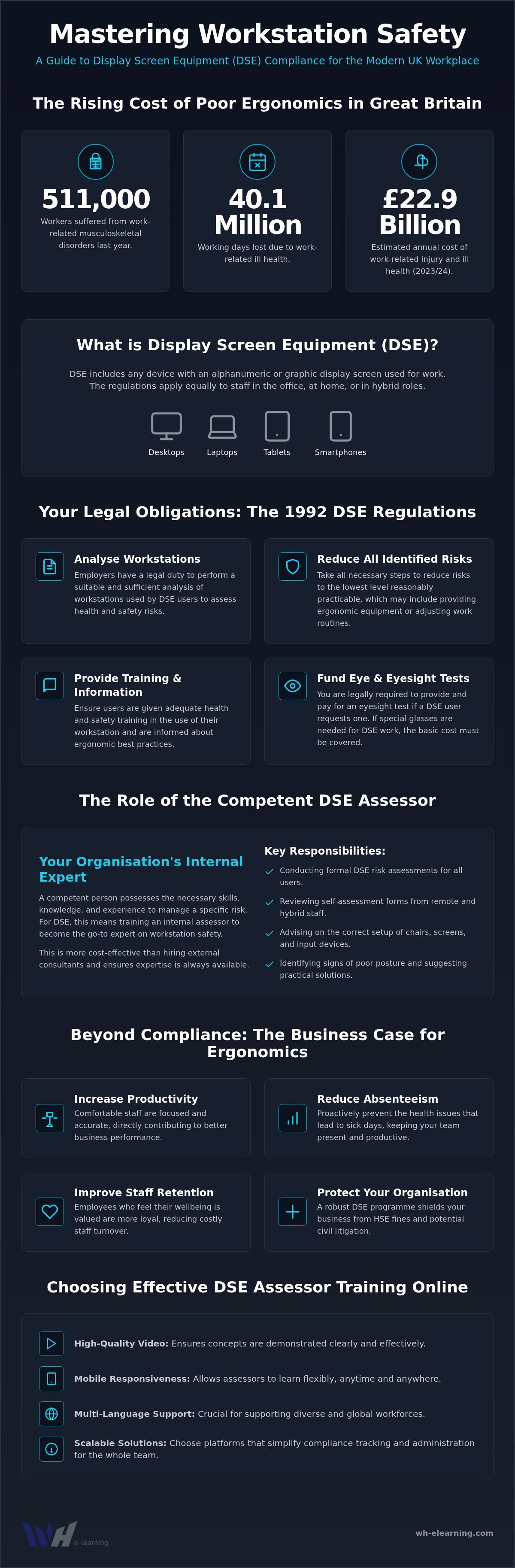
Did you know that an estimated 511,000 workers in Great Britain suffered from a work-related musculoskeletal disorder last year? This figure, alongside the 40.1 million working days lost to ill health, highlights why workstation safety is far more than a simple administrative task. If you're finding it difficult to apply the 1992 DSE Regulations to a modern, hybrid workforce, you aren't alone. Choosing the right DSE assessment training online is the most effective way to bridge the gap between traditional office safety and the reality of remote work.
We understand that managing the ergonomic health of a distributed team can feel like a daunting responsibility. You want to protect your staff from injury and shield your organisation from claims, but the logistics often seem complex. This guide promises to simplify that process, helping you master workstation ergonomics and maintain total legal compliance with ease. We'll examine the essentials of assessor training, explore how to manage remote assessments, and show you how to build a scalable, compliant safety culture that supports every member of your team.
Key Takeaways
- Understand your legal obligations under the 1992 DSE Regulations, including specific requirements for hybrid staff and mandatory eye test entitlements.
- Learn how to evaluate DSE assessment training online based on video quality, mobile responsiveness, and the ability to support global workforces with multi-language content.
- Follow a clear, step-by-step process to identify DSE users and empower internal assessors to conduct thorough, compliant risk assessments.
- Reduce the risk of work-related musculoskeletal disorders by mastering the core principles of workstation ergonomics and preventative care for all staff.
- Discover how to streamline compliance tracking and administrative tasks using scalable, accredited e-learning solutions designed for the modern professional environment.
What is DSE Assessment Training Online and Why is it Essential?
Display Screen Equipment, or DSE, encompasses almost any device with an alphanumeric or graphic display screen. This includes traditional desktop monitors, laptops, tablets, and even smartphones used for work purposes. In our modern, flexible work environment, DSE assessment training online serves as the vital link between these digital tools and the physical wellbeing of the people using them. It provides the technical knowledge required to identify and mitigate risks that are often invisible until they cause physical pain.
While every employee should have a basic level of DSE awareness to manage their own workstation, an internal DSE assessor takes on a more specialised role. They are the designated experts within your organisation who evaluate workstations to ensure they meet legal standards. By choosing an online route for this training, businesses can scale their safety protocols across multiple sites and remote locations simultaneously. This method is far more efficient than traditional classroom sessions, as it allows specialists to qualify without the downtime or travel costs associated with off-site workshops.
The core objective of this training is simple: the prevention of musculoskeletal disorders (MSDs) and chronic eye strain. By applying scientific ergonomic principles to every desk setup, assessors help staff avoid the repetitive strain and postural issues that lead to long-term health problems. It's a proactive approach that shifts the focus from reacting to injuries to preventing them from occurring in the first place.
The Definition of a Competent DSE Assessor
Under UK health and safety law, a competent person is someone who possesses the necessary skills, knowledge, and experience to manage a specific workplace risk. For a DSE assessor, this means being able to recognise the signs of poor posture, identify equipment that isn't fit for purpose, and suggest practical solutions. Their responsibilities include conducting formal assessments, reviewing self-assessment forms from remote staff, and advising on the correct setup of chairs, screens, and input devices. Training an internal expert is a smart financial move; it removes the need for expensive external consultants and ensures that someone who understands your specific business culture is always on hand to help new starters.
The Business Case for Ergonomic Excellence
Creating a comfortable workplace isn't just a "nice to have" feature; it's a fundamental driver of business performance. When staff aren't distracted by back pain or headaches, their focus and accuracy improve. Effective DSE management directly reduces the 40.1 million working days lost annually to work-related ill health, keeping your team active and productive. Furthermore, prioritising physical comfort is a powerful tool for employee retention. Staff who feel their health is valued are more likely to remain loyal to the organisation, reducing the costs associated with high turnover. In 2026, the ROI of DSE training is measured not just in avoided litigation but in the sustained performance of a healthy, agile, and engaged digital workforce.
The Legal Framework: Navigating the 1992 DSE Regulations
The foundation of workstation safety in the UK is the 1992 DSE Regulations. While these rules were established over three decades ago, they remain the gold standard for protecting employees who use screens for significant portions of their day. Employers have a clear legal duty to assess workstations, reduce risks, and provide adequate information and training. Additionally, you're legally required to provide and pay for an eyesight test if an employee requests one. If the test shows they need special glasses specifically for DSE work, you must cover the cost of a basic pair.
The 2002 "Miscellaneous Amendments" modernised these rules to ensure they covered portable devices like laptops and tablets, which are now ubiquitous. Ignoring these requirements carries heavy risks. Beyond potential fines from the Health and Safety Executive, businesses face the threat of civil litigation. With the estimated cost of work-related injuries and ill health reaching £22.9 billion in 2023/24, staying compliant isn't just about avoiding penalties; it's about protecting your bottom line. Implementing a robust DSE assessment training online programme ensures your team stays on the right side of the law without disrupting daily operations.
Employer Obligations for Remote and Hybrid Workers
Does the law apply if an employee works from their kitchen table? Yes. If a staff member uses a workstation regularly as part of their job, the location doesn't change your legal responsibility. You must ensure their home setup meets the same ergonomic standards as the office. This includes providing necessary equipment like separate keyboards, laptop stands, or adjustable chairs where a risk is identified. Documenting these assessments is crucial for compliance. It creates a clear record that you've fulfilled your duty of care for staff who work across multiple locations. If you're looking for a reliable way to manage this, you might want to explore accredited health and safety training options that fit your specific industry needs.
Certification and Accreditation Standards
When you're choosing a training provider, look for courses accredited by bodies like RoSPA or CPD. There's a significant difference between a simple "certificate of attendance" and an accredited qualification. An accredited course has been rigorously vetted to meet high educational and safety standards. This provides your business with the "due diligence" evidence needed in the event of an insurance claim or HSE inspection. You can verify a provider's validity by checking their registration with these bodies or looking for evidence of their video-based learning quality. High-quality DSE assessment training online should offer more than just a PDF; it should provide an interactive experience that proves your assessors are truly competent.
Choosing the Right DSE Assessment Training Online
Selecting the right DSE assessment training online involves more than just checking a compliance box. To ensure your investment translates into real-world safety, you need to evaluate the quality of the delivery. High-quality e-learning should be interactive, engaging, and fully mobile-responsive, allowing busy managers to complete modules on any device. Look for courses that go beyond theory by providing practical tools, such as a downloadable DSE risk assessment checklist, to help your newly trained assessors apply their skills immediately.
For organisations with a global presence, multi-language support is a critical factor. Training is most effective when delivered in an employee's native tongue, ensuring that complex ergonomic concepts aren't lost in translation. Whether you need a single enrolment for a new health and safety lead or corporate bulk licensing for a regional team, choose a provider that offers the flexibility to scale. This ensures that your DSE assessment training online remains consistent across all territories, regardless of how many sites you manage.
Video-Based Learning vs. Text-Heavy Modules
Engagement is the enemy of complacency. While text-heavy modules often lead to "click-through fatigue," video-based training significantly improves knowledge retention. Seeing a correct workstation setup in action is far more impactful than reading about it. At WH eLearning, our video-led approach breaks down intricate ergonomic adjustments into clear, visual steps that are easy to follow. We also prioritise accessibility by including accurate closed captions, ensuring that every member of your workforce can benefit from the training, regardless of their learning environment or hearing requirements.
Administrative Features and Compliance Tracking
Managing compliance for a distributed workforce shouldn't be a manual task. A robust training platform must include an intuitive administrative dashboard. This allows you to track progress in real-time, seeing exactly who has completed their modules and who hasn't. Automated reminders are equally essential; they take the pressure off HR teams by flagging when refresher training is due, typically every two to three years. By integrating these records into your wider health and safety systems, you create a seamless audit trail that proves your commitment to staff wellbeing and your legal duty of care.
Step-by-Step: How to Organise a DSE Risk Assessment
Organising a DSE assessment doesn't have to be a bureaucratic burden. The first step is to identify your "DSE users." According to HSE guidelines, this includes any employee who habitually uses display screen equipment as a significant part of their normal work, typically for continuous spells of an hour or more. Once you've identified these individuals, you need a competent person to lead the process. Investing in DSE assessment training online allows you to qualify an internal staff member quickly, ensuring they have the specialised knowledge to spot ergonomic risks that others might miss.
The most efficient workflow begins by distributing self-assessment forms to your employees. This acts as a primary screening tool, allowing staff to flag immediate concerns like screen glare, uncomfortable seating, or persistent headaches. Your trained internal assessor then reviews these forms to identify high-risk cases. Instead of assessing every desk with the same level of intensity, the assessor can focus their follow-up efforts on the individuals who have flagged specific issues, making the entire process more targeted and time-efficient.
Conducting Assessments in Modern Hybrid Environments
In a hybrid world, the "workplace" is no longer confined to a single office building. For staff using laptops at home, you must consider the use of risers, external keyboards, and mice to prevent the postural strain caused by hunching over a small screen. The assessment should also cover environmental factors that are often overlooked in non-office settings, such as inadequate lighting, excessive noise, or poor temperature control. Hot-desking environments require a different approach; you must ensure that every shared workstation is easily adjustable so that different users can set up their equipment safely and comfortably within minutes of arriving. To simplify this complex task, you can enrol your team in accredited health and safety training to ensure your assessors are prepared for every scenario.
Taking Corrective Action and Record-Keeping
Identifying a risk is only half the battle; you must also take clear, corrective action to mitigate it. This might involve prioritising ergonomic interventions based on the severity of the risk, such as providing a specialised chair for someone with existing back pain or adjusting the height of a monitor to reduce neck strain. Every change you make must be meticulously documented. Robust record-keeping is your best defence during a Health and Safety Executive (HSE) inspection, as it provides tangible proof that you've fulfilled your duty of care. Closing the loop on every assessment by confirming that the recommended changes have been implemented is the only way to ensure your DSE assessment training online leads to a genuinely safer workplace.
Future-Proof Your Workplace with WH eLearning
Achieving total compliance doesn't have to be a struggle against rigid systems and complex software. WH eLearning provides a streamlined, professional path to meeting your legal obligations through high-quality DSE assessment training online. We've designed our platform to remove the friction often associated with corporate training, allowing you to focus on what matters most: the health and productivity of your team. By choosing a solution that scales with your business, you ensure that your safety standards remain high as you grow.
One of the most significant hurdles for modern businesses is maintaining consistency across a diverse or international workforce. Our unique machine translation feature supports over 25 languages, ensuring that every employee receives the same high standard of instruction in their native tongue. This isn't just about convenience; it's about making sure that critical safety information is fully understood by everyone. When you combine this with our clear, video-based modules, you create a learning environment where knowledge retention is high and the risk of injury is low.
Accessible Training for a Global Workforce
In a digital-first world, your training needs to be as mobile as your workforce. Our learning centre is built with a mobile-first philosophy, allowing busy managers and remote staff to complete their DSE assessment training online on any device, at any time. We've also integrated accurate closed captions into our video content to ensure full accessibility for all employees. This approach guarantees that your safety standards are applied consistently across every branch, whether your staff are working in a central London office, a home study, or an international satellite site.
We understand that different organisations have different needs, which is why we offer flexible enrolment options. Whether you're looking for individual seats for a small team or corporate bulk licensing for hundreds of employees, our system handles the process with ease. You don't need to worry about the overhead of a standalone LMS; our interface is intuitive and ready to use immediately. This simplicity allows you to roll out your training programme across multiple sites without the need for extensive technical support or lengthy setup times.
Enrol Your Team Today
Investing in accredited training provides immediate benefits that go far beyond simple box-ticking. You gain the legal peace of mind that comes from knowing your organisation is fully compliant with the 1992 DSE Regulations, whilst your staff benefit from a healthier, more supportive working environment. Reducing the risk of musculoskeletal disorders leads to fewer absences, higher morale, and a more engaged workforce. It's a proactive investment in your company's most valuable asset: its people.
Getting started is straightforward. You can purchase individual seats directly through our website or contact us to discuss bulk rates tailored to your organisation's specific requirements. Take the next step in your compliance journey and Enrol in Accredited DSE Assessment Training Online today to secure a safer, more ergonomic future for your workplace.
Secure a Healthier, Compliant Future for Your Team
Building a resilient workstation policy is a strategic investment that pays dividends in staff wellbeing and long-term legal security. You've seen how navigating the 1992 Regulations and implementing a structured, step-by-step assessment process protects your employees, regardless of where they are working. Choosing the right DSE assessment training online is the final step in transforming these insights into a safer, more productive reality for your entire organisation.
WH eLearning provides CPD Accredited, video-based training that is trusted by global organisations to deliver consistent results in over 25 languages. Our platform removes the complexity of workplace compliance, allowing you to focus on supporting your people whilst meeting every regulatory standard with ease. It's time to replace administrative friction with a seamless, scalable solution that empowers your team to thrive. Browse Our Accredited DSE Assessment Training Courses and take the first step towards a more ergonomic workplace today. We're here to be your partner in professional growth.
Frequently Asked Questions
What is the difference between DSE awareness and DSE assessor training?
DSE awareness training provides all staff with the basics of workstation setup, while DSE assessor training qualifies a specialist to conduct formal risk assessments. Assessors learn to identify complex ergonomic hazards and recommend technical solutions that go beyond basic user knowledge. This specialised DSE assessment training online ensures your organisation has an internal expert capable of managing compliance across the whole team.
Is DSE assessment training a legal requirement in the UK?
Yes, providing training and information is a strict legal requirement under the Health and Safety (Display Screen Equipment) Regulations 1992. Employers must ensure that all "users" receive adequate health and safety training for the equipment they use. Failure to comply can lead to HSE interventions or costly civil claims if staff develop work-related musculoskeletal disorders or chronic eye strain.
How often should DSE assessor training be refreshed?
Most organisations refresh their assessor training every two to three years to stay updated with current best practices. You should also consider a refresh if there are significant changes to your work environment, such as a move to permanent hybrid working or the introduction of new hardware. Regular updates ensure your assessors remain competent and confident in identifying ergonomic risks as technology evolves.
Can DSE assessments be carried out entirely online for remote staff?
DSE assessments can be managed effectively online through a combination of digital self-assessment forms and expert review. Remote staff complete a detailed questionnaire about their home setup, which is then reviewed by your trained internal assessor. If the digital form flags any high-risk issues, the assessor can follow up via a video call to suggest specific ergonomic improvements and document the resolution.
Who is the best person in a company to become a DSE assessor?
The best candidates for this role are often found within HR, Facilities Management, or Office Operations teams. These individuals typically have a strong understanding of company policy and are in a good position to implement equipment changes. An ideal assessor is someone who is observant, approachable, and has the authority to ensure that corrective actions are carried out promptly across the business.
What equipment is required for a compliant DSE workstation in 2026?
A compliant workstation must include an adjustable chair with lumbar support, a stable desk, and a screen positioned at eye level. For hybrid workers, a separate keyboard, mouse, and laptop riser are essential to prevent postural strain. You must also ensure that the working environment has adequate lighting, low glare, and enough space for the user to change position comfortably.
Does WH eLearning provide a certificate upon course completion?
Yes, WH eLearning provides a formal certificate for every learner who successfully completes our DSE assessment training online. These certificates serve as vital evidence of compliance during health and safety audits or insurance reviews. You can easily download and store these records within our administrative dashboard to maintain a complete history of your organisation's training progress and regulatory due diligence.
How many languages are WH eLearning courses available in?
Our courses are available in over 25 languages through our advanced machine translation feature. This allows global organisations to deliver consistent safety training to their entire workforce, regardless of their location. By providing training in an employee's native language, you improve engagement and ensure that complex ergonomic concepts and legal responsibilities are fully understood by every member of your team.


