

If a fire alarm sounded in your building right now, would every member of your hybrid team know exactly what to do, or are you currently relying on outdated records and tick-box exercises? Staying on top of the Regulatory Reform (Fire Safety) Order 2005 is a significant challenge for any modern leader. You likely find that managing safety across a distributed workforce feels like a constant administrative hurdle. We understand that your time is valuable and that you want a solution that actually works rather than just meeting a minimum standard. Implementing fire safety training online is the most efficient way to bridge this gap, ensuring every employee receives high-quality, consistent instruction regardless of their location.
This article provides everything you need to master your workplace requirements and simplify your path to full legal compliance. You'll learn how to move beyond basic checklists to build a genuine culture of safety that protects your staff and your reputation. We'll preview the essential 2026 UK standards, explain how to track progress seamlessly, and show you how to choose training that truly engages your team. By the end of this guide, you'll have a clear, actionable roadmap to keep your organisation safe and compliant.
Key Takeaways
- Clarify your legal obligations under the Regulatory Reform (Fire Safety) Order 2005 and identify who holds the "Responsible Person" role in your organisation.
- Learn why fire safety training online is the most efficient, cost-effective way to maintain compliance for hybrid and remote teams in 2026.
- Master the core mechanics of fire safety, including the Fire Triangle and the specific responses required for different fire classifications.
- Adopt a practical employee checklist to turn daily prevention habits and emergency protocols into a natural part of your workplace culture.
- Identify the essential criteria for choosing an accredited training provider that simplifies tracking and certification for your entire staff.
Understanding Fire Safety Legislation and Your Employer Duties
UK fire safety legislation is designed to ensure that every person in a workplace can escape safely in the event of an emergency. The primary legal framework is the Regulatory Reform (Fire Safety) Order 2005, which applies to nearly all non-domestic premises in England and Wales. Similar regulations exist in Scotland and Northern Ireland, all sharing a common goal: shifting the responsibility for safety from the fire service to the individual in control of the building. Compliance isn't a one-time event; it's an ongoing commitment to risk management and staff awareness. Utilising fire safety training online has become the preferred method for modern organisations to maintain these high standards efficiently.
The Role of the Responsible Person
The law identifies a "Responsible Person" who carries the ultimate accountability for fire safety. This is typically the employer, the building owner, or the person who has control over the premises. If you're in this role, you've got a legal duty to take reasonable steps to reduce the risk from fire and ensure people can safely escape. Your obligations include providing clear information to employees and ensuring they receive adequate training. Ignoring these duties isn't just a safety risk; it's a legal one. Non-compliance can lead to severe enforcement notices, unlimited fines, or even prison sentences for serious negligence. Clear, accessible fire safety training online helps you discharge these duties by providing a documented trail of staff competence.
Fire Risk Assessments: The Foundation of Safety
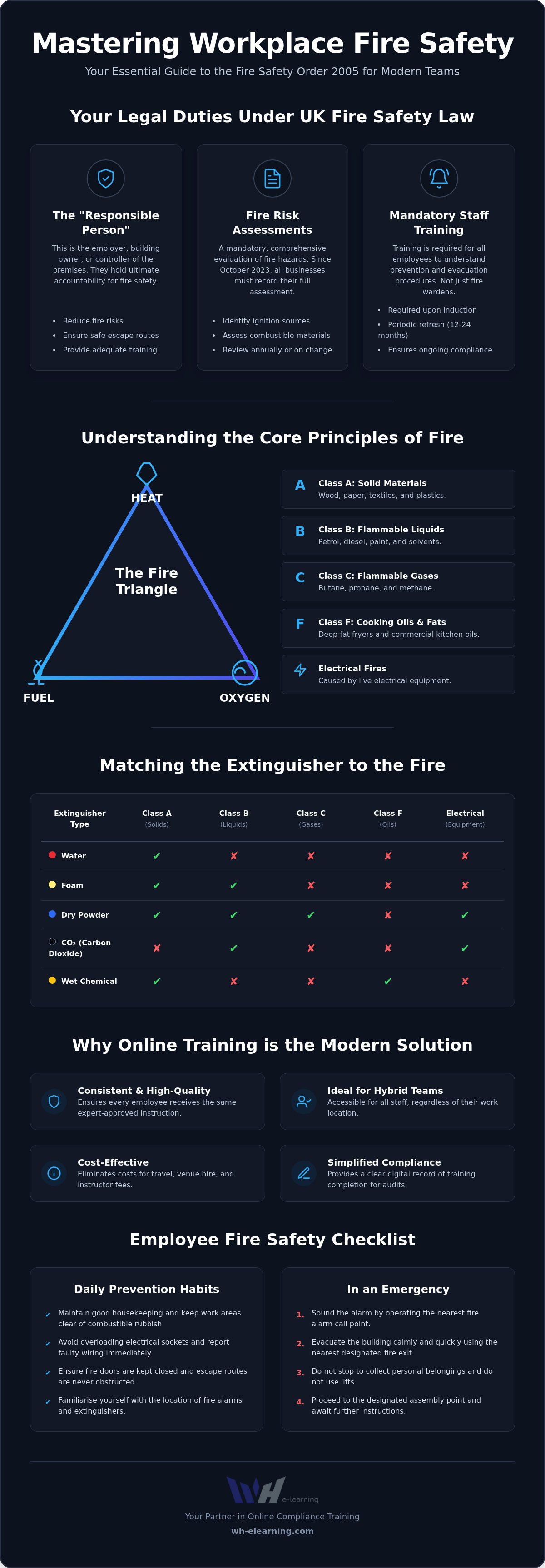
Every effective safety strategy starts with a comprehensive fire risk assessment. This process involves identifying potential ignition sources, combustible materials, and anyone who might be particularly at risk, such as visitors or staff with disabilities. Since October 2023, the law requires all businesses to record their full fire risk assessment, regardless of the number of employees. You'll need to review this document annually or whenever there's a significant change to your building layout or work practices. Your assessment findings should directly influence your training. If your workplace has specific hazards, like chemical storage or industrial kitchens, your team's training must address those specific risks to remain valid and effective.
Staff training is a mandatory requirement for all employees. It's not enough to train a few fire wardens; every member of your team needs to understand basic prevention and evacuation procedures. Legally, this training must happen during induction when a new employee joins and should be repeated periodically. Most UK organisations find that a refresh every 12 to 24 months keeps safety protocols fresh and ensures that your business remains fully compliant with the latest 2026 standards.
The Core Components of an Effective Fire Safety Course
High-quality training does more than tick a box; it changes how staff perceive risks in their immediate environment. A comprehensive course provides the technical knowledge needed to react calmly under pressure. Using fire safety training online allows you to deliver this vital information in a consistent, engaging format across your entire organisation. This ensures that every team member, whether in the office or working remotely, understands their role in preventing disaster.
Fire Chemistry and Behaviour
Understanding how a fire starts is the first step toward stopping it. Fire spreads through three main methods: conduction through solid materials, convection through moving air or liquids, and radiation through electromagnetic waves. The Fire Triangle is a model representing the three essential elements required for a fire to ignite and sustain itself: heat, fuel, and oxygen. Early detection is vital. Smoke alarms and heat detectors provide the necessary seconds to initiate an evacuation before a small flame becomes an uncontrollable blaze.
Fires are categorised by the type of fuel involved, ranging from Class A (solids like wood or paper) to Class F (cooking oils and fats). Effective prevention relies on simple, daily habits. Good housekeeping prevents rubbish build-up, whilst regular electrical testing reduces the risk of faulty wiring. Strict smoking policies ensure that ignition sources are kept away from flammable materials at all times.
Identifying Fire Extinguisher Types
Not all extinguishers are created equal. Using the wrong one can be disastrous. For example, water should never be used on electrical or fat fires as it can lead to electrocution or explosive spread. You must be able to identify extinguishers by their colour-coded labels: red for water, cream for foam, black for CO2, and blue for dry powder. If you're looking to upgrade your team's knowledge, exploring accredited health and safety training courses is an excellent place to start.
When using an extinguisher, remember the PASS method: Pull the pin, Aim at the base of the fire, Squeeze the handle, and Sweep from side to side. However, firefighting equipment is a secondary line of defence. The primary goal is always a safe evacuation. Your training must cover specific escape routes, the location of assembly points, and the distinct roles of fire wardens. Everyone should know exactly where to go the moment the alarm sounds, ensuring a swift and orderly exit.
Evaluating Online vs Face-to-Face Training: A Decision Checklist
Selecting the right delivery method for your team depends on your specific workplace risks and the distribution of your staff. Traditional classroom sessions were once the only option, but they often come with significant logistical hurdles. Organising a single date that suits everyone is nearly impossible in a hybrid world. Choosing fire safety training online removes these obstacles, allowing your team to complete their requirements at a time that fits their schedule. It's a frictionless way to ensure no one is left behind.
From a financial perspective, e-learning offers clear advantages. You eliminate the costs of venue hire, instructor travel, and the lost productivity associated with taking an entire department offline for half a day. Instead, you benefit from a centralised system where progress is tracked automatically. This digital trail is far more reliable than manual attendance sheets, providing instant proof of compliance during an audit or inspection. It's about replacing administrative stress with a streamlined, reliable process.
When Online Training is the Superior Choice
Digital platforms are ideal for delivering the theoretical knowledge every employee needs. This includes understanding fire classifications and evacuation protocols. To support a diverse workforce, you can utilise multi-language e-learning courses, ensuring that every team member understands the life-saving information provided. Video-based modules help reduce "training fatigue" by replacing dense text with engaging, visual storytelling. This method ensures every person receives the same high-standard message without the variability of different human instructors.
The Role of Practical, In-House Sessions
Whilst digital learning covers the essentials, some high-risk roles benefit from hands-on experience. For example, fire wardens may need to physically handle an extinguisher to build confidence. Many organisations now opt for a blended approach, combining the efficiency of e-learning with targeted in-house health and safety training for practical skills. This allows you to tailor physical drills to your specific building layout, such as practising the use of evacuation chairs or navigating complex stairwells. By using fire safety training online for the theory and in-person sessions for the practical, you create a robust safety culture that is both legally compliant and practically effective.
The Employee Fire Safety Checklist: Essential Knowledge for 2026
Fire safety isn't just about annual certificates or high-level risk assessments. It's about the choices your team makes every single day. Whilst the Responsible Person handles the legal framework, every employee acts as a frontline defender against potential hazards. Practical knowledge is what saves lives when seconds count. Using fire safety training online ensures these protocols remain fresh in everyone's mind without disrupting the working day. It turns abstract safety rules into actionable habits that protect your entire workforce.
Most workplace fires are entirely preventable. It's often the small oversights, such as a frayed cable or a propped-open fire door, that lead to disaster. Encouraging a culture of "see it, sort it" is the most effective way to keep your building safe. When staff feel empowered to flag a blocked exit or an overloaded socket, the risk of an incident drops significantly. This proactive mindset is the hallmark of a modern, safety-conscious organisation.
Daily Fire Prevention Checklist
- Are fire doors kept closed and never propped open? Fire doors are designed to resist flames and smoke for a specific period, but they only work if they're shut.
- Is there a clear 1-metre space around all heaters and electrical hubs? Combustible materials like paper or coats should never be left near heat sources.
- Are waste materials disposed of correctly to avoid fuel build-up? Regular clearing of cardboard and rubbish removes the fuel a fire needs to grow.
- Are all non-essential electrical items switched off at the wall? Reducing the number of live circuits overnight lowers the chance of an electrical fault starting a fire.
Emergency Response Checklist
When a fire is discovered, there's no time to read a manual. Immediate action is required. You should shout "Fire" to alert others and activate the nearest manual call point immediately. If you encounter smoke, stay low where the air is cleaner. Never use lifts during an alarm; always take the stairs. If you have visitors on-site, they are your responsibility. Guide them safely to the nearest exit and stay with them until you reach the assembly point.
- Do you know the location of the nearest manual call point? You should be able to find one within seconds of spotting a flame.
- Can you identify your primary and secondary escape routes whilst in the dark? Power cuts often accompany fires, making familiar corridors look different.
- Do you understand the specific alarm signals used in your building? Some premises use "staged" alarms that require different actions depending on the sound.
Reaching the assembly point isn't the end of the process. You must stay in your designated area until you're accounted for. Reporting to your fire warden ensures that emergency services don't risk lives searching for someone who is already safe. To equip your team with these essential skills, you can enrol your staff in accredited fire safety training today. This simple step ensures your team is ready for any emergency.
How to Implement Online Fire Safety Training for Your Team
Moving from a manual compliance system to a digital one requires a strategic approach to ensure no employee is left behind. Your first step is selecting an accredited provider that adheres strictly to UK standards. This choice guarantees that the certificates your team earns are recognised by insurers and fire authorities alike. Once you've selected a partner, establish clear deadlines for course completion. Setting a firm window, such as thirty days from enrolment, creates a sense of priority and prevents training from becoming a forgotten task at the bottom of a to-do list. Implementing fire safety training online is the most effective way to standardise your safety culture across various departments and locations.
Modern training platforms offer administrative portals that act as your central command centre. You can use these tools to track progress in real-time and identify any gaps in your organisation's compliance. Instead of chasing individuals for paper certificates, you can download comprehensive reports at the touch of a button. This level of visibility is essential for the Responsible Person, providing the documented evidence needed during a fire service inspection. Fire safety is most effective when integrated into your broader workplace safety training courses, creating a cohesive narrative of care and responsibility throughout the business.
Managing Bulk Enrolments for Large Teams
Organisations with a high headcount benefit significantly from corporate licensing models. These models reduce the per-head cost and simplify the administrative burden of managing hundreds of learners. You can easily assign different modules based on specific risk levels; for instance, giving general staff a foundational course whilst providing fire wardens with more intensive training. Automated reminders are a vital feature here. They handle the heavy lifting of notifying staff when their annual or biennial certificate renewals are due, ensuring your compliance never expires.
Ensuring High Engagement and Retention
Training only works if the information is actually retained. Video-based fire safety training online consistently outperforms text-heavy slides because it uses visual storytelling to illustrate hazards and responses. This format captures attention and makes complex procedures easier to remember during an actual emergency. For businesses with a diverse workforce, machine translation into 25+ languages ensures that every team member receives life-saving information in a language they fully understand. Encouraging a "safety-first" culture through regular internal updates and discussions further reinforces the lessons learned during the digital modules, making safety a natural part of the daily routine.
Securing Your Workplace for 2026 and Beyond
Mastering your legal duties under the Regulatory Reform (Fire Safety) Order 2005 doesn't have to be a source of administrative stress. By focusing on daily prevention habits and utilising modern tracking tools, you turn complex legislation into a manageable, frictionless process. We've explored how fire safety training online provides the consistency and flexibility needed for today's distributed workforces, ensuring every team member is prepared for an emergency. This digital approach replaces outdated tick-box exercises with a genuine culture of safety and awareness.
Building a safer working environment starts with choosing a partner that understands the high standards required for UK compliance. Our platform offers over 100 workplace compliance courses, all accredited by major safety bodies. With engaging video-based learning and machine translation into 25+ languages, we make professional growth accessible to every member of your organisation. You now have the roadmap to simplify your legal obligations whilst protecting your most valuable assets.
Ensure your team is compliant with our accredited Fire Safety Training Online and take the first step toward a more secure, empowered workplace today. You've got the tools to lead your team toward a safer future with quiet confidence.
Frequently Asked Questions
Is fire safety training online legally sufficient in the UK?
Yes, online training is a legally recognised method for meeting your obligations under the Regulatory Reform (Fire Safety) Order 2005. It's highly effective for delivering the essential theoretical knowledge every employee needs. To ensure full compliance, you must supplement this digital learning with site-specific information, such as the location of your building's fire exits and assembly points. Using accredited fire safety training online ensures your team receives high-quality, standardised instruction that satisfies UK fire authorities.
How often do employees need to refresh their fire safety training?
Employees typically need to refresh their training every 12 to 24 months to maintain high safety standards. Whilst the law doesn't specify a fixed expiry date, annual refreshers are considered best practice in most UK industries. You should also provide additional training if your workplace layout changes, if you introduce new hazardous materials, or if an employee's safety responsibilities increase. Regular updates ensure that emergency protocols remain fresh and that your organisation stays compliant with current 2026 standards.
Does every employee need to be a certified fire warden?
No, not every staff member needs to be a fire warden, but you must have an adequate number of trained individuals to cover your premises. The exact number depends on your fire risk assessment, the size of your building, and the complexity of your operations. Every employee requires basic fire safety awareness; however, fire wardens need more intensive instruction on evacuation management and equipment. Balancing foundational fire safety training online for all staff with specialist warden roles ensures comprehensive protection.
Can fire safety training be completed on a mobile device?
Yes, modern e-learning platforms are designed to be fully responsive across all devices, including smartphones and tablets. This flexibility is particularly useful for remote workers or staff who don't have regular access to a desktop computer. Employees can complete their modules during quiet periods or whilst on the move, which significantly improves completion rates. This accessibility removes the traditional barriers to training, making it easier for you to maintain a fully compliant and safe workforce.
What is the difference between IOSH training and basic fire safety courses?
Basic fire safety courses focus specifically on fire chemistry, prevention, and evacuation procedures. In contrast, IOSH training, such as Managing Safely, provides a broader overview of health and safety management, including risk assessment and legal accountability across various hazards. Whilst a basic course ensures every employee knows what to do during a fire, IOSH training equips managers with the skills to oversee an entire safety strategy. Both are essential components of a robust corporate compliance programme.
How do I prove my organisation is compliant during a fire service inspection?
You can prove compliance by presenting a well-maintained fire safety logbook and up-to-date training records. Digital administrative portals make this process effortless by allowing you to generate instant reports showing which employees have completed their courses. These records should include the date of training, the names of the participants, and copies of their accredited certificates. Having this information readily available demonstrates to inspectors that you take your legal responsibilities seriously and have a proactive safety culture.
Are there specific fire safety requirements for remote or home-based workers?
Employers still hold a duty of care for remote and home-based workers under UK health and safety law. Whilst you aren't responsible for the physical structure of an employee's home, you must ensure they understand how to work safely. This includes providing guidance on electrical safety, such as not overloading sockets, and ensuring they have a clear escape plan. Digital modules are the most practical way to deliver this vital information to a distributed team without requiring them to visit a central office.
What should be included in a basic fire safety induction for new starters?
A new starter's fire safety induction must cover the immediate essentials for their specific location. This includes the sound of the fire alarm, the location of all primary and secondary escape routes, and the designated assembly point. You should also introduce them to the fire wardens and explain how to report a fire. Supplementing this site-specific tour with a foundational online module ensures they also understand the broader principles of fire prevention and the chemistry of fire from day one.


