

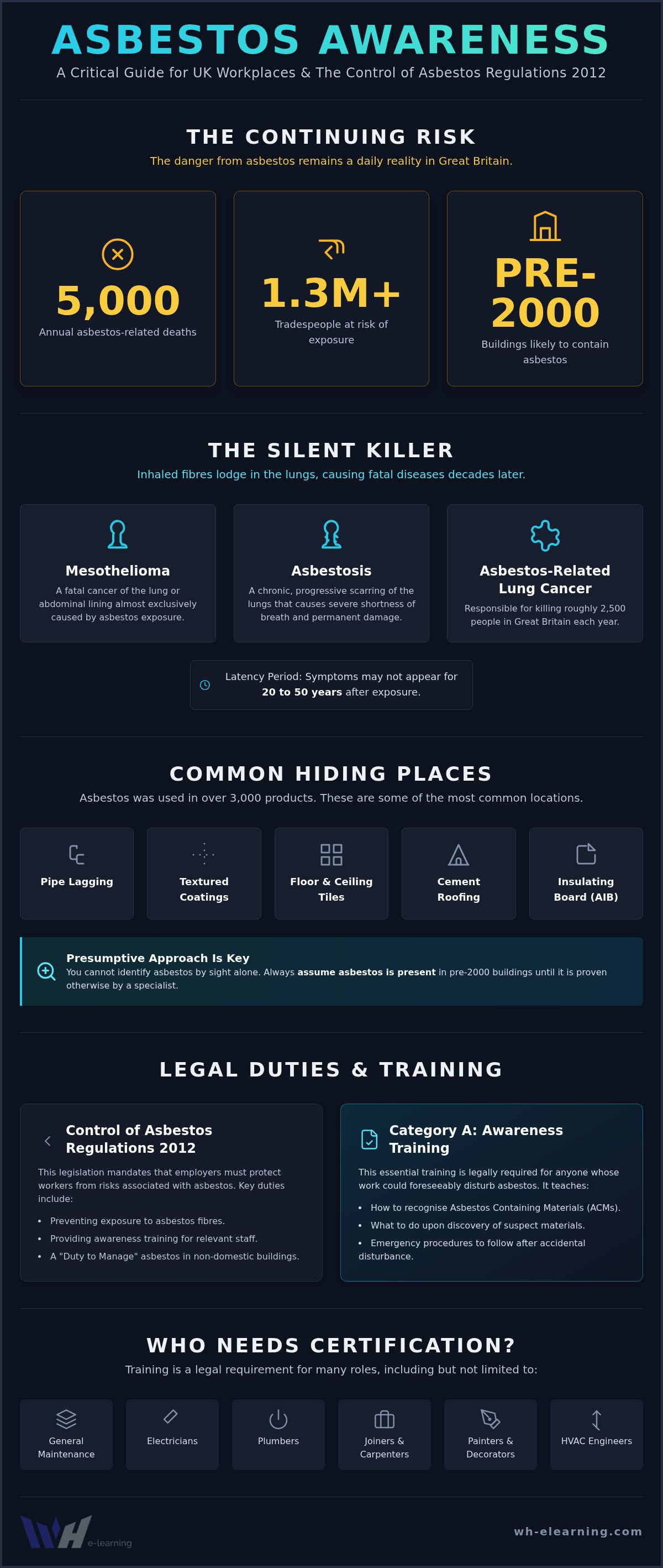
Did you know that approximately 5,000 asbestos-related deaths still occur annually in Great Britain? Even though the substance was banned decades ago, the risk remains a daily reality for over 1.3 million tradespeople working in buildings constructed before 2000. Securing your team's safety starts with a high-quality asbestos awareness online course that meets the rigorous standards of the Control of Asbestos Regulations 2012.
We understand that navigating health and safety requirements can feel overwhelming. You want to protect your staff and avoid the heavy HSE fines associated with non-compliance, but the confusion between training categories and the difficulty of tracking multi-language teams often creates friction. It's a challenge many modern organisations face whilst trying to maintain productivity and high standards.
This guide provides everything you need to secure accredited certification and manage your legal duties with total confidence. We'll break down the differences between Category A, B, and C training and show you a cost-effective way to train your entire workforce without any operational downtime. By the end, you'll have a clear roadmap for achieving seamless compliance in 2026.
Key Takeaways
- Master the legal requirements of the Control of Asbestos Regulations 2012 to ensure your organisation remains fully compliant with current HSE standards.
- Discover how an accredited asbestos awareness online course provides the essential Category A training required for tradespeople and maintenance staff who might encounter hazardous materials.
- Explore the critical components of a standard awareness syllabus, including the life-saving emergency procedures that every worker should know before entering a pre-2000 building.
- Choose the most effective training methods by comparing traditional text-based learning with modern, video-driven programmes that improve knowledge retention and engagement.
- Simplify compliance tracking for diverse teams with flexible, multi-language training solutions designed to streamline health and safety management across your entire workforce.
Understanding Asbestos and Why Awareness Training is Mandatory
Asbestos is a naturally occurring mineral that was once the backbone of British construction. Prized for its heat resistance and durability, it was used in everything from insulation to roofing until its final ban in 1999. If you're wondering, What is Asbestos?, it's a fibrous silicate that remains present in millions of UK homes and workplaces today. Because of this legacy, anyone entering a building constructed before 2000 needs an asbestos awareness online course to recognise potential hazards before they disturb them.
It's often called the "silent killer" for a reason. Unlike many workplace hazards, asbestos doesn't cause immediate injury. Instead, its effects are delayed by decades. This long latency period means that exposure today might not manifest as illness for 20 to 50 years. This section fits into a wider strategy of workplace safety training courses designed to build a proactive safety culture. Awareness isn't just about ticking a box; it's about ensuring every member of your team returns home safely at the end of their career.
The Health Risks: Why One Fibre is Too Many
When asbestos-containing materials (ACMs) are disturbed, they release microscopic fibres into the air. These fibres are so small they're invisible to the naked eye. Once inhaled, they lodge deep in the lung tissue where the body cannot break them down. This leads to three primary conditions:
- Mesothelioma: A fatal cancer of the lining of the lungs or abdomen, almost exclusively caused by asbestos exposure.
- Asbestosis: A chronic scarring of the lungs that causes severe shortness of breath and permanent damage.
- Asbestos-related lung cancer: A disease that kills roughly 2,500 people in Great Britain each year.
Exposure is cumulative. Every single fibre added to the lungs increases the risk of developing a life-altering disease. This is why tradespeople, who might encounter ACMs frequently, are at the highest risk. Protecting your workforce requires a clear understanding of where these risks hide and how to avoid them entirely.
Common Locations for Asbestos in UK Buildings
You can't identify asbestos by sight alone. It was frequently mixed with other materials, meaning a plain-looking wall or ceiling could hide a lethal hazard. This uncertainty is why an asbestos awareness online course emphasises a "presumptive" approach. If you don't know for sure, you must assume it's asbestos. Common hiding places include:
- Lagging: Thermal insulation found on old pipes and boilers.
- Textured coatings: Often known by the brand name Artex, used extensively on ceilings and walls.
- Floor tiles: Vinyl tiles often contain asbestos in the material or the bitumen adhesive underneath.
- Cement roofing: Corrugated sheets frequently found on garages or industrial sheds.
- AIB (Asbestos Insulating Board): Used in partition walls, fireproofing, and ceiling tiles.
Whether you're working in a residential flat or a massive commercial warehouse, these materials remain a threat. Proper training ensures you know when to stop work and call in the experts. It's the only way to prevent accidental exposure and maintain a safe site.
The Legal Framework: Control of Asbestos Regulations 2012
The Control of Asbestos Regulations 2012 (CAR 2012) serves as the primary legislation governing how asbestos is managed in Great Britain. This framework doesn't just suggest safety measures; it mandates them. It's designed to protect everyone from tradespeople to office workers by ensuring that asbestos is identified, recorded, and handled with extreme caution. The Health and Safety Executive (HSE) remains the rigorous enforcer of these standards, conducting regular inspections to ensure workplaces don't become hazardous zones.
A central pillar of this legislation is the "Duty to Manage" asbestos in non-domestic premises. If you're responsible for the maintenance or repair of a commercial building, you're likely the "duty holder." This role requires you to take reasonable steps to find out if there are materials containing asbestos, assess the risk, and create a detailed plan to manage that risk. Ignoring this duty isn't just a safety failure; it's a significant legal liability that can halt operations instantly.
Regulation 10 of CAR 2012 is particularly vital for workforce management. It explicitly requires employers to provide "adequate information, instruction and training" to any employee who might be exposed to asbestos fibres. For many, an asbestos awareness online course is the most efficient way to meet this requirement. The HSE provides clear guidance on asbestos awareness training, specifying that it must cover the properties of asbestos, its health effects, and what to do in an emergency. Securing this training ensures your team can recognise risks before they become accidents.
Employer Responsibilities and Liability
Your legal obligation as an employer is absolute. You must ensure that anyone liable to disturb asbestos during their work receives the correct level of training. Failing to provide this can lead to severe consequences, including unlimited fines and even imprisonment for serious breaches. It's not enough to simply provide the training; you must also maintain clear, up-to-date records. During an HSE inspection, being able to produce a valid certificate from an asbestos awareness online course for every staff member is your best defence against claims of negligence.
The 2026 Compliance Landscape
As of August 2026, the regulatory focus has shifted toward stricter enforcement and the digitisation of safety records. Following the HSE's 2026 consultation, there's a higher expectation for duty holders to maintain live, digital asbestos registers that are easily accessible to contractors. Whilst certificates don't have a legal expiry date, annual refresher training is the industry standard to ensure competency doesn't slip. For a broader look at staying ahead of these requirements, you can explore our mastering workplace compliance guide. Staying current with these changes helps you avoid the friction of sudden regulatory updates. You might also find our range of health and safety training courses useful for building a robust compliance strategy.
Identifying At-Risk Roles: Who Needs an Asbestos Awareness Certificate?
Category A training is specifically designed for workers who don't intend to work with asbestos but whose activities could lead to accidental disturbance. This is a strict requirement under the Control of Asbestos Regulations 2012. If your job involves entering building voids, drilling into walls, or removing floor tiles in older premises, you're legally required to hold a valid certificate. An asbestos awareness online course provides the foundational knowledge to spot these risks before a project begins.
It's a common misconception that only manual labourers need this training. In reality, supervisors and managers who oversee work in pre-2000 buildings also require it. They must be able to identify when a site needs a specialist survey or when a plan of work is insufficient. Regarding legal duties, the responsibility is clear. Employers must provide and pay for the training of their staff. Self-employed contractors, however, are responsible for their own compliance and must ensure they've completed a recognised asbestos awareness online course to work on most commercial sites.
Construction and Maintenance Trades
Plumbers, electricians, and joiners are frequently on the frontline of asbestos exposure. Often, it's the "minor works" like installing a new radiator or running a single cable that leads to the most dangerous accidental disturbances. These small tasks often bypass the rigorous planning of larger projects, yet they can release thousands of lethal fibres if an ACM is punctured. Painters and decorators also face risks when sanding down textured coatings or old woodwork. For roofers and demolition workers, the danger is even more pronounced, as they often deal with large volumes of cement roofing or fireproofing boards that have become brittle over time.
Facilities Management and Property Surveyors
Compliance doesn't stop at the toolbox. Architects and building surveyors need a high level of awareness during the design and inspection phases to ensure safety is built into the project from the start. Facilities managers are also key players in maintaining a safe environment. Whilst they might be more focused on day-to-day operations or DSE assessment training online for office staff, they must also manage the risks hidden in ceiling voids and service risers. IT cable installers and fire alarm technicians are particularly vulnerable here, as their work often requires them to reach into uninspected areas where old lagging or insulation board may be present.
What an Accredited Online Asbestos Awareness Course Covers
An accredited asbestos awareness online course isn't just a collection of slides; it's a structured educational programme designed to meet specific regulatory standards. To be truly effective, the content must align with the Health and Safety Executive's expectations for Category A training. This ensures that every learner walks away with a practical understanding of how to protect themselves and their colleagues from accidental exposure. Modern training uses video-based modules to replace dense blocks of text, making complex safety information much easier to retain for busy professionals.
The HSE-Aligned Syllabus
A comprehensive awareness programme is typically divided into three core modules that build a complete picture of the risk. These modules provide the essential knowledge required to work safely in older building environments:
- Module 1: Properties and health effects of asbestos fibres. This covers the physical nature of the mineral and why its microscopic structure is so damaging to human health.
- Module 2: Types, uses, and likely occurrence of ACMs. Learners discover where asbestos was commonly used, from industrial lagging to domestic floor tiles, and how to identify high-risk areas.
- Module 3: Avoiding the risks and following safe work protocols. This practical module explains the "presumptive" approach and the legal requirement to stop work if suspicious materials are found.
The "Emergency Procedures" module is arguably the most critical part of the entire course. It provides a clear, step-by-step guide on what to do if you accidentally disturb a material you suspect contains asbestos. Knowing how to secure the area and report the incident correctly can prevent a minor mistake from turning into a major health crisis. At the end of the modules, a final online exam validates the learner's knowledge. This assessment ensures that everyone who receives a certificate has genuinely understood the life-saving information provided.
Category A vs. Category B and C Training
It's vital to understand that an asbestos awareness online course covers Category A training only. This level is strictly for those who might encounter asbestos but are not intended to work with it. If your job involves any planned disturbance of asbestos, you'll require more advanced training that cannot be completed entirely online.
Category B training is required for non-licensable work. This includes tasks where you might intentionally disturb asbestos, such as removing floor tiles or drilling into asbestos cement. This level requires practical, face-to-face elements to ensure you can use personal protective equipment (PPE) and cleaning tools correctly. Category C training is the most advanced level, reserved for licensable work. This involves high-risk materials like asbestos lagging or insulation board and is conducted by specialist, highly regulated contractors.
Starting with Category A awareness is the foundation of every safety strategy. If you're ready to ensure your team meets these essential standards, you can browse our health and safety training courses to find the right fit for your organisation.
Choosing the Right Online Training for Your Organisation
Selecting an asbestos awareness online course requires looking beyond the initial cost. You need a partner that offers more than just a digital tick-box. High-quality training should be video-based rather than a series of text-heavy "page-turners" to ensure your team stays engaged and actually retains the life-saving information. This modern approach reduces the friction of learning and makes complex safety protocols much easier to digest for a busy workforce. When you choose a programme that leads with active, visual content, you're investing in a safer site environment rather than just a certificate.
For companies managing 50 or more employees, bulk licensing is a vital feature. It simplifies the entire procurement process and ensures that every new hire can be trained immediately without the need for individual transactions. This scalability is a key part of maintaining a robust safety culture across a growing business. It allows you to roll out essential training across different departments or sites simultaneously, ensuring that no one slips through the cracks of your compliance strategy.
Accessibility and Multi-Language Learning
Ensuring every worker truly understands the risks of asbestos is both a legal and moral obligation. When safety training is delivered in a worker’s native language, the chance of misunderstanding critical emergency procedures drops significantly. At WH eLearning, we empower diverse teams by providing training that can be translated into over 25 languages. By using closed captions and professional translations, you create an inclusive environment where safety knowledge is accessible to everyone. This level of support is essential for multi-language teams where clear communication can literally save lives.
Tracking Progress and Certification
Managing compliance for large, mobile teams shouldn't be a manual headache. An effective platform provides an administrative dashboard that allows you to monitor staff progress in real-time. You can quickly see which employees have completed their modules and who might need a supportive nudge to finish. This visibility is crucial for maintaining high standards and staying prepared for any HSE inspections.
Instant digital certification is equally vital for modern operations. In 2026, site managers often require proof of competency before allowing access to a project. Having a verifiable certificate ready on any device ensures your team can start work without delay or administrative friction. For more strategic procurement tips, you can explore our business compliance e-learning guide. This solution-oriented approach ensures your investment in training translates into long-term professional growth and consistent workplace safety.
Securing Your Workplace Safety for 2026 and Beyond
Meeting the requirements of the Control of Asbestos Regulations 2012 doesn't have to be a source of organisational friction. By choosing a high-quality asbestos awareness online course, you're doing more than just avoiding HSE fines. You're building a culture of safety where every worker, regardless of their native language, understands how to identify and avoid the "silent killer." This proactive approach ensures your projects stay on track whilst keeping your workforce protected.
Our platform makes this transition seamless. We provide video-based learning for maximum retention, ensuring that life-saving protocols stick. With instant digital certification upon completion and availability in 25+ languages, your global teams can stay compliant without unnecessary downtime. Tracking your team's progress through a centralised dashboard removes the guesswork from health and safety management, allowing you to focus on your core business operations.
Take the next step in protecting your workforce and streamlining your compliance. Enrol in our Accredited Asbestos Awareness Online Course Today and gain the peace of mind that comes with expert-led, recognised training. We're here to help your organisation grow safely and confidently.
Frequently Asked Questions
Is an asbestos awareness online course legally sufficient in the UK?
Yes, an asbestos awareness online course is legally sufficient for meeting Category A training requirements under Regulation 10 of the Control of Asbestos Regulations 2012. This level of training is designed for workers who are not intended to work with asbestos but might encounter it during their daily activities. It provides the essential information needed to identify hazards and avoid accidental disturbance whilst ensuring your organisation remains compliant with HSE standards.
How long does an asbestos awareness certificate last?
There is no specific legal expiry date for an asbestos awareness certificate under UK law. However, the Health and Safety Executive (HSE) strongly recommends that workers receive regular refresher training to keep their knowledge current. Industry best practice in 2026 suggests renewing your training every 12 months. This ensures that tradespeople remain alert to the risks and stay updated on any minor changes to safety guidance or reporting procedures.
Who is legally required to have asbestos awareness training?
Any employee whose work could potentially disturb the fabric of a building constructed or refurbished before the year 2000 is legally required to have this training. This includes a wide range of professions such as electricians, plumbers, joiners, and painters. It also extends to supervisors and maintenance staff who manage these environments. If there is a foreseeable risk of asbestos exposure during routine work, the employer must provide adequate training by law.
Does asbestos awareness training allow me to remove asbestos?
No, awareness training does not qualify you to remove or even intentionally disturb any asbestos-containing materials. This course is strictly for "Category A" awareness, which focuses on avoidance and safety. If your role requires you to handle non-licensed asbestos, you need Category B training. For high-risk, licensable work, you must complete Category C specialist training. Attempting to remove asbestos with only an awareness certificate is a serious breach of health and safety law.
What is the difference between UKATA, IATP, and other asbestos accreditations?
UKATA and IATP are independent trade associations that audit and monitor training providers to ensure their courses meet the HSE syllabus. Whilst the HSE does not "approve" individual training companies, they do set the standards that these bodies follow. Choosing an accredited asbestos awareness online course ensures the content is technically accurate and legally robust. Most major UK contractors will require proof of accreditation from a recognised body before allowing workers on a site.
Can I take the asbestos awareness course on a mobile phone?
Modern e-learning platforms are designed with a mobile-first approach, allowing your team to complete their training on any smartphone or tablet. This flexibility is ideal for busy tradespeople who need to fit compliance training around their site work. Video-based modules are particularly effective on mobile devices, providing a seamless learning experience without the need for a desktop computer. This ensures that every worker can access life-saving information exactly when and where they need it.
What should I do if I accidentally disturb asbestos during work?
If you suspect you have disturbed asbestos, you must stop work immediately and evacuate the area. Do not attempt to clean up the debris or use a standard vacuum cleaner, as this will spread lethal fibres into the air. Seal the room if possible and report the incident to your supervisor or the building's duty holder. They will then follow the emergency procedures outlined in your training, which typically involves air testing and professional decontamination by specialists.
How much does an online asbestos awareness course cost for a team?
The cost for a team depends on whether you are purchasing individual enrolments or a corporate training license. For organisations with a large or diverse workforce, corporate licensing is often the most efficient choice. This model typically provides bulk access to the course library and includes administrative tools for tracking progress. By using a scalable licensing system, businesses can ensure that all staff members are trained and certified whilst maintaining a cost-effective approach to health and safety compliance.


