

Could a single hour of oversight really cost your business hundreds of pounds before a legal fine is even issued? With the HSE Fee for Intervention now reaching £188 per hour for material breaches, the financial reality of non-compliance is steeper than ever. You likely already know that keeping your team safe is the priority, yet the complex jargon of the 1998 rules makes it difficult to find effective PUWER regulations training online that actually sticks.
It's frustrating to manage safety when tracking certifications for large or remote teams feels like an endless administrative mountain. This 2026 guide is designed to remove those obstacles. We'll show you how to master work equipment safety and ensure your organisation meets the latest HSE standards through a streamlined, digital approach. You'll learn how to simplify staff certifications, reduce workplace accidents, and maintain a robust audit trail that protects both your people and your bottom line.
Key Takeaways
- Understand how the 1998 regulations apply to your modern workplace, covering everything from simple hand tools to complex industrial machinery.
- Master the legal requirements for equipment maintenance and inspections to ensure every piece of kit is safe and documented correctly for HSE audits.
- Discover how PUWER regulations training online provides a faster, more engaging way for your team to retain critical safety information compared to traditional methods.
- Learn how to audit your current equipment and tailor safety training to specific roles, ensuring operators, supervisors, and managers all meet their legal duties.
- Scale your safety standards across international teams with video-based modules and multilingual support that removes language barriers for a diverse workforce.
Understanding PUWER Regulations: Why Professional Training is Essential in 2026
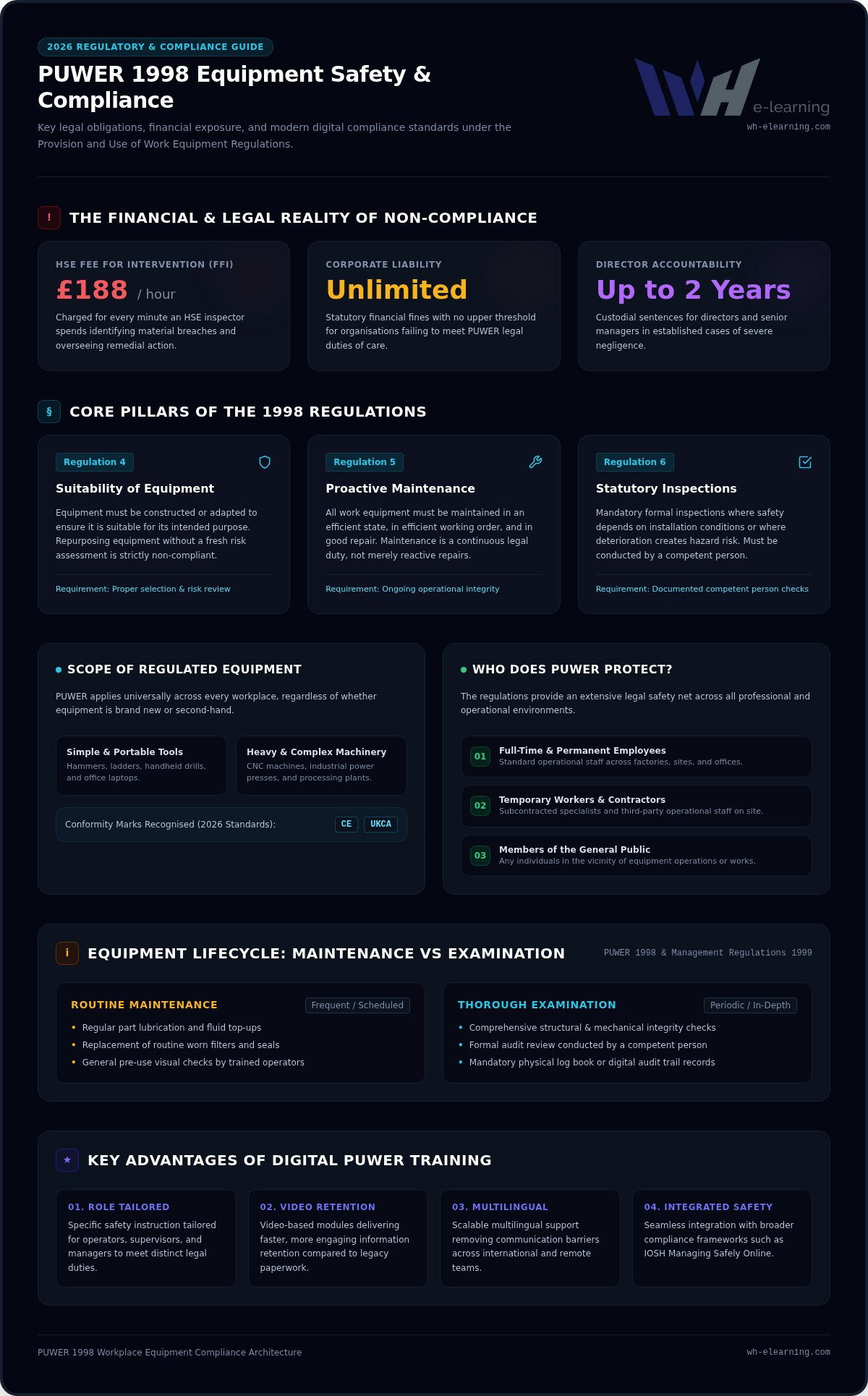
Safety standards don't stand still. The Provision and Use of Work Equipment Regulations 1998, known as PUWER, remains the definitive legal framework for equipment safety in the UK. Whilst the core legislation is established, the cost of getting it wrong in 2026 has never been higher. The Health and Safety Executive (HSE) now operates a Fee for Intervention (FFI) rate of £188 per hour. This means that if an inspector finds a material breach, your organisation pays for every minute they spend identifying the fault and overseeing the fix. Choosing high-quality PUWER regulations training online is the most efficient way to prevent these avoidable costs.
Work equipment is a broad category that covers almost everything your team uses to get the job done. It includes heavy machinery like CNC machines and power presses, but it also encompasses smaller items like hammers, ladders, and even office laptops. The regulations apply whether the kit is brand new or second-hand. Employers and the self-employed carry a strict legal duty of care to ensure this equipment is safe, maintained, and operated by competent people. Failing to meet these duties can result in unlimited fines and, in cases of severe negligence, custodial sentences of up to two years for directors.
Effective safety management goes beyond simple tick-box exercises. Leading organisations now link their equipment safety protocols to broader frameworks like IOSH Managing Safely Online. This integrated approach ensures that compliance isn't an isolated task but a core part of your business culture. By training your staff to recognise risks before they lead to accidents, you protect your people and your reputation simultaneously.
The Scope of Work Equipment Under PUWER
PUWER applies to every workplace, from bustling construction sites to quiet home offices. The law is clear: equipment must be suitable for its intended use. You can't simply repurpose a tool for a task it wasn't designed for without a new risk assessment. When you introduce new or second-hand machinery into your workflow, you're responsible for verifying it meets 2026 safety standards. This includes checking for the CE or UKCA markings, which the UK government has confirmed will continue to be recognised as baseline proof of manufacturer conformity.
Who Does PUWER Protect?
The regulations provide a safety net for everyone in your professional environment. This includes full-time employees, temporary contractors, and even members of the public who might be near your operations. Under Regulation 4, an employer's primary responsibility is to ensure that work equipment is constructed or adapted to be suitable for the purpose for which it is used or provided. By providing clear instructions and adequate training, you empower your workforce to operate safely whilst reducing the likelihood of a major incident.
The Core Pillars of Equipment Safety and Maintenance
Compliance isn't just about owning the right tools; it's about how you manage them over their entire lifecycle. The core of the 1998 regulations rests on Regulations 5 and 6, which work alongside the Management of Health and Safety at Work Regulations 1999. These rules require employers to identify risks and implement controls. By investing in PUWER regulations training online, your team learns to recognise that maintenance is a proactive duty, not a reactive fix after a breakdown.
Regulation 5 mandates that all work equipment is kept in an efficient state, in efficient working order, and in good repair. This applies to everything from a handheld drill to a complex power press. Regulation 6 takes this further by requiring formal inspections where safety depends on installation conditions or where deterioration could result in dangerous situations. Detailed HSE guidance on PUWER compliance emphasises that these inspections must be carried out by a competent person who has the necessary knowledge and experience.
Maintenance and Inspection Schedules
A clear distinction exists between routine maintenance and thorough examinations. Routine tasks might include oiling parts or replacing worn filters, whilst thorough examinations are periodic, in-depth assessments of a machine's integrity. Keeping a digital log book or a physical record of these actions is essential for demonstrating compliance during an audit. This systematic approach is a key component of broader workplace compliance training, ensuring that safety records are always inspection-ready.
Suitability and Risk Assessment
Assessing suitability involves checking if equipment is fit for its specific environment. A forklift used in a narrow warehouse requires different safety features than one used on a construction site. Operators play a vital role here; they are the first line of defence. A quick pre-use check can identify frayed cables or missing guards before they cause an injury.
Your risk assessments must also account for foreseeable misuse. People often take shortcuts, such as using a screwdriver as a chisel or standing on a swivel chair to reach a high shelf. Training helps staff understand why these behaviours are dangerous. For high-risk items like mobile work equipment, the stakes are even higher. Developing a culture of safety starts with ensuring every staff member has access to high-quality online compliance resources that empower them to work safely every day.
Evaluating Online PUWER Training: Efficiency, Retention, and ROI
Transitioning from paper-based logs to a digital safety strategy requires the right tools. When you choose PUWER regulations training online, you remove the logistical hurdles that often stall traditional classroom learning. Traditional sessions usually involve venue hire, travel costs, and the loss of entire working days for your team. By contrast, online modules are ready for immediate deployment. This allows you to meet the training duties specified in the UK Statutory Instrument 1998 No. 2306 without disrupting your operational flow.
Consistency is a major challenge for organisations with multiple sites or remote teams. Different trainers may emphasise different points; this leads to gaps in compliance. E-learning provides a unified message so that every employee receives the exact same high standard of instruction. For large workforces, the cost-saving potential of corporate training licences is substantial. Instead of paying per-head for expensive day rates, you can leverage bulk licensing to reduce the cost per user whilst maintaining a robust audit trail. This makes it easier to track progress through a central corporate portal.
Why Video-Based Learning Wins for Safety
Technical safety instructions are often difficult to grasp through text alone. Video-based learning bridges this gap by providing clear, visual demonstrations of machinery guards and emergency stop procedures. This visual approach significantly improves retention compared to dry, text-heavy manuals. Key benefits include:
- Improved Retention: Visual demonstrations help operators remember critical safety steps more accurately than written guides.
- Greater Accessibility: Closed captions and machine translation into 25+ languages support a diverse workforce.
- Higher Engagement: Interactive video content removes the "boredom factor" typically associated with compliance.
Measuring Training Effectiveness and ROI
Proving that your team understands their responsibilities is just as important as the training itself. Digital assessments at the end of each module provide instant proof of competency. This data is invaluable during an HSE inspection. You also reduce downtime by allowing staff to complete their PUWER regulations training online during quiet periods or between tasks. For a deeper look at how to quantify these benefits, explore our business compliance e-learning guide. It provides the frameworks you need to track progress and justify your investment in safety.
How to Implement a PUWER Training Programme for Your Workforce
Building a robust safety culture begins with a clear plan. You cannot manage what you haven't identified, so start by conducting a thorough audit of all work equipment currently in use. This list should include everything from basic hand tools to complex industrial machinery. Once your inventory is complete, you can identify the different levels of training required across your team. Operators need specific safety instructions for daily use, whilst supervisors and managers require a broader understanding of their legal oversight duties. Selecting accredited PUWER regulations training online allows you to deliver this essential theoretical knowledge quickly and consistently.
Effective implementation requires more than just a one-off course. You must establish a recurring schedule for refresher training to ensure competency doesn't fade over time. Integrate these training records into your central safety management system to maintain a "single source of truth" for your organisation. This proactive approach ensures you are always ready for a regulatory visit, protecting your business from the administrative failures that often lead to HSE intervention.
Identifying the Competent Person
Regulation 6 is specific about the need for inspections by a competent person. In the context of PUWER, this is someone with enough technical and practical knowledge to detect defects and understand their significance. Whilst PUWER regulations training online provides the necessary theoretical foundation, you must supplement this with documented on-site practical assessments for high-risk machinery. It is also vital that your supervisors have the IOSH managing safely skills needed to oversee these inspections and manage the broader risks associated with equipment use.
Tracking and Documenting Compliance
Legal necessity dictates that you keep up-to-date training certificates for every staff member. Digital platforms make this simple by using automated reminders to alert you before a certification expires. This prevents gaps in your compliance that could prove costly during an audit. The HSE recovered upwards of £4.5 million through FFI charges in recent reporting cycles, often due to poor documentation. Prepare for an inspection by keeping a "compliance folder" that houses training records, maintenance logs, and risk assessments in one accessible place.
Ready to streamline your safety management? Explore our accredited Health and Safety Training Courses to ensure your team stays compliant and safe.
Accredited PUWER E-Learning with WH eLearning: Modern Solutions for Global Teams
WH eLearning understands that modern teams need flexibility. Our video-based PUWER module is designed for busy professionals who cannot afford to lose productive days to off-site seminars. By choosing PUWER regulations training online, you provide your staff with engaging, high-quality content that they can access from any device at a time that suits them. This accredited approach helps build a robust safety culture where every team member understands their personal responsibility for equipment safety. Our solution is built to reduce the friction often associated with mandatory compliance, replacing it with a feeling of empowerment and professional growth.
A major advantage of our platform is the ability to maintain high standards across a diverse workforce. We focus on removing the obstacles that prevent staff from fully engaging with safety material. By providing a seamless, high-quality experience, we help your organisation transition from simply meeting a requirement to fostering a genuine commitment to workplace safety. This long-term investment in your people is what separates industry leaders from those merely trying to avoid a fine.
In-House and Multi-Language Support
Language barriers can be a significant hurdle in health and safety compliance, particularly for diverse workforces. WH eLearning bridges this gap with machine translation into 25+ languages and clear closed captions. This ensures that non-native English speakers receive the same level of critical safety information as the rest of your team, removing any ambiguity that could lead to a workplace accident. For more information on how to scale your global training effectively, visit our pillar guide on multi-language e-learning courses. While our online modules cover the essential theory of the 1998 regulations, we also offer In-House Face-to-Face Training for organisations that require specialist practical assessments on-site to verify operational competence.
Getting Started with Your Training Licence
Managing a workforce of hundreds shouldn't be a logistical nightmare for your HR or safety departments. Our corporate licensing model is built for administrative ease, allowing you to enrol staff in seconds and track their progress through a dedicated, user-friendly portal. You can see at a glance who has completed their training and who needs a reminder before a certification expires. This level of visibility is vital for maintaining a state of constant readiness for HSE inspections. Once a module is finished, digital certificates are issued immediately, providing instant proof of compliance for your central records. Secure your workplace for 2026 by providing your team with the best PUWER regulations training online, ensuring your safety standards remain high whilst your administrative burden stays low.
Securing Your Workplace Safety for 2026 and Beyond
Achieving full compliance with the 1998 regulations doesn't have to be a source of administrative stress. By implementing structured PUWER regulations training online, you empower your team with the knowledge to identify risks before they become accidents. You've seen how digital tracking simplifies the management of certifications and how video-based learning ensures that safety procedures actually stick. This modern approach protects your people whilst shielding your organisation from the financial impact of HSE intervention fees.
It's time to move away from dry, text-heavy manuals and embrace a more engaging, scalable solution. Our training is accredited by leading industry bodies and available in over 25 languages; it's the trusted choice for global organisations that value workplace compliance. You can easily track progress and maintain a flawless audit trail through our central corporate portal. This ensures you are always ready for an inspection without the last-minute scramble for paperwork.
Browse our accredited health and safety training online and start your PUWER compliance journey today. We're here to help you build a safer, more efficient future for your entire workforce. Let's work together to make safety a seamless part of your daily routine.
Frequently Asked Questions
Is online PUWER training legally sufficient for my employees?
Online training is legally sufficient for meeting the theoretical requirements of Regulation 9. It ensures staff understand safety principles, risks, and legal duties. However, for complex or high-risk machinery, the HSE specifies that theoretical awareness should be supplemented by documented on-site practical assessments. This hybrid approach ensures operators are both knowledgeable and operationally competent, providing a robust defence during any regulatory inspection or audit of your safety management systems.
How often do staff need to undergo PUWER refresher training?
The regulations don't specify a fixed expiry date for certifications, but refresher training is essential to maintain competency. Most organisations schedule updates every three to five years as a matter of best practice. You should also provide immediate training if equipment changes, if an accident occurs, or if an employee's behaviour suggests they have forgotten key safety protocols. Automated reminders in your digital portal can help you track these renewals effortlessly across your entire workforce.
Does PUWER apply to equipment that employees bring from home?
PUWER applies to any equipment used for work, regardless of who owns it. If an employee uses their own tools or devices for business tasks, you as the employer are responsible for ensuring that equipment is safe and suitable for the intended use. You must include these items in your maintenance and inspection regimes. Discouraging the use of personal equipment is often the simplest way to maintain strict safety standards and consistent documentation.
What is the difference between PUWER and LOLER regulations?
PUWER is a broad regulation covering almost all work equipment, from hand tools to production lines. LOLER (Lifting Operations and Lifting Equipment Regulations) is a specific set of rules that applies only to equipment used for lifting or lowering loads, such as cranes, hoists, and passenger lifts. If a piece of machinery lifts loads, it must comply with both sets of regulations simultaneously to ensure full legal compliance and operator safety in the workplace.
Can I use one online course for all types of machinery in my workshop?
A comprehensive PUWER regulations training online course covers the fundamental legal duties, maintenance requirements, and safety principles applicable to all equipment. This provides a vital baseline for your entire team. However, highly specialised or dangerous machinery, such as power presses or CNC machines, will require additional specific instruction tailored to those unique risks. Combining a general accredited module with specific in-house practical sessions creates the most effective safety management programme for a diverse workshop.
What happens if an employee refuses to follow safety training instructions?
Under the Health and Safety at Work etc. Act 1974, employees have a legal duty to cooperate with their employer on safety matters. If a staff member refuses to follow the protocols taught in their training, it becomes a disciplinary issue. You should document all training and provide clear warnings. Consistent refusal not only puts the individual at risk but can also jeopardise the safety of their colleagues, making firm enforcement a necessity for any responsible business.
Does the PUWER regulation apply to office equipment like printers and PCs?
PUWER is all-encompassing and includes common office items such as printers, photocopiers, and desktop PCs. Whilst these items are generally lower risk than factory machinery, they still require basic visual inspections and must be maintained in a safe condition. Your safety audit should include all equipment used by staff, ensuring that even office-based teams are aware of basic electrical safety and the importance of reporting any defects immediately to their designated safety supervisor.
How long does a typical online PUWER training course take to complete?
A typical PUWER regulations training online module is designed for efficiency, usually taking between 45 and 90 minutes to complete. Because the learning is self-paced, employees can pause and resume the video-based content around their existing schedule. This modular approach ensures high engagement levels and allows for immediate digital assessment. Once the final test is passed, a certificate is issued instantly, providing your organisation with immediate proof of compliance and individual competency.


