

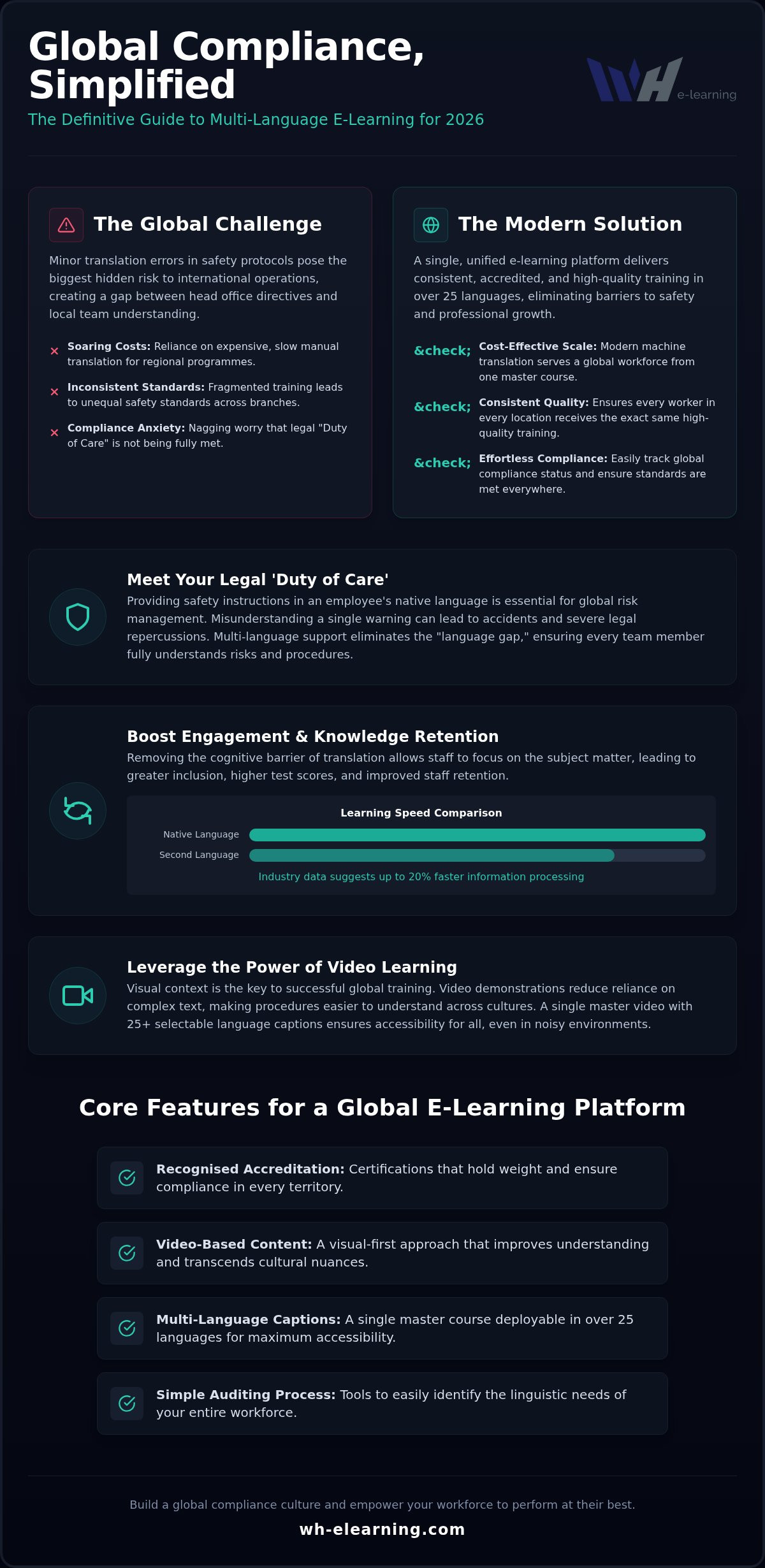
Could a minor translation error in your safety protocol be the biggest hidden risk to your international operations? For many global leaders, the gap between a head office directive and a local team's understanding is a constant source of anxiety. You likely feel the pressure of soaring costs for manual translation and the nagging worry that safety standards aren't being met equally across every regional branch. It's an exhausting challenge to maintain high standards whilst trying to implement multi-language e-learning courses that are often inconsistent or poorly localised.
We believe that language should never be a barrier to professional growth or workplace safety. This guide explores how modern digital training has become the definitive global resource for 2026, offering a path to consistent, accredited compliance in over 25 languages. You'll discover how to replace fragmented regional programmes with a single, efficient platform that delivers high-quality video learning and accredited certifications for all staff. We will preview the latest methods for tracking global compliance status effortlessly, ensuring your entire organisation stays protected and productive.
Key Takeaways
- Understand your legal "Duty of Care" and why providing safety instructions in an employee's native language is essential for global risk management.
- Discover the advantages of video-based content over text, as visual context significantly improves engagement and understanding across different cultures.
- Learn how to select multi-language e-learning courses that carry recognised accreditation to ensure your certifications hold weight in every territory.
- Master a simple auditing process to identify the linguistic needs of your workforce and build a consistent core library for global deployment.
- Explore how modern machine translation allows you to scale high-quality training to over 25 languages without the prohibitive costs of manual translation.
The Business Case for Multi-Language E-Learning Courses in 2026
Multi-language e-learning is the strategic delivery of identical educational content across various linguistic backgrounds. It isn't merely about translating text; it's about ensuring that a worker in London receives the exact same quality of safety training as a colleague in Madrid or Warsaw. This approach relies on established frameworks like Computer-Assisted Language Learning (CALL) to provide a structured, digital environment where complex information remains accessible to every employee. By implementing multi-language e-learning courses, your organisation builds a foundation of shared knowledge that transcends borders.
Meeting Legal Compliance and Duty of Care
Every employer carries a legal "Duty of Care" to protect their workforce. This responsibility is not met if critical safety instructions are provided only in English to staff who don't speak it as their first language. Misunderstanding a single warning can lead to catastrophic accidents and severe legal repercussions. Investing in comprehensive workplace compliance training is a vital step in avoiding litigation. Multi-language support ensures that every staff member, regardless of their native tongue, fully understands the risks and procedures associated with their role. This proactive approach eliminates the "language gap" that often leaves regional branches vulnerable to non-compliance issues.
Boosting Engagement and Knowledge Retention
Learners process information more effectively when it's delivered in their primary language. Removing the cognitive barrier of translation allows staff to focus entirely on the subject matter, leading to faster completion times and higher test scores. Some industry data suggests that learners process information up to 20% faster when studying in their native tongue. By utilising multi-language e-learning courses, you create a sense of inclusion that fosters a safer work environment and reduces workplace accidents amongst diverse teams. Localised content demonstrates that you value your employees' professional growth. When people feel heard and supported, they're more likely to stay with the company, directly improving staff retention rates.
Ultimately, developing a "Global Compliance Culture" serves as a powerful competitive advantage. It ensures that your high standards are maintained consistently across all territories. Companies that prioritise accessible, high-quality training are better positioned to scale quickly and safely in the global market. A unified training strategy doesn't just manage risk; it empowers your workforce to perform at their best, no matter where they are located.
How Modern E-Learning Localises Content for Global Teams
Scaling training across a global workforce used to require a choice between slow, expensive manual translation or low-quality, text-only slides. Modern multi-language e-learning courses have changed this dynamic by utilising scalable machine translation within a single, unified platform. Instead of managing dozens of different course versions, administrators can now deploy one master course with simple language toggles. This approach significantly reduces administrative overhead and ensures that every regional branch receives identical instruction without the traditional bespoke price tag. It's a seamless way to maintain standards whilst keeping costs under control.
Video-Based Learning with Multi-Language Closed Captions
Visual context is the secret to successful global training. Video-based learning is superior because it provides a visual demonstration that reduces the reliance on complex linguistic phrasing. When an employee sees a safety procedure performed correctly on screen, the accompanying text becomes a reinforcement rather than the sole source of truth. Technically, this works by overlaying 25 or more language captions onto a single video master. This method improves accessibility for non-native speakers and those who are hard of hearing, ensuring you meet modern digital accessibility standards. It also allows staff to learn on any device, even in noisy warehouse environments where audio might be difficult to follow. You can explore our multi-language course translation options to see how this visual-first approach simplifies complex topics.
The Role of AI and Machine Translation in 2026
By 2026, AI-powered translation has reached impressive accuracy levels for technical workplace compliance. These systems are now sophisticated enough to handle specific legal terminology whilst allowing for instant updates across an entire library. If a regulation changes, the platform can refresh the content in all 25+ languages simultaneously. This ensures your business compliance e-learning remains current and accurate at all times. Concerns about being "lost in translation" are mitigated by using standardised, accredited content as the source. This ensures that the core safety message remains consistent, regardless of the target language chosen by the learner. By removing the friction of manual updates, your organisation can focus on growth rather than administrative maintenance.
Adopting a single-platform strategy with multi-language toggles provides a massive cost-saving benefit. You no longer need to pay for multiple LMS instances or separate course licenses for every country. It's a high-quality, attainable solution that makes global compliance feel effortless. This modern approach ensures that your training is not just translated, but truly localised for a diverse, international audience.
Key Features to Look for in a Multi-Language Provider
Selecting the right provider for your multi-language e-learning courses requires more than just checking a list of available tongues. It's about finding a partner that understands the high-stakes environment of global compliance. You need a platform that balances rigorous standards with a user experience that feels effortless for every staff member, regardless of their location or technical background. A sophisticated provider acts as a mentor in your development, ensuring that your training investment translates into real-world safety and efficiency.
Accreditation and Industry Standard Recognition
Accreditation is the bedrock of any reliable training programme. Whilst generic certificates might look professional, they often lack the legal weight required for safety-critical roles. IOSH certification is widely recognised as a premier standard for workplace safety, offering a level of rigour that general university badges cannot match. Choosing a provider that offers these specific credentials protects your organisation's insurance standing and legal position. If you're unsure which level of training your team needs, our IOSH Managing Safely vs Working Safely guide provides a detailed breakdown. High-quality, accredited training ensures that your staff aren't just ticking a box, but are gaining skills that meet international regulatory requirements.
Administrative Features for Global Progress Tracking
Managing a workforce across several continents is a complex task. You need centralised reporting that allows you to monitor progress across all regional offices from a single dashboard. A robust system should offer automated tools that reduce the manual workload for your HR and safety teams. Look for features that simplify the management of large teams, such as:
- Automated Reminders: Ensure compliance never slips by automatically notifying staff when their certificates are due to expire.
- Bulk Licensing: Simplify procurement and deployment by managing thousands of training slots through a single corporate account.
- Regional Reporting: Filter data by location or language to identify which branches are leading the way in compliance.
These administrative capabilities ensure that your global training remains organised and measurable, providing clear data to stakeholders whenever it's required.
Library Breadth and User Experience
A truly versatile provider offers a comprehensive library that spans HR, Health and Safety, and Business Compliance. Having over 100 accredited courses in one place prevents the friction of managing multiple vendors and disparate systems. Finally, evaluate the user interface. It must be intuitive enough for staff with varying levels of digital literacy. A clean, simple design ensures that your multi-language e-learning courses are accessible to everyone, ensuring that technology facilitates learning rather than becoming an obstacle to professional growth.
Developing Your Strategy for a Multi-Lingual Workforce
Implementing a global training strategy requires a structured approach that moves from initial assessment to active deployment. Your first step is to audit the linguistic landscape of your current workforce. This involves a logical four-step process:
- Map your global footprint to identify every regional hub and satellite office.
- Survey your staff to determine their primary languages and secondary proficiencies.
- Determine the digital literacy levels of your teams to ensure the platform is accessible to all.
- Prioritise high-risk roles that require immediate, accredited certification.
Once you have this data, you can select a core "Compliance Library"—a set of essential multi-language e-learning courses that apply universally, such as fire safety or data protection. For staff who might be hesitant about digital platforms, focus on the ease of use and the tangible benefits to their professional development. Clear communication about how this training protects them and their colleagues often removes the friction associated with new technology. Use internal champions to demonstrate the platform and highlight that the courses are available in their native language; this reduces the perceived difficulty and empowers them to take control of their own progress.
Organising Bulk Training Licences for Regional Teams
Managing hundreds of individual enrolments is a recipe for administrative chaos. Instead, organise bulk training licences. This method is significantly more cost-efficient and allows you to delegate allocation to regional managers. You maintain central oversight through your dashboard whilst giving local leaders the autonomy to train their teams as needed. This flexibility is vital as your company expands into new territories, allowing you to add new languages to your library without disrupting existing programmes. It's a scalable solution that grows alongside your business.
Ensuring Consistency Across Remote and In-House Staff
Consistency is your greatest shield against risk. By adopting a "Single Source of Truth" approach, you ensure that a remote worker in a field-based role receives the same quality of instruction as a manager in the head office. This bridges the gap between different working environments, creating a unified safety culture. Whilst e-learning handles the theoretical foundation, some high-risk topics require a hands-on approach. We offer specialised In-House Face-to-Face Training to complement our digital modules, ensuring practical skills are mastered safely across your entire organisation. This hybrid model ensures no staff member is left behind, regardless of their location.
WH eLearning: Seamless Multi-Language Compliance Solutions
WH eLearning stands as a specialist in delivering accredited, video-based workplace training designed for the modern global economy. We understand that professional requirements shouldn't feel like a burden. Instead, we provide a simplified path to meeting international standards. By choosing our platform, you're partnering with an expert guide invested in your team's success. Our multi-language e-learning courses are built to reduce friction and empower your staff to grow, regardless of their location or language. We offer a sense of quiet confidence, knowing that your compliance needs are handled by a reliable partner.
Over 100 Accredited Courses in 25+ Languages
Our comprehensive library features over 100 courses ready for immediate global deployment. We cover essential categories that keep your business running safely and legally, including:
- Health and Safety: Accredited training such as IOSH Managing Safely and IOSH Working Safely.
- HR Compliance: Vital modules on equality, diversity, and workplace behaviour.
- Business Compliance: Essential guidance on data protection, anti-bribery, and cybersecurity.
We utilise sophisticated machine translation to scale these programmes into over 25 languages. This technology allows for rapid deployment across your international branches without the traditional costs associated with bespoke translation services. To ensure genuine knowledge transfer, we rely on video-based assessments where learners must demonstrate understanding through visual cues and practical scenarios. This method guarantees that your staff aren't just reading text, but are truly absorbing the material in a way that translates to safer workplace habits.
Flexible Learning for Any Device, Anywhere
Training should fit into your employees' lives, not disrupt them. The WH eLearning platform is entirely mobile-friendly, allowing staff to complete modules on smartphones, tablets, or laptops. This accessibility is enhanced by our use of closed captions, which facilitate learning during commutes, on-site breaks, or in quiet office environments. You can manage this entire process through our powerful administrative dashboard, which provides real-time tracking and automated reporting for your global workforce. It's a high-end experience that remains attainable and practical for businesses of any size, ensuring that professional growth is always within reach.
Ready to transform your global training strategy? View our multi-language course library today and discover how easy accredited compliance can be.
Empowering Your Global Workforce for 2026 and Beyond
Ensuring every member of your team has access to high-quality, accredited training isn't the logistical hurdle it once was. By prioritising consistent standards and clear visual instruction, you protect your organisation from legal risks whilst fostering a culture of genuine inclusion. Modern multi-language e-learning courses offer the perfect balance of scalability and precision, allowing you to deploy over 100 courses with instant access to 25+ languages via smart captions.
Global organisations now rely on these tools to maintain consistent compliance across every regional hub. With courses accredited by IOSH and other industry specialists, you can be certain that your certifications hold professional weight in any territory. It's a streamlined approach that removes the friction of manual translation, letting you focus on the safety and growth of your people. Explore our full library of multi-language e-learning courses to see how easy it is to unify your global training strategy. Your path to a safer, more compliant future starts with a single platform designed for everyone.
Frequently Asked Questions
What are multi-language e-learning courses and how do they work?
Multi-language e-learning courses provide identical training content to a global workforce across various linguistic backgrounds. These courses typically use a master video file with localised closed captions or voiceovers, allowing staff to select their preferred language at the start. This ensures that every employee receives consistent, high-quality instruction. By using a unified platform, organisations avoid the need to manage multiple versions of the same course, making the entire training process more efficient.
Is machine translation accurate enough for health and safety compliance?
Modern machine translation has reached high levels of accuracy for technical workplace compliance. In 2026, these systems are sophisticated enough to handle complex legal and safety terminology. To ensure safety, the core content remains based on standardised, accredited sources. This approach removes the risk of errors that often occur with manual translation. It provides a reliable way to scale health and safety training quickly across international branches without compromising the quality of the safety message.
Can I track the progress of employees taking courses in different languages?
Centralised administrative dashboards allow you to track the progress of every employee, regardless of the language they choose. You can monitor completion rates, test scores, and certification status from a single location. This feature is essential for maintaining global compliance and identifying regional branches that may need additional support. Automated reporting tools simplify the oversight of large, distributed workforces, ensuring that your HR and safety teams have real-time data at their fingertips.
Are the certifications valid if the course was taken with translated captions?
Certifications remain fully valid when a course is taken with translated captions, provided the underlying content is accredited by recognised bodies. For example, IOSH Managing Safely Online courses maintain their professional weight because the learning outcomes and assessments are standardised. Using multi-language e-learning courses ensures that the core curriculum meets international regulatory requirements. The translated captions act as a bridge to ensure the learner fully understands the material before completing their assessment.
How much do multi-language e-learning courses cost for a large organisation?
Costs for multi-language e-learning courses are typically managed through flexible corporate bulk licensing models. This approach is significantly more cost-efficient than purchasing individual enrolments for every staff member. The final investment depends on the number of licences required and the breadth of the course library being accessed. By using a single platform with machine translation, companies avoid the high fees associated with bespoke manual translation for every regional branch, making global training much more attainable.
What languages are typically supported in workplace e-learning platforms?
Leading workplace e-learning platforms now support a wide range of global languages to reflect diverse international workforces. WH eLearning provides support for over 25 languages, including major European, Asian, and Middle Eastern tongues. This extensive coverage removes barriers to professional growth and ensures that safety-critical information is accessible to almost every employee. Having such a broad selection allows organisations to expand into new territories with the confidence that their training protocols can be localised immediately.
Can I combine online multi-language training with face-to-face sessions?
A hybrid approach is often the most effective way to manage global compliance. You can use online multi-language training to establish a theoretical foundation across your entire workforce. For high-risk topics or practical skills, these digital modules can be supplemented with in-house face-to-face sessions delivered by industry specialists. This combination ensures that staff understand the core concepts in their native language whilst gaining hands-on experience tailored to their specific workplace environment and regional requirements.
Do multi-language courses include translated assessments and quizzes?
Effective multi-language training includes fully translated assessments and quizzes to ensure genuine knowledge transfer. It's vital that the testing phase matches the language of instruction so that learners can demonstrate their understanding accurately. These localised assessments use clear, standardised questions that mirror the core curriculum. This ensures that every employee, regardless of their native tongue, is held to the same high standards of competency required for their accredited certification and professional development.


