

What if the most effective way to boost your training completion rates wasn't a complex new curriculum, but a simple text overlay? For many organisations, e-learning with closed captions is still viewed as a mere box-ticking exercise for legal compliance. However, as we look towards 2026, this feature has become a strategic necessity for global workforce engagement. You're likely already feeling the pressure of meeting strict accessibility standards whilst trying to support remote staff in noisy environments or employees who speak English as a second language.
It's understandable to worry about failing audits or losing the interest of a diverse team. We believe that inclusive training shouldn't be a source of friction, but a clear path to professional growth. This guide will show you how to turn these challenges into a competitive advantage. You'll gain a clear understanding of your legal obligations, learn how to improve pass rates for accredited courses like IOSH, and see how captions act as the gateway to seamless multi-language translation for your entire global workforce.
Key Takeaways
- Distinguish between standard subtitles and closed captions to ensure your training content is fully accessible and compliant for every learner.
- Navigate the legal landscape of the Equality Act 2010 and WCAG 2.2 to provide necessary reasonable adjustments and protect your organisation.
- Boost engagement and retention by implementing e-learning with closed captions for staff in noisy environments or those with English as an additional language.
- Recognise why 100% accuracy and precise synchronisation are non-negotiable for safety-critical information in accredited health and safety courses.
- Leverage the synergy between captions and multi-language translation to scale your training programmes across more than 25 different languages.
What is E-Learning with Closed Captions?
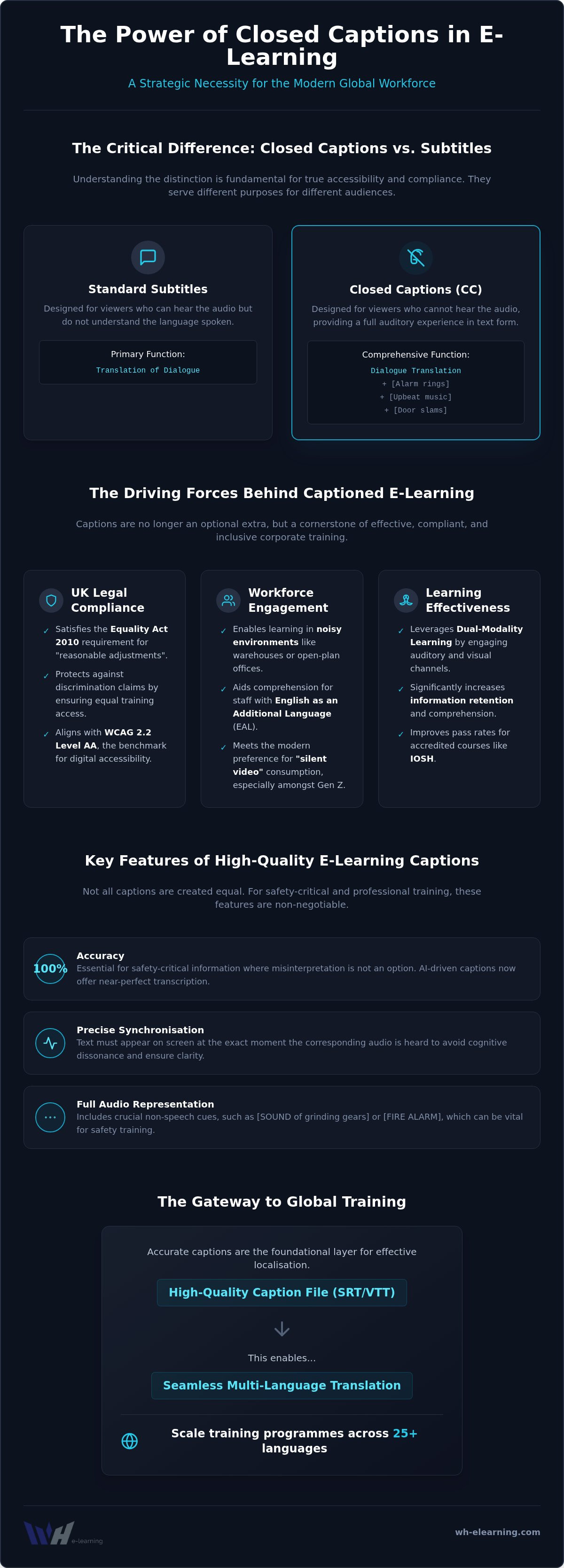
At its core, e-learning with closed captions involves more than just transcribing spoken words. It's a sophisticated layer of text that provides a full representation of the audio experience. This includes dialogue, sound effects, and musical cues, ensuring that every learner receives the same depth of information regardless of their hearing ability. By 2026, the industry has shifted from laborious manual transcription to highly accurate, AI-driven captioning. This allows training providers to scale their content rapidly whilst maintaining the precision required for professional standards.
Understanding the technical nuances is vital for compliance. You might wonder, what are closed captions? Unlike open captions, which are "burned" into the video file and cannot be removed, closed captions can be toggled on or off by the user. This flexibility is a hallmark of modern, user-centric training. It respects the learner's preference and environment, allowing for a personalised experience that reduces cognitive load and allows for steady, reliable progress.
This approach leverages "Dual-Modality Learning," a concept where the brain processes information through both auditory and visual channels simultaneously. When a trainee hears a safety instruction and sees it written on screen at the same time, their ability to retain that information increases. It's an efficient way to reinforce complex concepts, particularly in high-stakes environments like health and safety compliance where every detail matters.
Closed Captions vs Subtitles: The Critical Difference
It's easy to confuse these terms, but the distinction is critical for accessibility. Standard subtitles are generally designed for viewers who can hear the audio but don't understand the language; they focus solely on translating dialogue. In contrast, closed captions are designed for those who cannot hear the audio at all. They include vital non-speech information, such as [Door slams], [Alarm rings], or [Upbeat music].
In workplace safety training, missing a sound cue could mean missing a life-saving instruction. If a video demonstrates a machinery fault, the sound of a grinding gear is just as important as the instructor's explanation. Captions ensure these details aren't lost, making the path to meeting professional standards much smoother for everyone.
The Rise of Video-Based Learning
Video has become the dominant medium for corporate training because it's engaging and easy to digest. However, it often faces a physical barrier: the environment. Whether it's a noisy warehouse or a quiet open-plan office, audio isn't always accessible. Captions solve this "silent video" problem, allowing staff to complete their modules on mobile devices without needing headphones or a private room.
Current trends show that Gen Z professionals overwhelmingly prefer consuming content with the sound off, treating captions as a default rather than an optional extra. This shift in behaviour means that providing text-based support is no longer a niche requirement; it's a basic expectation for the modern workforce. By embracing this, you're not just meeting a requirement, you're meeting your team where they are.
Meeting UK Legal Requirements for Accessible Training
Compliance is often viewed with trepidation, but it's actually a foundation for a fairer, more efficient workplace. In the UK, providing accessible training isn't just a best practice; it's a legal pillar. Failure to meet these standards doesn't just invite legal challenges. It also risks significant reputational damage in an era where social responsibility is highly valued by both employees and clients. By prioritising e-learning with closed captions, you ensure your organisation remains compliant whilst fostering a culture of genuine inclusion.
The Equality Act 2010 and Professional Development
Under the Equality Act 2010, employers have a statutory duty to make "reasonable adjustments" for staff with disabilities, including those with hearing loss. Training is legally classified as a "service" or "benefit" provided by the employer. If an employee cannot fully engage with a safety module or a management course because of a lack of captions, they're being denied the same career progression opportunities as their peers. This creates a glass ceiling that can lead to costly discrimination claims. Accessible training protects your business and empowers your people to reach their full potential without unnecessary barriers.
Understanding WCAG Standards for Video
The Web Content Accessibility Guidelines (WCAG) 2.2 provide the technical framework for digital inclusion. These standards are categorised into three levels: A, AA, and AAA. For most UK corporate and public sector organisations, Level AA is the benchmark for compliance. This level specifically requires captions for all pre-recorded audio content in synchronised media. You can find detailed guidance on how these UK accessibility regulations apply to your digital assets through resources like Jisc. Whilst captions are the primary requirement, providing written transcripts serves as an excellent secondary layer, helping learners who prefer reading at their own pace or need to quickly reference specific facts.
Meeting these requirements doesn't have to be a complex burden. Modern platforms make it simple to integrate these features into your existing workflow. If you're looking to upgrade your current programme, exploring compliance-focused training that already meets these high standards is an efficient way to mitigate risk. Ultimately, legal compliance is the floor, not the ceiling. When you make your training accessible, you're telling your workforce that their development matters, regardless of how they process information. This investment in people always pays dividends in loyalty and performance.
The Business Case for Captions in the Modern Workplace
Investing in e-learning with closed captions is a strategic move that goes far beyond simple compliance. It's a catalyst for higher ROI across your entire training budget. When you provide text-based support, you aren't just helping a small percentage of staff; you're boosting information retention for everyone. Research in cognitive science suggests that dual-modality learning reduces the mental effort required to process new information. This lower "cognitive load" is especially vital during complex technical training, such as high-level safety protocols, where precision is a requirement for operational success.
Improved retention leads directly to higher course completion rates. When learners don't struggle to follow the audio, they're less likely to disengage or abandon the module. This creates a more inclusive workplace culture where every employee feels supported. Higher engagement scores often follow, as staff recognise that the organisation is investing in tools that respect their individual learning needs and professional growth.
Supporting English as an Additional Language (EAL)
Modern UK businesses often manage multi-lingual teams where English is a secondary language for many. Even for fluent speakers, technical jargon can be a barrier to full comprehension. Seeing the written word whilst hearing it spoken helps bridge this gap, ensuring that critical safety or compliance details are never misunderstood. This feature also serves as a perfect foundation for multi-language e-learning courses, allowing you to scale your training programmes across global offices with ease and consistency.
Learning on the Go: The Remote Work Factor
The flexibility of the modern workplace requires training that fits into a busy, mobile schedule. Captions enable staff to complete modules in "sound-sensitive" environments without needing headphones. This might be a remote worker in a noisy household, a professional on public transport, or an employee in an open-plan office. By removing the need for audio, you empower your team to learn whenever and wherever they are most productive. This flexibility significantly increases the speed of compliance roll-outs, as your workforce can finish their requirements without waiting for the perfect quiet environment.
Key Features of High-Quality E-Learning Captions
Not all text overlays are created equal. When you implement e-learning with closed captions, the quality of those captions directly impacts the effectiveness of the training. High standards in accuracy, timing, and presentation are what separate a professional resource from a basic video. This precision creates a feeling of empowerment and ease, replacing the friction often associated with technical training. By focusing on these technical details, you ensure that the learning experience is seamless, allowing your team to focus on the content rather than struggling with the delivery.
Technical Precision in Safety Training
Accuracy is the most critical feature of any captioning system, especially in high-stakes environments. In a professional occupational safety and health training course, a "close enough" transcription isn't acceptable. A single missed "not" or a misinterpreted technical term can lead to dangerous errors on the job. High-quality captions avoid the common pitfalls of basic AI tools by ensuring 100% accuracy. They also include speaker identification, which is vital when multiple experts are discussing a process. This clarity prevents the confusion that often occurs when learners can't distinguish who's speaking during complex role-play scenarios.
User-Controlled Customisation
Readability is about more than just font size. It requires careful consideration of contrast and placement. Captions should typically use sans-serif fonts with high contrast against the video background to reduce eye strain. Precise synchronisation is also a requirement; the text must appear within a fraction of a second of the audio to maintain the learner's focus. Modern platforms take this further by making the captioned data searchable. This allows a user to type a specific term into a search bar and jump directly to the moment that topic is discussed in the video. This searchability is a game-changer for long-term retention, as it allows for quick refreshers without re-watching entire sections.
User experience is enhanced when learners have control over their environment. High-quality systems allow users to toggle captions on or off and adjust text sizes to suit their visual needs. It's also vital that captions are placed so they don't obscure important on-screen graphics or instructional diagrams. You can browse our full range of health and safety courses to see these professional features integrated into every accredited module we provide.
Optimising Inclusive Training with WH eLearning
WH eLearning understands that the modern professional needs training that is both high-quality and easy to access. We've integrated e-learning with closed captions into our entire library of more than 100 accredited courses. This commitment ensures that whether you're delivering high-level health and safety protocols or essential HR compliance, every member of your team has the tools they need to succeed. Our video-based modules are specifically designed to remain responsive and accessible on any device, from desktop monitors to smartphones. This allows your workforce to progress through their professional development whilst on the move or during quiet periods in the office, without any loss in quality.
From Captions to Multi-Language Excellence
Our approach to inclusion starts with captions but extends to global scalability. We use these precise transcriptions as the foundation for our machine translation feature, which currently supports more than 25 different languages. This synergy allows global organisations to maintain a single, unified platform for their entire workforce, regardless of where they are based. By streamlining workplace compliance training, we remove the logistical headache of managing multiple providers for different international regions. Our specialised process ensures that every translation remains strictly accurate to the original accreditation, protecting the integrity of your training programmes and maintaining high corporate standards across the board.
Accredited Content, Accessible Delivery
Accreditation is the cornerstone of our service. Our IOSH Managing Safely Online and IOSH Working Safely Online courses are prime examples of how e-learning with closed captions improves real-world outcomes. We've observed that providing clear, synchronised captions helps learners grasp complex safety concepts more effectively; this often leads to significantly improved pass rates on the first attempt. This efficiency reduces the time and cost associated with course re-sits, ensuring your team is qualified and safe as quickly as possible. We invite you to explore our extensive business compliance e-learning library to see how our solution-oriented approach can support your organisation's long-term growth and compliance goals.
Future-Proof Your Training Strategy
Embracing e-learning with closed captions is a transformative step for any organisation looking to lead in 2026. You've seen how this technology bridges the gap between simple legal compliance and genuine workforce engagement. By prioritising accuracy and synchronisation, you protect your staff and ensure your safety-critical training is understood by everyone, regardless of their location or language background. High-quality captions don't just meet standards; they empower your team to learn with quiet confidence and clarity.
Accessible training is no longer a niche requirement; it's the standard for professional growth. We're here to help you navigate this path with ease and expertise. Our video-based courses are accredited by IOSH and available in over 25 languages, ensuring your global team receives consistent, high-end instruction. These modules are designed to boost pass rates and simplify your compliance tracking through high engagement and user-friendly delivery.
Take the next step in your organisation's development. Explore our library of inclusive, captioned e-learning courses to discover how video-based assessments can drive higher engagement and better results for your team. We look forward to being your partner in building a more inclusive and high-performing culture. Your journey towards a more accessible future starts today.
Frequently Asked Questions
Is closed captioning a legal requirement for UK e-learning?
Yes, providing captions is a legal obligation under the Equality Act 2010 to ensure "reasonable adjustments" for staff with disabilities. Public sector organisations must also adhere to specific accessibility regulations for digital content. Implementing e-learning with closed captions ensures that training, which is legally considered a service or benefit, is accessible to all employees. Failure to provide these can lead to discrimination claims and creates unnecessary professional friction.
What is the difference between open and closed captions in training?
The primary difference lies in user control and technical delivery. Open captions are permanently "burned" into the video file and cannot be turned off by the viewer. Closed captions are a separate data track that can be toggled on or off based on the learner's preference. For professional training, closed captions are preferred as they offer flexibility for different environments whilst maintaining the visual integrity of the instructional graphics when not required.
Can closed captions be automatically translated into other languages?
Yes, modern platforms allow for seamless integration between caption files and translation engines. At WH eLearning, we use the original caption data as a gateway to provide machine translation into more than 25 different languages. This process ensures that your global workforce receives consistent, accredited training. It allows organisations to scale their compliance programmes across international borders without the need for multiple training providers or expensive manual re-dubs.
How do closed captions improve learning for staff without hearing impairments?
Captions benefit all learners through "dual-modality learning," where seeing and hearing information simultaneously improves memory retention. They are particularly useful for staff working in noisy environments or those who speak English as an additional language. By reducing the cognitive load required to process spoken dialogue, e-learning with closed captions helps every employee understand complex technical jargon more clearly. This leads to higher pass rates and better long-term knowledge application across your team.
What WCAG level should my corporate e-learning meet?
For most UK corporate and public sector organisations, WCAG 2.2 Level AA is the target standard. This level requires that all pre-recorded synchronised media include captions to ensure accessibility for the deaf or hard of hearing. Whilst Level A is a basic requirement, Level AA is widely recognised as the benchmark for professional compliance. Meeting this standard demonstrates a commitment to high-quality, inclusive training and protects your organisation from potential legal challenges or audits.
Do closed captions work on mobile devices for remote training?
Yes, high-quality e-learning modules are designed to be fully responsive across all devices, including smartphones and tablets. This allows remote workers to complete their training during commutes or in public spaces without needing audio. The captions are delivered as a separate text track that scales automatically to fit smaller screens. This ensures that the text remains readable and does not obscure vital on-screen instructional content, regardless of the device being used.
How accurate do e-learning captions need to be for safety courses?
Accuracy must be 100% for safety-critical training. In courses like IOSH Managing Safely, a minor transcription error can lead to a fundamental misunderstanding of a hazard or a safety protocol. Professional e-learning with closed captions requires precise speaker identification and the inclusion of relevant sound cues. This level of technical precision ensures that the training remains reliable and that your organisation meets the highest standards of occupational health and safety compliance.
Can I track if my employees are using captions during their training?
Yes, organisations can often track engagement through administrative features in a training platform. Whilst the primary goal is to ensure accessibility, tracking tools allow managers to see how staff interact with the content, including the use of captions or different language versions. This data provides valuable insights into the diverse needs of your workforce. It helps you refine your training strategy to improve completion rates and overall employee engagement without adding complexity.


