

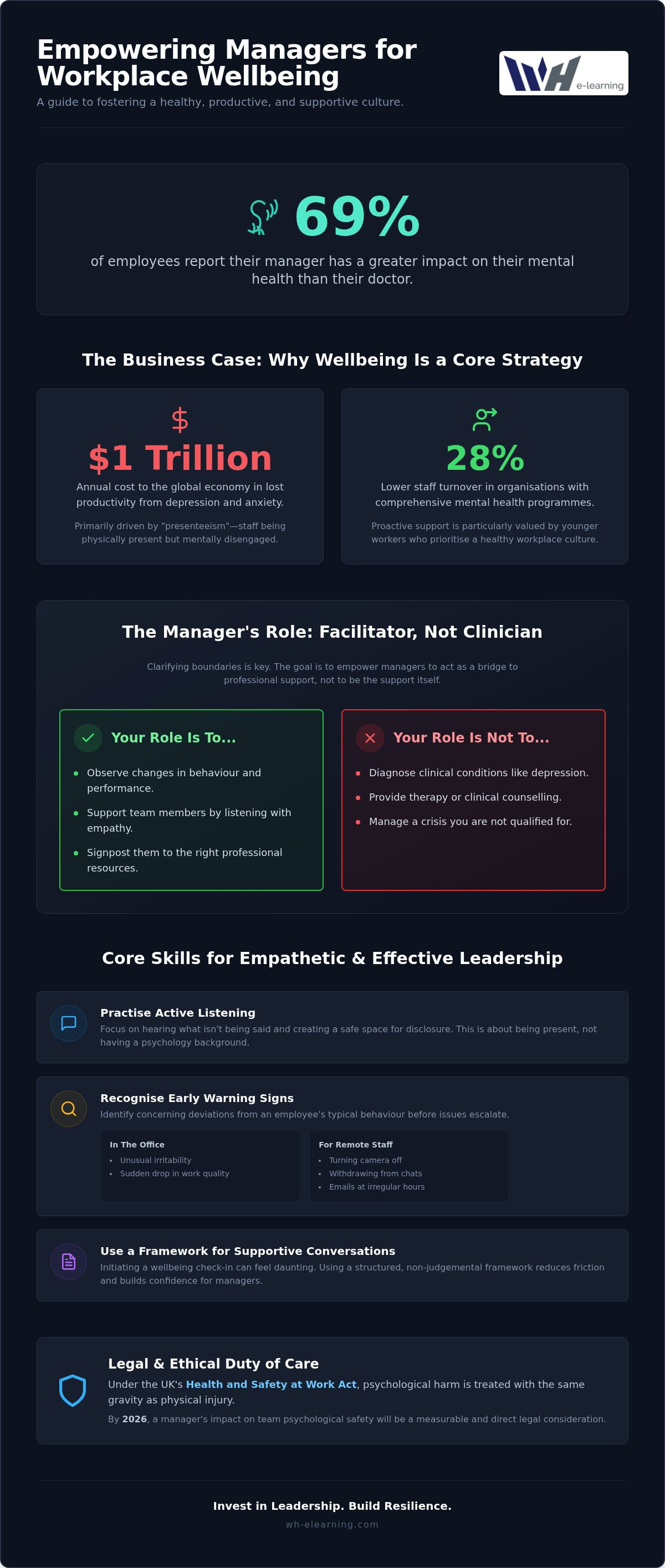
Did you know that 69% of employees believe their manager has a greater impact on their mental health than their doctor? It's a staggering figure that highlights why mental health training for managers is now a vital pillar of organisational success. You've likely seen the strain that burnout puts on your teams, leading to high turnover and a frustrating lack of interest in existing support programmes. It's difficult for leaders to feel confident when they don't have the right tools or qualifications to handle these sensitive conversations.
We understand that your managers are already stretched thin, and the thought of adding more responsibilities can feel counterproductive. However, this guide will show you how to empower your leadership team without adding to their burden. You'll learn how to equip your managers with the skills to reduce burnout, improve retention, and foster a truly healthy workplace culture. We'll explore the essential skills and practical frameworks needed to transform your leadership team into a proactive force for wellbeing whilst ensuring your business meets its 2026 legal obligations.
Key Takeaways
- Define the manager's role as a proactive facilitator of wellbeing rather than a clinician to ensure your team meets its duty of care.
- Identify the core skills required to recognise subtle signs of distress in both remote and office-based staff through empathy-led leadership.
- Learn how to select the most effective delivery method for mental health training for managers, balancing online flexibility with face-to-face sessions.
- Discover practical strategies to overcome "initiative fatigue" and break down the stigma surrounding mental health in traditional sectors.
- Scale your strategy across global teams using accredited, multi-language training that makes tracking compliance and staff progress simple for HR.
The Strategic Importance of Mental Health Training for Managers
Managers often feel a sense of dread when mental health is mentioned in a professional context. They worry they'll be asked to diagnose clinical depression or manage a crisis they aren't qualified to handle. Effective mental health training for managers clarifies this boundary immediately. Your leaders are facilitators; they aren't clinicians. Their primary role is to observe, support, and signpost. By framing the responsibility this way, you remove the friction that often prevents managers from engaging with wellbeing initiatives. It's about giving them the confidence to act as a bridge to professional support without feeling overwhelmed.
In 2026, the impact of a manager's behaviour on team psychological safety is measurable and direct. When leaders model healthy boundaries and open communication, productivity rises naturally. Conversely, a lack of support leads to a toxic environment that drains resources and talent. This year requires a more nuanced approach to leadership wellbeing training that moves beyond simple awareness and into practical, everyday application.
Legal and Ethical Duty of Care
Modern workplace safety legislation in the UK now treats psychological harm with the same gravity as physical injury. Under the Health and Safety at Work Act, employers have a clear obligation to protect staff from foreseeable mental health risks, including chronic stress and burnout. Investing in mental health training for managers is a vital step in mitigating corporate risk. It ensures that those on the front line can identify early warning signs before they escalate into long-term absenteeism or legal disputes. Beyond compliance, there's a powerful ethical case. In a high-pressure economy, supporting staff wellbeing is a hallmark of a high-quality, reliable organisation that values its people as its greatest asset.
The Business Case: Retention and Productivity
The financial implications of ignoring mental health are staggering. Depression and anxiety cost the global economy an estimated $1 trillion per year in lost productivity, often driven by "presenteeism" where staff are physically present but mentally disengaged. Early intervention by a trained manager can reverse this trend. Organisations that implement comprehensive programmes report 28% lower turnover; a statistic that is particularly relevant amongst younger workers who prioritise workplace culture and support. This proactive approach aligns perfectly with modern occupational safety and health training course standards. It transforms wellbeing from a peripheral HR concern into a core business strategy. Much like the framework found in Mental Health First Aid, manager training provides a practical path for maintaining a resilient and focused workforce.
Core Skills Every Manager Mental Health Programme Should Include
Effective mental health training for managers focuses on practical, repeatable skills rather than abstract theory. To lead with empathy, managers must master active listening; the ability to hear what isn't being said whilst providing a safe space for disclosure. This doesn't require a background in psychology; it requires a commitment to presence. Leaders who prioritise these skills can transform the employee experience, ensuring that team members feel seen and supported before small issues escalate into significant crises. Professional training provides the structure needed to navigate these interpersonal dynamics with quiet confidence.
Recognising Early Warning Signs
Managers are the first line of defence against workplace burnout, but they must know what to look for. In an office setting, this might look like unusual irritability or a sudden drop in work quality. For remote staff, signs are often more subtle, such as turning off cameras during meetings, withdrawing from group chats, or sending emails at irregular hours. A behavioural baseline is the unique pattern of conduct and performance typical for an individual employee, serving as a reference point for managers to identify concerning deviations. Recognising these shifts early allows for a supportive intervention before a staff member reaches a breaking point. If you're looking to standardise this knowledge across your leadership team, our HR and business compliance courses offer a streamlined way to build these essential competencies.
The Framework for Supportive Conversations
Initiating a wellbeing check-in can feel daunting, but the right framework reduces this friction. The goal is to start a dialogue without sounding accusatory. Instead of saying, "Your performance has slipped," a trained manager might say, "I've noticed you haven't seemed yourself lately, and I wanted to check in." This shift from judgement to curiosity is backed by research on the impact of supervisor training, which suggests that managers who use open-ended questions foster much higher levels of trust.
Managing emotional responses is equally vital. If an employee becomes distressed, a manager's job isn't to "fix" the emotion but to remain calm and supportive. This involves:
- Maintaining boundaries: Gently redirecting the conversation if it becomes too clinical or personal.
- Effective signposting: Knowing exactly how to guide the employee toward your internal Employee Assistance Programme (EAP) or external professional resources.
- Follow-up: Agreeing on a specific time to check in again to ensure the support is working.
Comprehensive mental health training for managers ensures your leaders don't overstep into the role of a therapist. By mastering these core skills, they become effective navigators who can guide their teams through challenges whilst maintaining professional standards and high productivity.
How to Organise and Deliver Effective Manager Training
Organising mental health training for managers requires a thoughtful approach that goes beyond simply selecting a course. It starts with a clear assessment of your management culture and the specific challenges your leaders face. Are your managers overseeing remote teams across different time zones, or are they on the factory floor? Understanding these dynamics allows you to tailor the training so it feels relevant rather than like a generic corporate requirement. A realistic timeline for rollout is equally important. Avoid rushing the process; a phased completion schedule respects the heavy workloads of your leadership tier whilst ensuring the material is properly absorbed.
Selecting the Right Delivery Method
Choosing how to deliver your training is a strategic decision that impacts engagement levels. Video-based e-learning is often the most effective solution for busy, time-poor managers. It offers the flexibility to learn in short bursts, which fits seamlessly into a high-pressure schedule. For organisations with complex operational risks, you might choose to supplement these digital modules with in-house health and safety training. This hybrid approach allows for deep-dive discussions on company-specific policies whilst maintaining the broad reach of online learning. Consistency is vital for global firms. Using a platform that offers multi-language support ensures that every manager, regardless of their location, receives the same high standard of instruction and support.
Accessibility and Inclusion in Training
Inclusive training practices are essential for a modern wellbeing strategy. In 2026, providing e-learning with closed captions is a non-negotiable standard for accessible L&D. This supports employees with hearing impairments and benefits those working in shared offices or noisy environments. Retention rates improve significantly when managers can access training in their native language. By offering courses in over 25 different languages, you remove the barriers to understanding and make the learning process feel more personal and supportive.
To ensure high engagement, your mental health training for managers must also be device-agnostic. Leaders are often on the move, and the ability to switch between a desktop, tablet, or smartphone without losing progress is a hallmark of a high-quality user experience. This level of accessibility reduces the perceived difficulty of professional development, positioning it as an attainable goal rather than a burdensome task. When training is easy to access and simple to navigate, your managers are far more likely to embrace it as a valuable tool for their own growth and the success of their teams.
Overcoming Common Implementation Challenges
Managers often view new training as another weight on an already heavy schedule. This "initiative fatigue" is a significant barrier to the success of any wellbeing programme. To overcome this, your mental health training for managers shouldn't exist in a vacuum. It must be woven into your existing workplace compliance training framework. When leaders see wellbeing as a fundamental safety requirement rather than an optional HR extra, engagement levels shift. This approach is particularly effective in traditional industries where mental health stigma might still persist. By focusing on performance and risk mitigation, you make the conversation practical and grounded, ensuring that every leader understands the direct link between a healthy team and a productive one.
Managing the "Not a Therapist" Fear
The most common objection from managers is the fear of saying the wrong thing or overstepping into a therapeutic role. Clear boundaries are the antidote to this anxiety. Your training must explicitly define where a manager's duty ends and professional support begins. Providing "cheat sheets" and scripts for sensitive conversations gives leaders a tangible tool to lean on during moments of stress. Video-based scenarios are particularly powerful here. They allow managers to see a supportive conversation in action, building the quiet confidence needed to handle real-world distress without feeling unqualified. This practical focus replaces the perceived difficulty of the task with a clear, manageable process.
Maintaining Momentum After the Course
Behavioural change doesn't happen overnight. It requires consistent reinforcement to prevent training from becoming a "tick-box" exercise. High-quality business compliance e-learning platforms provide the administrative tools needed to track progress and identify gaps in knowledge. Beyond the initial module, regular "refresher" sessions keep wellbeing at the centre of the management agenda. Peer-support groups also offer a valuable space for leaders to share their experiences and learn from one another's challenges. This ongoing engagement ensures that the skills learned during mental health training for managers are applied consistently across the organisation. Steady reinforcement transforms a one-off event into a long-term investment in your company's leadership culture.
Empower your leadership team with the tools they need to succeed. Explore our accredited training courses to find the right fit for your organisation.
Scale Your Global Wellbeing Strategy with WH eLearning
Scaling a wellbeing strategy across multiple borders shouldn't be a logistical struggle. WH eLearning removes this friction by providing an accredited library of over 100 workplace training courses designed for the modern professional. Our platform is built to support businesses that value high standards but need a simplified path to meeting them. By centralising your training, you ensure that every leader in your organisation has access to the same quality of resources, regardless of their department or seniority.
Our video-based approach ensures higher engagement amongst leadership compared to traditional, text-heavy modules. Managers learn through high-quality visual storytelling that mirrors real-world workplace scenarios, making the lessons easier to remember and apply. This method reduces the cognitive load on busy professionals, turning a mandatory requirement into an engaging experience that encourages genuine professional growth.
A Solution for the Modern, Global Manager
Consistency is the foundation of a strong corporate culture. With multi-language e-learning courses, you can ensure that every leader receives the same high standard of instruction. We utilise machine translation to offer support in over 25 languages, which makes mental health training for managers locally relevant whilst maintaining global standards. Whether your team is remote-first or operates in a hybrid model, our device-agnostic platform fits seamlessly into their daily routine. This flexibility allows managers to complete their training at a pace that suits them, ensuring the material is properly absorbed rather than rushed.
Streamlining Compliance and Certification
Managing training for a diverse workforce shouldn't be a manual, time-consuming task. Our platform simplifies the entire process through bulk licensing and robust administrative features. HR managers can monitor compliance status across the entire organisation at a glance, identifying exactly who has completed their assessments and who may need a reminder. This transparency helps you maintain high standards and ensures your investment in mental health training for managers delivers a measurable return in both productivity and employee retention.
Instant digital certification is awarded upon successful completion of assessments. This provides immediate proof of competency and ensures your business remains fully compliant with the latest health and safety regulations. By centralising your training on a single, reliable platform, you create a simplified path to growth for your entire management tier. It's an efficient, forward-thinking way to protect your staff and your business reputation simultaneously.
Explore our mental health and compliance training library today and see how easy it is to foster a healthier, more resilient workplace culture.
Empowering Your Leadership for a Resilient Future
Managers are the first line of defence in protecting your team's wellbeing and your business's productivity. By clarifying their role as facilitators rather than clinicians, you remove the hesitation that often stalls progress. High-quality training isn't just a tick-box exercise; it's a strategic investment in staff retention and legal compliance. You've seen how practical skills and accessible delivery can transform a leadership tier into a proactive force for good.
Investing in mental health training for managers ensures your leaders have the quiet confidence to handle sensitive conversations whilst maintaining professional boundaries. WH eLearning provides a seamless path to this goal. Our platform is accredited by industry-leading bodies and trusted by global organisations for multi-language training. Our video-based learning ensures maximum engagement, helping you build a consistent culture of care across every office.
Start your organisation’s journey to better mental health with WH eLearning. You have the tools to create a workplace where every employee feels seen and every manager feels equipped to succeed. Let's make progress together.
Frequently Asked Questions
What is mental health training for managers?
Mental health training for managers is a structured educational programme designed to give leaders the skills to identify, understand, and respond to signs of mental health issues in their teams. It focuses on practical intervention, supportive communication, and resource navigation. Unlike general awareness sessions, this training specifically targets the manager's role in maintaining productivity and psychological safety whilst meeting legal duty of care requirements.
Are managers expected to act like therapists after this training?
No, managers are explicitly trained to act as facilitators and signposters rather than clinical professionals. The training defines clear boundaries, ensuring leaders don't attempt to diagnose or treat mental health conditions. Instead, they learn how to initiate supportive conversations and guide employees toward professional services like EAPs or medical experts. This distinction is vital for reducing manager anxiety and preventing them from overstepping into clinical territory during sensitive discussions.
How long does an online mental health training course usually take?
Most accredited online modules are designed to be completed in one to three hours. This allows busy leaders to fit professional development into their schedules without disrupting daily operations. Video-based courses, such as those offered by WH eLearning, often use a modular structure so managers can pause and resume their progress. This flexibility ensures high completion rates whilst maintaining a high standard of learning and knowledge retention.
Can mental health training be integrated with IOSH or other safety certifications?
Yes, mental health training for managers is increasingly integrated with health and safety certifications like IOSH Managing Safely. Since psychological harm is recognised under workplace safety legislation, modern compliance frameworks treat mental wellbeing as a core safety pillar. Combining these topics ensures a holistic approach to risk management. Leaders learn to manage both physical and mental hazards with equal competence, ensuring the organisation meets its full duty of care obligations.
How do I measure the ROI of manager mental health training?
ROI is typically measured through reduced absenteeism, lower staff turnover, and improved engagement scores. According to research, organisations with comprehensive mental health programmes report a 41% reduction in absenteeism and 28% lower turnover. By tracking these metrics alongside the cost of recruitment and sick leave, HR teams can demonstrate a clear financial return. Improved productivity through reduced presenteeism also serves as a powerful indicator of the training's long-term commercial value.
Is online training as effective as face-to-face sessions for mental health?
Online training is highly effective when it uses interactive, video-based content that simulates real-world scenarios. Whilst face-to-face sessions offer direct interaction, online platforms provide the benefit of consistency and scalability, especially for global teams. Features like machine translation into over 25 languages and closed captions ensure that all managers receive the same high-quality instruction. For many organisations, a hybrid approach combining digital modules with in-house workshops provides the best results.
What should I do if a manager is resistant to mental health training?
Resistance often stems from a fear of increased workload or a lack of clinical expertise. To address this, emphasise that the training is designed to simplify their role by providing clear frameworks for difficult conversations. Frame the programme as a tool for improving team performance and reducing the stress of managing crises. Showing the direct link between mental health support and meeting business targets often helps win over sceptical leaders.
How often should managers refresh their mental health training?
We recommend a refresher every 12 to 24 months to keep skills sharp and stay updated on evolving workplace legislation. Mental health awareness and best practices change quickly, especially with the rise of hybrid and remote work. Regular updates ensure that managers remain confident in their ability to support staff and use the latest signposting resources. Short, targeted e-learning modules are an efficient way to maintain this ongoing competency.


