

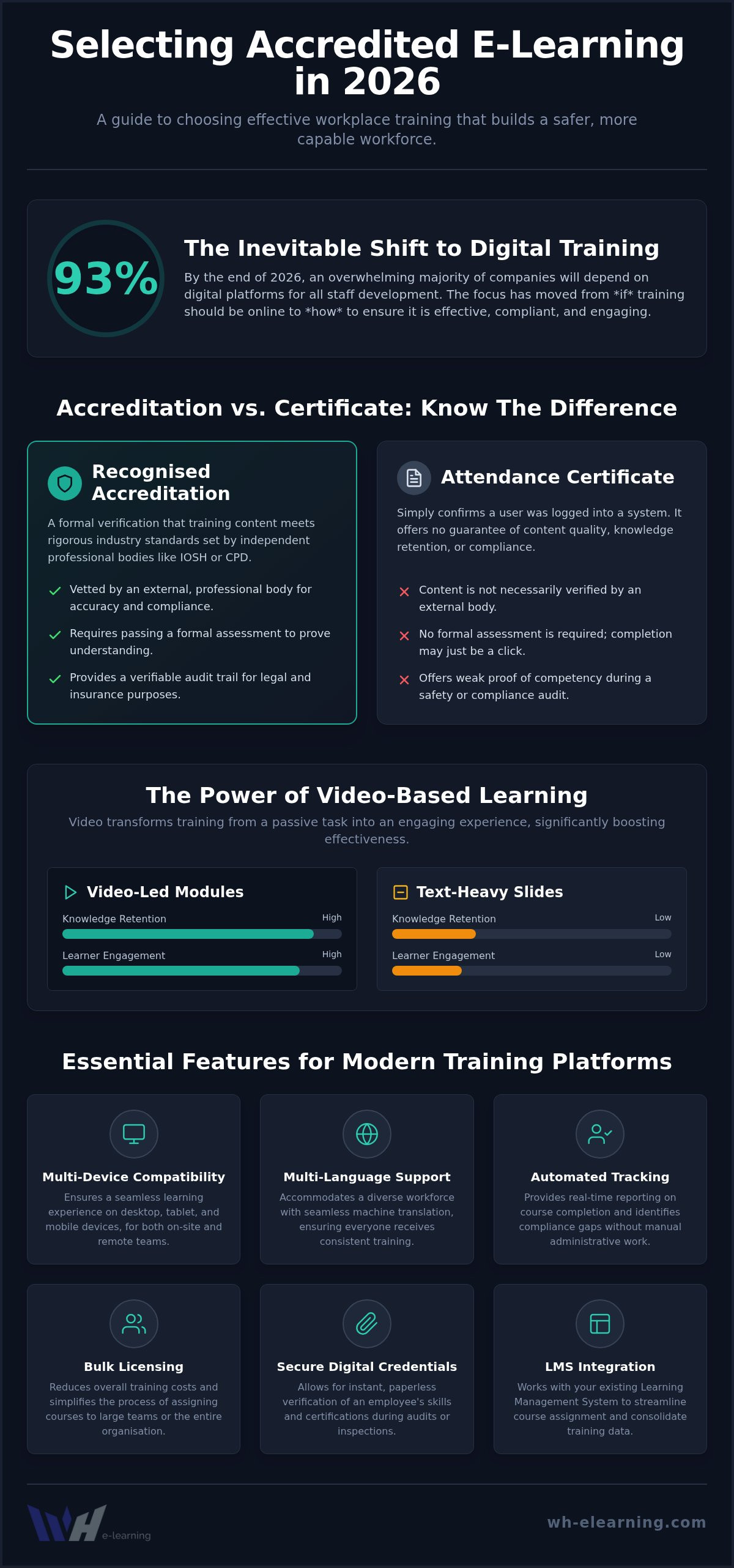
Did you know that 93% of companies will rely on digital platforms for staff development by the end of 2026? It's no longer a question of whether to move your training online, but how to ensure your chosen accredited e-learning courses for workplace training actually deliver results. Managing compliance often feels like a stressful balancing act between legal necessity and genuine employee engagement. You want to protect your organisation from the risks of non-compliance; however, you're likely tired of seeing staff switch off during dry, text-heavy modules that feel like a chore.
This guide shows you how to select training that doesn't just tick a box but builds a safer, more capable workforce. You'll discover how to reduce training costs whilst maintaining the high standards required for certifications like IOSH. We'll explore the shift toward video-based learning, the importance of multi-language support for diverse teams, and the simple steps to implement a programme that your employees will actually value. By the end of this article, you'll have a clear roadmap to keep your organisation compliant and your team empowered throughout 2026.
Key Takeaways
- Learn the critical difference between simple attendance certificates and recognised accreditations to ensure your training meets 2026 legal standards.
- Discover why prioritising video-based content over text-heavy slides is the most effective way to boost staff engagement and knowledge retention.
- Find out how to manage a diverse, multi-lingual workforce using accredited e-learning courses for workplace training that offer seamless machine translation.
- Identify high-stakes compliance areas where specific IOSH certifications are non-negotiable for protecting both your supervisors and general employees.
- Understand how bulk licensing and automated tracking can reduce your training costs whilst simplifying the administration of your entire compliance programme.
What are Accredited E-Learning Courses for Workplace Training?
Accredited e-learning courses for workplace training are digital educational programmes that have undergone a rigorous vetting process by external, independent professional bodies. This verification ensures that the training content is accurate, up to date, and aligned with the latest industry regulations. In 2026, accreditation isn't just a badge of quality; it's a critical component of an organisation's risk management strategy. By choosing courses approved by bodies like IOSH or the CPD Certification Service, you ensure that your team receives instruction that meets a standardised level of excellence. This is particularly important for high-stakes topics where incorrect information could lead to serious safety incidents or legal liabilities.
Modern standards for accredited e-learning courses for workplace training have moved far beyond the "click-next" slide decks of the past. Today, the most effective courses rely on video-led content to keep learners engaged and improve knowledge retention. This shift is driven by the need for training that feels relevant and accessible to a diverse workforce. Accreditation from a reputable body confirms that these video modules aren't just entertaining, but are educationally sound and legally compliant. For many businesses, having a library of these accredited courses is an insurance necessity, providing a clear audit trail that proves the company has met its duty of care towards its employees.
The Role of Professional Bodies in 2026
Professional bodies like IOSH remain the gold standard for safety training because they provide a bridge between complex legislation and practical workplace application. As teams become more distributed, the shift towards digital-first accreditation has accelerated. This allows remote and hybrid workers to access the same high-quality training as their office-based colleagues, ensuring consistency across the entire organisation. Using these verified programmes is a vital part of mastering workplace compliance. Most companies manage this through a Learning Management System (LMS), which simplifies the process of assigning courses and monitoring completion rates in real-time.
Accreditation vs. Certification: Understanding the Difference
It's vital to understand that whilst all accredited courses provide a certificate, not every certificate you find online is accredited. An attendance certificate merely confirms that a user was logged into a system for a certain duration. It doesn't necessarily mean the content was accurate or that the learner understood the material. Accredited courses, however, require students to pass a formal assessment that is recognised by an awarding body. You should always look for the official logo of the professional body to verify the course's status. In 2026, the industry has embraced secure digital credentials, which allow for instant verification of an employee's skills during audits, removing the administrative burden of managing physical paperwork.
Key Features to Look for in Online Workplace Training
Selecting the right accredited e-learning courses for workplace training requires looking beyond the course title. In 2026, the most effective programmes prioritise the user experience to ensure that training isn't just completed, but understood. You should look for platforms that offer seamless multi-device compatibility. Whether your team is using a desktop in the office, a tablet on a construction site, or a mobile whilst commuting, the learning experience must be consistent and intuitive. Robust tracking and reporting tools are also essential. These features allow managers to monitor progress and identify compliance gaps automatically, reducing the administrative burden on HR departments.
The Power of Video-Based Learning
Video content has transformed how professionals absorb information. Traditional text-heavy slides often lead to cognitive overload, where the learner stops processing details. In contrast, video-led modules use visual storytelling to improve knowledge retention and maintain focus. This is particularly effective for complex subjects like video-based health and safety training, where seeing a procedure in action is far more valuable than reading about it. Modern assessments have also evolved; video-led evaluations present realistic scenarios that require learners to apply their skills in a practical context rather than simply memorising facts.
Accessibility and Multi-Language Support
A significant gap in many training programmes is the lack of support for a diverse, international workforce. Ensuring your team stays safe means removing every possible barrier to understanding. This is why multi-language e-learning courses are now a necessity for global organisations. High-quality platforms now utilise machine translation to offer content in 25+ languages, alongside closed captions for those who are hard of hearing or working in noisy environments.
When reviewing your options, consider the standards set by international bodies. For instance, looking at OSHA-authorized online training providers can give you a benchmark for the level of rigour required in safety education. Implementing these inclusive features ensures that every employee, regardless of their native language or location, receives the same high-quality instruction. If you're looking for a streamlined way to manage your team's growth, you can find a variety of solutions at wh-elearning.com.
Comparing Essential Course Categories: Safety, HR, and Compliance
Organising your training library effectively ensures that your team stays safe whilst your business remains legally protected. Most organisations categorise their accredited e-learning courses for workplace training into three main pillars: Health and Safety, HR Compliance, and Business Operations. Whilst professional development is vital for long-term growth, your primary focus must be on high-stakes compliance where accreditation is a non-negotiable requirement. Balancing these mandatory modules with culture-building courses like Mental Health Awareness creates a holistic environment that values both physical safety and psychological wellbeing.
Successful managers don't just assign courses at random; they align training with specific job roles and risk profiles. For example, a warehouse supervisor requires a different level of safety certification than a remote-based marketing executive. By categorising your training, you can ensure that every employee receives the exact knowledge they need to perform their duties safely and ethically. This structured approach also makes it much easier to track completion rates and prepare for external audits or insurance renewals.
Health and Safety: The Non-Negotiables
This category forms the backbone of any robust compliance strategy. You should prioritise occupational safety and health training courses that carry significant weight with insurers and regulators. The IOSH Managing Safely Online course is the premier choice for supervisors and managers, providing them with the practical tools to assess and control workplace risks. For general staff, IOSH Working Safely offers a high-impact introduction to essential safety principles. Don't overlook niche but critical topics such as Asbestos Awareness, COSHH, and Fire Safety, which are vital for maintaining a safe physical environment.
HR and Business Compliance
Protecting your organisation from tribunal risks and data breaches is an ongoing requirement. Essential training for 2026 includes GDPR, Anti-Bribery, and Cyber Security modules that reflect the latest digital threats and legislative updates. These courses empower your team to handle sensitive data responsibly and recognise suspicious behaviour before it causes financial or reputational harm. In our modern hybrid work era, DSE (Display Screen Equipment) assessments are also crucial. They ensure that employees working from home maintain the same ergonomic standards as those in the office, reducing the risk of long-term health issues and associated liability claims. Investing in these areas creates a culture of transparency and security that benefits the entire organisation.
Standout Accredited Courses: Selecting the Right Training for Your Team
Selecting the perfect accredited e-learning courses for workplace training doesn't have to be a complex task. You can simplify the process by following a straightforward framework: start with the employee's role, determine their specific risk level, and match it to the required accreditation. A manager on a construction site requires a different level of rigour than a retail assistant, and your training choices should reflect those unique responsibilities. High-risk roles demand gold-standard certifications, whilst lower-risk positions may only need awareness-level modules. This framework ensures that you don't over-train staff in low-risk environments whilst ensuring those in high-stakes roles have the specific credentials required by law. By aligning your strategy this way, you ensure your budget is spent where it has the most impact on safety and compliance.
Top Picks from the WH eLearning Education Collection
IOSH Managing Safely Online remains the premier choice for supervisors and managers across all industries. It provides the essential manager's toolkit for effective risk assessment and safety management. For general staff awareness, IOSH Working Safely is the recommended route for building foundational knowledge. To ensure comprehensive organisational protection, the Business Compliance bundle is an excellent option that covers various regulatory requirements in one go. Beyond safety, GDPR training is vital for ensuring data compliance in every department, whilst Mental Health Awareness modules support staff wellbeing in a modern, fast-paced environment. You can explore the full range of these high-impact programmes and secure your team's future in our Education collection.
Common Mistakes to Avoid When Buying E-Learning
One of the most frequent errors is choosing unaccredited e-learning courses for workplace training simply to save money. This is a classic false economy; if a course isn't verified by a professional body, it may not stand up during a legal audit or insurance claim. Another common pitfall is ignoring the user experience (UX). If the platform is clunky or the content is boring, your completion rates will plummet, leaving your organisation vulnerable. Finally, always verify that the content is current. Training materials that haven't been updated for 2026 regulations can provide a false sense of security while leaving your team exposed to outdated practices. Reliability is key, so choosing a partner that prioritises regular content refreshes is essential for long-term compliance.
How to Implement and Scale Your Workplace Training Strategy
Implementing a robust training programme shouldn't be a logistical hurdle for your business. Once you've identified the right accredited e-learning courses for workplace training, the focus shifts to efficient rollout and long-term management. For growing organisations, the ability to scale training without increasing administrative overhead is crucial. Modern platforms allow you to move away from fragmented spreadsheets; instead, you can use built-in administrative features to track progress, identify compliance gaps, and manage certification renewals automatically. This proactive approach ensures you're never caught off guard by an expiring qualification, keeping your workforce safe and your records audit-ready.
The transition from selection to execution is a great opportunity to refine your internal processes. By centralising your training through a single, reliable partner, you ensure that every department follows the same high standards. This consistency is particularly important when managing a diverse or multi-lingual workforce, where clear, standardised instruction is essential for safety. A well-implemented strategy doesn't just tick a compliance box; it creates a culture of continuous improvement where employees feel valued and supported in their professional development.
Corporate Licensing and Bulk Enrolment
Large-scale organisations benefit significantly from corporate licensing models. Bulk purchasing not only reduces the per-course cost for your team but also simplifies the enrolment process. You can assign essential modules to hundreds of employees simultaneously, ensuring everyone receives identical, high-quality instruction regardless of their department or location. This level of consistency is vital for maintaining universal safety standards across the business. By automating the tracking of these courses, you can focus your energy on high-level strategy rather than chasing individual staff members for completion certificates.
Blended Learning: Combining Online and In-House Training
Whilst digital modules are perfect for delivering theoretical knowledge and regulatory updates, some skills require a more hands-on approach. A blended learning strategy combines the flexibility of online training with the practical depth of In-House Face-to-Face Training. You might use online modules for the classroom-based elements of a course and then bring in industry specialists to tailor practical sessions to your specific site or equipment. This hybrid model provides a comprehensive learning journey that caters to different learning styles and operational needs.
The next step in your compliance journey is to browse our full library to build a custom training calendar. This allows you to map out mandatory renewals and professional development milestones across the entire year. Ready to upskill your team? Explore our full range of accredited e-learning courses here. By integrating these tools into your daily operations, you create a seamless path to professional growth that supports both your employees and your business objectives.
Securing Your Organisation’s Future in 2026
Ensuring your team remains safe and compliant requires more than just a tick-box exercise. By prioritising high-quality accredited e-learning courses for workplace training, you protect your organisation from legal risks whilst empowering your staff with practical, life-saving skills. This guide has highlighted the critical need for independent verification, the engagement benefits of video-led modules, and the efficiency of managing compliance through scalable digital platforms. Moving forward with a clear strategy ensures that your training budget is an investment in growth rather than just an administrative cost.
As a trusted IOSH approved training provider, WH eLearning offers over 100 accredited courses designed for maximum retention and ease of use. Our video-based approach reduces the friction of professional requirements, making it simpler than ever to maintain high standards across your entire workforce. Whether you're managing a small team or a global organisation, the path to a safer workplace starts with the right educational partner. Browse the Accredited Education Collection and Secure Your Team’s Training Today. We're here to support your journey towards a more skilled and secure professional future.
Frequently Asked Questions
What makes an e-learning course "accredited" for workplace training?
An e-learning course is accredited when it has been independently reviewed and approved by a recognised professional body, such as IOSH or the CPD Certification Service. This vetting process ensures the content is technically accurate and meets specific industry standards for 2026. Choosing accredited e-learning courses for workplace training provides peace of mind that your organisation is meeting its legal obligations whilst delivering high-quality, standardised instruction to every member of your team.
Is the IOSH Managing Safely online course the same as the classroom version?
Yes, the IOSH Managing Safely online course follows the exact same syllabus and leads to the same recognised qualification as the traditional classroom-based version. The primary difference is the delivery method, which allows your supervisors to study at their own pace and on their own schedule. It includes the same rigorous assessments and risk-project requirements, ensuring that the high standards of safety management are maintained regardless of the learning environment.
Can I purchase e-learning courses in bulk for my entire company?
Organisations can certainly purchase training in bulk through corporate licensing agreements to cover their entire workforce. This approach is highly efficient for growing teams, as it significantly reduces the administrative burden of individual enrolments. Bulk purchasing allows you to assign specific modules to hundreds of staff members simultaneously, ensuring that everyone receives consistent instruction. It also provides a more cost-effective way to manage your organisation's long-term compliance requirements.
How do I track which employees have completed their mandatory compliance training?
You can monitor employee progress through integrated administrative features that provide real-time data on course completions and assessment scores. These tracking tools allow you to identify compliance gaps immediately and send automated reminders to staff who have yet to finish their modules. Having this centralised data is essential for maintaining accurate training records, which are often required during health and safety audits or when renewing professional insurance policies.
Are these online courses mobile-friendly for staff who do not work at a desk?
Every course in our library is fully responsive and can be accessed on any device, including smartphones, tablets, and desktop computers. This flexibility is vital for staff who work in the field, on construction sites, or in retail environments without regular desk access. By providing mobile-friendly accredited e-learning courses for workplace training, you ensure that all employees can complete their required modules at a time and place that suits their specific role.
Do the courses support languages other than English for global teams?
Yes, our platform supports global teams by offering machine translation into more than 25 different languages. This feature, combined with comprehensive closed captions, removes significant barriers to learning for a diverse workforce. By providing training in an employee's native language, you improve knowledge retention and ensure that critical safety and compliance information is clearly understood. This inclusive approach is a key standard for modern international business operations in 2026.
How long does an accredited certificate remain valid?
The validity period of a certificate depends on the specific subject and the awarding body's requirements. Many high-stakes safety certifications, such as IOSH, are typically valid for three years, after which a refresher course is recommended to stay current with new regulations. However, some compliance topics like GDPR or Cyber Security may require annual updates. Our system helps you manage these timelines by automatically notifying you when a renewal is due.
What happens if an employee fails the online assessment?
If an employee does not pass their assessment on the first attempt, they are typically given the opportunity to review the course material and retake the test. Our video-based assessments are designed to be engaging and clear, which helps learners identify where they went wrong. This supportive approach encourages professional growth rather than penalising mistakes, ensuring that every member of your team eventually reaches the required standard of competence for their role.


