

Can your team distinguish a genuine internal request from an AI-generated phishing attempt that looks and sounds exactly like your CEO? It's an unsettling question, yet it represents the daily reality for UK businesses facing a new generation of sophisticated cyber threats. You likely already know that your employees are your first line of defence, but keeping them engaged with traditional, text-heavy compliance modules is an uphill battle. This guide provides the tools you need to master information security awareness training, helping you transform staff behaviour from a potential vulnerability into your greatest asset.
We understand that managing workplace compliance often feels like navigating a maze of technical jargon and administrative hurdles. You want to ensure full alignment with UK-GDPR and ISO 27001 standards without losing hours to manual audit tracking or chasing uncompleted modules. In the following sections, we'll show you how to build a resilient, security-first culture through accessible, video-based learning that simplifies the path to total compliance. You'll discover practical strategies to reduce security incidents and streamline your reporting, ensuring your organisation remains protected and prepared for the challenges of 2026.
Key Takeaways
- Understand why addressing human error is the most effective way to prevent data breaches in the modern threat landscape.
- Learn how to use bite-sized, video-based content to increase staff engagement and prevent cognitive overload during training sessions.
- Master the core components of information security awareness training to ensure your organisation meets UK-GDPR and ISO 27001 standards.
- Discover how to move beyond simple completion rates by using assessments to verify true staff competence and behaviour change.
- Explore the benefits of accredited, multi-language e-learning for scaling compliance across diverse and growing professional teams.
The Critical Need for Information Security Awareness Training in 2026
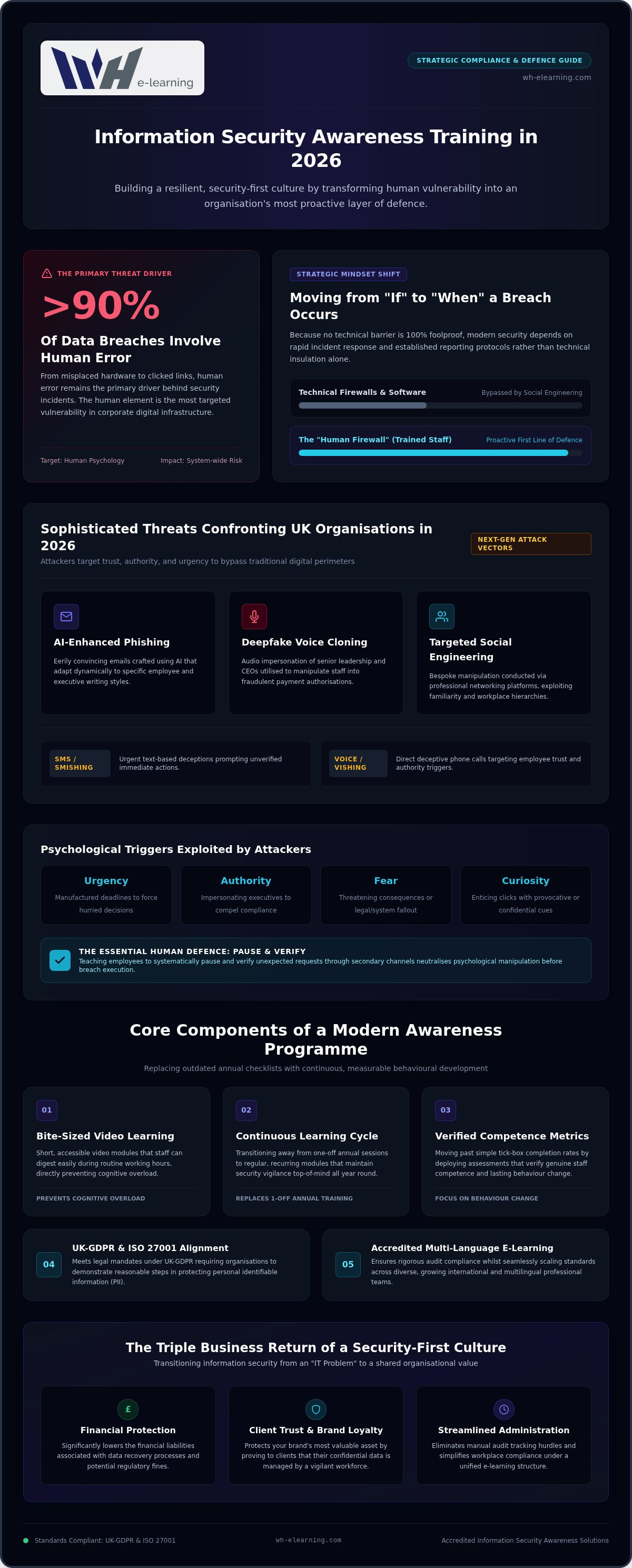
Effective information security awareness training is a strategic programme designed to empower your team to identify and neutralise cyber threats before they escalate. It's much more than a simple checkbox for HR. It's an investment in your people that turns them into a proactive layer of protection. Statistics consistently reveal that human error remains the primary driver behind security incidents, contributing to over 90% of data breaches. Whether it's a misplaced laptop or a clicked link, the human element is often the most vulnerable point in your digital infrastructure.
The threat landscape in 2026 has evolved rapidly, making traditional training methods feel outdated. Cybercriminals now use sophisticated AI to craft hyper-personalised phishing emails and deepfake audio to impersonate senior leadership. These attacks don't just target systems; they target trust. Beyond the technical risk, there's a clear legal mandate. Under UK-GDPR and various industry-specific regulations, organisations must demonstrate they've taken reasonable steps to protect personal data. Regular training is a non-negotiable part of this regulatory compliance, ensuring your business stays on the right side of the law.
Why Technical Defences Are No Longer Enough
Modern security isn't just about software. Even the most advanced firewalls can't stop an employee from clicking a link in an email that appears to come from a trusted colleague. This is where the concept of the "Human Firewall" becomes vital. Sophisticated attackers bypass technical barriers by targeting human psychology, exploiting trust, urgency, or curiosity. Because no system is 100% foolproof, the shift in 2026 is moving from "if" a breach occurs to "when". Your staff's ability to react quickly and follow established protocols determines whether an incident is a minor blip or a catastrophic failure. Comprehensive security awareness training ensures your team is ready to respond effectively to these evolving tactics.
- AI-enhanced phishing that adapts to specific employee writing styles.
- Deepfake voice cloning used for fraudulent payment authorisations.
- Targeted social engineering through professional networking platforms.
The Business Value of a Security-First Culture
Building a security-first culture delivers measurable returns for your organisation. It significantly reduces the financial burden associated with data recovery and potential regulatory fines. Beyond the balance sheet, it protects your brand's most valuable asset: client trust. When customers know their data is handled by a vigilant team, loyalty grows. Integrating these sessions into your broader workplace compliance training strategy simplifies administration and ensures a consistent standard across the organisation. It moves security from a technical "IT problem" to a shared company value, fostering a sense of collective responsibility and professional pride.
Core Components of a Modern Security Awareness Programme
Building a resilient organisation requires more than just a list of rules. A modern information security awareness training programme focuses on lasting behaviour change through consistent, engaging content. To avoid cognitive overload, top-tier programmes use bite-sized modules that staff can digest easily during their normal working day. These modules shouldn't be a one-off annual event. Instead, they should form a continuous learning cycle that keeps security top-of-mind. Choosing accredited courses ensures the content meets high industry standards and provides the legal validity required for rigorous audits.
Identifying Phishing and Social Engineering
Phishing remains a persistent threat, with attackers constantly refining their methods. Your team must be trained to spot red flags across various channels, including SMS (smishing) and voice calls (vishing). Attackers often exploit psychological triggers like urgency, fear, or authority to bypass critical thinking. The 2026 landscape features a rise in AI-generated phishing content that is eerily convincing. Teaching staff to pause and verify unexpected requests is a simple yet powerful defence that tech alone cannot provide.
Data Protection and UK-GDPR Compliance
Every employee handles personally identifiable information (PII) to some degree. Training must cover the essential rules for managing this data, from digital encryption to physical security. Simple habits like clear desk policies and the secure disposal of documents are often overlooked but remain vital for compliance. According to the official Cyber Security Breaches Survey, phishing is the most common type of breach, making data protection awareness even more critical. You can explore our business compliance e-learning for a deeper look at these regulatory requirements.
Password Hygiene and Multi-Factor Authentication (MFA)
Strong passwords are no longer enough to stop modern attackers. Staff should be encouraged to use long passphrases and password managers to mitigate the risk of credential stuffing. Multi-factor authentication (MFA) is now a non-negotiable standard for any secure workplace. It adds a vital layer of protection even if a password is compromised. Educating your team on the risks of reusing passwords across personal and work accounts is an essential step in securing your digital perimeter. For organisations looking to simplify this process, using WH eLearning’s accredited video courses makes rolling out these essential modules both efficient and engaging for large teams.
Comparing Delivery Methods: Online E-Learning vs. Traditional Workshops
Selecting the most effective delivery method for your information security awareness training is a strategic choice that impacts both budget and retention. For many UK firms, information security awareness training is most effective when it can be scaled instantly without sacrificing quality. Online e-learning has become the standard for growing businesses due to its unmatched efficiency. Whilst traditional workshops require significant logistics and travel costs, digital licences allow you to onboard hundreds of employees across multiple locations simultaneously. This approach is far more cost-effective than hiring a permanent in-house specialist or paying for the recurring daily rates of external consultants.
Flexibility is another major factor in the current working environment. As hybrid and remote models remain permanent fixtures for British professionals, your team needs to access training at a time that suits their individual schedules. Digital modules enable staff to learn from any location, ensuring that security remains a priority regardless of where the work happens. This accessibility aligns with the latest ICO data security guidance, which stresses the importance of regular, verifiable staff training as a core organisational safeguard. Key benefits of the digital-first approach include:
- Lower cost per head compared to face-to-face sessions.
- Instant deployment for new starters and annual refreshers.
- Centralised tracking for simplified compliance reporting.
- Reduced disruption to daily business operations.
The Advantages of Video-Based E-Learning
Video-based learning is particularly effective for complex security topics. Visual storytelling captures attention far more successfully than static text or long PDF documents. It allows employees to see real-world scenarios in action, such as how a phishing attempt looks in a modern inbox or the correct way to handle a suspicious phone call. This medium also offers practical advantages; staff can pause, rewind, and re-watch key sections to ensure they've fully grasped the information. E-learning guarantees a consistent message across the entire organisation, removing the risk of a trainer's personal bias or fatigue affecting the quality of the session.
When to Consider In-House Specialist Training
Whilst digital platforms handle the heavy lifting of broad compliance, there are specific scenarios where in-house or face-to-face training adds unique value. High-level executive briefings often benefit from the interactive nature of a live session, allowing senior leaders to ask nuanced questions about liability and strategy. You might also consider specialist workshops if your business operates in highly regulated sectors like finance or healthcare, where deep-diving into niche security challenges is required. Many successful organisations adopt a hybrid approach, using accredited video courses for their digital foundations whilst reserving practical, hands-on workshops for specific departments or leadership teams. This balance ensures total coverage whilst maintaining a personal touch where it matters most.
Measuring Success: How to Track and Improve Staff Compliance
Measuring the impact of your information security awareness training requires looking beyond simple completion percentages. Whilst a 100% completion rate looks excellent on a report, it doesn't guarantee that staff can actually spot a sophisticated spear-phishing attempt. True success is found in competence, not just attendance. By using video-based assessments and interactive quizzes, you can verify that employees have actually absorbed the material and can apply it to their daily roles. This shift from ticking a box to verifying understanding is what builds a truly resilient organisation.
Centralised administrative dashboards are essential for HR and Compliance Managers to manage this process effectively. These tools provide real-time visibility into which modules are finished and where knowledge gaps remain. Instead of chasing individuals manually, you can use automated tracking to see which departments might be falling behind or which specific topics are causing confusion. This data-driven approach allows you to intervene with targeted support, ensuring that no part of your business becomes a weak link in your digital perimeter.
Key Performance Indicators (KPIs) for Security Training
To evaluate the real-world effectiveness of your programme, you should track specific metrics that reflect staff behaviour. Monitoring course completion rates across different teams is a basic starting point, but more advanced KPIs provide deeper insights. For example, tracking the reduction in click rates during simulated phishing tests offers a direct measure of improved vigilance. Equally important is the speed at which employees report suspicious activity to your IT department. A fast response time indicates that your team isn't just avoiding risks, but actively contributing to the organisation's security posture.
Creating an Audit Trail for Regulatory Bodies
Maintaining a robust audit trail is a legal necessity for UK businesses. Digital certification provides concrete proof of due diligence, which is vital when preparing for ISO 27001 or Cyber Essentials certifications. Under UK-GDPR, the principle of accountability requires you to demonstrate that you've taken appropriate technical and organisational measures to protect data. Having a centralised, unalterable record of all staff training ensures you're always ready for an inspection or audit without the stress of last-minute paperwork. Take the stress out of audit preparation by using WH eLearning’s administrative tracking and reporting tools.
Scaling Your Training with WH eLearning’s Accredited Solutions
WH eLearning acts as your strategic partner in simplifying complex professional requirements. We provide a streamlined path to achieving total compliance through our extensive library of over 100 accredited, video-based courses. This collection ensures your team has access to high-quality information security awareness training that meets the rigorous standards of modern industry bodies. For growing organisations, our bulk licensing options provide a scalable way to roll out training across hundreds of employees without the friction of individual seat management. By centralising your information security awareness training with us, you gain a reliable mentor in your professional development whilst ensuring your training is relevant, legally sound, and easy to deploy.
Inclusive Training for a Global Workforce
International teams require a solution that respects linguistic diversity and promotes inclusion. We offer machine translation into more than 25 languages, ensuring that every staff member understands the nuances of cyber safety in their native tongue. This multi-language support significantly improves engagement and reduces the risk of misinterpretation, which is vital when dealing with high-stakes security topics. Accessibility is a fundamental priority for us. Every module includes clear closed captions and is built on a device-agnostic platform. Whether your team is based in a central London office or working remotely from another continent, they can access the same high standard of training on a smartphone, tablet, or desktop.
Simple Implementation and Tracking
Implementation shouldn't be a hurdle for busy professionals. Our platform allows you to enrol individuals or entire departments in minutes, removing the technical barriers often associated with large-scale corporate training. Once the programme is live, the intuitive administrative portal gives HR and Compliance Managers a clear, at-a-glance view of organisational progress. You can track completions, manage licences, and generate reports for audits with just a few clicks. This level of transparency ensures you are always prepared for regulatory checks. Enrol your team today or explore our corporate licensing options to start building a resilient, security-first workplace culture that protects your business for the long term.
Securing Your Organisation’s Future
Building a resilient workplace culture begins with empowering your staff to recognise and neutralise modern digital threats. You've seen how moving beyond simple completion rates to verified competence creates a robust human firewall that technical defences alone cannot match. By prioritising accredited, video-based content and centralised administrative tracking, you can transform complex compliance requirements into a seamless part of your daily operations. This proactive approach ensures your team remains vigilant against AI-enhanced phishing and social engineering tactics whilst maintaining focus on their core roles.
Effective learning programmes must be accessible, engaging, and easy to monitor for HR and compliance leads. Whether you are managing a local team or a global workforce, having the right partner simplifies the path to meeting UK-GDPR and ISO 27001 standards. Our platform offers comprehensive tracking for compliance audits and is trusted by organisations worldwide to deliver high-quality learning experiences. Protect your business with our accredited information security awareness training and turn your employees into your strongest asset. We're here to support your professional growth every step of the way.
Frequently Asked Questions
What is information security awareness training?
Information security awareness training is an educational programme designed to help employees recognise, report, and prevent cyber threats. It focuses on the human element of security, teaching staff how to handle sensitive data and identify social engineering attempts. By fostering a security-first culture, this training ensures that everyone in the organisation understands their role in protecting digital and physical assets from unauthorised access or accidental loss.
How often should employees undergo security awareness training?
Employees should ideally undergo formal training at least once a year to stay updated on the latest threats and regulatory changes. However, security isn't a one-off event. Many successful UK organisations supplement annual modules with quarterly "bite-sized" refreshers or monthly newsletters. This continuous approach keeps vigilance high and ensures that new starters are brought up to speed immediately rather than waiting for an annual cycle to begin.
Is information security training a legal requirement in the UK?
Yes, it's a fundamental requirement under the UK-GDPR and the Data Protection Act 2018. These regulations mandate that organisations implement appropriate technical and organisational measures to protect personal data. Providing regular information security awareness training is considered a vital organisational measure. Failure to demonstrate that staff have been adequately trained can lead to significant regulatory fines and increased liability in the event of a data breach.
What are the most important topics to cover in security training?
A comprehensive programme must cover phishing identification, password hygiene, and the correct handling of personally identifiable information (PII). It should also address modern risks like deepfake social engineering, mobile device security, and the importance of multi-factor authentication (MFA). Including modules on clear desk policies and secure document disposal ensures that physical security isn't overlooked. These core topics form the foundation of a resilient defence strategy for any professional team.
Can online e-learning be as effective as face-to-face training?
Online e-learning is often more effective than traditional workshops because it provides a consistent, high-quality message that staff can digest at their own pace. Video-based modules allow learners to pause and rewind complex sections, improving information retention. For growing businesses, digital platforms offer unmatched scalability and easier administrative tracking. Whilst face-to-face sessions are useful for executive briefings, e-learning ensures that every employee receives the same standard of accredited instruction.
How do we track if staff have actually understood the training?
Effective tracking moves beyond simple completion logs by using interactive assessments and quizzes at the end of each module. These tools verify that the learner has grasped the core concepts before a certificate is issued. Modern administrative dashboards allow compliance managers to monitor these scores in real time. This data helps identify specific departments that may need additional support, ensuring that the organisation’s overall security posture remains strong and verifiable.
What is the difference between cybersecurity and information security?
Information security is a broad discipline focused on protecting data in all forms, whether it's digital files, physical documents, or even spoken conversations. Cybersecurity is a specific subset of this field that deals exclusively with protecting electronic data and the systems that house it. Whilst cybersecurity focuses on technical barriers like firewalls and encryption, information security encompasses wider organisational behaviours, such as how staff manage physical access to the office.
Does our small business really need formal security training?
Absolutely, as small businesses are often targeted specifically because they may have weaker technical defences than larger corporations. A single data breach can be devastating for a smaller firm, leading to irreparable reputational damage or crippling financial penalties. Formal information security awareness training provides an affordable way to mitigate these risks. It empowers your team to act as a proactive defence layer, protecting your business's future without requiring a massive IT budget.


