

With the HSE Fee for Intervention now set at £188 per hour, a single material breach during a lifting inspection is no longer just a safety risk; it's a significant financial drain. Managing complex lifting operations across multiple sites often feels like a constant battle against confusing terminology and shifting deadlines. You likely feel the pressure of ensuring every Competent Person actually meets the legal standard while trying to keep staff training records organised and accessible.
Our guide to a LOLER regulations training course will demystify the 1998 regulations, helping you master legal requirements and safeguard your workforce with confidence. We believe that achieving full compliance shouldn't be a source of stress, so we've simplified the path to professional growth. You will learn the specific statutory intervals for thorough examinations, how to correctly define a Competent Person, and the most efficient ways to track staff progress. By the end of this guide, you'll have a clear roadmap to maintaining a safe, certified, and fully compliant workplace in 2026.
Key Takeaways
- Grasp the 2026 regulatory environment and understand why the Lifting Operations and Lifting Equipment Regulations 1998 remain the essential legal standard for safety.
- Identify the precise criteria for a Competent Person to ensure your lifting equipment inspections are legally valid and free from conflicts of interest.
- Discover the core modules of a LOLER regulations training course, covering everything from hazard identification to the planning of complex lifting operations.
- Learn how video-based online learning and multi-language support can improve knowledge retention and simplify compliance for diverse, multi-site teams.
- Explore how accredited certification and digital tracking help you maintain an audit-ready trail that builds trust with insurers and the HSE.
Understanding LOLER 1998 in the 2026 Regulatory Landscape
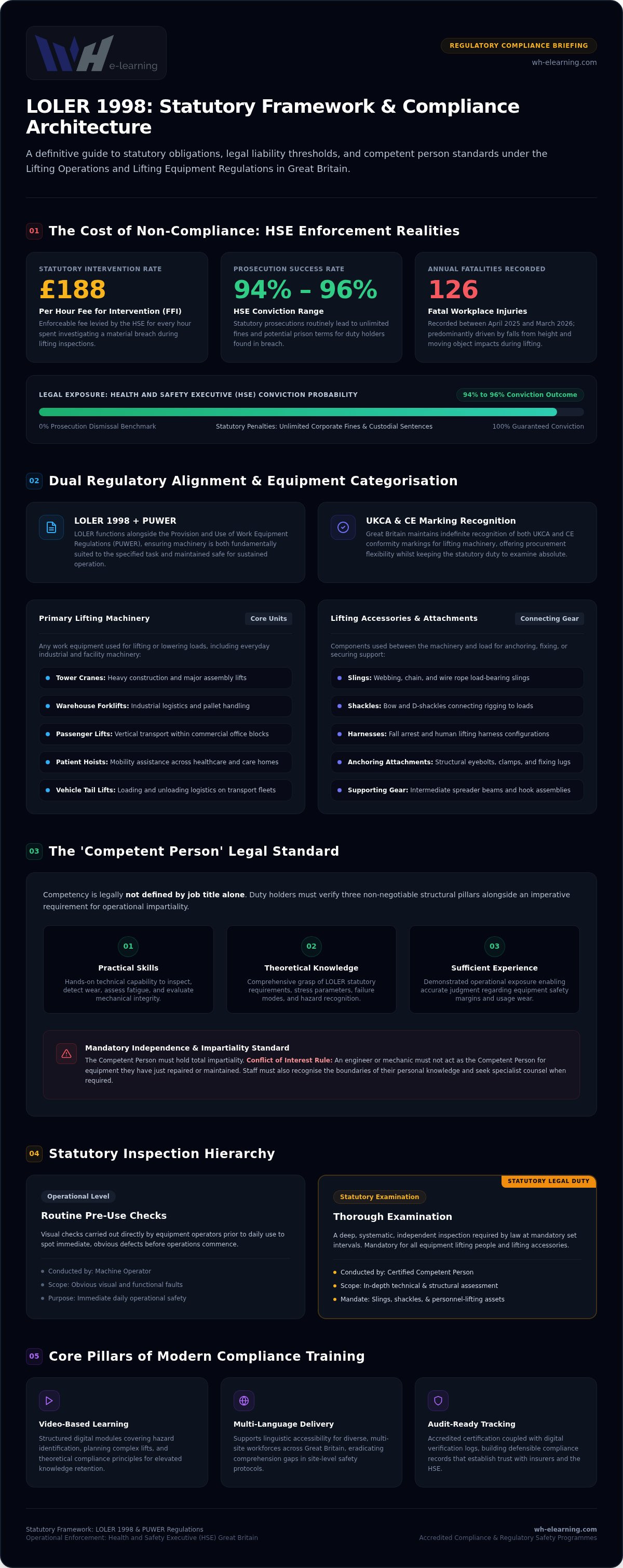
The Lifting Operations and Lifting Equipment Regulations 1998, commonly known as LOLER, place specific duties on people and companies who own, operate, or have control over lifting equipment. Even in 2026, following a comprehensive HSE review cycle, these regulations remain the definitive standard for ensuring lifting safety across Great Britain. Whilst the government recently evaluated modernisation through digital sensors and telemetry, the core legal duties of LOLER 1998 stay fully enforceable and active. These rules don't exist in isolation; they work alongside the Provision and Use of Work Equipment Regulations (PUWER) to ensure that all machinery is both suitable for its task and safe for continued use.
Ignoring these requirements carries heavy risks. HSE data shows that 126 workers were killed in workplace accidents between April 2025 and March 2026; many of these incidents involved falls from height or being struck by moving objects during lifting operations. With the HSE Fee for Intervention (FFI) now at £188 per hour as of April 2026, the cost of a material breach adds up quickly. Beyond the financial drain, the HSE maintains a 94% to 96% conviction rate for health and safety prosecutions, often resulting in unlimited fines or prison terms. Enrolling your team in a professional LOLER regulations training course is the most effective way to avoid these pitfalls.
What Qualifies as Lifting Equipment?
Lifting equipment includes any work equipment used for lifting or lowering loads, including the attachments used for anchoring, fixing, or supporting it. It's vital to distinguish between the primary machinery, such as a tower crane or a warehouse forklift, and lifting accessories like slings, shackles, and harnesses. In 2026, we see "hidden" lifting equipment in almost every sector; think of passenger lifts in office blocks, patient hoists in care homes, or tail lifts on delivery vehicles. All of these require the same rigorous inspection schedule to remain compliant and safe for daily use.
The Scope of LOLER Regulations
These regulations apply across all sectors, covering employers, the self-employed, and even those who hire out equipment. Whether you operate a single site or manage a diverse workforce across the UK, the standards remain consistent. With the indefinite recognition of both UKCA and CE marking for lifting machinery in Great Britain, equipment sourcing is flexible, but the duty to inspect is absolute. Completing a LOLER regulations training course ensures your duty holders understand these geographic and legal boundaries. The primary objective of LOLER is to ensure that all lifting operations are planned by a competent person, supervised appropriately, and carried out in a safe manner to minimise the risk of injury.
The 'Competent Person' Standard and Legal Duties
Appointing a 'Competent Person' is one of the most critical duties under the 1998 regulations, yet it remains a frequent point of confusion for duty holders. Many businesses mistakenly believe that any experienced engineer or site manager automatically qualifies. According to HSE guidance on LOLER compliance, competency is not defined by a job title alone. It relies on three essential pillars: practical skills, theoretical knowledge, and sufficient experience. Crucially, this person must also possess the independence to make impartial judgements. For example, a mechanic shouldn't act as the competent person for equipment they have just repaired, as this creates a conflict of interest that could compromise safety.
Employers have a strict legal responsibility to verify these traits before assigning inspection tasks. You must ensure your staff understand the limits of their own knowledge and when to seek specialist advice. A LOLER regulations training course provides the necessary theoretical foundation to underpin this practical expertise, helping staff identify hazards that aren't always visible to the untrained eye. It's your job to keep an updated record of who has been authorised to perform these duties and to ensure their training remains current as technology evolves.
Thorough Examination and Inspection Requirements
There's a significant legal difference between a routine pre-use check and a statutory Thorough Examination. Pre-use checks are simple visual assessments carried out by the operator to catch obvious defects. A Thorough Examination is a much deeper, systematic inspection required by law at set intervals. For any equipment lifting people or for lifting accessories like slings and shackles, this must happen every 6 months. For all other lifting machinery, such as standard forklifts or cranes, the interval is every 12 months. If a serious defect is found, the competent person must report it to the HSE within 28 days. Your digital logs must show a clear, unbroken history of these reports to satisfy auditors during a site visit.
Planning and Supervising Lifting Operations
Every lifting operation must be planned, supervised, and carried out safely. For routine lifts, this might involve a standard operating procedure, but complex or high-risk lifts require a detailed, written lifting plan. This document should outline the equipment used, the weight of the load, and the specific path the lift will take. The supervisor's role is to ensure the team follows this plan exactly whilst remaining alert to environmental changes like high winds or ground instability. Taking an accredited LOLER training programme ensures your supervisors have the confidence to stop a lift if conditions become unsafe, protecting both your workforce and your business from legal exposure.
What a LOLER Regulations Training Course Covers
A high-quality LOLER regulations training course bridges the gap between basic awareness and professional competency. It begins with the broad legal framework of the Health and Safety at Work etc. Act 1974 before diving into the specifics of Statutory Instrument 1998 No. 2307. This foundation ensures that every team member understands their personal and corporate liability. From there, the training shifts to practical hazard identification. You'll learn to spot early signs of wear in accessories and recognise the physical principles that keep a load stable, such as the centre of gravity and the base of support.
Effective training also focuses on the mechanics of safe lifting. Understanding how load weight interacts with equipment stability is vital for preventing overturns or structural failures. Operators gain the skills to perform rigorous pre-use inspection protocols, ensuring that every piece of gear is fit for purpose before work starts. This proactive approach encourages a culture where reporting defects is second nature, stopping potential accidents before they happen.
Core Syllabus Modules
The syllabus typically breaks down complex legal text into digestible, actionable modules. Module 1 focuses on Regulation 8, which dictates how to plan lifting operations so they remain safe and supervised. Module 2 covers Regulation 9, detailing the mandatory Thorough Examination intervals and the reporting of serious defects. Module 3 addresses equipment marking; it's vital that staff can interpret the Safe Working Load (SWL) for various configurations to avoid overloading machinery.
Assessing Risks in Lifting Operations
Risk assessment is not a static document but a continuous process. Whilst routine lifts might follow a standard template, non-routine operations require a dynamic approach that considers changing variables. A comprehensive LOLER regulations training course teaches you to evaluate the environment before the first lift begins. You must account for soft ground conditions that could cause a crane to topple, overhead power lines that pose an electrocution risk, and wind speeds that affect load stability. The SWL mark serves as a non-negotiable safety limit that ensures equipment is never pushed beyond its engineered capacity during these operations.
Why Online LOLER Training is the Modern Compliance Standard
Traditional classroom settings often struggle to keep pace with the demands of modern industry. Many organisations are now adopting a hybrid approach where the complex theoretical components of a LOLER regulations training course are delivered online, leaving only specific equipment-based practicals for on-site sessions. This shift ensures that every worker starts from the same high-quality knowledge base. Video-based learning is particularly effective for technical safety information, as it allows staff to see equipment failures and correct procedures in a controlled, visual format that sticks in the memory far longer than a text-heavy manual.
Scalability is another major advantage for businesses with diverse or international workforces. With machine translation available in over 25 languages, a single platform can provide standardised training to teams across the globe. It's a far more cost-effective solution than hiring multiple face-to-face trainers for different sites. You save on travel expenses and downtime whilst ensuring that every employee receives identical, specialist-led instruction.
Tracking Compliance and Progress
Maintaining an audit-ready trail is much easier when you use a Learning Management System (LMS). You can track staff training progress in real-time across multiple departments, ensuring that no one is operating machinery without the proper certification. Automated reminders for refresher sessions mean you'll never face a gap in your legal coverage. This digital approach allows you to integrate your lifting safety requirements into a wider workplace compliance training strategy, giving you a holistic view of your company's safety health.
Accessibility and Inclusivity in Training
Inclusivity is no longer optional in professional development. Modern online courses include closed captions and clear machine translations to support staff who speak English as a second language. Mobile-friendly platforms allow workers to complete their modules on-site or during a quiet moment in the office, reducing the friction often associated with meeting professional standards. This level of accessibility ensures that safety knowledge isn't gatekept by location or language barriers. It's about empowering every member of your team to contribute to a safer workplace.
Ready to streamline your safety records? You can explore our accredited online health and safety courses to get started today.
Accredited LOLER Training with WH eLearning
WH eLearning provides a comprehensive LOLER regulations training course designed to meet the rigorous standards of 2026. Our video-based modules are led by industry specialists, ensuring that technical safety information is presented in a clear, engaging way. By choosing an accredited programme, you aren't just training your staff; you're building a verifiable wall of compliance that satisfies both insurers and HSE inspectors. This digital certification serves as concrete evidence of your commitment to safety. It's a vital asset when navigating a landscape where material breaches lead to significant financial and legal consequences.
For managers looking to strengthen their entire safety culture, lifting operations are often just one piece of the puzzle. It's beneficial to pair specific technical training with a broader occupational safety and health training course. This wider perspective allows you to manage risks across all departments, ensuring that LOLER compliance is integrated into your general health and safety management system rather than sitting in a silo. We believe that professional growth should be accessible, so we've designed our courses to be as straightforward as they are thorough.
The WH eLearning Advantage
Our platform is built for the modern professional who values efficiency and quality. Every course in our library can be integrated into our wider business compliance e-learning suites. This means you can manage all your staff training from a single, intuitive dashboard. Our guides are modern experts who understand that your time is valuable. We focus on removing obstacles to learning so your team can reach practical competency faster. Whether you're a small business or a large warehouse operation, our flexible licensing options scale to fit your specific needs.
Getting Started with Your Team
Enrolling your workforce is a simple, frictionless process. You can choose to enrol individual learners for immediate certification or organise bulk corporate access for your entire department. This allows you to track progress across multi-site operations and ensure every worker is up to date with their refresher training. Once the online theory is complete, your team will have the confidence and knowledge to apply these safety principles in real-world lifting scenarios. It's a seamless path from meeting professional standards to maintaining a safer workplace.
If you're unsure where to start structuring your workforce qualifications, explore our practical workplace safety management guides to see how a LOLER regulations training course fits into your broader team development plan.
Securing Your Safety Standards for 2026
Mastering the 1998 regulations is about more than avoiding enforcement action; it's about fostering a culture where every lift is planned and executed with precision. You now have a clear roadmap to navigate Thorough Examination intervals and the specific criteria for competency. Transitioning to a digital training model allows you to track progress effortlessly whilst providing high-quality, expert-led instruction to a diverse workforce. Investing in specialist-led education provides the technical foundation your team needs to identify hazards before they lead to incidents and costly downtime.
Our platform is accredited by leading UK safety bodies and trusted by thousands of organisations worldwide. We offer video-based learning with machine translation into 25+ languages, making it easier than ever to standardise safety across multiple sites. Take the next step in your professional development and ensure your lifting operations remain a benchmark for safety and efficiency. Secure your team's compliance with our LOLER regulations training course today and build a safer, more resilient business for the future.
Frequently Asked Questions
What is a LOLER regulations training course?
It is a structured educational programme designed to teach duty holders and operators their legal obligations under the Lifting Operations and Lifting Equipment Regulations 1998. The course covers everything from hazard identification and risk assessment to the planning of complex lifting operations. By completing a LOLER regulations training course, staff learn how to ensure equipment is fit for purpose and that all lifting tasks are carried out safely and legally.
Is online LOLER training legally sufficient for my employees?
Online training is legally sufficient for the theoretical components of the regulations, such as understanding legal duties and statutory inspection intervals. However, the HSE often recommends a blended approach where e-learning is supplemented by practical, on-site competency assessments. This ensures that whilst staff understand the law, they also possess the physical skills to operate specific machinery safely. It's a highly efficient way to standardise knowledge across a large, multi-site workforce.
How often should staff undergo LOLER refresher training?
There is no fixed statutory interval for refresher training, but industry best practice suggests a review every three years. You should also provide training if there are changes to lifting equipment, new working methods, or if an incident suggests a gap in knowledge. Regular refreshers ensure that safety remains a priority and that your team stays updated on the latest HSE guidance and technological advancements in lifting safety and digital reporting.
What is the difference between LOLER and PUWER?
PUWER (Provision and Use of Work Equipment Regulations) applies to all work equipment, ensuring it is suitable and safe for use. LOLER specifically targets lifting equipment and operations, adding extra layers of requirements for planning, supervision, and thorough examinations. Essentially, all lifting equipment must comply with PUWER, but only equipment used for lifting and lowering loads falls under the additional, more stringent remit of the LOLER regulations to manage the higher risks involved.
Who is considered a 'Competent Person' under LOLER?
A Competent Person is someone with the practical and theoretical knowledge, plus the experience, to detect defects or weaknesses in lifting equipment. They must be sufficiently independent and impartial to allow them to make objective decisions. This independence is vital; the person performing a Thorough Examination should not be the same individual responsible for the routine maintenance of that specific piece of equipment to avoid any conflicts of interest during the safety sign-off.
Does LOLER training cover lifting accessories like slings and shackles?
Yes, a comprehensive LOLER regulations training course must cover lifting accessories as they are frequently involved in workplace accidents. Accessories include items like slings, shackles, chains, and eyebolts used to connect the load to the lifting machinery. Because these items face significant wear and tear, they require more frequent Thorough Examinations; specifically every six months; to ensure they remain safe for continued use in the workplace and don't fail under load.
What are the Thorough Examination intervals for lifting equipment?
Statutory intervals are determined by the type of equipment and its use. Equipment used for lifting people and all lifting accessories must be examined every 6 months. For all other lifting machinery, such as standard forklift trucks or overhead cranes, the interval is every 12 months. An alternative examination scheme can be drawn up by a competent person if they believe different intervals are more appropriate for specific site conditions or equipment usage patterns.
How do I track my team's LOLER training compliance?
The most effective way to track compliance is through a Learning Management System (LMS) that provides real-time data on course completions. You can monitor progress across different departments and set automated reminders for upcoming refresher dates. This digital approach creates an audit-ready trail that is easily accessible during HSE inspections, proving that your staff have received the necessary training to manage lifting risks effectively and maintain full legal compliance.


