

Did you know that over 30% of major hazardous plant incidents are attributed to communication breakdowns during shift handovers or conflicting permits? It's a sobering reality for any safety manager. You likely recognise the daily tension between maintaining operational speed and ensuring every high-risk task is strictly controlled. Most professionals agree that a permit isn't just an administrative hurdle; it's a vital life-saving protocol. However, implementing effective permit to work system training across multiple sites often feels like a constant battle against confusion and human error.
This guide empowers you to master these complexities and transform your safety culture. You'll learn how to implement accredited training that ensures both workplace safety and rigorous regulatory compliance for 2026. We'll explore the legalities of HSG250, clarify the differences between permit types like hot work and confined space, and show you how a digital-first approach can streamline your tracking. By the end, you'll have a clear roadmap to reduce incident rates and build a team that's truly competent, not just compliant. We believe that meeting high standards should feel like a step forward, not a barrier to your progress.
Key Takeaways
- Understand how Permit to Work systems act as a formal safety shield for high-risk activities whilst ensuring your organisation remains fully compliant with current UK safety legislation.
- Clarify the distinct responsibilities between the Authorising and Performing Authorities to eliminate communication gaps that often lead to preventable workplace accidents.
- Discover how to implement accredited permit to work system training that uses engaging, video-based modules to improve staff competence and safety protocol retention.
- Learn to streamline compliance across global sites by utilising digital training platforms that offer multi-language support and automated administrative tracking for your entire workforce.
- Identify the critical authorisation steps and physical components required for a valid permit to ensure every high-risk task is properly vetted before any work begins.
What is a Permit to Work (PTW) and Why is Training Vital?
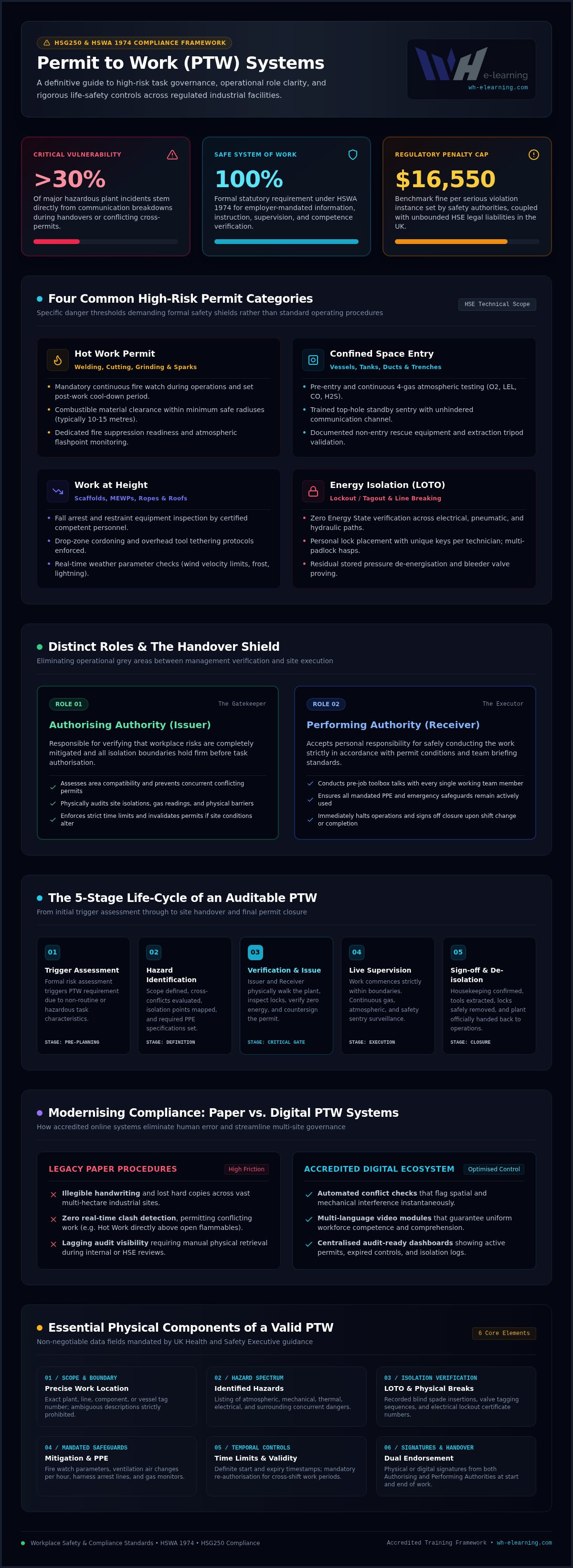
A Permit to Work (PTW) is much more than a simple piece of paper or a digital tick-box exercise. It's a formal, documented communication process designed to prevent accidents during high-risk activities. By using a PTW, you ensure that everyone involved understands the specific hazards and the strict controls required to stay safe. It's the final gatekeeper in your safety strategy, ensuring that hazardous tasks only proceed when it's safe to do so.
In the UK, the Health and Safety at Work Act (HSWA) 1974 places a clear duty on employers to ensure the health, safety, and welfare of their staff. Modern permit-to-work systems serve as a core component of a broader Safe System of Work (SSOW). They provide a structured framework where work is only authorised after a thorough check of the environment, equipment, and personnel. The primary goal is simple: ensure every hazard is identified and controlled before a single tool is lifted.
The Legal Requirement for Competence
Legal standards require you to provide "information, instruction, and training" to your workforce. Competence is the essential benchmark here. If a supervisor issues a permit or a contractor receives one without proper permit to work system training, the entire safety chain breaks. The consequences of failing to ensure this competence are severe. Beyond the human cost, the HSE can impose substantial fines. For context, equivalent global regulators like OSHA have set maximum penalties for serious violations at $16,550 per instance as of 2026. By using a provider like WH eLearning, you ensure your staff meet these legal benchmarks through accredited, video-based learning that simplifies complex compliance rules.
When is a Permit to Work Required?
Not every task needs a permit. PTWs are typically reserved for non-routine, high-risk scenarios where standard operating procedures aren't enough to guarantee safety. Common examples include:
- Hot work involving sparks, naked flames, or welding.
- Entry into confined spaces with limited oxygen or potential toxic gases.
- Complex work at height where falls could result in serious injury.
- Energy isolation (Lockout/Tagout) during machinery maintenance or line breaking.
A robust risk assessment is what triggers the requirement for a permit. It's the mechanism that identifies when a task's complexity or danger level necessitates this extra layer of formal authorisation. Implementing permit to work system training ensures your team can recognise these triggers, preventing high-risk work from being carried out under standard, less-rigorous procedures.
Essential Components and Types of Work Permits
A permit to work is more than a checklist; it's a dynamic safety contract between those managing the site and those performing the task. Every effective permit must clearly identify the scope of work, the specific hazards involved, and the essential precautions required to mitigate risk. This documentation ensures that nothing is left to chance. According to the HSE guidance on permit-to-work systems, the physical permit serves as a primary tool for coordinating activities and preventing conflicting tasks.
The authorisation phase is critical. This is where a competent Issuer verifies that all isolations are in place and that the site is truly safe for work to begin. It's not just a signature. It is a confirmation of reality. Equally important is the time-limited nature of these documents. Permits must reflect current site conditions. A permit issued in the morning may no longer be valid if weather conditions change or if other high-risk tasks start nearby. Comprehensive permit to work system training helps staff understand why these time limits and authorisation steps are non-negotiable.
Common High-Risk Permit Categories
Different tasks carry unique dangers, requiring specialised permits. Hot Work permits focus on fire prevention during welding or grinding, often mandating a fire watch period after work stops. Confined Space permits manage atmospheric hazards and ensure rescue protocols are ready. Electrical Work permits are vital for ensuring Lock Out Tag Out (LOTO) procedures remain secure, preventing the accidental re-energisation of machinery whilst work is in progress. To ensure your team understands these specific categories, consider professional health and safety training courses that cover these high-risk scenarios in detail.
The Lifecycle of a Permit
A permit follows a strict three-step lifecycle to close the safety loop successfully. The first step is the Issue, where the scope and duration are defined. Next is Acceptance, where the performer confirms they fully understand the controls. Finally, the Return/Cancellation phase confirms the work is complete and the site is returned to a safe state. This final step is vital. It ensures all tools are removed and that equipment is fit for service before being reconnected. High-quality permit to work system training ensures that every person in the chain understands their role in this lifecycle, reducing the risk of a communication breakdown that could lead to a serious incident.
Defining Key Roles and Responsibilities in PTW Training
Success in high-risk environments depends on everyone knowing exactly where they stand. A Permit to Work (PTW) system functions like a relay race; the baton of safety must be passed clearly between specific roles. Effective permit to work system training ensures that these individuals don't just know the rules, but understand their unique legal and operational duties. When roles are blurred, communication breaks down, and that's when accidents happen.
The system relies on two primary figures: the Authorising Authority (Issuer) and the Performing Authority (Receiver). The Issuer is typically a manager or supervisor who has the power to grant permission. They're responsible for verifying that all isolations are secure and the area is safe. Conversely, the Receiver is the person in charge of the work party. They must confirm they understand the hazards and controls before work starts. A 'Competent Person' often bridges these roles by conducting the initial risk assessment, whilst the Site Supervisor monitors ongoing behaviour to ensure the permit's conditions aren't ignored once the task begins.
Training for Permit Issuers
Issuers carry a heavy weight of responsibility. Their training focuses on hazard identification, rigorous site inspection techniques, and the legal accountability that comes with signing off on a high-risk task. They must have the confidence to revoke a permit immediately if site conditions change or if unforeseen risks emerge. Because a permit is only as good as the analysis behind it, completing risk assessment training online is an essential prerequisite for anyone in this role. This ensures the Issuer can accurately evaluate the environment before any work is authorised.
Training for Permit Receivers and Workers
For those on the ground, training prioritises the practical application of safety controls. Receivers must be able to interpret every requirement listed on the permit, from specific PPE to atmospheric monitoring. A core part of modern permit to work system training is the 'stop-work authority'. Every worker should feel empowered to halt a task if they believe the environment has become unsafe. This is especially vital in high-stakes scenarios, such as those outlined in the OSHA standard for permit-required confined spaces, where duties for entrants and attendants are strictly defined. Finally, training must cover the handover process, ensuring that safety remains consistent when shifts change or a task is passed to a new team.
Best Practices for Implementing Online PTW Training Programmes
Implementing a robust permit to work system training programme requires more than just assigning a few modules to your team. To truly reduce risk, you must select accredited courses that meet recognised industry standards. Video-based learning is particularly effective for this. It transforms complex safety protocols into digestible, visual content, which significantly improves retention compared to traditional text-heavy alternatives. By using a centralised tracking system, you can monitor staff progress in real-time and ensure that no one steps onto a high-risk site with an expired certificate.
Whilst online theory provides the essential legal and procedural foundation, it works best as part of a blended approach. We recommend pairing your digital modules with site-specific practical inductions. This ensures workers can apply their theoretical knowledge to the actual machinery and environments they'll encounter daily. This combination of standardisation and local context creates a much stronger safety culture than either method could achieve alone.
Overcoming the Language Barrier in Safety
Safety is a universal requirement, yet language barriers often create dangerous blind spots in multi-national workforces. Training a diverse team in a single language they might not fully master is a significant risk. Utilising multi-language e-learning courses for PTW systems ensures that every safety detail is understood. Features like machine translation and closed captions in over 25 languages mean that vital instructions regarding isolations or emergency protocols are never lost in translation. This inclusivity doesn't just meet compliance; it saves lives by ensuring everyone is on the same page.
Auditing and Refreshing Training
Complacency is often the silent enemy of workplace safety. Establishing a regular refresher cycle, typically every two to three years, keeps safety protocols fresh in the minds of your staff. Digital assessments are an excellent tool for this. They allow you to identify specific knowledge gaps within departments before they lead to an incident. Where possible, link these training records directly to site access permissions. This automated gatekeeping ensures that only those with valid, up-to-date training can sign off or receive a permit. To begin modernising your approach, you can explore our full library of accredited health and safety training online.
Elevating Safety Standards with WH eLearning Compliance Training
Meeting modern safety standards requires a partner who understands the balance between rigorous compliance and operational efficiency. WH eLearning simplifies this journey with a library of over 100 accredited workplace safety courses designed for the modern professional. By moving away from dense, text-heavy manuals, our video-based format makes complex PTW concepts accessible and engaging for every employee. This visual approach ensures that critical safety steps are not just read, but truly understood and retained.
Our platform is built to support global organisations. With 25+ language options available for every module, you can standardise your permit to work system training across diverse sites without the risk of communication gaps. This global reach, combined with corporate licensing options, allows you to manage large-scale safety transitions with quiet confidence. We position ourselves as a facilitator of your growth, removing the obstacles often associated with professional development and regulatory requirements.
Scalable Solutions for Global Teams
Managing compliance for a large workforce shouldn't be an administrative nightmare. Our platform allows you to organise bulk training and monitor progress via a single, centralised dashboard. You can track compliance status in real-time, receiving automated alerts when certifications are due for renewal. This level of oversight reduces the administrative burden on your safety team, allowing them to focus on site-specific risks. For organisations with highly specialised or complex site requirements, we also offer in-house health and safety training to provide a tailored, face-to-face experience when needed.
Accredited Excellence for Peace of Mind
Choosing an accredited provider like WH eLearning ensures your organisation remains on the right side of the law. Our permit to work system training aligns with international standards, providing you with the peace of mind that your team's competence is verified. In the event of an HSE inspection, our digital certification provides an instant, unalterable audit trail. This transparency demonstrates your commitment to high safety standards and simplifies the reporting process. Ready to empower your team and streamline your compliance? Browse our full range of workplace safety courses to find the perfect fit for your organisation's needs.
Securing Your Future with Advanced Safety Standards
Mastering permit systems is about more than avoiding fines; it's about protecting your team and streamlining your operations for 2026 and beyond. We've explored how defining clear roles and implementing rigorous authorisation steps can prevent the communication breakdowns that often lead to site incidents. By adopting a digital-first approach, you ensure that your safety protocols are accessible to every worker, regardless of their location or primary language.
Investing in accredited permit to work system training is the most effective way to build a culture of competence and trust across your organisation. WH eLearning provides a seamless path to meeting high standards through video-based learning and support for 25+ languages. Our courses are accredited by leading safety bodies and trusted by global organisations to manage multi-site compliance with ease. Secure your organisation's safety with accredited PTW training today and take the friction out of professional requirements. Your journey towards a safer, more efficient workplace begins with a reliable partner dedicated to your progress.
Frequently Asked Questions
What is the difference between a permit to work and a risk assessment?
A risk assessment is the foundation that identifies hazards, whilst a permit to work is the formal authorisation to carry out a specific high-risk task. Think of the assessment as the "why" and the permit as the "how" and "when". The permit ensures all control measures identified in the assessment are physically in place before work starts. It's a dynamic communication tool, whereas a risk assessment is often a broader planning document.
How long is a permit to work training certificate valid for?
There's no fixed legal expiry for these certificates, but industry best practice suggests a refresher every two to three years. Safety protocols and digital systems evolve, so regular permit to work system training prevents complacency amongst staff. Organisations often set their own internal renewal dates to ensure everyone remains competent. If your site conditions change significantly, you should consider more frequent updates to keep safety knowledge current.
Is online permit to work training legally sufficient in the UK?
Yes, online training is legally sufficient for meeting the "information, instruction, and training" requirements under the Health and Safety at Work Act. It provides a robust, standardised foundation of theoretical and legal knowledge. However, employers should ideally use a blended approach. This involves pairing online modules with site-specific inductions to ensure workers understand the unique practical hazards of their physical environment. This combination ensures full compliance and maximum safety.
What are the five main types of permit to work?
Whilst specific sites may vary, the five most common types of permit to work include:
- Hot Work: For tasks involving flames or sparks.
- Confined Space: For entry into restricted, hazardous atmospheres.
- Electrical: For work on high-voltage equipment or isolations.
- Work at Height: For tasks where fall risks are significant.
- Excavation: For digging or ground-breaking activities.
Each type requires specific controls and competent authorisation to ensure the safety of the work party.
Who is responsible for issuing a permit to work on a construction site?
The responsibility lies with the Authorising Authority, usually a site manager, supervisor, or designated safety officer. This individual must possess the necessary competence to verify that all safety precautions are in place before work begins. They're not just signing a form; they're confirming that the site is safe. On construction sites, this person is often appointed by the principal contractor to maintain oversight of all high-risk activities.
Can I use the same permit for different high-risk tasks?
No, you cannot use a single permit for multiple high-risk tasks. Each activity carries its own unique set of hazards and requires specific control measures. For example, the precautions for a confined space entry are entirely different from those needed for hot work. Issuing separate permits ensures that every risk is individually assessed and managed. This clarity prevents confusion and ensures that workers follow the correct safety protocols for their specific task.
What happens if a worker violates the conditions of a permit?
If a worker violates a permit condition, work must stop immediately. The permit is typically revoked, and the site is made safe before an investigation takes place. Consequences can range from internal disciplinary action to legal prosecution if the breach leads to a serious incident. Regular permit to work system training is vital here. It ensures staff understand that permit conditions are non-negotiable safety requirements, not mere suggestions for the workforce.
How does multi-language training improve permit to work compliance?
Multi-language training ensures that every worker, regardless of their native tongue, fully understands the safety protocols and stop-work triggers. It eliminates the dangerous guesswork that occurs when non-native speakers struggle with complex technical jargon. By providing modules in over 25 languages, WH eLearning helps organisations standardise safety across global sites. This inclusive approach reduces the risk of communication errors during shift handovers and significantly improves overall site compliance and worker safety.


