

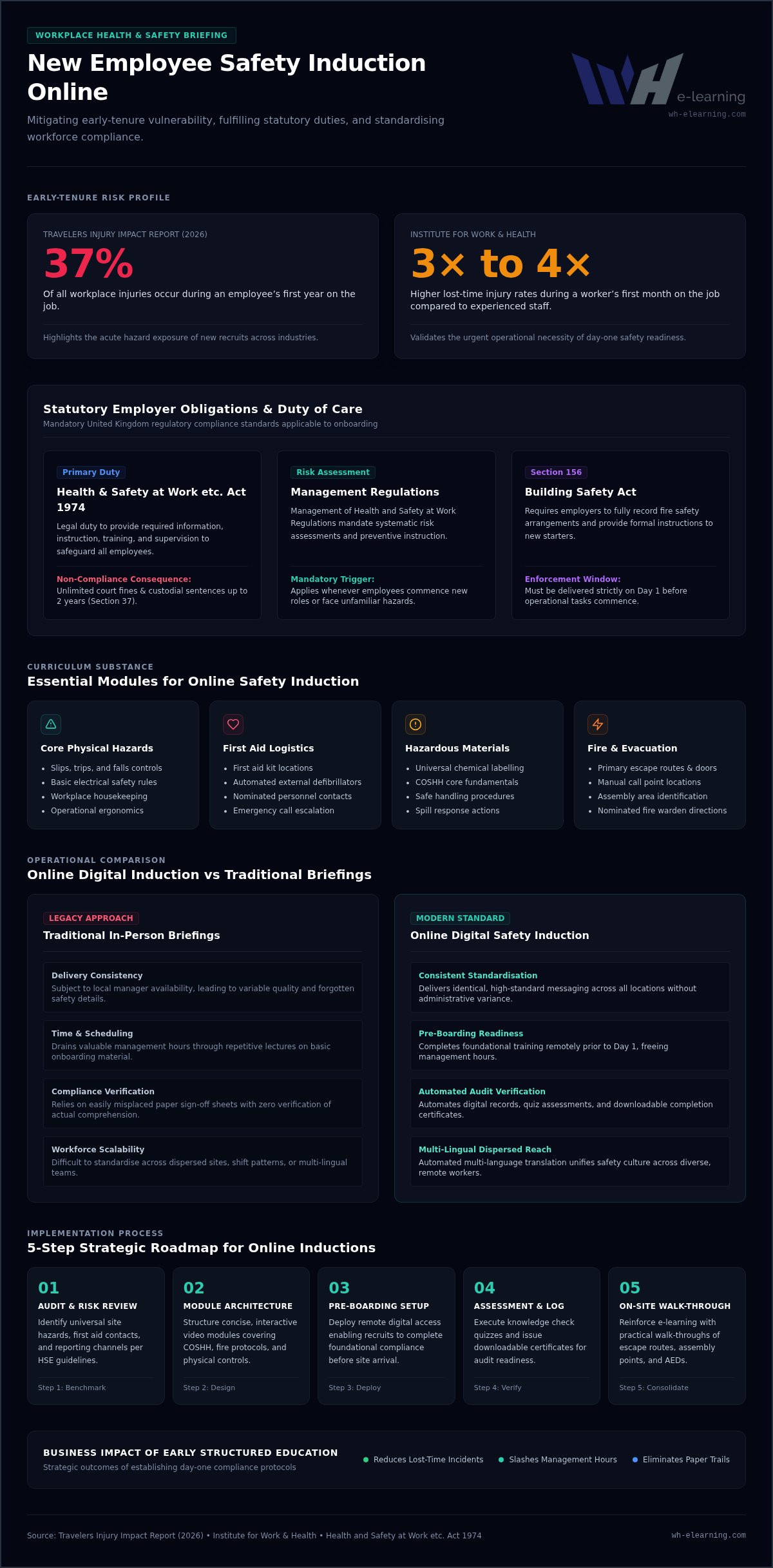
According to the 2026 Travelers Injury Impact Report, 37% of all workplace injuries occur during an employee's first year on the job. You already know the friction of traditional onboarding: repetitive in-person briefings drain valuable management hours, whilst the nagging fear remains that staff merely click through slides without absorbing vital safety procedures. When managing multi-lingual or dispersed teams, standardising safety messaging feels even harder. Rolling out a robust new employee safety induction online transforms this vulnerable transition into an empowering, audit-ready process before recruits even set foot on site.
In this guide, you'll discover how to deliver an engaging, legally compliant online safety induction for new employees that cuts onboarding time whilst thoroughly safeguarding your organisation. We'll examine core statutory requirements, demonstrate how to balance digital modules with practical walk-throughs, and share a five-step roadmap to standardise compliance across your entire workforce.
Key Takeaways
- Understand statutory duty-of-care requirements under the Health and Safety at Work etc. Act 1974, ensuring total legal compliance before a recruit's first day.
- Establish an essential curriculum covering emergency evacuation, incident reporting, and hazard management across office, remote, and operational environments.
- Compare digital delivery against traditional classroom briefings to see how interactive video modules boost knowledge retention whilst slashing management hours.
- Follow a proven five-step roadmap to implement an engaging new employee safety induction online that eliminates administrative overhead.
- Discover how accredited training with automated multi-language translation standardises safety culture across dispersed and diverse workforces.
What Is an Online Safety Induction for New Employees?
A digital safety induction is a structured e-learning workflow designed to educate new hires on core hazard controls, operational risks, and site protocols before they commence work. Rather than reducing onboarding to a passive digital tick-box or basic visitor sign-in gate, it serves as structured employee induction training that builds working knowledge. Traditional paper booklets and monotone classroom lectures often overwhelm recruits on their first morning. In contrast, modern e-learning leverages concise, interactive video modules that establish an immediate, visible culture of safety across your entire organisation.
Deploying a new employee safety induction online provides clear commercial advantages:
- Consistent standardisation: Delivers the exact same high-standard safety messaging across multiple locations without relying on busy local managers.
- Pre-boarding readiness: Enables recruits to complete foundational health and safety training remotely, ensuring day-one operational readiness.
- Automated verification: Replaces lost paper sign-off sheets with digital records, quiz results, and downloadable completion certificates.
Statutory Employer Obligations and the Duty of Care
Under the Health and Safety at Work etc. Act 1974, employers have an uncompromising legal obligation to provide the necessary information, instruction, training, and supervision to protect staff. The Management of Health and Safety at Work Regulations reinforces this duty by requiring systematic risk assessments and relevant preventive training whenever employees take on new roles or encounter unfamiliar operational hazards. Aligning digital inductions with broader frameworks for mastering workplace compliance ensures your organisation meets statutory duty-of-care benchmarks before Day 1.
The Measurable Cost of Inadequate Day-One Safety Onboarding
Research from the Institute for Work & Health reveals that workers face lost-time injury rates three to four times higher during their first month on the job than experienced colleagues. Failing to deliver structured safety education leaves your organisation vulnerable to severe enforcement action. Breaches under the Health and Safety at Work Act carry unlimited court fines and potential custodial sentences of up to two years under Section 37. Beyond regulatory penalties, inadequate day-one onboarding triggers insurance premium spikes, operational downtime, and lost staff morale. Providing an engaging new employee safety induction online removes operational anxiety, giving new starters the psychological confidence to navigate their environment safely.
Essential Topics Every Online Safety Induction Must Cover
Proprietary software tools often focus heavily on portal logins while ignoring curriculum substance. A truly compliant programme delivers instructional depth that protects workers across office, remote, and operational roles. In line with official HSE guidance on protecting new workers, induction training must directly target early-tenure vulnerability by clearly outlining universal hazards, first aid contacts, and reporting channels before tasks begin. Structuring a comprehensive curriculum with accredited workplace safety training courses ensures your recruits develop an immediate awareness of their day-to-day surroundings.
Every effective digital programme builds on several non-negotiable fundamentals:
- Core physical hazards: Practical controls for slips, trips, falls, and basic electrical safety.
- First aid logistics: Locations of first aid kits, automated external defibrillators (AEDs), and nominated personnel.
- Hazardous materials: Universal chemical labelling and Control of Substances Hazardous to Health (COSHH) basics.
Emergency Procedures and Fire Safety Protocols
Under Section 156 of the Building Safety Act, UK employers must record fire safety arrangements in full and instruct all new starters on day one. Your digital modules need to walk learners through identifying primary escape routes, fire doors, and manual call points. Recruits must understand exact evacuation procedures, designated assembly areas, and how to follow instructions from nominated fire marshals during emergency roll calls.
Ergonomics, Manual Handling, and Workstation Health
Musculoskeletal disorders account for substantial lost workdays across both physical and desk environments. Training should demonstrate safe lifting mechanics, load assessment, and spine protection techniques. For remote and hybrid personnel, modules must guide display screen equipment (DSE) workstation setups, chair adjustments, and screen positioning, while offering clear mechanisms to report physical discomfort or faulty gear.
Incident Reporting and Whistleblowing Channels
Open communication prevents minor hazards from escalating into major disasters. Inductions must instruct new starters on reporting near-misses and hazards under RIDDOR (Reporting of Injuries, Diseases and Dangerous Occurrences Regulations) frameworks. A transparent, no-blame culture encourages workers to log concerns immediately without fear of reprisal. If you want to standardise these topics seamlessly, you can explore accredited modules on wh-elearning.com to build an effective new employee safety induction online.
Online Safety Inductions vs In-Person Briefings: A Comparative Analysis
Traditional classroom briefings often drain operational resources without guaranteeing comprehension. Busy managers rush through slide decks, while fatigued recruits struggle to absorb complex rules. Conversely, passive online tick-box forms encourage mindless clicking. Modern safety leadership solves this dilemma through accredited, video-driven e-learning paired with practical on-site orientation. Aligning your onboarding structure with established OSHA safety education and training practices confirms that interactive, self-paced instruction fosters genuine hazard recognition far better than uninspired lectures.
Research from the Institute for Work & Health shows that self-directed digital learning matches classroom instruction for baseline knowledge retention, trailing by an insignificant 2.5%. Yet interactive digital multimedia and microlearning can elevate retention to between 25% and 60%, compared to single-digit retention from passive speeches. A blended delivery framework provides the perfect balance: theoretical compliance is mastered digitally, leaving practical machinery walk-throughs and PPE fitting for the workplace floor.
Delivery Consistency and Standardised Safety Messaging
In-person briefings vary wildly depending on who leads them. Stressed supervisors frequently rush explanations or accidentally omit critical guidelines when production demands mount. Deploying a structured new employee safety induction online eliminates human error entirely. Every recruit receives the identical high-calibre instruction, clear visual hazard examples, and precise procedural demonstrations, regardless of their location or start date.
Audit Readiness and Verifiable Digital Records
Paper sign-in sheets get misplaced, coffee-stained, or filed incorrectly. Digital induction platforms automatically log exact timestamps, assessment pass marks, and identity verifications into tamper-evident cloud records. During an HSE inspection or insurance review, compliance managers can pull up verifiable digital completion certificates instantly. That level of transparency provides ironclad proof that your statutory duty of care was fulfilled before work began.
Time-to-Productivity and Business Cost Efficiencies
Pre-boarding digital modules turn Day 1 from a gruelling lecture marathon into an active, productive shift. Completing theoretical modules from home ensures staff arrive informed and ready to work safely. Management recovers dozens of lost briefing hours every month, allowing senior staff to focus on mentoring rather than repeating basic rules. As seasonal hiring surges or contractor intake expands, a new employee safety induction online scales effortlessly across hundreds of learners without increasing overheads or stretching internal resources.
How to Implement an Effective Online Safety Induction in 5 Steps
Simply uploading old PowerPoint slides to a generic portal will not create safe working behaviours. Building a successful programme requires a systematic approach that links regulatory obligations directly to daily tasks. When organisations implement a structured new employee safety induction online, they replace haphazard onboarding with an engaging, reliable standard. Here is the five-step framework to get it right:
- Step 1: Conduct a tailored risk assessment. Audit your operational environments to identify role-specific hazards alongside universal premises risks.
- Step 2: Choose accredited, video-first training courses. Select professionally produced e-learning modules from accredited safety bodies rather than relying on static text slides.
- Step 3: Remove comprehension barriers. Implement multi-language translations and closed captions so international and frontline workers understand critical instructions.
- Step 4: Incorporate interactive assessment checkpoints. Test learner understanding with dynamic knowledge checks that require active participation to pass.
- Step 5: Review safety data to refresh content. Track near-miss reports and incident logs annually to update your induction tracks as operational risks shift.
Mapping Workplace Risks to Induction Pathways
Differentiate baseline regulatory training from specialised operational dangers. Every employee requires foundational health and safety awareness, but warehouse operatives need focused guidance on forklift exclusion zones and manual handling. Enrolling staff in recognised qualifications like IOSH Working Safely provides an outstanding, universally respected foundation for operational roles. Establish clear tracks tailored specifically for remote desk workers, frontline operators, and team supervisors.
Removing Barriers with Multi-Language Support
Modern frontline teams are linguistically diverse. Presenting technical safety procedures exclusively in English creates acute operational hazards and serious legal liability during accident investigations. Using courses with automated machine translation in over 25 languages ensures non-native speakers fully grasp complex emergency and hazardous substance rules. Pairing this with closed captions ensures accessibility for hearing-impaired learners and those studying in bustling environments. Review our detailed guide on multi-language e-learning courses to discover how global translation transforms multinational workforce safety.
Verifying Comprehension and Automating Renewal Cycles
Prevent mindless clicking by setting rigorous pass thresholds on mandatory module quizzes. Cloud systems trigger automated alerts to line managers if a candidate fails to complete their onboarding before their start date. Once onboarded, schedule automated annual refresher intervals to keep compliance active. If you are ready to modernise your onboarding workflow today, explore accredited video courses on wh-elearning.com to launch an effective new employee safety induction online.
Scaling Workplace Safety with WH eLearning Induction Solutions
Generic forms and uncurated slide portals often leave employers juggling compliance gaps and poor knowledge retention. Delivering an effective new employee safety induction online demands high-calibre, professionally produced course content that captures attention from the start. WH eLearning solves this by providing access to an extensive library of over 100 accredited workplace training titles. Rather than treating inductions as an administrative barrier, these courses transform onboarding into an engaging, confidence-building experience tailored to modern operational demands.
Every organisation operates under unique logistical conditions. WH eLearning adapts to those realities through flexible delivery structures:
- Single course enrolments: Ideal for targeted hires, contractor site inductions, or immediate role transitions.
- Corporate multi-user licensing: Cost-effective packages designed to standardise pre-boarding across growing workforces.
- Blended delivery options: Seamless pairing of accredited e-learning with expert in-house face-to-face training for specialised requirements.
Engaging, Video-Based Safety Courseware
Static text slides cause cognitive fatigue. WH eLearning replaces dull presentations with concise, modular video lessons featuring real-world workplace scenarios and practical visual demonstrations. As an official provider of IOSH Managing Safely Online and IOSH Working Safely Online, the curriculum meets stringent educational benchmarks. Built-in machine translation across more than 25 languages, coupled with closed captions, ensures every learner grasps complex protocols. Once recruits pass their knowledge assessments, the system issues verifiable digital certificates immediately.
Flexible Corporate Licensing and Administrative Oversight
Managing high-volume onboarding requires central visibility without bureaucratic friction. Corporate multi-user licensing gives safety managers real-time oversight to track individual module completions, quiz scores, and audit readiness across multiple sites. Complete mobile responsiveness allows recruits to finish their training on smartphones, tablets, or laptops before stepping foot on site. When complex machinery or local procedures demand physical instruction, organisations can easily supplement their new employee safety induction online with qualified in-house face-to-face sessions.
Build a Safer, Fully Compliant Workforce from Day One
Modernising your onboarding protects your organisation against costly regulatory penalties and avoidable workplace accidents. Establishing a robust new employee safety induction online ensures every recruit gains essential hazard awareness before setting foot on site. Replacing passive slide decks with engaging, accredited video modules elevates comprehension, standardises safety messaging across dispersed teams, and reclaims valuable management hours.
With an extensive catalogue of over 100 accredited video-based workplace compliance courses, WH eLearning makes scaling workforce safety straightforward. Benefit from automated machine translation in more than 25 languages with closed captions, instant digital certification, and comprehensive progress tracking for corporate teams. Equip your staff with the knowledge they need to stay safe from their very first shift: explore accredited health and safety induction courses and build a resilient safety culture today.
Frequently Asked Questions
Can an employer legally conduct a health and safety induction online in the UK?
Yes. The Health and Safety at Work etc. Act 1974 requires employers to provide adequate information, instruction, and training, but it does not mandate a specific classroom format. Digital e-learning fully satisfies statutory duty-of-care obligations provided the curriculum addresses relevant workplace hazards and assesses comprehension. High-risk environments should always pair online theory with an on-site physical walk-through.
How long should an effective online safety induction take for new employees?
An effective induction generally takes between 45 and 90 minutes. Dividing content into concise microlearning modules lasting 10 to 15 minutes helps prevent cognitive fatigue and promotes higher retention. This bite-sized structure allows new starters to absorb critical topics like fire evacuation, reporting procedures, and manual handling comfortably without feeling overwhelmed before their first shift.
What happens if a new hire fails to complete their online safety induction?
Staff should not commence operational duties or enter hazardous work zones until their induction is completed. Allowing untrained personnel on site breaches employer duty-of-care obligations and exposes the business to regulatory enforcement. Centralised tracking alerts managers to overdue training instantly, allowing teams to pause site access until the recruit reviews the modules and passes the assessments.
Is an online safety induction suitable for high-risk industrial environments?
Yes, especially when deployed as the theoretical foundation of a blended onboarding programme. Completing a new employee safety induction online ensures recruits understand chemical labelling, hazard reporting, and regulatory standards before stepping onto the premises. Supervisors can then focus valuable face-to-face time on physical equipment demonstrations, PPE fittings, and site-specific emergency isolations.
How can employers ensure staff do not simply skip through online induction slides?
Video-first learning naturally eliminates passive slide-clicking by delivering practical, real-world demonstrations. Modern courses incorporate mandatory playback progression, mid-lesson interactions, and end-of-module assessments with defined pass marks. Recruits must actively engage with the visual material and prove their understanding before the system unlocks the next section or issues a verifiable certificate.
Can online safety induction modules be translated for non-native English speakers?
Yes. Leading training providers incorporate automated machine translation supporting more than 25 languages alongside closed captions. Delivering safety education in an employee's primary language removes dangerous misunderstandings, supports diverse frontline teams, and demonstrates proactive legal compliance during regulatory inspections.
How often should established employees retake or refresh their safety induction?
Industry standards recommend completing refresher training annually, or immediately following significant equipment changes, site relocations, or updated regulations. Assigning an updated new employee safety induction online as a recurring refresher reinforces vigilance, prevents procedural complacency, and maintains audit readiness across your entire workforce year after year.


