

Handing a dense, ring-bound induction folder to an apprentice on day one doesn't build workplace safety; it guarantees they tune out before their first shift even begins. Inexperienced team members face disproportionately high injury risks, making effective onboarding vital from their very first hour. Adopting purposeful young workers safety e-learning isn't just a modern convenience; it's an essential strategy to engage Gen Z employees whilst fulfilling your legal obligations under the Management of Health and Safety at Work Regulations 1999.
You already know that keeping younger staff safe requires far more than a rushed, tick-box exercise. What proves difficult is verifying compliance across dispersed or shift-based teams without generating administrative friction. In this guide, you'll discover how to protect young employees, ensure HSE legal compliance, and deliver engaging digital safety training that entry-level recruits readily absorb. We examine your core statutory duties, show how interactive microlearning drives genuine behavioural change, and explain how to establish verifiable audit trails that shield your organisation from regulatory liability.
Key Takeaways
- Clarify your legal responsibilities under UK safety law, including mandatory risk assessments tailored specifically to team members under 18.
- Discover why modern young workers safety e-learning outperforms static induction binders by delivering mobile-first, interactive video training.
- Identify the core curriculum modules every apprentice needs before stepping on-site, from manual handling to ergonomic awareness.
- Master a step-by-step implementation strategy that blends pre-shift digital learning with direct workplace mentoring and supervision.
- Learn how to choose accredited training platforms that automatically track completions and maintain tamper-proof audit trails for HSE compliance.
Understanding Employer Duties for Young Workers Safety
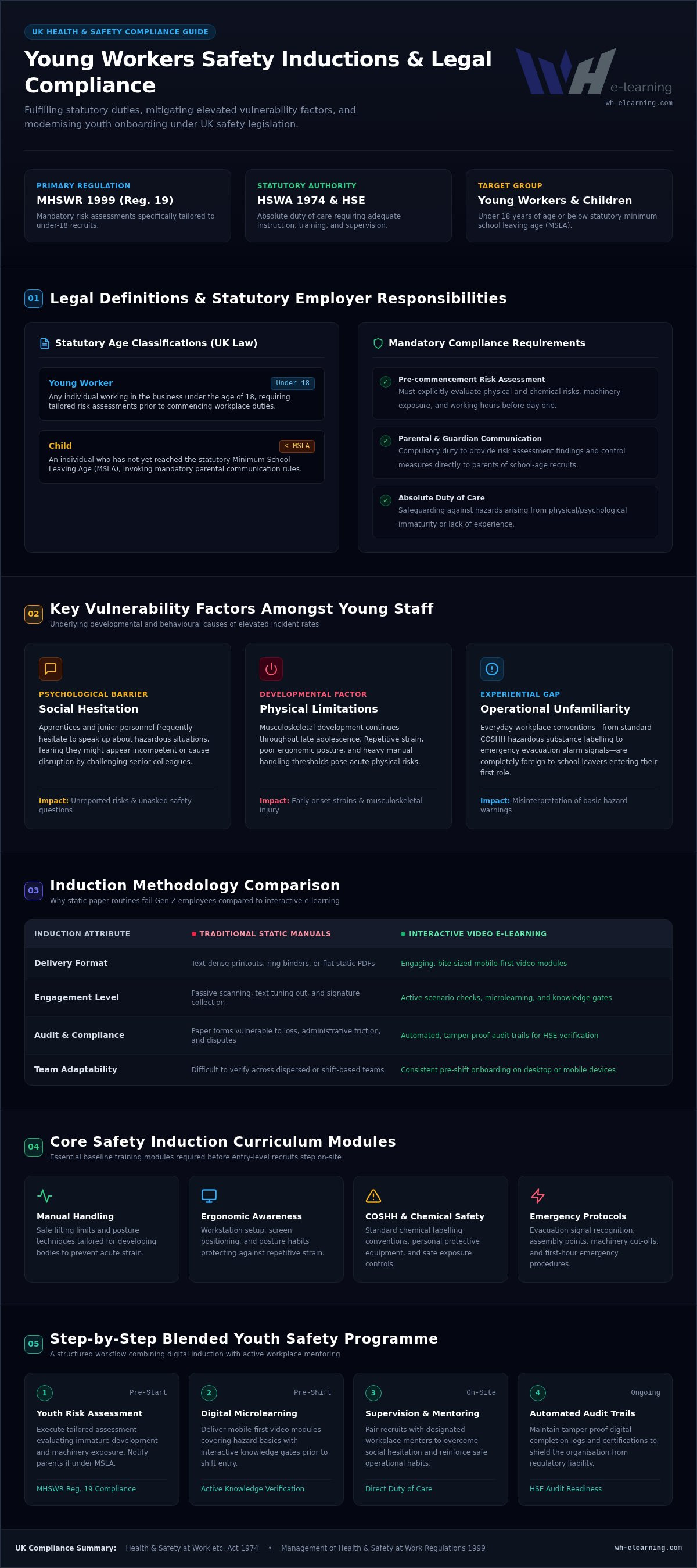
UK health and safety legislation draws a strict line regarding age in the workplace. Under domestic law, a "young worker" is defined as anyone under the age of 18, whereas a "child" refers to an individual who has not yet reached the statutory minimum school leaving age (MSLA). Under UK law, employers hold an absolute statutory duty of care to ensure that young employees are protected from any risks to their health and safety that arise from physical or psychological immaturity, lack of experience, or unfamiliarity with workplace hazards.
Regulation 19 of the Management of Health and Safety at Work Regulations 1999 places direct obligations on business owners. You must complete a specific risk assessment before a young person begins their role. General workplace precautions rarely suffice because inexperienced recruits often fail to perceive environmental hazards. While you can build broad organisational competencies through dedicated workplace safety training courses, young workers require direct legal safeguarding tailored to their unique vulnerabilities. Integrating accredited young workers safety e-learning into your onboarding workflow ensures these statutory protections translate into practical, verifiable understanding from day one.
The Legal Framework: HSE Guidelines and Statutory Duties
The Health and Safety at Work etc. Act 1974 requires employers to provide adequate instruction, training, and supervision to maintain a safe working environment. For young team members, this principle is reinforced by established discipline in Occupational safety and health (OSH) and overseen by the Health and Safety Executive (HSE). Before welcoming a young recruit, your risk assessment must explicitly review physical and chemical risks, machinery exposure, and working hours.
Crucially, if the individual is of compulsory school age, your communication duties expand. You must provide clear details of the risk assessment findings, alongside the specific protective control measures implemented, directly to their parents or legal guardians before work commences.
Key Vulnerability Factors Amongst Young and Inexperienced Staff
Young personnel face elevated incident risks driven by clear psychological and developmental factors:
- Social hesitation: Apprentices and junior staff often hesitate to speak up about hazardous situations, fearing they might appear incompetent or cause disruption by challenging senior colleagues.
- Physical limitations: Musculoskeletal development continues throughout late adolescence. Repetitive strain, poor ergonomic posture, and heavy manual handling thresholds represent acute physical risks for younger bodies.
- Operational unfamiliarity: Everyday workplace conventions, from standard COSHH labelling to emergency evacuation signals, are completely foreign to school leavers entering their first professional role.
Deploying interactive young workers safety e-learning allows your organisation to unpack these specific hazard areas, breaking down essential safety rules into accessible modules that give young employees the confidence to work safely.
Why Traditional Induction Fails Young Workers vs Digital E-Learning
Static induction binders and marathon slide presentations fail younger recruits. Delivering pages of dense policy text assumes that passive reading translates into practical safety habits. It rarely does. Young workers have grown up consuming modular, interactive digital media. Expecting them to absorb vital hazard protocols from faded ring binders invites disengagement. Leading health agencies outline extensive guidance on employer responsibilities for young workers, establishing that tailored instruction remains a pillar of workforce protection. Modern young workers safety e-learning bridges this gap by replacing static paper routines with immersive, bite-sized instruction designed for mobile and desktop screens.
| Induction Attribute | Traditional Static Manuals | Interactive Video E-Learning |
|---|---|---|
| Delivery Format | Text-dense printouts or flat PDFs | Engaging, bite-sized video modules |
| Engagement Level | Passive scanning and signature collection | Active scenario checks and knowledge gates |
| Knowledge Retention | Rapid drop-off after initial onboarding | High retention through visual application |
| Verification | Unchecked self-certification signatures | Automated scoring and digital audit trails |
Overcoming Cognitive Overload in Workplace Inductions
Handing an apprentice a seventy-page operations manual on their first morning creates immediate cognitive overload. Confronted with dense jargon, young employees simply flick through to the back page and sign the declaration. This creates an illusion of compliance without building genuine competence. Microlearning eliminates this friction. By dividing complex hazard topics into brief video segments, dynamic scenarios demonstrate how machinery guards operate or where trip hazards arise. Visual learning contextualises abstract safety rules into realistic operational choices.
Digital Accountability and Compliance Tracking
Paper sign-off sheets offer zero defence when an incident occurs. An inspector from the HSE will scrutinise whether an employee understood their instruction, not just whether they scribbled a signature. Modern e-learning systems solve this liability risk through automated tracking. Each module requires the learner to pass interactive checks before unlocking the next topic. Upon passing, the system logs time-stamped records and generates accredited digital certificates, giving your business complete records for external audits.
To modernise your broader organisational onboarding and ensure full legal alignment across all departments, explore our strategic guide on business compliance e-learning. You can also explore flexible digital packages directly on WH eLearning to build structured, audit-ready training programmes across your teams.
Essential Curriculum Modules for Young Worker Safety Inductions
A well-rounded safety induction strikes a careful balance between universal statutory baselines and high-frequency, everyday risks. It isn't enough to run through generic fire alarm testing routines. Young people entering the workforce need targeted guidance that covers physical hazards, personal protective equipment (PPE) rules, chemical safety (COSHH), and fundamental worker rights. The Health and Safety Executive sets out explicit expectations regarding training and supervision for young people, stressing that early-career staff require clear, practical explanations rather than abstract policy outlines. Structuring your syllabus through accredited young workers safety e-learning ensures these fundamental competencies are delivered systematically before recruits handle tools or work unsupervised.
Core Occupational Hazards: Slips, Trips, and Manual Handling
Everyday physical injuries remain the most frequent cause of workplace disruption for junior staff. Kinetic lifting techniques form the core of early injury prevention. Training modules must illustrate stable base postures, bending at the knees, keeping heavy loads close to the body, and respecting weight limits to protect developing spines. In sectors like retail, logistics, and hospitality, slips and trips represent constant hazards. Modules should instill immediate housekeeping habits, correct anti-slip footwear choices, and swift spill-reporting steps to eliminate common foot-traffic accidents.
Digital Ergonomics and Workstation Safety
Musculoskeletal risks are not confined to physical manual labour. Young apprentices spending long shifts at computer workstations frequently adopt poor spinal postures that lead to neck stiffness and chronic repetitive strain. Teaching fundamental Display Screen Equipment (DSE) principles early builds lasting physical habits. Employers can embed dedicated DSE assessment training online to help young learners correctly align screen heights, adjust lumbar chair supports, position keyboards comfortably, and schedule micro-breaks away from monitors throughout the day.
Rights, Responsibilities, and Refusing Dangerous Work
Empowering young employees requires clarity on legal boundaries and voice. Section 7 of the Health and Safety at Work Act reminds workers that they carry personal duties to cooperate with safety procedures and protect themselves and others. Crucially, young workers must also recognise their fundamental right to step back from dangerous situations. Induction modules should provide practical communication frameworks for apprentices:
- Identifying defective equipment: Knowing how to spot frayed cabling, faulty interlocks, or missing safety guards and removing them from service immediately.
- Voicing concerns safely: Offering established, anonymous or direct reporting channels that bypass fear of peer pressure or supervisory criticism.
- Refusal protocols: Outlining clear escalation steps if an assigned operational task feels unsafe or lacks necessary supervisory oversight.
Standardising these topics within a digital curriculum gives inexperienced personnel the clarity they need to work productively without putting their health at risk.
Step-by-Step Implementation of a Blended Youth Safety Programme
Protecting inexperienced recruits demands a structured sequence rather than an ad-hoc safety chat. A successful onboarding initiative connects theoretical understanding directly to day-to-day operations through a clear, five-stage framework:
- Step 1: Document age-specific assessments: Evaluate the workplace setting for adolescent physiological and psychological risk factors before the worker steps on-site.
- Step 2: Assign digital induction modules: Enrol recruits into young workers safety e-learning so they absorb vital hazard rules prior to physical workplace exposure.
- Step 3: Appoint dedicated safety mentors: Pair every recruit with a qualified colleague who provides active supervision and steady guidance.
- Step 4: Conduct practical walkthroughs: Guide the worker across the shop floor to bridge online theory with physical isolation switches, emergency exits, and PPE stores.
- Step 5: Review at 30 and 90 days: Schedule structured milestone reviews to detect operational shortcuts or emerging bad habits before incidents happen.
Pre-Employment Induction and Digital Pre-Boarding
Rushing young employees straight onto active work floors invites immediate error. Pre-boarding via digital training removes that pressure. Giving apprentices access to modular training on their mobile devices allows them to process safety fundamentals in a calm, familiar setting at their own pace. Passing online assessments before shift one ensures they arrive understanding site rules, PPE requirements, and basic hazard symbols. Supervisors simply check the digital completion badge before allowing recruits into operational zones.
Mentorship and Bridging the Gap to Practical Application
Digital learning delivers essential knowledge, but human guidance anchors daily safety habits. Supervisors leading young teams must understand how operational oversights occur. Evaluating your leadership needs through structured safety training helps establish whether supervisors or line operatives hold the right credentials to guide younger colleagues.
Mentors should hold five-minute morning check-ins, actively inviting questions about machine quirks or physical strain. They maintain direct shadowing during early equipment use, stepping back only when safe operating competence is proven.
Ready to modernise your youth onboarding workflow? Explore our full catalogue of accredited courses on WH eLearning to equip your teams with certified, high-impact digital training today.
Selecting the Best Young Workers Safety E-Learning Platform
Choosing an instructional platform requires evaluating how well its design matches the cognitive habits of modern apprentices. A digital portal filled with wall-to-wall text slides offers little improvement over a paper binder. Selecting high-calibre young workers safety e-learning requires examining production standards, mobile accessibility, and whether the content holds verified industry accreditations with objective end-of-module testing.
Enterprise scalability matters just as much as instructional content. When onboarding seasonal workers, apprentices, or part-time student staff across multiple sites, managers need centralised visibility. The right platform simplifies workforce management by providing corporate licensing options, automated enrolment triggers, and real-time oversight over completion metrics.
Crucial Platform Features: Engagement, Video, and Accessibility
Visual storytelling drives comprehension. Selecting video-led courses rather than text click-throughs keeps young team members engaged, demonstrating operational hazards through dynamic scenarios that mirror real working environments. Accessibility must also run deeper than basic compliance:
- Responsive mobile interface: The platform must load flawlessly across smartphones, tablets, and desktop computers so recruits can learn on their preferred hardware.
- Subtitle and caption support: Clear closed captions ensure high retention in noisy workplace environments or for individuals who process written cues better than pure audio.
- Language accessibility: Today's entry-level workforce is culturally diverse. Examining the capabilities of multi-language e-learning courses guarantees that non-native English speakers absorb safety-critical directives without confusion.
Empowering Your Teams with WH eLearning Solutions
Meeting your statutory obligations shouldn't feel like an administrative uphill battle. WH eLearning delivers an extensive catalogue of over 100 accredited video-based workplace compliance and safety modules, purpose-built to engage modern digital learners. Modules feature multi-language machine translation across more than 25 languages, ensuring consistent safety comprehension across diverse operational teams.
With flexible corporate licensing tailored for onboarding apprentices, interns, and young recruits, administrators gain full oversight across their operations. Automated digital tracking and certification deliver tamper-proof evidence for HSE audits, giving leadership confidence that entry-level teams are protected, competent, and fully compliant.
Build a Safer Future for Your Young Workforce
Protecting inexperienced staff doesn't require complex bureaucracy; it demands the right balance of clear statutory risk assessments, supportive mentorship, and engaging instruction. By replacing static induction manuals with interactive young workers safety e-learning, you empower apprentices and entry-level recruits to recognise workplace risks, challenge unsafe conditions, and develop lifelong safety habits from day one.
Streamlining your health and safety compliance is straightforward with the right learning partner. WH eLearning provides over 100 accredited video-based workplace compliance and safety modules, complete with closed captions and multi-language course translation across 25+ languages. Backed by centralised compliance reporting and automated digital certification, you can track onboarding progress effortlessly whilst building a confident, fully protected team. Explore Accredited Safety Training Courses for Your Team and set your organisation on the path to lasting safety excellence.
Frequently Asked Questions
What is the legal definition of a young worker under UK health and safety law?
Under UK health and safety law, a young worker is anyone under 18 years of age. A child refers specifically to a person who has not yet reached the statutory minimum school leaving age. These definitions determine the specific supervisory duties, risk assessment criteria, and parental notification obligations that employers must uphold in the workplace.
Can young workers safety e-learning replace practical workplace supervision entirely?
No, digital training cannot replace direct human supervision. While young workers safety e-learning establishes essential theoretical foundations and hazard awareness before work starts, employers must pair digital modules with on-site shadowing and dedicated mentoring. Practical supervision ensures recruits translate digital concepts into safe operational habits around active machinery and site risks.
Is an employer required to carry out a separate risk assessment for workers under 18?
Yes, Regulation 19 of the Management of Health and Safety at Work Regulations 1999 legally requires a risk assessment tailored specifically to young people. Employers must review psychological maturity, physical development, and hazard perception before work commences. If employing a child below school leaving age, findings and controls must be shared directly with parents or guardians.
What workplace tasks and machinery are young workers legally prohibited from operating?
Young workers cannot perform tasks involving extreme cold or heat, toxic chemicals, high radiation, or power-driven equipment presenting severe risk, such as industrial balers and circular saws. An exception applies only if the task is essential for vocational training, involves proper risk control, and occurs under the continuous supervision of a competent person.
How does video-based safety e-learning improve knowledge retention in younger employees?
Video-based instruction mirrors the media formats digital-native workers interact with daily. Short, scenario-driven clips contextualise abstract safety rules, illustrating real working environments, machinery guards, and kinetic lifting far better than text manuals. Interactive knowledge checkpoints require active engagement, preventing passive skimming and ensuring core principles are retained during operational shifts.
Can employers track and audit staff safety course completion through the training platform?
Yes, robust training platforms provide centralised administrative tracking. WH eLearning offers corporate licensing that gives managers clear visibility over individual enrolments, pass marks, and module completion dates. The platform generates automated digital certifications upon assessment completion, delivering verifiable, time-stamped audit trails to satisfy internal reviews and HSE regulatory inspections.
What happens if an organisation fails to provide adequate induction training to young employees?
Failing to provide adequate safety training exposes businesses to severe regulatory enforcement, uncapped fines, and criminal prosecution under the Health and Safety at Work etc. Act 1974. If an untrained young recruit suffers an injury, the employer faces substantial compensation claims and uninsurable regulatory penalties, alongside serious, lasting brand damage.


