

Fifty percent of UK employees report experiencing workplace discrimination, yet standard tick-box presentations rarely alter day-to-day professional behaviour. If you feel frustrated by dull compliance modules that staff resent and promptly forget, you aren't alone. Sourcing the right unconscious bias training online UK employers can rely on means moving beyond passive awareness. The right programme protects your workplace culture whilst establishing the reasonable preventive steps required under the Equality Act 2010 to safeguard your organisation.
Genuine cultural progress happens when training balances clear legal defensibility with practical, bite-sized behavioural nudges that managers respect. In this 2026 buyer's guide, you'll discover how to evaluate course delivery, simplify compliance tracking across distributed or multilingual teams, and roll out accredited HR and business compliance courses smoothly. We'll walk through the essential evaluation criteria, administrative reporting features, and implementation strategies you need to make a confident, cost-effective investment that elevates your workplace.
Key Takeaways
- Understand how effective training establishes defensible "reasonable steps" under the Equality Act 2010 to protect your organisation against tribunal claims.
- Learn how to evaluate unconscious bias training online UK employers can depend on, prioritising realistic video-based scenarios over passive slide decks.
- Compare digital e-learning and in-house workshops to identify the optimal delivery method for your operational schedule and workforce size.
- Follow a clear five-step procurement roadmap to audit existing training protocols, align stakeholders, and ensure measurable post-course adoption.
- Discover how corporate licensing dashboards and automated digital certification streamline administrative oversight across distributed and multilingual teams.
Evaluating Unconscious Bias Training Online in the UK: 2026 Employer Standards
Unconscious bias refers to automatic mental shortcuts, learned associations, and social stereotypes that influence workplace judgements without conscious intent. In operational UK environments, these cognitive blind spots quietly distort hiring panels, task delegation, succession planning, and annual appraisals. Modern employers no longer treat this as mere academic theory; unchecked bias directly damages employee retention and exposes businesses to serious legal fallout. Adopting high-calibre unconscious bias training equips teams to identify these hidden patterns before they solidify into systemic discrimination.
The Legal and Commercial Case for UK Employers
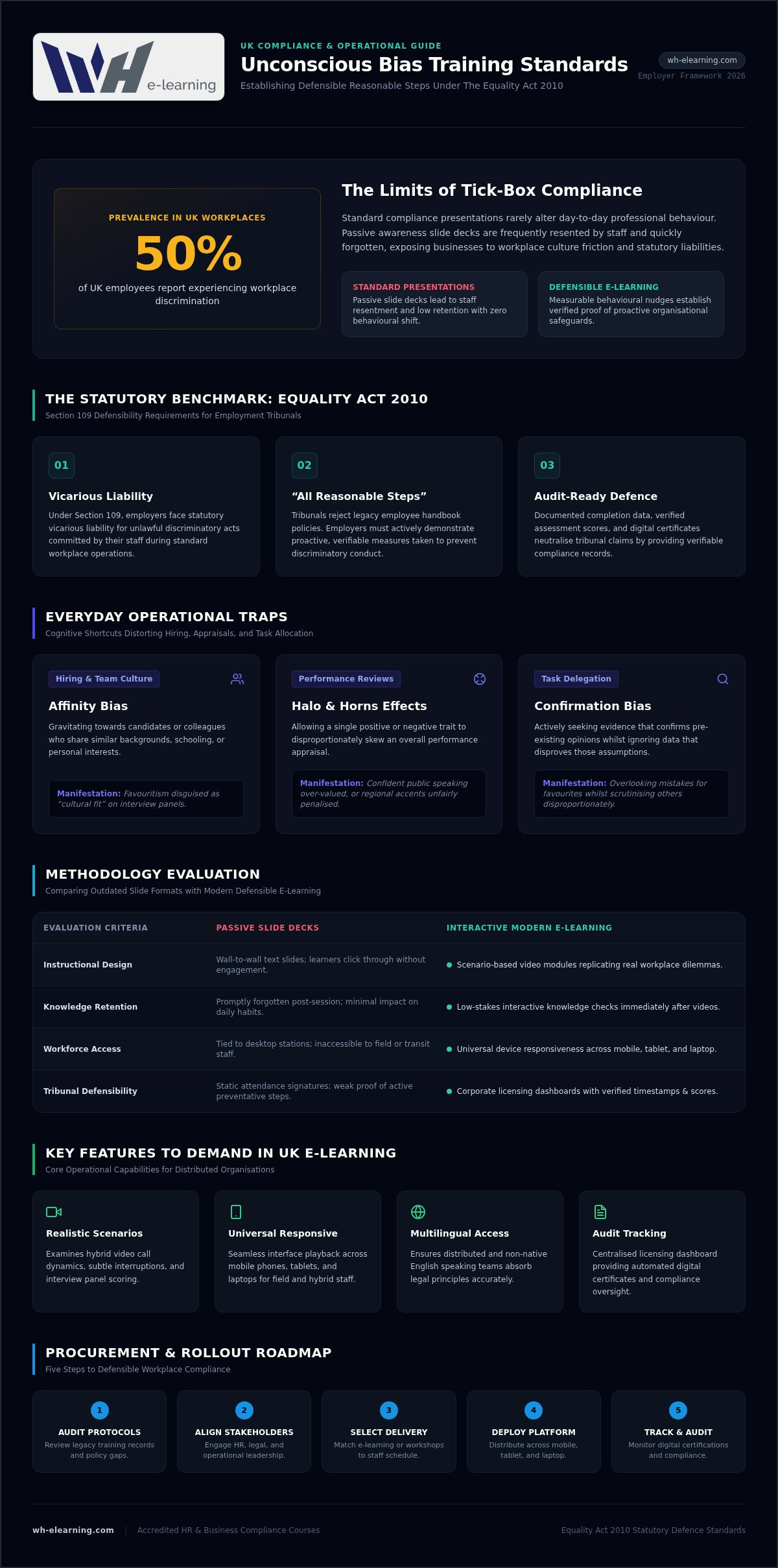
Under the Equality Act 2010, employers face vicarious liability for unlawful discriminatory acts committed by their workers. However, section 109 provides a statutory defence if an organisation can prove it took "all reasonable steps" to prevent discriminatory behaviour. Simply holding a legacy policy in an employee handbook won't satisfy an employment tribunal. Deploying defensible unconscious bias training online UK organisations can audit gives leadership documented proof of proactive compliance, recording verifiable time stamps, assessment scores, and completion certificates that help neutralise costly tribunal claims.
Recognising Common Biases in Daily Workplace Operations
Operational bias rarely manifests as overt hostility. Instead, it surfaces through subtle micro-behaviours and systemic habits that quietly derail equality, diversity, and inclusion (EDI) targets. When procuring unconscious bias training online UK HR directors should ensure programmes tackle these everyday operational traps directly:
- Affinity bias: Gravitating towards candidates or colleagues who share similar backgrounds, schooling, or personal interests, often disguising favouritism as "cultural fit".
- Halo and horns effects: Allowing a single positive trait (such as confident public speaking) or perceived negative factor (like a regional accent) to disproportionately skew an overall performance appraisal.
- Confirmation bias: Actively seeking evidence that confirms pre-existing opinions about an employee whilst systematically ignoring data that disproves those assumptions.
Addressing these workplace dynamics through practical HR and business compliance courses transforms subjective managerial instincts into objective, measurable operational standards.
Key Features to Look For in Online Unconscious Bias Courses
Most compliance programmes fail because they rely on wall-to-wall text slides that learners simply click through to get back to work. As highlighted in Harvard Business Review's guidance on Unconscious Bias Training That Works, changing habits requires immersive experiences rather than abstract rules. When shortlisting unconscious bias training online UK programmes for your organisation, focus on dynamic instructional elements that encourage critical thinking while remaining light on cognitive load.
Instructional Design: Scenario-Based Video Modules
Static slides tell employees what the law says; scenario-based video training shows them how bias surfaces during real operational dilemmas. High-quality modules place learners inside realistic workplace interactions, from subtle conversational interruptions in hybrid video calls to subjective scoring during recruitment panel interviews. By embedding low-stakes, interactive knowledge checks immediately after these video sequences, courses prompt honest self-reflection. This approach helps staff spot unconscious patterns in their own routines without feeling defensive or judged.
Accessibility, Multilingual Translation, and Device Compatibility
Modern workforces are rarely gathered in a single room, so digital learning must adapt to different working styles and physical settings. If a course isn't fully responsive across mobile phones, tablets, and laptops, operational teams working on shop floors or in transit quickly drop behind on completion targets. Look for e-learning platforms that support diverse operational realities through specific accessibility features:
- Universal device responsiveness: Ensures busy field personnel and hybrid desk workers experience the same seamless playback and interface design.
- Closed captions: Provides vital support for neurodivergent learners, employees with hearing impairments, or staff accessing content in busy open-plan environments.
- Multi-language capability: Utilising multi-language e-learning courses guarantees that distributed, multilingual teams grasp complex nuances in their preferred language.
Selecting intuitive unconscious bias training online UK teams genuinely enjoy using doesn't have to strain internal resources. If you're looking to simplify rollout, explore how WH eLearning delivers practical HR and business compliance courses with built-in accessibility and centralised reporting.
Delivery Methods Compared: Online E-Learning vs In-House Workshops
Choosing between digital courses and live facilitation often stalls procurement teams trying to balance operational budgets with real cultural impact. While in-person seminars offer lively debates, coordinating diaries for hundreds of shift workers, remote staff, and regional managers quickly creates logistical chaos. As outlined in the UK government evidence on bias training, interventions must be structured purposefully to avoid becoming tick-box routines. Weighing both formats side by side clarifies which approach delivers the best return on investment for your organisational structure.
Self-Paced Digital E-Learning: Scalability and Consistency
Asynchronous e-learning delivers identical, legally sound compliance standards across every tier of your workforce. Whether an employee joins in Aberdeen or London, they receive the exact same quality of instruction without tutor variance. Digital delivery removes scheduling friction, allowing deskless staff and hybrid workers to complete modules during natural operational lulls. Crucially, opting for unconscious bias training online UK employers can deploy via corporate dashboards replaces manual sign-in sheets with real-time audit trails, instantly capturing completion timestamps and knowledge test scores.
In-House Face-to-Face Training: When to Deploy Specialist Facilitators
Certain organisational challenges demand real-time, human interaction. In-house face-to-face training shines when working with senior executive committees or addressing specific cultural tensions following an internal grievance. Specialist facilitators create a confidential environment where leadership teams can challenge entrenched practices and debate strategic EDI accountability. However, relying solely on classroom delivery across a 500-person enterprise introduces heavy administrative overheads, room booking expenses, and continuous disruption to daily client operations.
For most growing UK enterprises, a blended model offers the ideal balance. Rolling out accredited unconscious bias training online UK wide establishes baseline awareness and legal defensibility at a predictable scale. Organisations can then reserve targeted in-house sessions for senior decision-makers, hiring managers, and board members who steer recruitment strategy and executive appointments.
How to Procure and Roll Out Bias Training Across Your Organisation
Procuring digital compliance programmes often gets bogged down by internal bureaucracy or unclear implementation steps. Without a systematic roadmap, even the highest-rated learning modules suffer from low engagement and poor completion rates. Rolling out unconscious bias training online UK organisations can take pride in requires aligning legal obligations, operational logistics, and employee buy-in from the outset.
Step-by-Step Implementation Framework
Executing a successful organisation-wide launch comes down to four coordinated phases:
- Phase 1: Conduct a training needs analysis. Audit current EDI policies and evaluate existing risk areas using a structured workplace compliance training review.
- Phase 2: Determine your purchasing structure. Decide whether individual pay-as-you-go enrolments fit immediate new-starter needs or bulk corporate licensing provides better value for entire departments.
- Phase 3: Connect with broader programmes. Embed your bias awareness modules alongside wider business compliance e-learning pathways to avoid treating equality as an isolated chore.
- Phase 4: Frame internal messaging around development. Position the training as practical leadership upskilling rather than corrective discipline, which helps eliminate learner resistance before courses launch.
Tracking Compliance, Metrics, and Digital Certification
Proof of learning is just as critical as the instruction itself. Relying on self-reported completion dates leaves your business vulnerable if policies are tested in an employment tribunal. Modern training platforms resolve this friction through centralised management dashboards that track progress in real time. Administrators can spot lagging departmental participation instantly, send automated nudges, and export verifiable completion logs at the click of a button.
Upon finishing their modules, staff immediately receive accredited digital certificates that permanently validate their understanding of statutory standards. Over the following quarters, HR leaders can cross-reference these completion records against internal indicators, such as recruitment shortlist balance and retention figures, to measure lasting cultural progress.
Ready to modernise your compliance strategy? Explore corporate workforce licensing with WH eLearning to access flexible dashboards and ensure your staff stay fully compliant.
Choosing the Right UK Training Partner: The WH eLearning Advantage
Securing effective unconscious bias training online UK businesses can easily roll out shouldn't mean wrestling with rigid software or dry, legalistic lectures. Modern employers need training that respects their employees' time while giving administrators complete visibility over statutory benchmarks. That's where WH eLearning simplifies compliance delivery. With an extensive library of over 100 accredited business compliance and safety courses, organisations gain access to practical, video-based learning designed specifically for UK operational settings.
Accredited Content Built for Practical Workplace Application
Engaging instructional design sits at the centre of real behavioural change. Rather than forcing staff through generic slides, WH eLearning delivers video-led modules featuring relatable workplace dilemmas. These scenarios unpack complex interpersonal dynamics into practical, everyday actions staff can apply immediately. Built-in digital knowledge checks verify comprehension before generating automated digital certification. This structured approach gives your organisation clear, defensible evidence of preventive compliance under UK employment standards.
Scalable Corporate Solutions and Dedicated Account Support
Every organisation manages training differently depending on workforce distribution and team size. Whether you need single enrolments for new starters or an enterprise rollout, WH eLearning provides flexible corporate licensing dashboards that centralise user progress and compliance reporting. If your operational teams require accessible content, closed captions and multi-language translation across 25+ languages ensure nobody gets left behind. For businesses addressing sensitive cultural challenges, complementary in-house face-to-face training delivered by experienced industry specialists provides targeted guidance for senior leadership.
Finding effective unconscious bias training online UK teams will actually complete starts with choosing a partner committed to frictionless delivery. To discover how flexible licensing and practical modules can transform your workplace culture, browse WH eLearning corporate training solutions and equip your staff with confidence today.
Modernise Your Workplace Culture and Safeguard Compliance
Fulfilling your statutory duties under the Equality Act 2010 doesn't have to be an administrative headache. Moving away from passive compliance slides towards dynamic, scenario-based learning ensures your managers recognise how subtle assumptions influence daily operational outcomes. Selecting the right unconscious bias training online UK employers rely on protects your staff, strengthens psychological safety, and provides an airtight audit trail for statutory peace of mind.
WH eLearning makes professional workforce development straightforward and accessible. With an extensive library of over 100 accredited online compliance and safety courses, multi-language course translation available in more than 25 languages, and flexible enterprise licensing with comprehensive administrative progress tracking, building a fairer workplace has never been simpler. Equip your team with accredited workplace compliance training today and take a confident, proactive step towards an empowered, legally resilient organisation.
Frequently Asked Questions
Is unconscious bias training mandatory for employers under UK law?
No specific UK statute legally mandates unconscious bias training for private employers. However, under the Equality Act 2010, organisations face vicarious liability for discrimination carried out by their employees. Providing regular training forms a critical part of proving that your business took "all reasonable steps" to prevent unlawful behaviour. Deploying accredited unconscious bias training online UK wide demonstrates proactive statutory diligence.
Can online unconscious bias training protect our business at an employment tribunal?
Yes, robust online training can serve as vital documentary evidence during tribunal proceedings. Under section 109 of the Equality Act 2010, an employer must prove they took reasonable preventive actions before an incident occurred. Automated digital certificates, module timestamps, and formal assessment records demonstrate that your organisation actively educates staff on equality benchmarks rather than relying on unread handbook policies.
How long does an effective online unconscious bias training course take to complete?
Most practical digital courses take between 30 and 60 minutes to complete. This microlearning timeframe prevents cognitive fatigue whilst maintaining high retention through scenario-based interactions. Delivering training in bite-sized modules allows operational staff and hybrid workers to complete instruction during normal working hours without disrupting daily client deliverables or operational schedules.
How often should UK employees refresh their unconscious bias training?
Employers should refresh bias training every 12 to 24 months to maintain high operational awareness and statutory protection. Providing one-off training during initial onboarding won't satisfy an employment tribunal if an issue arises several years later. Scheduling regular refresher modules ensures that established teams, newly promoted managers, and fresh recruits stay aligned with evolving UK workplace standards.
What is the difference between conscious prejudice and unconscious bias in the workplace?
Conscious prejudice involves explicit, deliberate discrimination or hostility directed toward individuals based on protected characteristics like race, age, or sex. Unconscious bias operates beneath conscious awareness through automatic mental associations and social conditioning. While conscious prejudice requires immediate formal disciplinary action, unconscious bias is best mitigated by structured workplace training that helps employees spot hidden cognitive blind spots.
Can unconscious bias training be delivered effectively to non-desk or multilingual workers?
Yes, modern e-learning platforms ensure accessibility for deskless and international operational teams. With fully responsive video modules accessible on mobile devices, staff can complete training from any location. High-calibre HR and business compliance courses also include closed captions and machine translation into more than 25 languages, ensuring all team members grasp vital nuances in their preferred language.
What administrative features should HR managers expect from corporate e-learning licences?
Corporate licensing should provide an intuitive central dashboard that eliminates manual spreadsheets and tracking errors. Administrators need real-time visibility over enrolment statuses, individual completion percentages, and assessment scores across diverse departments. Automated digital certificate generation and exportable compliance reports are also essential, allowing HR teams to provide immediate evidence during internal reviews or statutory audits.


