

What if an incident your team dismisses as a near miss is one that must be reported to the HSE? A RIDDOR reporting training course can help employees and managers make that distinction, understand their responsibilities and act within the required timeframes.
It’s understandable to worry about missing a reporting deadline or facing penalties for non-compliance. RIDDOR 2013 sets out which work-related injuries, occupational diseases and dangerous occurrences must be reported. Applying the rules confidently can be challenging, especially across a large, multilingual workforce.
This 2026 guide explains what effective training should cover, how to distinguish reportable from non-reportable incidents, and what current reporting and record-keeping requirements involve. It also separates regulations in force from the HSE’s proposed reforms, so you can prepare without mistaking proposals for current law. You’ll find practical ways to use video-based e-learning, corporate licensing and machine translation into more than 25 languages to support consistent learning, assessment and training records.
Key Takeaways
- Understand how RIDDOR 2013 fits into wider workplace health and safety responsibilities, and why accurate reporting matters.
- Use a RIDDOR reporting training course to build confidence in recognising reportable incidents, specified injuries and occupational diseases.
- Compare video-based e-learning with in-house training to choose a practical format for remote, shift-based and on-site teams.
- Consider how machine translation into more than 25 languages can make compliance training more accessible to a multilingual workforce.
- Track employee training progress and keep clear records to support compliance oversight and audits.
Understanding RIDDOR: Why Professional Training is Essential
A workplace incident can be serious without being reportable under RIDDOR, while a less dramatic event may meet a specific reporting threshold. The Reporting of Injuries, Diseases and Dangerous Occurrences Regulations 2013 (RIDDOR) require certain work-related deaths, injuries, occupational diseases and dangerous occurrences to be reported to the Health and Safety Executive (HSE). For an overview of the regulations and their background, see RIDDOR Regulations 2013.
RIDDOR sits within the wider framework of the Health and Safety at Work etc. Act 1974. The Act provides the basis for health and safety regulations, while RIDDOR sets out specific reporting duties. Reporting an incident doesn’t replace the broader responsibility to manage workplace risks, and not every accident needs an HSE report. Accurate decisions help organisations avoid both missed reports and unnecessary submissions.
Failure to report an incident that should be reported is a criminal offence. Prosecution can lead to unlimited fines, and individuals may face imprisonment in serious cases. Legal action can also damage an organisation’s reputation, undermine workforce confidence and raise questions about how effectively safety is managed. A RIDDOR reporting training course helps turn complex rules into practical decisions, so staff know what to recognise, record and escalate.
The Legal Responsibility of Employers and Duty Holders
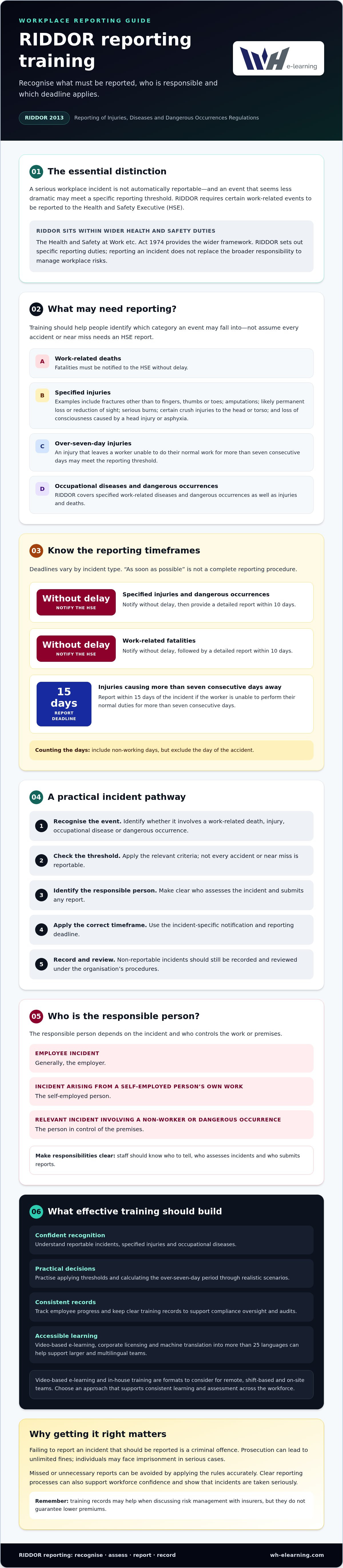
Under RIDDOR, the “responsible person” is generally the employer for incidents involving employees, a self-employed person for incidents arising from their own work, or the person in control of premises for relevant incidents involving non-workers and dangerous occurrences. Responsibilities depend on the incident and who controls the work or premises. Make clear who assesses incidents and submits reports, so staff know where to raise concerns.
Deadlines vary by incident type, so “as soon as possible” isn’t a complete reporting procedure. Specified injuries and dangerous occurrences require notification without delay, with a detailed report within 10 days. Injuries causing more than seven consecutive days away from work or unable to perform normal duties must be reported within 15 days.
The Business Case for High-Quality Training
Consistent training can support a safer culture. Employees are more likely to raise concerns when they see incidents taken seriously and understand what information to share. Demonstrable training records may also help when discussing risk management with insurers, although they don’t guarantee lower premiums.
A tick-box module may confirm completion without showing whether someone can apply the rules. Video-based learning can make examples easier to follow and keep attention on practical scenarios. WH eLearning offers corporate licensing and machine translation into more than 25 languages, options that can help organisations support consistent learning across larger and multilingual teams.
What a Comprehensive RIDDOR Reporting Course Must Cover
A useful RIDDOR course should prepare learners to respond to real incidents, not simply memorise legal categories. It should explain how to check whether an event meets a reporting threshold, who should make the report, which deadline applies and what information to record. The HSE RIDDOR guidance is the authoritative reference when checking the current rules.
Not every workplace injury or near miss is reportable. For example, an injury that doesn’t meet the specified-injury criteria or result in more than seven consecutive days of incapacity may not need an HSE report. It should still be recorded and reviewed under the organisation’s own procedures, so hazards and patterns aren’t missed.
Reportable Injuries and Deaths
Training should explain that specified injuries include fractures other than to fingers, thumbs or toes, amputations, and injuries likely to cause permanent loss or reduction of sight. It should also cover serious burns, certain crush injuries to the head or torso, and loss of consciousness caused by a head injury or asphyxia. Work-related fatalities must be notified to the HSE without delay, followed by a detailed report within 10 days. Where police are investigating, staff should follow instructions and avoid disturbing relevant evidence.
For the over-seven-day rule, count consecutive days the worker is unable to do their normal work, including non-working days, but exclude the day of the accident. If the threshold is met, the report is due within 15 days of the incident. A practical scenario can help learners apply the calculation consistently.
Occupational Diseases and Dangerous Occurrences
Courses should cover reportable occupational diseases such as carpal tunnel syndrome, occupational dermatitis and occupational asthma. They should explain that reporting is triggered when the responsible person receives a diagnosis from a registered medical practitioner. Dangerous occurrences are specific events, not every near miss. Examples include the collapse or failure of lifting equipment and certain fires or explosions. In higher-risk work, training should explain how to check whether a gas-related event matches a defined RIDDOR category, rather than relying on assumptions.
Learners also need to know how to submit a report through the HSE’s online reporting service and what details to prepare. Training should direct them to current HSE instructions rather than rely on potentially outdated references to the Incident Contact Centre. Keep an internal record of non-reportable incidents too, noting what happened and any action taken. Video-based learning can use realistic examples to help learners practise these decisions. Organisations reviewing wider learning options can explore video-based health and safety training.
Online vs In-House: Choosing the Right Training Format
The right format depends on your workforce, work patterns and the risks people need to recognise. Video-based e-learning gives remote and shift-based teams a consistent foundation without requiring everyone to attend at the same time. In-house face-to-face training can add discussion when staff need to apply reporting principles to complex, site-specific situations. A blended approach can support both consistent learning and practical understanding.
The Power of Video-Based E-Learning
Video can show how an incident unfolds, which details matter and how a reporting decision is made. For example, learners might consider whether an injury meets a specified-injury threshold or whether a dangerous occurrence falls within a defined category. Assessments let them apply what they have learnt to scenarios and help organisations check understanding, rather than relying only on course completion.
Online learning can also fit around different locations and shifts. Corporate licensing can make it easier to enrol larger groups, while individual enrolments may suit smaller or more occasional training needs. Compare the options based on team size, access requirements and how you’ll track completion, rather than price alone. For a broader look at building effective safety learning, explore workplace safety training courses.
Tailored In-House Specialist Training
Some teams benefit from discussing how RIDDOR applies to their working environment. A construction team might work through a scenario involving lifting equipment, whilst a healthcare team could consider how to escalate a work-related injury or suspected occupational disease. These examples help staff connect legal categories to workplace hazards without assuming that every incident in a particular sector is reportable.
Face-to-face sessions can give managers, responsible persons and duty holders space to clarify internal roles and practise decision-making through facilitated scenarios. A practical site walk or tabletop exercise may help staff understand how to preserve incident information and raise concerns through the right channels. These activities should complement, not replace, instruction on reporting criteria and deadlines.
For many organisations, an effective RIDDOR reporting training course combines a shared online foundation with targeted discussion where local risks or responsibilities warrant it. WH eLearning offers video-based compliance training, corporate licensing, multi-language course translation and in-house face-to-face training. These options can help organisations support varied teams and encourage a consistent approach to reporting.
Managing Compliance for a Global, Multilingual Workforce
A safety message only works if employees can understand and act on it. If staff aren’t confident with the language used in training, they may miss the difference between an incident to report internally and one that meets a RIDDOR reporting threshold. A hazard or injury may then go unreported, leaving managers without the information they need to assess and respond.
For organisations with UK operations, consistent training can help employees understand how to raise concerns and whom to tell. Multilingual learning can reduce misunderstandings that contribute to missed or delayed reports, helping organisations lower the risk of reporting failures that may prompt HSE scrutiny. It can’t guarantee compliance: clear procedures, responsible decision-making and accurate reporting remain essential.
Breaking Down Language Barriers in Safety
Machine-translated courses can make key safety information more accessible to employees who prefer to learn in another language. WH eLearning offers machine translation into more than 25 languages. Explore its multi-language e-learning courses to see how translated learning could support your teams. Check that learners can follow incident examples, reporting routes and key terms, and provide a way for them to ask for clarification.
For 2026, organisations should distinguish between consistent safety principles and legal requirements that vary by location. RIDDOR applies to relevant incidents in Great Britain; international sites may need training aligned with the rules that apply in their own jurisdictions.
Inclusive Training Strategies
Translation is one part of accessibility. Clear video scenarios, plain language and familiar visual cues can help explain what happened, what details to record and when to escalate an incident. Closed captions may support learners who are deaf or hard of hearing, those learning in a noisy environment, and employees who find written reinforcement useful. Check course accessibility features before assigning training, and offer suitable alternatives where required.
A well-designed RIDDOR reporting training course should make it straightforward for people with different language needs and learning preferences to engage with the same core material. Assessments can help check understanding, while administrative tracking features can show who has completed training and where follow-up may be needed. Use those records alongside team discussions and reporting procedures, rather than treating course completion as proof that everyone can apply the rules.
To support multilingual teams, explore multi-language training options and consider how translated, video-based learning could fit your organisation’s compliance programme.
Implementing RIDDOR Training with WH eLearning
Putting training in place is only part of compliance. Organisations also need to know who has completed learning, where follow-up is needed and what evidence is available for an audit. WH eLearning provides corporate licensing and administrative features for tracking employee progress and compliance status, which can help training managers oversee larger teams. Before rolling out a programme, check how course access and records will fit your existing training processes.
A RIDDOR reporting training course can sit within a wider compliance plan alongside clear internal procedures for reporting incidents. Use tracking information to identify practical gaps. For example, a team may have high course completion but still need a refresher on who assesses incidents or how concerns should be escalated. Tracking supports oversight; it doesn’t replace checking that people can apply the rules in practice.
Strategic Compliance Management
Review completion records by team, location or role where your administration process allows, then follow up with employees who haven’t completed assigned learning. Keep suitable evidence of completion and assessment outcomes, and check which certification or records are provided for the specific course. Set a review date for the training and your internal procedures. Don’t assume certificates renew automatically; confirm any renewal arrangements and manage reminders through your own compliance process. For wider planning ideas, read mastering workplace compliance.
Getting Started: Your RIDDOR Training Roadmap
Start by reviewing how incidents are currently raised, assessed and recorded. Look for uncertainty about reporting thresholds, unclear responsibilities, missed escalation routes or training that isn’t accessible to all employees. Then choose a format that suits the team: video-based e-learning can provide a consistent foundation, while in-house face-to-face training may help address role-specific questions and workplace scenarios.
- Map the audience: identify relevant roles, sites, shifts and language needs.
- Assign training: choose individual enrolments or corporate licensing to suit the size of your team.
- Check progress: review completion and assessment information, then follow up where needed.
- Keep records: retain appropriate evidence and review it alongside incident procedures.
WH eLearning offers video-based compliance training, machine translation into more than 25 languages, corporate licensing and in-house specialist training. To explore options for your organisation, review WH eLearning training options and check course coverage, assessment and certification details before enrolment.
Build a More Confident Reporting Culture
In 2026, effective RIDDOR compliance depends on more than knowing the rules. Teams need to recognise which incidents may be reportable, understand their responsibilities and know how to raise concerns promptly. Training should work for the people taking it, whether they work different shifts, are based across several sites or are more comfortable learning in another language.
A well-chosen RIDDOR reporting training course can give employees a shared foundation, while video-based learning and multi-language options can make essential information more accessible. Pair training with clear reporting procedures and suitable records, then review both as your organisation’s needs evolve.
WH eLearning provides video-based compliance training, course translation into more than 25 languages and corporate licensing for teams. Explore the available options and check course content, assessments and certification details to find a suitable fit for your organisation.
Explore WH eLearning training options and take a practical step towards clearer reporting and a more confident safety culture.
Frequently Asked Questions
What is the main purpose of a RIDDOR reporting training course?
A RIDDOR reporting training course helps employees and managers understand which work-related incidents must be reported, who is responsible for reporting them and which deadlines apply. It can also explain how to record incidents that don’t meet the reporting threshold, so they can still be reviewed internally. The aim is to help people apply RIDDOR 2013 confidently in practice, not simply memorise legal terms.
Who is responsible for reporting an accident under RIDDOR 2013?
The responsible person depends on the circumstances. For incidents involving employees, this is generally the employer; for incidents involving a self-employed person, it’s usually that person. For certain incidents involving non-workers or dangerous occurrences, responsibility may fall to the person in control of the premises. Organisations should make reporting responsibilities clear internally, so staff know who assesses an incident and submits a report when required.
Do all workplace injuries need to be reported to the HSE?
No. Only injuries and other incidents that meet RIDDOR’s reporting criteria must be reported to the HSE. These include specified injuries and work-related injuries that leave an employee unable to do their normal work for more than seven consecutive days. An injury below these thresholds may not require a RIDDOR report, but it should still be recorded and reviewed under the organisation’s incident procedures.
How long does a RIDDOR online training course typically take to complete?
Course duration varies by provider and by the topics and assessments included. Check the specific course information before enrolment, as there’s no standard completion time for every RIDDOR course. Video-based e-learning can give learners flexibility to complete training around work, but organisations should allow enough time for employees to engage with the material and assessment, rather than treating speed of completion as the main measure of learning.
Is RIDDOR training a legal requirement for all UK employees?
There isn’t a blanket legal requirement for every UK employee to complete a course specifically called RIDDOR training. However, employers need to ensure that people involved in recognising, assessing and reporting incidents understand the procedures relevant to their roles. Training is one way to support that understanding. Its level and format should reflect responsibilities, workplace risks and whether staff can apply the reporting process correctly.
What happens if a business fails to report a RIDDOR-eligible incident?
Failing to report an incident that must be reported under RIDDOR is a criminal offence. Enforcement action can include prosecution and unlimited fines; individuals may face imprisonment in serious cases. A missed report can also damage trust and raise questions about an organisation’s safety management. Accurate training, clear responsibilities and reliable reporting procedures can help reduce the risk of overlooking a reportable event.
Can RIDDOR training be delivered in multiple languages for global teams?
Yes. WH eLearning provides machine translation into more than 25 languages, which can help employees access compliance learning in a language they understand. Its courses are video-based and include features such as closed captions. For organisations with international sites, remember that RIDDOR applies to relevant incidents in Great Britain; teams elsewhere may need additional learning on the reporting laws that apply locally.
How often should staff undergo RIDDOR refresher training?
RIDDOR doesn’t set one universal refresher-training interval for all staff. Review training when reporting procedures or responsibilities change, after an incident reveals uncertainty, or when checks show employees aren’t applying the criteria consistently. Organisations can also set review dates suited to their risks and roles. Keep records of completion and follow-up, and make sure relevant staff know where to find current procedures.


