

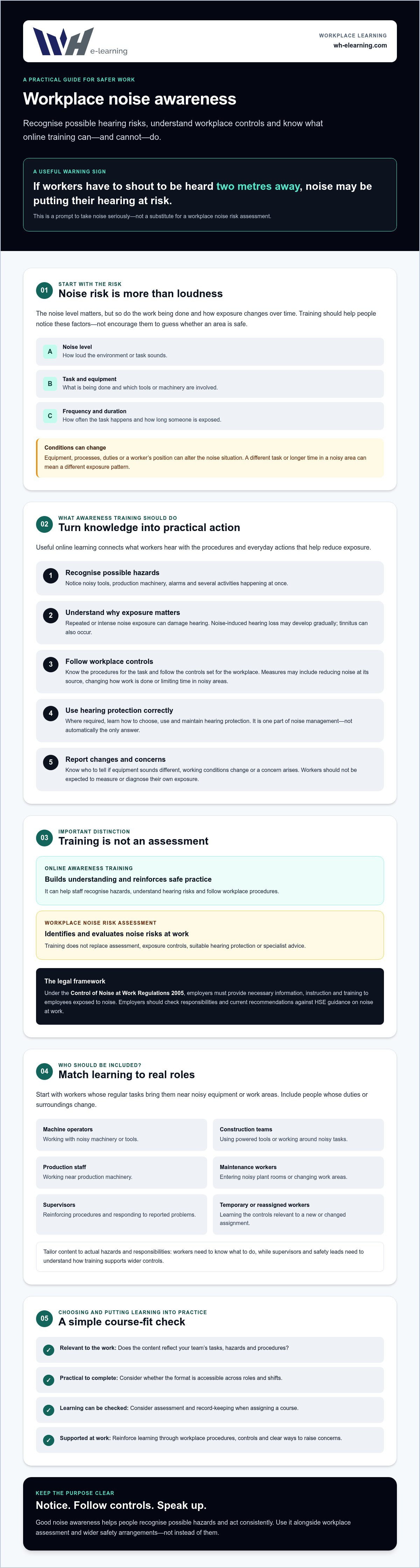
If workers have to shout to be heard two metres away, noise may be putting their hearing at risk. Recognising a hazard is only the first step. Effective noise awareness training online should help people connect what they hear with the controls and everyday actions that reduce exposure.
It can be difficult to judge when workplace noise is harmful, especially when tasks and conditions change during a shift. Training can build practical understanding in a flexible format, but it cannot replace a noise risk assessment. Under the Control of Noise at Work Regulations 2005, employers must provide necessary information, instruction and training to employees exposed to noise.
This guide explains what useful awareness training should cover, from possible effects on hearing to reducing exposure and choosing, using and maintaining hearing protection. It also explains how training differs from assessment and how to put learning into practice alongside wider workplace safety arrangements.
Key Takeaways
- Look beyond how loud a workplace sounds. Consider the tasks, equipment and length of exposure when identifying possible noise risks.
- Choose noise awareness training online that helps staff recognise hazards, understand hearing risks and follow workplace controls.
- Use training to build awareness, not to replace workplace assessment, exposure controls, suitable hearing protection or specialist advice.
- Check that course content matches your team’s tasks and procedures. Consider accessibility, assessment and record-keeping before assigning it.
- Help workers put learning into practice by following noise-control procedures and raising concerns when conditions change.
What is noise awareness training, and who needs it at work?
Noise awareness training teaches people to recognise situations that could put hearing at risk and respond according to workplace procedures. It helps workers understand what makes a task noisy, how exposure can build up and what to do if equipment or working conditions change.
Risk is not determined by loudness alone. The noise level, the task and equipment, how often the task is done and how long a person is exposed all matter. For example, someone using a noisy tool for short periods may have a different exposure pattern from someone working beside operating machinery throughout a shift. Training should help staff recognise these differences, not encourage them to guess whether an area is safe.
Noise awareness training online can make foundational learning easier to organise across different roles and shifts. It should reinforce practical workplace controls, such as following procedures, reporting concerns and using hearing protection correctly where required. It does not replace a workplace noise risk assessment, exposure controls or specialist advice.
How can workplace noise affect hearing and wellbeing?
Repeated or intense noise exposure can damage the delicate structures involved in hearing. Noise-induced hearing loss may develop gradually, so a worker might not immediately notice a change. Tinnitus, often described as ringing or buzzing, can also occur. These are general risks, not symptoms that training can use to diagnose an individual.
Consider a construction worker using power tools, a manufacturing employee stationed near production machinery or a maintenance worker entering a noisy plant room. Noise can make instructions and warning signals harder to hear, affect concentration and make communication more difficult. Awareness helps workers recognise when to follow site controls and raise concerns, rather than simply getting used to the sound.
Who should receive noise awareness training?
Start with people whose regular tasks bring them near noisy equipment or work areas. This may include machine operators, construction teams, production staff and maintenance workers. Supervisors also need enough understanding to reinforce safe procedures, respond to reported problems and make sure workers know which controls apply to their tasks.
Include temporary workers and anyone moving into a new or changed assignment. A familiar workplace can present different noise risks when equipment, processes or duties change. Tailor learning to actual hazards and responsibilities. Workers need to know what to do, while supervisors and safety leads may need to understand how training supports wider controls. Keep the focus practical, so people can recognise noise concerns and act consistently at work.
What should effective online noise awareness training teach?
Useful training turns basic knowledge into practical decisions. Learners should be able to spot possible noise hazards, understand why exposure matters and follow the controls set for their workplace. Content should connect these points to real tasks, rather than leave staff with general advice that is difficult to apply on shift.
In the UK, the Control of Noise at Work Regulations 2005 provide the legal framework for managing workplace noise. Training should help employees understand the procedures relevant to their roles. Employers should check responsibilities and current recommendations against HSE guidance on noise at work. A course can explain what to look out for, but it should not ask workers to measure or diagnose their own exposure.
Recognising noise hazards and warning signs
Learning should cover familiar sources such as powered tools, production machinery, alarms and several activities taking place at once. It should also explain that conditions can change. A tool may become noisier if damaged, a worker may move closer to equipment, or a different task may increase time spent in a noisy area.
For example, someone using a cutting tool should follow the relevant site procedure and report an unexpected change in sound, rather than assume the task remains safe. Training should make clear who to tell and how to raise a concern. Workers do not need to identify a precise exposure level themselves.
Understanding controls and hearing protection
Effective learning presents hearing protection as one part of noise management, not the automatic first or only answer. Workplace controls may include reducing noise at its source, changing how a task is carried out or limiting time spent in noisy areas. The appropriate measures depend on the workplace assessment and competent advice.
Where hearing protection is required, workers need to know how to select the specified type, fit it correctly, wear it consistently and look after it according to instructions. Poor fit or inconsistent use can undermine its intended protection. Workers should also know which areas or tasks require protection and what to do if equipment is damaged or uncomfortable.
Good noise awareness training online uses realistic scenarios to check understanding. A learner might be asked what to do if a machine sounds different, or how to respond before entering an area where hearing protection is required. The answer should point back to workplace procedures and a supervisor or competent safety contact, rather than substitute for task-specific instruction.
When comparing general learning options, check that the content fits your workplace and confirm the availability and details of any noise-specific course. For broader online learning, explore health and safety training courses, then verify whether a suitable noise course is currently offered.
Is online noise awareness training enough to manage workplace noise?
No. Online learning can build awareness, but it is not a complete noise-management programme. A course can give workers consistent foundational knowledge, help them recognise possible hazards and explain how to report concerns. It cannot measure exposure, inspect a particular site or decide whether a specific task needs further controls.
Managing workplace noise also involves assessing actual conditions, acting on the findings and checking that controls work in practice. Depending on the assessment, this may involve reducing noise at source, changing work arrangements, providing suitable hearing protection and supervising procedures. The Control of Noise at Work Regulations 2005 set the UK legal framework. Employers should check current HSE guidance and seek competent support when interpreting requirements for their workplace. Completing noise awareness training online alone does not prove that risks have been assessed or legal duties met.
What online training can and cannot do
Training can explain why noise exposure matters, what warning signs to report and how staff are expected to follow local procedures. It can also give supervisors a shared foundation for reinforcing those messages. General learning cannot confirm how much noise a worker encounters, whether a control is suitable for a particular task or whether hearing protection fits correctly.
Think of a course as one part of the process. It prepares people to recognise and respond, while assessment and workplace action address the specific risk. Employers remain responsible for connecting learning to the conditions people actually face.
When does a workplace need further noise assessment?
Review the situation if tasks or equipment change, work moves to a different area, a worker raises a concern or there is reason to suspect potentially harmful exposure. A review may show that existing information is sufficient, or that noise measurement or specialist assessment is needed. Workers should report changes and concerns rather than estimate exposure themselves.
Use competent support to decide what further investigation is appropriate, and refer to current HSE guidance when planning action. Where legal interpretation is uncertain, get qualified advice instead of relying on a training module or general online summary.
| Part of noise management | Main responsibility | Example follow-up |
|---|---|---|
| Awareness learning | Employer and learner | Staff learn reporting routes and workplace procedures. |
| Assessment | Employer, with competent support as needed | Review exposure when tasks or conditions change. |
| Controls and protection | Employer and supervisors | Apply agreed controls and check required protection is used correctly. |
| Everyday practice | Workers and supervisors | Follow procedures, raise concerns and respond to changes. |
How to choose and put online noise awareness training into practice
Choose learning that fits the people doing the work, then connect it to the controls and reporting routes they use on site. Before assigning noise awareness training online, check that the course’s learning outcomes match your workplace hazards and the actions staff are expected to take.
What should employers check before choosing a course?
Use this checklist to compare options and plan delivery:
- Identify the audience. Decide which workers, supervisors or other roles need foundational awareness, including anyone starting a temporary or changed assignment.
- Check workplace relevance. Compare the syllabus with real tasks, equipment, noisy areas and your noise-control procedures. Look for practical examples that workers can relate to.
- Review accessibility. Check whether learners can access the course on suitable devices and whether features such as closed captions or language support meet their needs. Confirm these details for the specific course rather than assuming every feature applies.
- Understand assessment and completion evidence. Find out how learning is checked and what record of completion is provided. Verify any accreditation or certificate claims for that course before relying on them.
- Plan records and follow-up. Decide who will track completion, how gaps will be addressed and when learning should be reviewed against workplace changes.
Accessibility matters in practice: a course is useful only if the intended learners can follow and complete it. For broader context on selecting learning that supports workplace practice, see workplace safety training courses.
How can managers reinforce learning after completion?
Build a short follow-up into existing team or task briefings. Ask workers to identify the relevant noise-control procedure, explain how to raise a concern and say who to contact if equipment or conditions change. Make those instructions easy to find, including for staff working across shifts or locations.
Supervisors can check that workers understand the procedures and use required controls, then direct questions to the appropriate safety contact. Keep completion records, but treat them as evidence of learning activity, not proof that a workplace has been assessed or its noise risks are controlled.
Review training when roles, tasks, equipment or procedures change, and address any gaps you notice. WH eLearning offers health and safety training options. Explore its course range and confirm directly whether a suitable noise-specific course is currently available, along with its features and assessment details.
Build noise awareness across your team with flexible online learning
Build a simple path from learning to action: recognise possible noise risks, understand the controls that apply, follow workplace procedures and raise concerns when conditions change. Online learning can help individuals and distributed teams develop shared foundational knowledge without gathering everyone in one place. It should complement, not replace, workplace assessment and practical controls.
WH eLearning provides a library of more than 100 video-based workplace courses, including health and safety training, accessible on any device. Organisations can purchase bulk access and track employee progress, helping them coordinate learning across teams. Before assigning a course, confirm whether noise-specific training is currently available and check that its content, assessment and any accreditation claims meet your needs. For additional subject context, read the guide to occupational safety and health training.
How can organisations make training accessible to different teams?
Plan access around how people work. Consider which devices staff can use, how training can fit around shift patterns and whether learners need support to use online materials confidently. A consistent course can give teams a shared starting point, while supervisor briefings connect the learning to specific tasks and local procedures.
WH eLearning’s platform includes closed captions and machine translation into more than 25 languages. These are general platform capabilities, so check whether they apply to the specific course and suit your learners’ needs. If your organisation is considering language support more broadly, explore multi-language e-learning courses.
What should learners and employers do next?
Learners should apply what they have learned by following workplace procedures, asking supervisors when instructions are unclear and using the agreed route to report noise concerns. Employers can reinforce those actions through team discussions, track completion and review training when people’s roles, tasks or controls change.
Before enrolment, confirm course availability, relevance and any assessment or accreditation details. If you are looking for flexible learning options, explore WH eLearning’s health and safety training and check whether a suitable noise-specific course is currently offered.
Turn noise awareness into everyday action
Strong noise management starts with people who can recognise when conditions may put hearing at risk, understand the procedures that apply to their work and speak up when something changes. Noise awareness training online can support that shared understanding, but it works best alongside workplace assessment and practical controls.
Choose learning that suits your team’s roles and access needs, then reinforce it through clear guidance from supervisors. WH eLearning provides more than 100 video-based workplace courses across multiple topics. Its platform includes closed captions and machine translation into more than 25 languages, while organisational options include employee progress tracking. Check that these general platform features are relevant to any specific course.
Before enrolling, confirm whether noise-specific training is currently available and review its content and course details. Explore WH eLearning’s health and safety training to find flexible learning options for your team.
Frequently Asked Questions
What is noise awareness training?
Noise awareness training teaches workers to recognise possible noise hazards and respond according to workplace procedures. It can explain how repeated or intense exposure may affect hearing, why risks vary between tasks and what controls or reporting routes apply. For example, a worker might learn to report a change in machinery noise rather than assume the equipment is safe. Training builds awareness; it does not assess an individual’s hearing or workplace exposure.
Is online noise awareness training effective?
Yes, noise awareness training online can provide a flexible way to build foundational knowledge, particularly for teams working different shifts or locations. Its value depends on whether the content is relevant, accessible and connected to workplace tasks and procedures. Online learning can help workers recognise hazards and understand expected actions, but it cannot measure exposure or check practical behaviour on site. Reinforce learning with workplace guidance and supervisor follow-up.
Who needs noise awareness training at work?
Workers whose tasks bring them near noisy machinery, tools or work areas may benefit, as can supervisors and people responsible for workplace safety. Consider temporary staff and employees taking on new or changed duties, since their tasks or exposure conditions may differ. Employers should base training decisions on actual workplace hazards and responsibilities, rather than assigning the same material without checking whether it applies to each role.
Does noise awareness training meet UK legal requirements?
The Control of Noise at Work Regulations 2005 require employers to provide necessary information, instruction and training to employees exposed to noise. A course may contribute to this, but completion alone does not establish that the training is suitable or that other responsibilities have been met. Employers should connect learning to workplace risks and procedures, and check current Health and Safety Executive guidance or seek competent advice when unsure.
Can online training replace a workplace noise risk assessment?
No. A course provides general learning, while a workplace noise risk assessment considers the specific tasks, equipment, locations and exposure conditions workers encounter. Training cannot measure noise or determine whether controls are adequate for a particular site. If work changes, concerns are raised or exposure is suspected, employers should review the situation and consider whether measurement or competent specialist support is needed.
What should an online noise awareness course include?
Look for learning on recognising common noise hazards, possible effects on hearing, workplace controls and how to report concerns. It should explain the role of hearing protection, including following instructions for selection, fitting and use where required. Check that examples and learning outcomes suit your workplace tasks. Before relying on a course, verify its assessment, completion evidence and any accreditation or certificate claims for that specific course.
How can employers check whether staff have completed online training?
Choose a course or training arrangement that provides clear completion evidence, then keep records showing who has finished and identify any gaps for follow-up. WH eLearning’s organisational options include employee progress tracking, but confirm which features apply to the particular course before enrolment. Records help coordinate learning; they do not prove that workers understand or apply procedures, so reinforce training through briefings and supervisor checks.


