

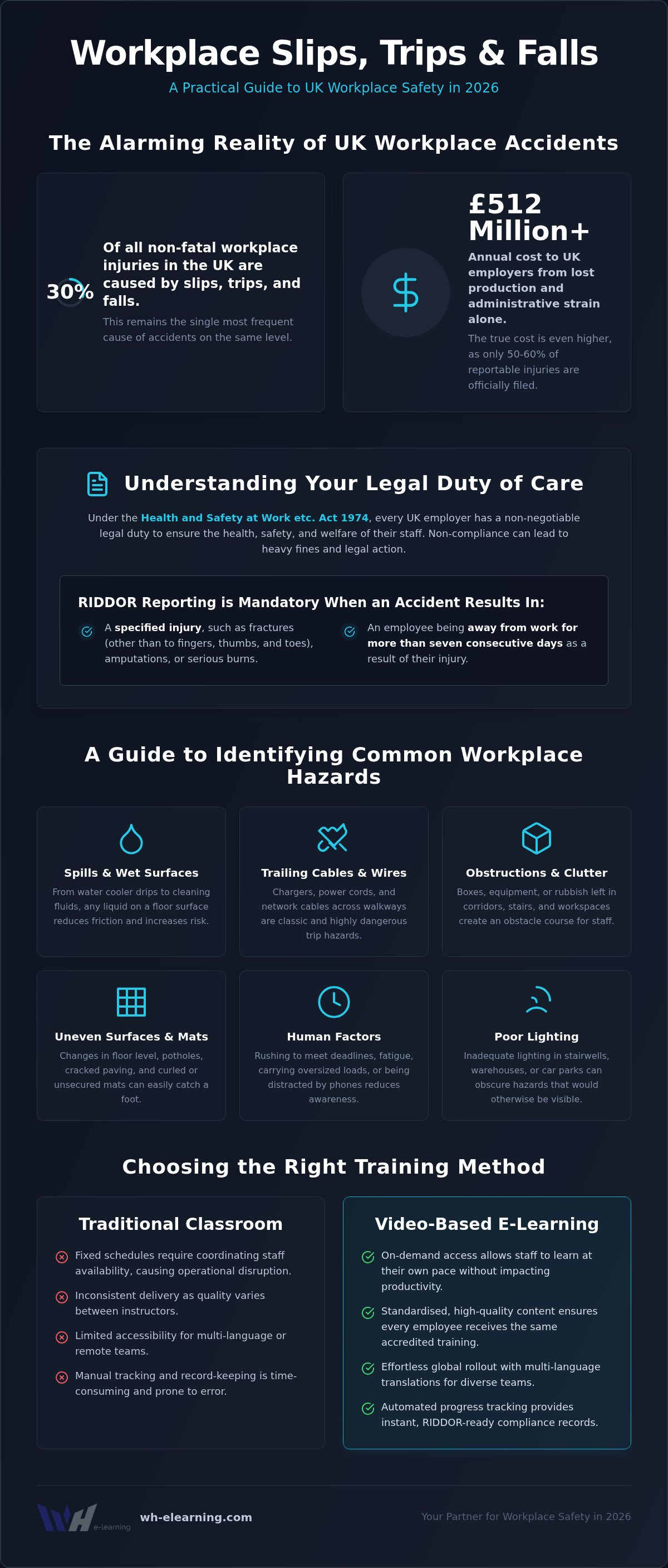
Did you know that slips, trips, and falls on the same level still account for 30% of all non-fatal workplace injuries in the UK? In 2026, these preventable accidents cost employers over £512 million annually in lost production alone. You likely already recognise that keeping your team safe is a top priority, yet engaging a multi-language workforce in safety topics often feels like an uphill battle. Managing rising insurance premiums whilst ensuring every employee understands your slip and trip risk assessment guide is a constant challenge for any modern business.
It's time to replace friction with empowerment. This comprehensive guide shows you how to protect your workforce and ensure full HSE compliance through accredited, video-based training that staff actually enjoy. We'll explore how to simplify your health and safety obligations, reduce accident rates, and use automated tracking to stay RIDDOR-ready without the administrative headache. Discover how a modern approach to prevention can transform your workplace culture from a box-ticking exercise into a seamless, high-quality experience for everyone.
Key Takeaways
- Understand your legal obligations under the Health and Safety at Work Act 1974 to maintain a safe environment and avoid costly penalties in 2026.
- Master the essentials of identifying common workplace hazards like spills and trailing cables using our practical slip and trip risk assessment guide.
- Compare the benefits of video-based online learning against traditional classroom methods to find the most effective way to engage your staff.
- Learn how to implement a seamless global training rollout for diverse teams using multi-language course translation and automated progress tracking.
- Discover how accredited training improves knowledge retention and helps your business remain fully compliant with HSE and RIDDOR requirements.
Slips, Trips, and Falls: Understanding UK Compliance and Duty of Care
Under the Health and Safety at Work etc. Act 1974, every UK employer has a non-negotiable legal duty to ensure the health, safety, and welfare of their staff. Slips, trips, and falls aren't just minor mishaps; they are legally defined incidents where an individual loses their footing or balance. Understanding Slips, Trips, and Falls is the first step in fulfilling your Duty of Care. This obligation requires you to provide a safe working environment, which includes maintaining floor surfaces and removing obstructions. Failing to manage these risks triggers the Reporting of Injuries, Diseases and Dangerous Occurrences Regulations (RIDDOR). If an accident results in a specified injury or keeps a worker away from their role for more than seven days, you must report it to the HSE. In 2026, the financial burden is staggering, with UK employers facing direct costs of approximately £512 million per year due to lost production and administrative strain.
The Legal Framework for UK Employers
Implementing a robust workplace compliance training strategy is essential for your legal protection. It isn't just about safety. It's about building a defensible position against potential litigation. Non-compliance often leads to heavy fines, legal action, and lasting reputational damage that can alienate clients and talent alike. By using a comprehensive slip and trip risk assessment guide, you demonstrate a proactive approach to safety. Accredited courses ensure your team meets HSE inspection standards, providing the documented proof of competence that inspectors look for during a visit.
Statistical Trends in Workplace Injuries
In 2026, slips and trips remain the most frequent cause of non-fatal workplace injuries, representing 30% of all reported incidents. Whilst every sector is vulnerable, the accommodation and food service industries consistently report the highest rates of injury. Manufacturing and office environments also face significant risks from wet floors and trailing cables. Despite these high numbers, the HSE estimates that only 50-60% of reportable injuries are actually filed under RIDDOR. This suggests the true economic impact is even higher than official records show. A "See It, Sort It" culture serves as your primary prevention tool by empowering every staff member to take immediate ownership of workplace hazards. Integrating these values into your slip and trip risk assessment guide ensures that safety becomes a shared responsibility rather than a management burden.
Identifying Hazards: A Practical Slip and Trip Risk Assessment Guide
Preventing accidents begins with a keen eye for detail. Common workplace hazards often hide in plain sight, such as a trailing charging cable in an office or a small oil patch in a warehouse. This slip and trip risk assessment guide helps you spot these issues before they become injuries. Understanding the mechanics of a fall is equally vital. Friction between the shoe and the floor provides stability; when that friction is lost, or the body's centre of gravity shifts unexpectedly, a fall is inevitable. By identifying these physical triggers, you can implement controls that stop a slip before it starts.
Human behaviour plays a significant role too. Fatigue, rushing to meet deadlines, or simply being distracted by a phone can make a clear path dangerous. While we often focus on the physical environment, addressing these human elements is a core part of any slip and trip risk assessment guide. Maintaining high lighting standards and rigorous housekeeping routines ensures that even when a worker is tired, the environment remains as safe as possible. Practical steps, like securing loose mats and clearly marking uneven surfaces, provide a reliable safety net for your team.
Hazard Identification and Risk Assessment
Static risk assessments are a great start, but the best protection comes from teaching staff to perform dynamic risk assessments whilst they work. This means constantly scanning their surroundings for new hazards as they arise. Such skills are often a cornerstone of a broader occupational safety and health training course. Encouraging a culture where near misses are reported is essential. If someone almost trips over a loose carpet tile, reporting it allows you to fix the problem before the next person actually falls. You can view CDC workplace fall statistics to see just how prevalent these incidents remain globally.
Footwear and Environmental Controls
Control doesn't stop at the floor surface. Choosing the right slip-resistant footwear is a critical preventative step, especially in environments like kitchens or hospitals where spillages are frequent. You must also manage environmental changes. Wet weather can bring moisture into entryways, and cleaning schedules should be timed to avoid peak foot traffic. Implementing a consistent floor maintenance programme ensures that surfaces don't degrade over time. If you're looking to empower your team with these skills, our health and safety training courses provide the practical knowledge needed to manage these risks effectively.
Choosing the Right Training: Video-Based E-Learning vs Traditional Methods
Selecting the right training format is just as critical as the content itself. Traditional face-to-face classroom sessions offer direct interaction; however, they often struggle with logistical scheduling and high costs. In contrast, modern e-learning provides a flexible alternative that fits into the busy schedules of 2026 professionals. Whilst some businesses rely on simple checklists, these don't provide the depth found in a comprehensive slip and trip risk assessment guide. Accredited training, like that available from WH eLearning, ensures your business meets recognised standards that HSE inspectors value during an audit.
Video-based content significantly outperforms static PowerPoint modules. Moving images and real-world scenarios improve knowledge retention by making the material more relatable and engaging. For large organisations, bulk licensing offers a clear cost-benefit advantage. It allows you to roll out high-quality instruction across your entire workforce at a fraction of the cost of booking multiple in-person workshops. This approach removes the obstacles of travel and downtime, making professional development both high-end and attainable for every team member.
The Benefits of Online E-Learning
Digital platforms offer 24/7 accessibility on any device. This is a game-changer for remote teams or shift workers who cannot attend a central training day. You also gain a consistency of message that's hard to replicate with different trainers in different locations. Every employee receives the same high standard of instruction regardless of when they log in. Crucially, these systems allow you to track staff training progress online, giving you instant visibility of compliance levels and helping you identify any gaps in knowledge before an accident occurs.
When to Consider In-House Training
Online theory is powerful, but some high-risk industrial environments benefit from specialist-led sessions. These in-person days allow for practical, on-site hazard spotting that's tailored to specific sectors like construction or retail. You might choose to combine online modules with face-to-face workshops to create a blended learning approach. This ensures that whilst the core principles are mastered digitally, the specific nuances of your unique workplace are addressed by an expert on the ground. This combination provides a supportive path to meeting professional standards whilst ensuring your slip and trip risk assessment guide is applied correctly in real-world scenarios.
Organising a Global Training Rollout for Diverse Teams
Managing a safety initiative across multiple regions requires a structured approach that respects the diversity of your workforce. Whether your team is based in a single UK warehouse or spread across international hubs, a consistent slip and trip risk assessment guide ensures everyone speaks the same safety language. To achieve this at scale, you must move beyond manual spreadsheets and embrace a digital strategy designed for 2026.
- Step 1: Audit requirements. Review your current workforce to identify specific language needs and accessibility requirements, such as closed captions for hearing-impaired staff.
- Step 2: Choose the right platform. Select a provider that offers multi-language e-learning courses to ensure every worker can learn in their native tongue.
- Step 3: Define oversight. Establish a clear completion timeline and assign administrative roles to manage the rollout across different departments.
- Step 4: Analyse compliance. Use automated reporting tools to identify any gaps where staff haven't completed their training, allowing for targeted follow-ups.
Overcoming Language and Accessibility Barriers
Language should never be a barrier to safety. By utilising machine translation, you can reach a global team in over 25 languages without the prohibitive costs of traditional bespoke translation services. This technology ensures that the core principles of your slip and trip risk assessment guide are understood by every member of staff, regardless of their background. Inclusivity goes further than just words; modern platforms integrate closed captions and accessible UI designs to support every learner. This approach reduces friction and makes high-standard safety training attainable for everyone in your organisation.
Tracking and Managing Compliance at Scale
Scaling your training programme is simplified through corporate licensing, which allows for the rapid onboarding of new starters. You can set up automated reminders to prompt staff about training refreshers, ensuring that safety remains a continuous priority rather than a one-off event. Digital certificates provide an instant and permanent audit trail that allows you to demonstrate full compliance to HSE inspectors at the touch of a button. This level of transparency protects your business whilst empowering your employees to grow professionally. To start building a safer, more compliant workforce today, explore our full range of accredited health and safety courses.
Why WH eLearning is Your Partner for Workplace Safety in 2026
Choosing a training partner is about more than just buying a course; it's about finding a reliable mentor for your long-term safety strategy. At WH eLearning, we've replaced the friction of traditional training with a high-end, video-based approach that ensures higher engagement and better knowledge retention. Our content is delivered by industry specialists who understand the practical realities of the modern workplace. This isn't just theory. It's a way to bring your slip and trip risk assessment guide to life, ensuring that every member of staff knows exactly how to apply safety principles in their daily routine.
We provide access to over 100 accredited courses, ranging from specialised health and safety modules to broader business compliance. Our platform is built for the professional of 2026, offering seamless integration that works on any device, anywhere in the world. This flexibility is essential for busy teams who need to find information and make decisions quickly. By choosing a partner that values quality and reliability, you remove the obstacles to professional growth and create a simplified path to meeting the highest safety standards.
Empowering Your Team with Engaging Content
Effective training must move beyond simple tick-box exercises to inspire genuine behaviour change. Our video-based learning doesn't just inform; it reshapes how employees perceive risk, fostering a safer company culture where everyone feels empowered to take action. Managing this at scale is effortless with our bulk licensing options, which are designed to support organisations of any size. Whether you're a small local business or a global enterprise, we provide the tools to track progress and maintain full compliance whilst supporting the individual professional growth of your workforce. This approach ensures that your slip and trip risk assessment guide remains a living document that actively protects your team every day.
Get Started with WH eLearning Today
Take the first step towards a safer, more compliant workplace by exploring our full library of workplace safety training courses. Our resources are designed to be modern, tech-literate, and practical, ensuring your team remains protected against the most common workplace accidents. You can enrol individual learners today to fill immediate gaps or request a bespoke quote for corporate licensing to cover your entire organisation. Don't wait for an accident to happen before you act. Enrol your team in our Slips, Trips and Falls Prevention Course today and secure your business for the future.
Secure Your Workplace for a Safer 2026
Implementing a robust safety strategy doesn't have to be a complex administrative burden. By following a clear slip and trip risk assessment guide, you've already taken the first step toward reducing accidents and protecting your bottom line. You now understand that the right training isn't just a box-ticking exercise; it's a vital investment in your team's welfare and your company's future growth. Modern businesses require modern solutions that respect both the employer's time and the employee's learning experience.
Our video-based learning ensures 90% better retention. It makes safety protocols stick. Trusted by global organisations for 2026 compliance, our courses are accredited by industry specialists to give you total peace of mind during HSE inspections. Whether you're managing a local office or a multi-language global team, we're here to simplify your path to professional excellence and regulatory safety.
Protect your workforce: Enrol in our Slips, Trips and Falls Course
We're ready to help you build a culture where safety is seamless, accessible, and high-quality for every employee. Let's make your workplace safer together.
Frequently Asked Questions
Is a slips, trips and falls prevention course a legal requirement in the UK?
Yes, providing adequate training is a key part of your legal obligations under the Health and Safety at Work etc. Act 1974. Employers must ensure staff are competent to recognise and manage workplace hazards effectively. Whilst the law doesn't specify a named course, providing accredited training is the most reliable way to meet HSE standards. It ensures your team follows a formal slip and trip risk assessment guide to keep the workplace safe.
How long does the online slips, trips and falls course take to complete?
Most learners complete our video-based modules in approximately 45 to 60 minutes. The content is designed to be concise and engaging, allowing staff to fit professional development into their busy schedules without significant downtime. Because it's accessible on any device, employees can work through the material at their own pace. This efficient approach helps you maintain high safety standards whilst respecting your team's valuable time and effort in 2026.
Do employees receive a certificate upon completion of the training?
Yes, every learner receives a digital certificate immediately after successfully passing the course assessment. These certificates serve as formal proof of training and are essential for maintaining your company's compliance records. Having these documents readily available provides an instant audit trail for HSE inspectors. It demonstrates that your business takes its Duty of Care seriously and has invested in high-quality, specialist-led instruction for every member of the team.
Can this course be translated for staff who do not speak English as their first language?
Absolutely, we offer machine translation into more than 25 different languages to support your global workforce. This feature ensures that every employee, regardless of their native tongue, can fully understand your slip and trip risk assessment guide and safety protocols. We also include closed captions to improve accessibility. This inclusive approach removes language barriers and ensures that critical safety information is understood by everyone, reducing the risk of accidents across your organisation.
How often should staff take a refresher course on slips and trips?
We recommend that staff complete a refresher course at least every twelve months or whenever there are significant changes to your workplace environment. Regular updates ensure that safety remains a top priority and that best practices are fresh in everyone's minds. If an accident occurs or a near miss is reported, it's also a good time to re-evaluate training needs. Consistent learning helps maintain a proactive safety culture and reduces long-term risks.
What is the difference between online and face-to-face safety training?
Online training offers 24/7 flexibility and a consistent message for all staff, making it ideal for remote or shift-based teams. It's a highly efficient way to deliver theoretical knowledge at scale. Face-to-face training, delivered by our industry specialists, allows for practical, on-site hazard spotting tailored to your specific location. Many businesses choose a blended approach, using online modules for core compliance and in-house sessions for high-risk industrial tasks or specific environmental challenges.
Are these courses accredited by recognised health and safety bodies?
Yes, our health and safety training courses are accredited and designed to meet the rigorous standards expected by industry bodies. For example, we offer IOSH Managing Safely and Working Safely Online, which are globally recognised certifications. Using accredited material ensures that the instruction your team receives is accurate, up-to-date, and legally defensible. This commitment to quality helps your business achieve full compliance with HSE and RIDDOR requirements whilst empowering your workforce.
Can I track the progress of my employees through the online platform?
Yes, our corporate training licenses include comprehensive administrative features that allow you to monitor employee progress in real time. You can easily see who has completed their modules, track assessment scores, and identify any gaps in compliance across large teams. Automated reminders can also be set up to prompt staff who haven't finished their training. This oversight simplifies your management duties and ensures your safety records are always audit-ready for inspections.


