

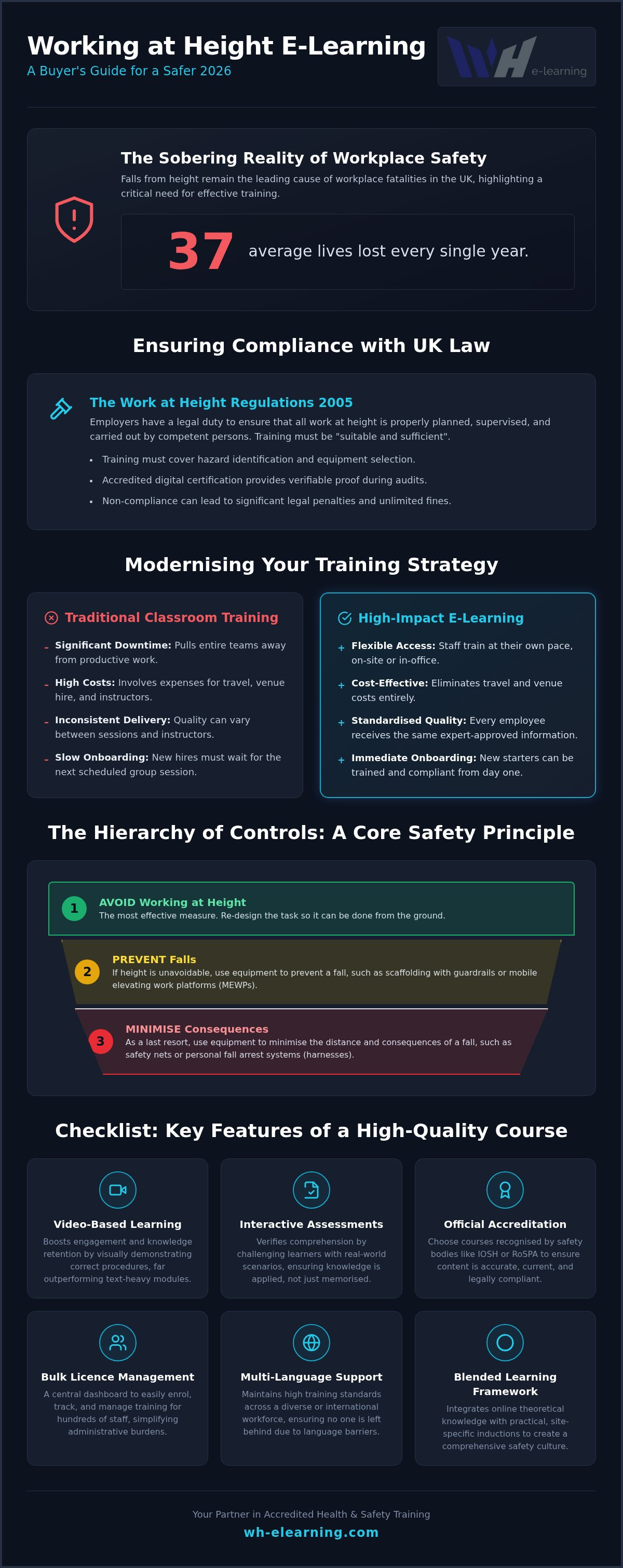
Did you know that falls from height remain the leading cause of workplace fatalities in the UK, claiming an average of 37 lives every single year? It's a sobering reminder that safety isn't just about ticking boxes; it's about ensuring every team member returns home safely at the end of their shift. You likely already know that keeping hundreds of staff compliant with the Work at Height Regulations 2005 is a massive administrative challenge. Finding a working at height e-learning course that actually engages your team whilst bridging language gaps often feels like an uphill battle, especially when generic modules fail to hold their attention.
We're here to simplify that process and help you regain control over your training records. In this 2026 buyer's guide, you'll discover how to select an accredited training solution that ensures total workplace compliance and significantly reduces fall-related risks. We'll explore why video-based learning outperforms traditional text, how to manage bulk licenses for a diverse workforce, and the essential administrative features you need to audit progress without the usual stress. By the end of this guide, you'll have a clear path to a safer, more efficient workplace.
Key Takeaways
- Understand how to align your training strategy with the Work at Height Regulations 2005 to ensure full legal compliance and robust workplace safety.
- Learn why video-based modules and interactive assessments are essential for boosting staff engagement and knowledge retention compared to traditional text-heavy courses.
- Discover how a modern working at height e-learning course simplifies administrative burdens through central dashboards and flexible bulk licensing for large teams.
- Identify the most effective framework for integrating online theoretical knowledge with practical, site-specific inductions to create a comprehensive safety culture.
- Explore the advantages of choosing an accredited provider that offers multi-language support to maintain high training standards across a diverse or international workforce.
Understanding the Need for a Working at Height E-Learning Course
Under the Work at Height Regulations 2005, working at height is defined as any place where, if no precautions were in place, a person could fall a distance liable to cause personal injury. This doesn't just apply to high-rise construction sites; it includes working on a ladder, a flat roof, or even near an opening in a floor. To manage these risks, the Health and Safety Executive (HSE) requires that all work at height is properly planned, supervised, and carried out by competent persons. Investing in a working at height e-learning course is the most efficient way to establish this baseline competence across your entire workforce.
The stakes for getting this right are incredibly high. Falls from height remain the leading cause of workplace fatalities in the UK, with an annual average of 37 deaths recorded over the last four years. Beyond the human cost, the risks of non-compliance include significant legal penalties and unlimited fines. By prioritising accredited training, you ensure your team understands the hierarchy of controls, which dictates that you should avoid working at height where possible, prevent falls through proper equipment, and minimise the consequences of any potential fall.
Legal Requirements and the Work at Height Regulations
Employers hold a legal duty to ensure that everyone involved in work at height is trained and competent. The regulations demand "suitable and sufficient" training, which means your staff must understand how to select the right equipment and identify site-specific hazards. Accredited training provides a verified standard that stands up to scrutiny during inspections. In a modern health and safety environment, digital certification is a game-changer for audits. Instead of sifting through paper files, you can instantly prove compliance with a centralised digital record that shows exactly who has completed their training and when it expires.
The Advantages of Digital Training Over Traditional Methods
Traditional classroom sessions often lead to significant workforce downtime and expensive travel costs. A digital working at height e-learning course removes these obstacles by allowing staff to complete modules at their own pace, whether they're in the office or on-site. This approach ensures total consistency in training delivery; every employee receives the same high-quality information on essential safety components, such as fall arrest systems and collective protection. You gain the ability to onboard new starters immediately, ensuring they have the theoretical knowledge required to stay safe before they even step onto a ladder. This streamlined process doesn't just save money; it builds a more responsive and safety-conscious culture.
Key Features to Look for in a High-Quality Safety Course
Selecting the right training isn't just a matter of fulfilling a requirement; it's about choosing a platform that actually changes behaviour. A high-quality working at height e-learning course must move beyond static text and dry PDFs. Video-based learning is the gold standard here because it allows workers to visualise hazards in a way that words simply cannot match. By seeing a harness fitted correctly or a ladder secured properly on screen, learners retain information at a much higher rate. This visual approach aligns with the high standards seen in OSHA fall protection standards, which prioritise clear demonstration of safety protocols.
Interactive assessments are equally vital. These shouldn't be simple "tick-box" exercises at the end of a module. Instead, they should challenge the learner to apply their knowledge to specific scenarios throughout the course. This active participation verifies that the individual has truly understood the risks of working at height before they receive their certification. If you're looking for a solution that combines these engaging elements with robust tracking, exploring the accredited health and safety training library at WH eLearning is an excellent starting point.
Accreditation and Industry Recognition
Always verify the credentials of your training provider. Look for courses recognised by established safety bodies such as IOSH or RoSPA. These endorsements provide peace of mind that the content is accurate, up-to-date, and legally compliant; it builds trust amongst employees and stakeholders alike. It's also important to distinguish between "awareness" training and "operator" training. A digital course is perfect for providing the essential awareness and theoretical knowledge needed for compliance, whilst specific equipment operation may require additional hands-on induction on-site.
Accessibility and Inclusive Learning Design
In a diverse workforce, accessibility is both a legal and ethical necessity. Closed captions are a critical feature, not only for staff with hearing impairments but also for neurodivergent learners who process information better through text and video simultaneously. Modern courses now utilise machine translation to offer support in over 25 languages, ensuring that language barriers don't compromise safety for international firms. Finally, ensure the course is mobile-friendly. Workers on busy sites often need to access training on tablets or smartphones, so the learning experience must be seamless across all devices.
Choosing the Right Enrolment Model for Your Organisation
Selecting how to deploy your working at height e-learning course is a strategic decision that affects both your budget and your administrative workload. For many, the choice rests between individual "pay-as-you-go" enrolments and a comprehensive corporate licensing model. Both paths lead to compliance. However, the right choice depends on the scale of your workforce and the complexity of your safety audits. Finding a balance between flexibility and oversight is key to a successful training programme.
Individual Enrolment for Small Businesses
For sole traders or micro-businesses, individual enrolment is often the most sensible route. It allows for immediate setup without a long-term commitment. You simply purchase the course when needed, ensuring a new hire is trained before their first day on-site. This flexibility is ideal for those who need a specific occupational safety and health training course to meet a particular contract requirement. It’s a low-friction way to stay compliant without the need to manage a large-scale training programme.
Corporate Licensing and Compliance Tracking
Larger organisations face a different set of challenges. Tracking progress for hundreds of employees manually is nearly impossible and prone to error. This is where corporate licensing becomes essential. By purchasing a working at height e-learning course in bulk, you significantly reduce the cost per employee, making it a highly cost-effective investment for growing teams. More importantly, it gives you access to a professional training dashboard. This central hub allows you to:
- Monitor real-time progress of every staff member from one location.
- Generate instant reports for health and safety audits.
- Automate expiry reminders so no one’s certification lapses.
- Assign courses to new starters automatically as part of their onboarding process.
Integrating your height safety modules into a broader workplace compliance training strategy ensures that safety is never an afterthought. A robust dashboard removes the administrative burden, allowing your safety officers to focus on site-specific risks rather than chasing paperwork. It turns training from a disjointed task into a streamlined, reliable process that evolves with your business needs.
Implementing Height Safety Training: A Practical Framework
Successful implementation starts with the understanding that a working at height e-learning course is the bedrock of a safe site. It provides the essential vocabulary and safety principles every worker must master before they set foot on a scaffold or ladder. However, the most effective organisations don't treat the digital certificate as the final step. They use that theoretical knowledge as a springboard for practical, site-specific safety measures that protect staff in real-world conditions.
Conducting Site-Specific Risk Assessments
Whilst e-learning covers universal physics and regulatory requirements, it cannot account for the unique layout of your specific warehouse or construction site. You must integrate digital training into your wider risk assessment process. Use the data from your course dashboard to identify which employees excelled and who might need extra supervision during physical inductions. This allows you to target high-risk areas in the business with more focused, hands-on guidance. Identifying hazards like fragile roof panels or overhead power lines becomes much easier when your team already understands the fundamental risks of falls.
A common mistake is treating online training as a standalone solution. It isn't; it's a component of a blended approach. Another frequent error is failing to provide regular refreshers. Safety knowledge naturally degrades over time, so scheduling annual or biennial updates is vital for maintaining a safe culture. Without these reminders, staff can become complacent, leading to the very risks the training was designed to prevent.
Building a Culture of Safety and Compliance
Safety shouldn't feel like a chore or a tick-box exercise. By providing high-quality workplace safety training courses, you show your employees that you're invested in their well-being. This proactive approach often pays for itself through reduced insurance premiums and fewer days lost to injury. Well-trained staff are also more likely to report near-misses, which helps you prevent future accidents before they happen. You can even use these training statistics in board-level reporting to demonstrate your commitment to legal compliance and corporate responsibility.
Ready to protect your team and streamline your compliance? Explore our accredited working at height e-learning course options and start building your safety framework today.
Why WH eLearning is the Premier Choice for Height Safety
Choosing a training provider is about more than just finding a course; it's about selecting a partner that understands the complexities of modern compliance. We've built our reputation on providing high-quality, accessible education that empowers teams to work safely. By offering an accredited library of over 100 courses, we ensure that your organisation can manage every aspect of health and safety from a single, reliable source. Our working at height e-learning course is a cornerstone of this collection, designed to deliver essential safety knowledge with the quiet confidence of an industry leader.
Global Reach with Multi-Language Support
In 2026, the workforce is more diverse than ever. Language barriers shouldn't be a hurdle to life-saving safety information. Our multi-language e-learning courses use advanced machine translation to support over 25 languages, ensuring every team member understands their responsibilities. This feature, combined with clear closed captions, removes obstacles for international firms and neurodivergent learners alike. It allows you to maintain a strict standardisation of safety protocols across global offices, ensuring that a worker in London receives the exact same high-standard training as a colleague in Dubai or Berlin.
Flexible Training Solutions for Every Business
We recognise that a one-size-fits-all approach rarely works for professional development. Whether you're a sole trader looking for an individual certificate or a multinational firm requiring bulk corporate licenses, our platform adapts to your needs. You gain the flexibility to scale your training as your business grows, with administrative tools that make auditing a seamless part of your routine. We don't just stop at digital modules; we also provide specialist-led in-house training for those who require tailored, face-to-face sessions to hone practical skills on-site.
This blended approach ensures your staff aren't just "aware" of the risks but are truly competent in managing them. We act as a facilitator of growth, helping you meet professional standards without the usual friction of complex logistics. Our commitment to your success is built on long-term investment rather than simple transactions. We're here to help you navigate the evolving regulatory landscape with ease and authority. We're committed to simplifying training delivery through video-based excellence, ensuring every learner gains the confidence to work safely at height.
Take the Next Step Towards a Safer Workplace in 2026
Ensuring your team stays safe whilst working above ground level doesn't have to be a complex administrative burden. By choosing a high-quality safety programme, you're investing in more than just a certificate; you're building a foundation of competence that protects both lives and your business reputation. We've explored how video-based learning and interactive assessments bridge the gap between theory and site-specific safety. With robust tracking tools and multi-language support, you can now manage global compliance with total confidence and ease.
Our platform is accredited by leading safety bodies and trusted by global organisations for 2026 compliance. We offer over 25 languages at no extra cost, making it simpler than ever to protect every member of your workforce regardless of their primary language. It's time to replace friction with progress and turn your safety requirements into a streamlined path for professional growth. Explore our accredited working at height e-learning course and secure your team today. Together, we can ensure every worker returns home safely at the end of the day.
Frequently Asked Questions
Is a working at height e-learning course legally sufficient in the UK?
A working at height e-learning course is legally sufficient for providing the essential theoretical knowledge required by the Work at Height Regulations 2005. It establishes a baseline of competence by teaching staff how to identify hazards and follow the hierarchy of control. Whilst it covers the legal requirements for safety awareness, employers must still provide site-specific inductions. This ensures workers understand the unique risks and equipment found in their specific environment, creating a complete safety framework.
How long does a working at height certificate remain valid?
Most working at height certificates are valid for three years, although this can vary depending on your specific industry standards. We recommend that organisations schedule refreshers every one to two years to maintain a high level of safety awareness amongst staff. Regular updates help prevent complacency and ensure that everyone remains familiar with the latest regulatory changes. Staying proactive with your training schedule is a simple way to reduce the risk of workplace accidents.
Can I take the working at height course on a mobile device?
Yes, you can access our training on any modern mobile device, including smartphones and tablets. We've designed our platform to be fully responsive, allowing workers to complete modules whilst on-site or during transit. This flexibility reduces downtime and makes it easier for busy professionals to fit essential learning into their daily routines. Whether your team uses iOS or Android, they'll experience the same high-quality video content and interactive assessments without any technical friction.
What is the difference between working at height awareness and practical training?
Awareness training focuses on the theoretical principles of safety, such as understanding the Work at Height Regulations 2005 and identifying potential fall risks. Practical training involves the hands-on operation of specific equipment like scaffolding or mobile elevating work platforms. Our working at height e-learning course provides the vital awareness foundation that every worker needs. Once this theoretical knowledge is secured, it should be supplemented with site-specific practical inductions to ensure total operational competence.
Do your courses include closed captions for the hearing impaired?
All our video-based modules include high-quality closed captions to ensure they are accessible to everyone. This feature supports staff with hearing impairments and assists neurodivergent learners who process information more effectively through a combination of text and audio. We believe that safety training should be inclusive by design. By removing these learning obstacles, we help you meet your ethical and legal obligations whilst ensuring that every employee can engage fully with the material.
How do I manage training for a large team with different language needs?
Managing a diverse workforce is simple with our administrative dashboard and machine translation features. You can assign training to hundreds of employees at once and offer the content in over 25 different languages. This ensures that every worker receives life-saving information in a language they fully understand, which is critical for high-risk safety training. Our centralised tracking system allows you to monitor progress and audit compliance across your entire global organisation from one location.
What happens if an employee fails the online assessment?
If an employee fails the online assessment, they don't need to worry about starting the entire process from scratch. Our platform allows learners to review specific video modules to reinforce their understanding before attempting the test again. This supportive approach encourages genuine learning rather than just memorisation. Managers can also use the tracking dashboard to see which areas a staff member struggled with, allowing for targeted coaching to help them reach the required standard of competence.
Is the WH eLearning working at height course accredited by a recognised body?
Yes, our working at height course is fully accredited by recognised safety bodies, ensuring it meets the highest industry standards for 2026. This accreditation provides peace of mind that the content is accurate, up-to-date, and legally compliant with UK regulations. Using accredited training builds trust with your employees and stakeholders alike. It also ensures that your digital certifications are valid for health and safety audits, protecting your business from the risks of non-compliance.


