

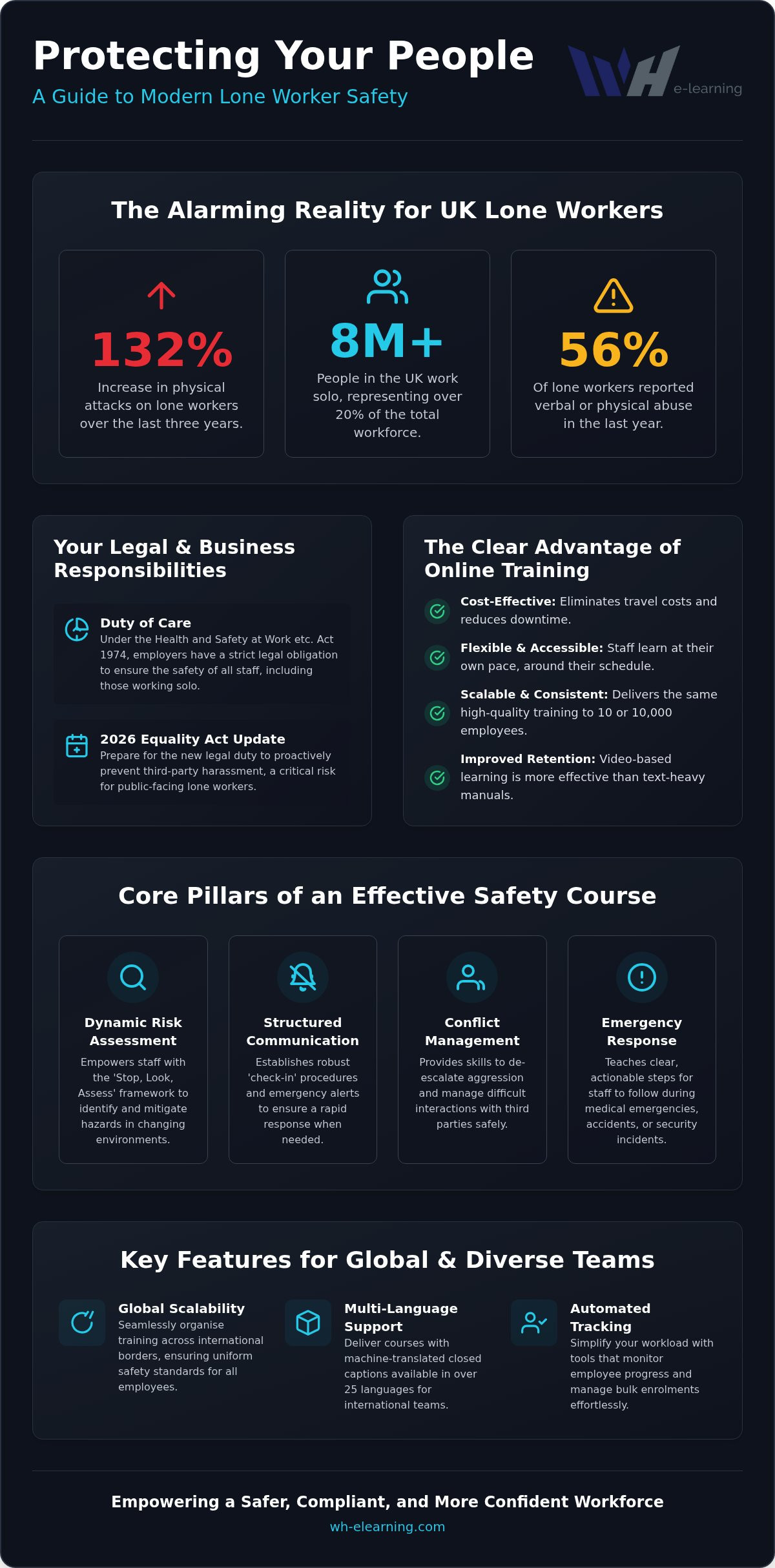
Did you know that physical attacks on lone workers have increased by 132% over the last three years? With over 8 million people in the UK now working solo, implementing effective lone worker safety training online is more pressing than ever. It's a sobering reality for any manager, and you likely feel the weight of ensuring your team is truly protected rather than just ticking a box. You need a way to make sure training is actually understood and completed, especially whilst managing international teams with varying language needs.
This guide helps you discover how to protect your solo employees and ensure full legal compliance with accredited, video-based lone worker safety training online. We'll explore the vital 2026 updates to the Equality Act regarding third-party harassment and show you how to simplify administrative tracking for even the largest teams. By the end of this article, you'll have a clear roadmap to reducing workplace incidents and improving safety behaviours with confidence.
Key Takeaways
- Master the latest 2026 legal requirements, including the updated duty to prevent third-party harassment and core HSE standards for solo staff.
- Discover why accredited lone worker safety training online is the most efficient way to ensure your team remains protected and your business stays compliant.
- Learn how video-based learning improves knowledge retention compared to traditional text-heavy courses, leading to safer workplace behaviours.
- Explore how to scale safety protocols across international borders using machine translation and closed captions in over 25 languages.
- Simplify your administrative workload by using automated tracking tools to monitor employee progress and manage bulk corporate enrolments effortlessly.
Why Lone Worker Safety Training Online is Essential in 2026
The modern workforce has undergone a radical transformation. By 2026, an estimated 8 to 9 million people in the UK are classified as lone workers, representing over 20% of the total working population. This shift means that safety is no longer just about managing a physical office space; it's about protecting individuals who operate far beyond your direct line of sight. Implementing lone worker safety training online is no longer a luxury for forward-thinking firms. It's a fundamental requirement for any organisation that values its people and its legal standing.
Employers hold a strict legal obligation to ensure the safety of solo staff whilst they are on the clock. Under the Health and Safety at Work etc. Act 1974, your duty of care doesn't diminish just because an employee is working from home or visiting a remote site. Beyond compliance, there is a significant psychological benefit to robust training. When employees feel equipped to handle risks, their anxiety levels drop. This sense of security directly correlates with higher employee retention and a more positive workplace culture.
Defining the Modern Lone Worker
The definition of a lone worker has expanded significantly. Traditionally, we might have pictured a night-shift security guard or a utility engineer in a remote field. Today, the scope is much broader. What is a lone worker? In the current landscape, it includes any individual who works without direct or closely situated supervision. This encompasses the home-based consultant, the delivery driver, and even the retail manager opening a shop alone.
Many organisations struggle to identify these "hidden" lone workers. Remote working has made isolation a standard part of the professional day for many. The specific risks associated with this isolation include a lack of immediate support during medical emergencies and an increased vulnerability to third-party aggression. With 56% of lone workers reporting verbal or physical abuse in the last year, understanding these risks through lone worker safety training online is the first step toward effective mitigation.
The Business Case for Online Training
Transitioning to digital learning offers clear advantages for growing businesses. Traditional face-to-face sessions often involve high travel costs and significant downtime. In contrast, e-learning is exceptionally cost-effective. It allows you to organise training around the employee's schedule rather than forcing them to attend a rigid seminar.
Scalability and consistency are equally vital. Whether you need to train 10 local staff or 10,000 employees across global territories, online platforms deliver the same high-quality safety message to every learner. Video-based modules ensure that complex safety behaviours are demonstrated clearly, reducing the risk of misunderstanding that often comes with static, text-heavy manuals. This unified approach ensures that every member of your team, regardless of their location, meets the same rigorous international safety standards.
Core Modules of an Effective Lone Worker Safety Course
High-quality lone worker safety training online must do more than provide a list of rules. It should empower staff to make critical decisions under pressure. A comprehensive curriculum focuses on four essential pillars: proactive risk identification, structured communication, conflict management, and emergency response. By covering these areas, you ensure that employees aren't just aware of the hazards but are actively prepared to mitigate them.
Dynamic Risk Assessment Skills
Standard risk assessments are often static documents reviewed once a year. However, solo workers face shifting environments that require a more fluid approach. Training should teach the 'Stop, Look, Assess' framework. Before entering a property or starting a site visit, employees learn to pause and identify new hazards that weren't present during the initial planning. This might include aggressive pets, poor lighting, or restricted exit paths. For a deeper dive into these methodologies, you might explore risk assessment training online to build a stronger safety foundation for your team.
Establishing robust communication protocols is a non-negotiable legal requirement for modern businesses. Clear 'check-in' procedures ensure that if a worker fails to report back at a scheduled time, an alarm is raised immediately. This aligns with the HSE guidance on protecting lone workers, which emphasises the need for regular contact and effective supervision. Effective training teaches staff how to use these systems without them becoming a burden on their daily workflow.
Personal Safety and Behaviour Management
Public-facing roles carry unique risks. With weapon-related incidents involving lone workers rising by 104% over the last three years, de-escalation techniques are vital. Training helps staff recognise the early signs of aggression and manage their own physiological response to stress. It's about maintaining a professional boundary whilst ensuring a safe exit path is always available. This is particularly relevant given the 2026 legal updates requiring employers to take all reasonable steps to prevent third-party harassment.
Complacency is often the greatest risk for experienced solo staff who have performed the same tasks for years. Training addresses the 'human factor' by reinforcing why personal safety devices and apps must be used consistently. It encourages a culture where safety is a habit rather than a reaction to a visible threat. This proactive mindset is what separates a compliant business from a truly safe one.
When help isn't immediate, knowing the exact steps to take can be life-saving. Emergency modules should cover everything from 'man-down' sensor alerts to pre-arranged emergency contacts who are authorised to take action. Investing in accredited health and safety training online ensures your team is prepared for these high-stakes scenarios with confidence and clarity.
Meeting UK HSE and International Compliance Standards
The Health and Safety at Work etc. Act 1974 remains the cornerstone of UK workplace safety. It mandates that employers manage the risks to all staff, including those working in isolation. Failing to provide adequate instruction or supervision isn't just a lapse in safety; it's a significant legal liability. By choosing accredited lone worker safety training online, you ensure your business meets these statutory requirements whilst protecting your most vulnerable team members.
Global organisations must also navigate a complex web of international standards. Whilst OSHA in the United States and EU-OSHA in Europe have their own nuances, the core principles of risk management remain consistent. Aligning your internal policies with these global benchmarks ensures that your safety culture is robust, regardless of where your employees are stationed. This unified approach reduces confusion and ensures every team member operates under the same high safety standards.
UK HSE Guidelines for Solo Employees
The HSE is clear that employers must provide sufficient information and training to ensure lone workers are as safe as those in a supervised environment. This includes specific training on risk assessment and emergency procedures. Investing in comprehensive workplace compliance training is a proactive way to avoid the heavy fines associated with safety breaches. It demonstrates that you've prioritised the unique challenges faced by those working without immediate support.
You must also stay mindful of reporting requirements under RIDDOR. If a solo worker suffers a reportable incident, having a documented training history is vital for your defence during any subsequent investigation. It proves you took all reasonable steps to mitigate known hazards and equipped your staff with the necessary skills to stay safe. Without this audit trail, your organisation is far more vulnerable to legal challenges and reputational damage.
Accreditation and Certification Quality
Not all training courses are created equal. Opting for unverified or non-accredited modules puts your organisation at risk because they may lack the technical rigour required by regulatory bodies. Look for providers that align with recognised organisations like IOSH. High-quality lone worker safety training online should meet the same standards found in broader occupational safety and health training courses to ensure total compliance.
For businesses operating across borders, global standards provide a helpful framework. The CCOHS lone worker safety principles offer a globally recognised approach to risk management that complements UK laws. Digital certification provides an immediate, verifiable audit trail. During a regulatory inspection, you can instantly produce progress reports and certificates for your entire workforce. This level of transparency is essential for maintaining high standards in 2026.
Organising and Tracking Global Safety Training
Managing a safety programme for a handful of local employees is relatively straightforward. However, as your organisation grows across borders, the administrative burden can quickly become overwhelming. Effectively delivering lone worker safety training online to a diverse, multi-national workforce requires more than just a digital portal. It demands a system that respects linguistic diversity and simplifies oversight for busy managers who need to ensure every member of the team is protected.
Safety is a universal right, but it is best understood in a learner's native tongue. When technical safety terms are misconstrued, the risk of a workplace incident increases. By utilising closed captions and machine translation, you can now offer inclusive training that reaches every staff member, regardless of their primary language. This approach removes the friction often associated with global compliance and ensures that critical safety protocols are deeply understood by everyone.
Bridging the Language Gap
Inclusive training is a core component of modern risk reduction. Using multi-language e-learning courses ensures that your global operations remain compliant with both local and international standards. Modern platforms now support machine translation into over 25 languages, making high-quality safety education accessible to a truly global audience. This ensures that critical instructions, such as emergency 'check-in' protocols, are never misunderstood due to a language barrier.
Managing Bulk Training Licences
For large organisations, the ability to deploy training to hundreds of employees with a single click is a significant operational advantage. Administrative dashboards provide a bird's-eye view of your entire compliance landscape. You can track individual progress, monitor pass rates, and identify renewal dates before they become a liability. Automated reminders take the pressure off HR teams by prompting staff who haven't yet completed their modules, ensuring that no one is left unprotected.
These reporting features are indispensable during Health & Safety audits or board-level compliance reviews. They provide documented proof that your legal duties are being met. Integrating this specific safety module into a wider business compliance e-learning strategy creates a seamless experience for your staff and a consolidated data source for your managers. It's about building a culture of safety that scales effortlessly with your growth.
Ready to protect your global team? Explore our bulk licensing options for accredited safety training today.
Accredited Lone Worker Training with WH eLearning
Visual engagement is the key to real-world behaviour change. When staff watch a high-quality video, they retain significantly more information than they would by skimming a static PDF. Our lone worker safety training online uses professionally produced video content to demonstrate hazards and safety protocols in a way that feels tangible. This approach ensures your staff don't just pass a test; they develop the instincts needed to stay safe whilst in the field.
Accessibility is equally important for a remote workforce. Whether your staff are on a construction site, in a client's home, or working from a home office, they can access their modules on any device. This flexibility removes the common obstacles to completion and ensures that safety training fits seamlessly into their working day. It allows your team to learn at their own pace, in an environment where they feel most comfortable.
The WH eLearning Advantage
Choosing the right partner means gaining access to a comprehensive library of over 100 workplace safety training courses. This extensive range allows you to build a tailored training programme that addresses every facet of your organisation's risk profile. Our content is designed by industry specialists to meet the rigorous standards of 2026, ensuring your business remains ahead of regulatory changes and industry best practices.
We understand that global teams have unique needs. That's why our platform supports comprehensive translation features, including machine translation into more than 25 languages. This ensures that your safety culture is inclusive and that every employee receives the same high standard of instruction, regardless of their location or primary language. It's a seamless way to maintain high standards across an entire international operation.
Get Started with Your Safety Strategy
Deciding on the right lone worker safety training online package depends on your team's size and growth plans. Individual enrolments are perfect for smaller teams or new starters who need immediate certification. For larger organisations, bulk corporate licences offer a more scalable and cost-effective solution, providing managers with advanced tracking and reporting tools to monitor progress across departments.
Getting your team certified is a straightforward process:
- Select: Choose the courses that match your specific risk assessment and industry requirements.
- Customise: Decide between individual enrolments for immediate needs or a bulk licensing package for larger groups.
- Deploy: Assign the modules to your staff and track their progress through your dedicated administrative dashboard.
This simple approach allows you to move from a potential compliance gap to a fully certified workforce in hours, not weeks. Secure your team's safety with our lone worker training today and build a resilient, protected workforce for the future.
Building a Future-Proof Safety Culture
Protecting your solo workforce is a continuous commitment that extends far beyond a simple risk assessment. By prioritising accredited lone worker safety training online, you fulfill your legal duties whilst empowering your staff with the skills they need to navigate 2026's unique challenges. You've seen how video-based learning and multi-language support can transform a complex administrative task into a seamless part of your daily operations.
WH eLearning is here to support your growth with over 100 accredited workplace courses designed for maximum engagement. Whether you are managing a local team or a global organisation, our platform provides the high-quality, inclusive training required for full compliance. Take the next step in your safety journey and ensure every member of your team feels secure and supported, no matter where they work.
Browse our accredited Lone Worker Safety Training Online and protect your team today. It's time to replace the friction of professional requirements with a sense of ease and progress.
Frequently Asked Questions
Is lone worker safety training a legal requirement in the UK?
Yes, providing adequate training for solo staff is a legal requirement under the Health and Safety at Work etc. Act 1974. Employers must ensure that lone workers are as safe as those in a supervised environment. This involves conducting risk assessments and providing specific instruction to mitigate hazards. Failing to offer lone worker safety training online or via other methods can lead to significant fines and legal liability if an incident occurs.
What should be included in a lone worker risk assessment?
A robust risk assessment should identify hazards specific to the worker's environment, such as potential for violence, medical emergencies, or equipment failure. It must evaluate the suitability of the location and the individual's ability to work alone. You should document clear communication protocols, including scheduled check-ins and emergency exit plans. Regularly updating this document ensures that your safety protocols remain relevant to the evolving risks your team faces daily.
Can I train my international staff in their own language?
Yes, you can deliver training in over 25 different languages to ensure total comprehension across your global workforce. Our platform utilises machine translation and closed captions to make complex technical safety terms accessible to every learner. This inclusive approach reduces the risk of accidents caused by language barriers. By providing instruction in a worker's native tongue, you demonstrate a higher standard of care and ensure consistent compliance across all international territories.
How often should lone worker safety training be refreshed?
Whilst there is no single legal expiry date, industry best practice suggests refreshing safety training at least every 12 to 24 months. You should also provide refresher modules if a worker's role changes, new hazards are identified, or after a safety incident occurs. Regular updates ensure that safety behaviours remain top-of-mind. Digital platforms make this process efficient by allowing you to re-enrol staff and track their updated certification status automatically.
What is the difference between online and face-to-face safety training?
Online training offers maximum flexibility and scalability, allowing staff to learn on any device at their own pace. It is particularly cost-effective for large or remote teams. Face-to-face training, which we also provide, allows for hands-on practical skills and direct interaction with industry specialists. Many organisations choose a blended approach, using lone worker safety training online for theoretical knowledge and in-house sessions for specific, high-risk practical applications tailored to their sector.
How do I track if my employees have completed their online safety course?
You can monitor progress through a dedicated administrative dashboard that provides real-time data on your workforce. This system allows you to see who has started, completed, or failed their modules. You can also track pass rates and renewal dates for your entire team. These reporting features are essential for internal audits and prove to regulatory bodies that your organisation is meeting its legal obligations for employee safety and instruction.
Are your lone worker courses accredited by recognised bodies?
Yes, our courses are accredited and designed by industry specialists to meet the latest 2026 standards. We offer recognised certifications, including IOSH Managing Safely Online and IOSH Working Safely Online, which are respected globally by health and safety professionals. Choosing accredited lone worker safety training online ensures that the content is technically rigorous and meets the requirements of regulatory inspections. This quality protection is vital for maintaining high compliance standards.
Can I purchase training for a single employee or do I need a bulk licence?
You have the flexibility to choose the enrolment model that best fits your current needs. Individual enrolments are ideal for small businesses or for training a single new starter immediately. For larger organisations, our corporate training licences provide bulk access to the course library and include advanced administrative features for tracking progress. This scalability allows you to start with a single course and transition to a full workforce licence as your company grows.


