

Did you know that 69% of knowledge workers now suffer from Digital Eye Strain, according to 2026 research? While the office is often viewed as a low-risk environment, the physical and mental toll of modern desk work is rising. Ensuring robust health and safety for office workers isn't just about avoiding trips or slips anymore; it's about protecting a distributed team from long-term ergonomic harm. You might feel overwhelmed by the 200 plus course options available, making it difficult to justify spending on what feels like a simple requirement.
We understand that balancing the needs of hybrid staff whilst maintaining strict UK regulatory compliance can feel like a constant hurdle. This guide provides a clear roadmap to help you select the most effective training, moving away from static equipment checks toward a modern, behaviour-driven approach. You'll discover how to streamline your safety spend, reduce DSE-related injuries, and gain total peace of mind for your next audit. We will break down the essential 2026 updates, from mandatory remote ergonomic audits to new mental wellness standards, so you can lead your team with quiet confidence.
Key Takeaways
- Master the transition from basic fire drills to holistic well-being to meet 2026 UK compliance standards.
- Identify and mitigate the most common desk-based hazards, with a specific focus on DSE risks and digital eye strain.
- Compare the cost-effectiveness of online platforms versus in-house training to find a scalable solution for hybrid teams.
- Use our comprehensive buyer's checklist to build a curriculum that ensures total health and safety for office workers.
- Discover how video-based learning and multi-language support can boost engagement and simplify progress tracking.
Why Health and Safety for Office Workers is Critical in 2026
Modern office safety has moved far beyond the traditional fire drill. In 2026, health and safety for office workers is defined as a sophisticated blend of physical ergonomics and mental safeguarding. This holistic approach ensures that your team stays protected from the subtle, chronic risks that define the modern desk-based environment. Prioritising these standards isn't just a matter of ethics; it's a strategic business move. Proactive safety measures reduce absenteeism, improve staff retention, and boost overall productivity by removing the physical discomforts that hinder focus.
The Evolution of Office Hazards
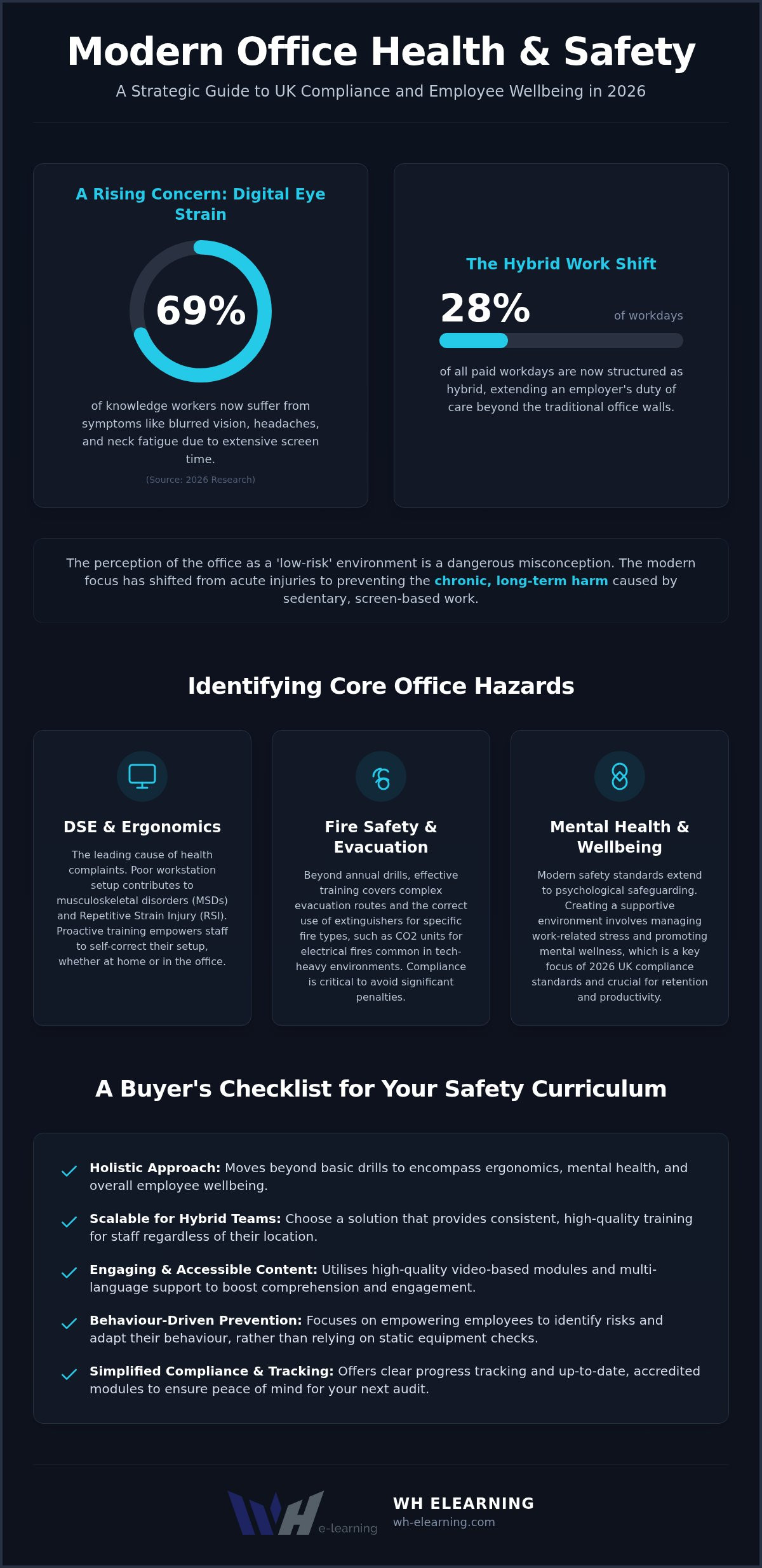
Labelling an office as a low-risk environment is a dangerous misconception that often leads to complacency. Whilst we don't see the acute injuries found in construction or manufacturing, the shift toward chronic musculoskeletal disorders is significant. A 2026 study reveals that 69% of knowledge workers now suffer from Digital Eye Strain, highlighting how technology-dependent roles create new health challenges. The rise of the structured hybrid work model, which now accounts for nearly 28% of all paid workdays, has further complicated the employer's duty of care. You're now responsible for ensuring safety standards are met across multiple locations, requiring a more agile approach to Occupational safety and health than ever before. This evolution demands a move away from static equipment checks toward behaviour-driven prevention.
Regulatory Expectations for Modern Businesses
Meeting UK workplace compliance standards is a legal imperative that protects your organisation from heavy fines and litigation. The regulatory landscape in 2026 is increasingly focused on how businesses manage the long-term health of their distributed workforce. Implementing robust workplace compliance training is the most effective way to build a foundation for a safe culture. It provides your team with the knowledge to identify hidden dangers through regular risk assessments, ensuring that issues like poor posture or psychological stress are addressed before they escalate. By integrating these high standards into your daily operations, you create a seamless path to compliance that feels like a natural part of professional growth. Total peace of mind during a health and safety audit comes from knowing your health and safety for office workers is managed through accredited, up-to-date training modules.
Identifying Core Office Hazards: Ergonomics, Fire, and Mental Health
Recognising the specific risks in a desk-based environment is the first step toward building a resilient team. Effective health and safety for office workers focuses on the hazards that cause the most long-term damage, rather than just the obvious ones. It's a fundamental principle that Federal law gives you the right to a safe workplace, and this includes protection from both chronic physical strain and psychological stress. Whilst an office might feel secure, the sedentary nature of the work introduces unique challenges that require targeted training to mitigate.
Mastering DSE and Ergonomics
Display Screen Equipment (DSE) is the leading cause of health complaints in the modern office. A 2026 study indicates that 69% of knowledge workers suffer from Digital Eye Strain, which manifests as blurred vision, headaches, and neck fatigue. Poor monitor height, incorrect chair set-up, and awkward keyboard positioning contribute to musculoskeletal disorders that often take months to resolve. Implementing DSE assessment training online empowers your staff to self-correct their workstations. This proactive behaviour is essential for preventing Repetitive Strain Injury (RSI). Regular training intervals ensure that even as staff move between home and the office, their ergonomic standards remain consistently high. High-quality video modules can demonstrate the correct way to align the spine and support the wrists, making the learning process both simple and effective.
Fire Safety and Emergency Procedures
Fire safety in the office requires more than a simple annual drill. Staff must understand the core components of evacuation, especially in complex multi-storey buildings where escape routes can be confusing. Training should cover the specific use of extinguishers, such as CO2 units for electrical fires, which are prevalent in tech-heavy environments. As of 2026, fire safety violations can result in significant penalties, with serious citations costing upwards of $16,550. Ensuring your team knows how to organise a swift evacuation and identify the correct fire-fighting equipment is a vital part of risk management. Clear evacuation routes and designated assembly points form the backbone of a safe workplace, providing total peace of mind for both managers and employees.
Beyond physical layout, you must address "invisible" hazards like workplace stress and mental fatigue. These factors are just as debilitating as physical injury and are now major contributors to long-term sickness absence. Similarly, manual handling is not just for warehouse staff. Office workers often lift heavy boxes of stationery or move hardware without proper technique, leading to avoidable back injuries. Training staff to assess a load before lifting ensures they maintain their physical health during everyday tasks. You can explore our curated training modules to address these varied risks efficiently and maintain a high standard of care for your entire team.
Choosing the Right Training Format: E-Learning vs In-House
Selecting the delivery method is as vital as the content itself. For modern health and safety for office workers, the choice between digital and traditional formats impacts both your budget and employee engagement. In 2026, the National Institute for Occupational Safety and Health (NIOSH) continues to emphasise that the effectiveness of safety programmes depends heavily on how information is disseminated and reinforced. Traditional classroom delivery now typically costs more per head than digital alternatives, making the transition to online platforms a logical step for most businesses.
Online business compliance e-learning has become the standard for modern firms because it offers unparalleled scalability for managing health and safety for office workers. Whilst a physical session is limited by room size and trainer availability, online platforms can support an unlimited number of staff simultaneously. This ensures every employee receives the same high standard of information, regardless of whether they joined the company today or five years ago.
Engagement is another critical factor. Video-based assessments provide a level of interaction that static PDF manuals simply cannot match. Seeing a correct ergonomic adjustment or a fire safety procedure in motion helps with long-term memory retention. It's much easier for staff to apply these lessons to their actual work environment when they've seen them demonstrated clearly on screen. This approach reflects the 2026 trend of using technology to streamline safety compliance, allowing for more dynamic and memorable learning experiences.
When to Choose Online E-Learning
Online learning is the ideal solution for multi-site organisations and the growing number of staff in hybrid roles. Managing global teams is simplified through multi-language e-learning courses, which bridge the communication gap for international staff by offering content in over 25 languages. For HR departments, the ability to automate tracking and reporting is a major time-saver, providing a clear audit trail for safety audits without the need for manual data entry.
The Role of Face-to-Face Specialist Training
Specialist in-person training still holds a valuable place in a comprehensive safety strategy. Practical, hands-on sessions are often the best choice for high-level safety committee coaching or complex risk assessment training. Using specialists for these targeted roles complements the digital theory provided to the wider workforce. A hybrid approach often yields the best results, using e-learning for broad compliance and face-to-face sessions for specific, practical leadership skills.
Building Your Office Safety Curriculum: A Buyer’s Checklist
Selecting a training provider is a significant investment in your organisation's future. To ensure you're providing the best health and safety for office workers, you need a structured approach to procurement. Unlike posters or handouts which offer no verifiable proof of learning, a curated digital curriculum provides a robust audit trail for your records. This checklist helps you move from identifying risks to implementing a solution that actually works.
- Step 1: Conduct a comprehensive risk assessment. Identify the specific hazards in your physical or hybrid office space, including recent 2026 mandates like mandatory remote ergonomic audits.
- Step 2: Categorise modules. Separate mandatory training, such as fire safety and DSE, from recommended well-being modules like stress management or mental health awareness.
- Step 3: Verify industry accreditation. Look for courses recognised by respected bodies like IOSH to ensure the content meets high professional standards.
- Step 4: Prioritise accessibility. Ensure your platform includes features such as closed captions and multi-language translation to support a diverse, global workforce.
Comparing Course Quality and Accreditation
Accreditation is the hallmark of quality in professional development. Choosing an occupational safety and health training course that carries an industry stamp ensures the content is accurate and legally defensible. For instance, understanding the nuance of IOSH Managing Safely vs Working Safely is vital for assigning the right level of responsibility to your team. Unaccredited training might seem cost-effective initially, but it often fails to meet the rigorous standards required during a formal UK health and safety audit.
Common Mistakes to Avoid When Buying Training
Many businesses settle for generic content that fails to resonate with desk-bound staff. If a course uses examples from a construction site to teach health and safety for office workers, engagement will naturally plummet. Boring, low-quality video content is another common pitfall that leads to low completion rates and forgotten information. Your team needs modern, mobile-friendly access that fits into their busy schedules without friction. Providing a seamless user experience ensures that training feels like a professional growth opportunity rather than a box-ticking exercise.
Ready to simplify your compliance? Browse our Office training collection to find accredited, video-based courses designed specifically for modern desk-based teams.
Standout Solutions from the WH eLearning Office Collection
The WH eLearning Office Collection features 214 courses designed specifically for desk-based teams. This comprehensive library ensures that health and safety for office workers is never treated as a generic afterthought. By choosing video-based learning, you provide an engaging experience that keeps staff focused whilst they acquire vital skills. Deployment is fast. These high-quality videos demonstrate real-world scenarios that employees can immediately relate to their daily routines, ensuring high retention rates across your entire organisation.
Protecting an international workforce requires more than a one-size-fits-all approach. Our platform utilises machine translation to offer content in over 25 languages, coupled with closed captions for maximum accessibility. This removes the communication barrier for global teams, ensuring that every employee understands their safety responsibilities regardless of their first language. For Office Managers, the ease of management is a standout benefit. Bulk licensing simplifies the procurement process, allowing you to deploy training across large departments with just a few clicks through our streamlined interface.
Top Recommended Modules for UK Offices
Focusing on high-impact areas is the most efficient way to build your curriculum. DSE Training remains the cornerstone of health and safety for office workers, protecting your team from the long-term risks associated with sedentary work and digital eye strain. Mental Health Awareness is another essential module, empowering managers to recognise signs of fatigue and support their teams effectively. Finally, Fire Safety provides the fundamental compliance needed for every physical office location, ensuring your business meets the strict legal requirements discussed earlier in this guide.
Why WH eLearning is the Professional Choice
We position ourselves as a reliable partner in your organisation's development. Our accredited courses stand up to the strictest regulatory scrutiny, providing you with total peace of mind during official audits. The seamless Shopify-powered buying experience allows you to purchase individual modules or bulk licences with ease, fitting perfectly into your existing business workflows. By choosing WH eLearning, you invest in a sophisticated but approachable path to meeting professional standards and safeguarding your most valuable assets.
Browse the full Health and Safety for Office collection here to discover how we can simplify your training requirements and protect your team today.
Empower Your Team with Modern Safety Standards
Managing health and safety for office workers in 2026 requires a proactive shift from basic compliance to a culture of genuine well-being. You now have the strategic tools to address chronic ergonomic risks and mental fatigue with absolute precision. By choosing accredited, video-based training, you ensure your staff remain engaged whilst meeting the highest regulatory standards. Our platform is trusted by organisations globally for workplace compliance. We offer courses accredited by IOSH and other leading bodies, featuring over 25 language options to support your entire workforce seamlessly. This approach removes the friction from professional requirements and simplifies your path to a successful audit. It's a straightforward way to provide a safer, more productive environment for your team with quiet confidence. Taking these steps today protects your most valuable assets and fosters long-term professional growth.
Secure your team’s safety today – Browse the Office Training Collection
Frequently Asked Questions
Is health and safety training legally required for office workers in the UK?
Yes, employers have a legal duty to provide health and safety for office workers under UK law. The Health and Safety at Work etc. Act 1974 mandates that staff receive sufficient information and training to perform their roles safely. This includes specific regulations for Display Screen Equipment (DSE) and fire safety. Failing to provide this training can lead to significant fines and legal action during a formal workplace audit.
How often should office staff refresh their health and safety training?
Industry best practice suggests refreshing office safety training every one to three years. There's no single legal expiry date, but you should provide top-up sessions if a worker's role changes, if new equipment is introduced, or if you move to a new office layout. Regular updates ensure that safety protocols remain fresh in your team's minds and reflect current 2026 regulatory standards, maintaining high compliance levels across your organisation.
What is the most important health and safety course for an office environment?
DSE (Display Screen Equipment) assessment training is the most critical course for a desk-based environment. Since 69% of knowledge workers report digital eye strain in 2026, teaching staff how to correctly set up their workstations is vital for preventing chronic injuries. This course directly addresses the most common cause of long-term sickness in offices, making it a foundational element of any robust safety curriculum for your professional staff.
Can IOSH Managing Safely be taken online by office managers?
Yes, office managers can complete IOSH Managing Safely Online through our platform. This course provides a high-level overview of risk management and legal responsibilities specifically tailored for those in leadership roles. It's an accredited programme that can be accessed on any device, allowing managers to balance their professional development with their daily operational duties without needing to attend a physical classroom session or take time away from the office.
Does the office health and safety training cover remote and hybrid workers?
Our health and safety for office workers training is designed with the modern distributed workforce in mind. All modules are video-based and accessible on any device, meaning staff can complete their training from home or the office. This ensures that hybrid workers receive the same high standard of instruction as their on-site colleagues, helping you meet your duty of care across all work locations without logistical difficulty.
How do I track which employees have completed their online safety courses?
Tracking is simplified through our corporate training license features. HR and Office Managers gain access to administrative tools that provide a real-time overview of employee progress and compliance status. You can see exactly who has finished their modules and who requires a reminder, automating the record-keeping process. This digital audit trail is essential for demonstrating compliance during health and safety inspections or internal reviews, saving significant administrative time.
Are the WH eLearning office courses accredited by recognised bodies?
Every course in our Office Collection is accredited by leading industry bodies, such as IOSH. This ensures that the content has been rigorously reviewed for accuracy and professional standards. Choosing accredited training provides you with the quiet confidence that your safety programme is legally defensible and reflects current best practices. It avoids the risks associated with unaccredited training that may not stand up to regulatory scrutiny during a formal audit.
Can I buy office safety training for a large team all at once?
You can certainly purchase training for large teams all at once through our corporate licensing options. This provides bulk access to our library of 214 office-specific courses, making it a cost-effective solution for growing organisations. We offer a seamless Shopify-powered buying experience that handles high-volume enrolments efficiently. This allows you to deploy a consistent training standard across your entire department or company with just a few simple steps.


