

What if your biggest overhead isn't your rent or your inventory, but the mounting cost of a safety culture that fails to keep pace with your staff turnover? You likely recognise that maintaining a safe environment is essential for your brand's reputation; however, the reality of coordinating health and safety training for retail staff across dozens of locations often leads to administrative headaches. It's frustrating when language barriers or complex scheduling get in the way of total workplace compliance.
This 2026 buyer's guide is designed to help you cut through the noise and select accredited training that truly protects your team. We'll examine how to move away from expensive, outdated methods towards flexible, digital solutions that offer easy-to-access certificates for every audit. From multi-language support to streamlined progress tracking, you'll discover how to build a safer, more resilient workforce whilst saving time and reducing risk across your entire estate.
Key Takeaways
- Master the latest UK compliance standards to protect your staff and safeguard your brand's reputation in a changing regulatory landscape.
- Identify the essential modules required for a safe shop floor, including manual handling, fire safety, and customer conflict management.
- Learn how to deliver consistent health and safety training for retail staff across multiple locations using scalable digital solutions.
- Simplify your administrative workload with automated tracking and corporate licenses that make audit preparation effortless.
- Improve engagement amongst a diverse workforce by utilising video-based content and multi-language support in 25+ languages.
Why Health and Safety Training for Retail Staff is Critical in 2026
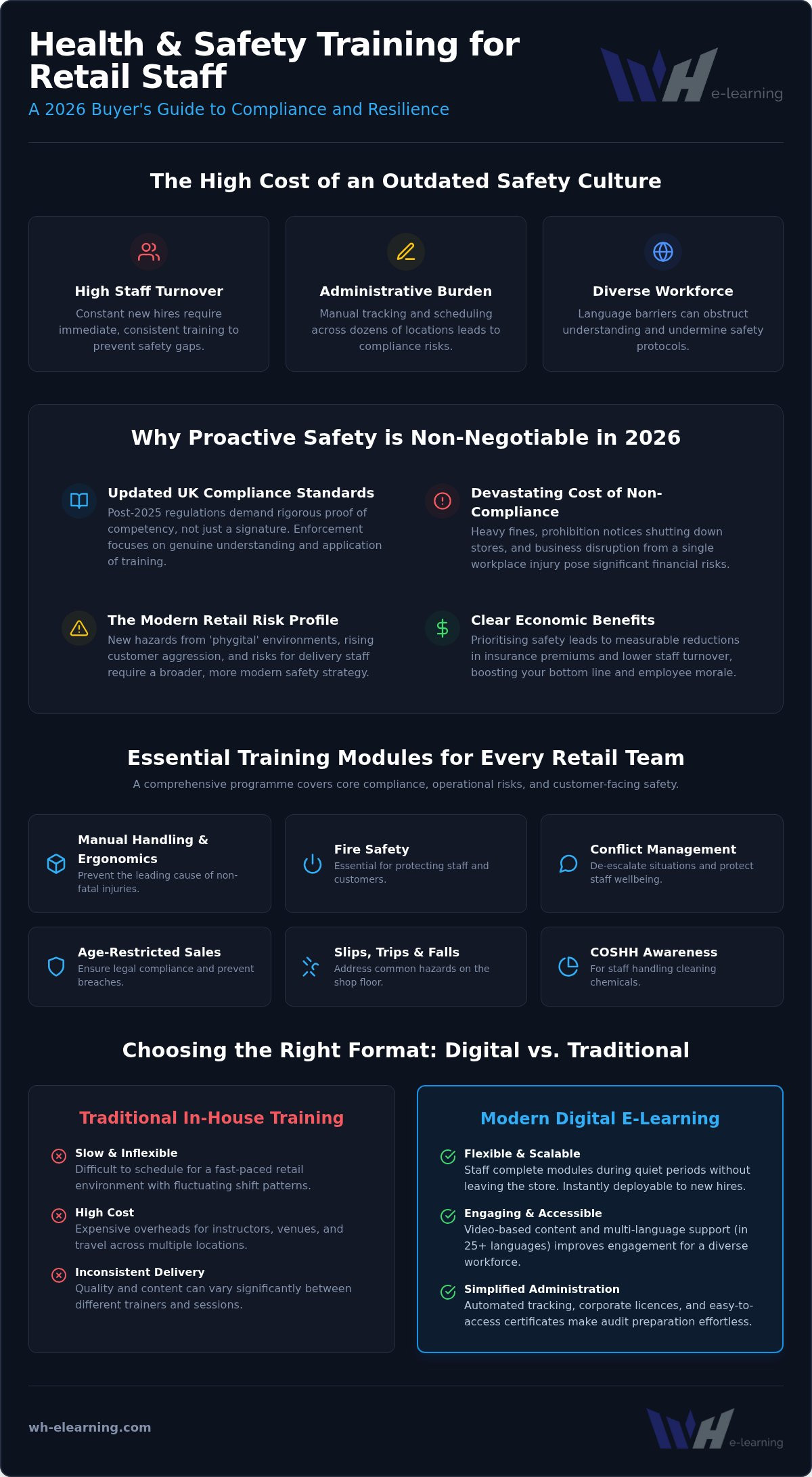
Retail safety is often misunderstood as merely preventing slips and trips in an aisle. In reality, it's a multi-layered strategy designed to protect your staff from harm, ensure customer wellbeing, and safeguard your brand's hard-earned reputation. The broader field of Occupational safety and health provides the framework for these standards, but retail presents unique challenges that require a specialised approach. Effective health and safety training for retail staff ensures that every person on your shop floor knows how to identify risks before they escalate into accidents.
The legal landscape has shifted significantly. Following regulatory updates in late 2025, UK workplace compliance standards now demand more rigorous proof of competency. It's no longer enough to rely on a signed piece of paper from three years ago. Modern enforcement focuses on whether training was actually understood and applied. Beyond the law, the economic benefits are clear. Businesses that prioritise safety see a measurable reduction in insurance premiums and lower staff turnover, as employees feel more valued and secure in their roles.
By 2026, the delivery of this knowledge has transformed. Traditional classroom sessions are often too slow for the fast-paced retail sector. Instead, digital-first, video-based learning has become the industry standard. It's flexible, engaging, and allows your team to complete modules during quiet periods without leaving the store. This approach ensures that even with high staff turnover, every new hire is brought up to speed immediately.
The High Cost of Non-Compliance in Retail
Failing to meet these standards carries heavy penalties. Legal fines can be devastating, and the risk of prohibition notices can shut down a shop floor instantly, halting your revenue. For smaller businesses, a single workplace injury can disrupt continuity for weeks. In 2026, Duty of Care in retail is the legal and moral requirement for a business to take all reasonable steps to prevent foreseeable harm to anyone interacting with their physical or digital operations.
Addressing the 2026 Retail Risk Profile
Modern retail spaces are more complex than ever. The rise of "phygital" environments, where digital kiosks and automated stock systems sit alongside customers, introduces new mechanical and electrical risks. Aggression towards retail workers has also prompted a shift in health and safety training for retail staff, which now frequently includes de-escalation and conflict management. Additionally, your safety strategy must now extend to delivery and click-and-collect staff, who face unique hazards whilst moving goods between the stockroom and the kerbside.
Essential Training Modules for Every Retail Team
Selecting the right modules for your team is about more than just ticking boxes; it's about building a resilient operation. Whilst international frameworks such as OSHA small business resources provide excellent general guidance, UK retailers must focus on accredited content that addresses specific shop-floor hazards. A comprehensive health and safety training for retail staff programme should cover core compliance, operational risks, and customer-facing safety to ensure total workplace protection.
Beyond the basics, your team requires specialist knowledge. This includes Control of Substances Hazardous to Health (COSHH) for cleaning staff who handle chemicals, and age-restricted sales training to prevent legal breaches. Slips, trips, and falls remain a constant threat on the shop floor, especially during peak trading hours or wet weather. Addressing these through targeted learning modules reduces the likelihood of expensive personal injury claims. You can find these essential modules and more within our curated retail training collection.
Manual Handling and Ergonomics
Manual handling remains the leading cause of non-fatal injuries in the retail sector. It's not just about lifting heavy pallets in the stockroom. Repetitive strain from shelf-stacking or scanning items at a till can lead to long-term health issues if staff aren't taught proper ergonomic techniques. Effective courses should cover safe lifting, pushing, and pulling, alongside the importance of posture during long shifts. For a deeper dive into how these modules fit into your broader strategy, explore our guide on workplace safety training courses.
Conflict Management and Staff Wellbeing
Modern health and safety training for retail staff must acknowledge that the "risk" isn't always physical infrastructure; sometimes, it's human behaviour. Violence and aggression towards shop workers have risen, making conflict management a vital skill for every customer-facing employee. Training your team in de-escalation techniques helps them handle difficult situations calmly and safely. This focus on staff wellbeing, including mental health awareness, ensures your team feels supported in high-pressure environments. When staff know how to protect themselves from verbal or physical abuse, turnover rates typically drop, and the workplace culture improves significantly.
Choosing the Right Format: Online E-Learning vs In-House Training
Selecting the delivery method for your team is as important as the content itself. For many retail managers, traditional in-house training feels thorough but quickly becomes a logistical burden. When you're managing high staff turnover, the cost of hiring external trainers or pulling senior staff away from the shop floor for every new hire is unsustainable. Digital e-learning provides a scalable alternative, offering a significantly lower cost-per-head whilst ensuring that health and safety training for retail staff remains a constant, rather than an occasional event.
Modern retail operations often span multiple postcodes, making it difficult to maintain a uniform safety message. Online platforms solve this by delivering the exact same standard of health and safety training for retail staff to every store, whether it's a flagship city centre location or a small local branch. This consistency is paired with 24/7 accessibility. Shift workers can complete their modules on mobile devices during scheduled training windows, removing the need for complex group sessions that leave the shop floor understaffed.
The Benefits of Video-Based Learning
Video-based content is much more effective than static, text-heavy slide decks. It captures attention quickly and allows staff to see correct procedures in action, such as the safe way to use a ladder or clear a spill. Video content enhances retention for health and safety protocols by providing a clear, repeatable visual reference that bridges the gap between theory and real-world shop-floor application. This visual approach ensures that safety behaviours are mimicked correctly in the stockroom and on the shop floor alike.
Managing Language Barriers in Retail
A diverse workforce is a strength, but it can present challenges for compliance if training is only available in English. Misunderstood instructions are a primary cause of workplace accidents, making inclusive training a safety necessity. Utilising machine translation into 25+ languages ensures that every team member, regardless of their native tongue, fully understands their responsibilities. Exploring multi-language e-learning courses allows you to provide high-quality instruction that respects the diversity of your team whilst maintaining total compliance across your entire estate.
How to Organise and Track Retail Compliance at Scale
Managing safety for a single boutique is straightforward, but coordinating compliance across a national retail chain requires a more sophisticated approach. The biggest administrative burden often stems from high staff turnover and the resulting need for constant re-training. Corporate Training Licences solve this by simplifying bulk enrolments, allowing you to assign health and safety training for retail staff to hundreds of employees with just a few clicks. This system removes the friction of individual transactions and ensures your entire workforce is protected from day one.
Automated tracking is the most effective way to identify which staff members are overdue for their refreshers. Instead of relying on outdated spreadsheets, a digital dashboard provides real-time visibility into your compliance status. This helps you avoid the common mistake of ignoring expiry dates on safety certificates, a lapse that can lead to severe legal consequences if an accident occurs. Digital certification provides a permanent, audit-ready record that eliminates the need for physical filing cabinets and ensures your documentation is always organised.
Streamlining Multi-Site Management
Regional managers require a centred reporting system to monitor store-level compliance efficiently. This high-level overview allows them to see which branches are excelling and which require additional support. By setting up automated reminders, you ensure that health and safety remains a constant priority rather than a last-minute scramble. This proactive management style is a cornerstone of mastering workplace compliance in a large-scale retail environment. You can easily oversee your entire team's progress by securing a corporate licence for our retail collection today.
Preparing for a Health and Safety Audit
An audit shouldn't be a source of anxiety. The key is having your documentation prepared and verifiable. Inspectors typically look for a clear history of training, including induction dates and refresher intervals. Digital transcripts from WH eLearning simplify the audit process by providing instant access to every employee's learning history. It's also vital to ensure your higher-level qualifications, such as your IOSH managing safely vs working safely certifications, are fully current. Having these professional credentials stored alongside your basic retail modules creates a robust, comprehensive safety profile that satisfies even the most rigorous inspections.
Standout Courses in the WH eLearning Retail Collection
Building a safe shop floor requires more than generic advice; it needs specialised content that reflects the daily reality of your team. The WH eLearning Retail Collection for 2026 is a curated suite of modules designed to address the specific risks found in modern retail environments. Unlike broad industrial courses, our health and safety training for retail staff focuses on the high-pressure, customer-facing nature of your business. This ensures that every lesson is relevant, relatable, and easy to apply during a busy shift.
Manual Handling (Retail Specific) is a cornerstone of this collection. It moves beyond basic lifting theory to cover the practicalities of shelf-stacking, cage-unloading, and stockroom organisation. Similarly, our Fire Safety for Retail Staff module is tailored for the shop floor. It provides clear guidance on evacuation procedures in public spaces and the correct use of extinguishers, ensuring your team can lead customers to safety with confidence. For those on the front line, Conflict Management in Retail has become a vital resource. It equips staff with the de-escalation skills needed to manage difficult customer interactions safely and professionally.
Featured Products for Retail Managers
Effective safety starts with leadership. For store and area managers, IOSH Managing Safely Online remains the gold standard. This course provides the high-level oversight needed to run a compliant operation whilst empowering managers to lead by example. We also offer specialised DSE assessment training for office-based staff and managers who spend time at workstations. This ensures that even your administrative environments meet the highest ergonomic standards. To round out your strategy, our Slips, Trips and Falls module provides practical steps for maintaining a safe floor, which is essential for reducing public liability claims.
Start Your Compliance Journey Today
Securing your team's future is simple and efficient. You can choose to purchase individual courses for specific needs or opt for bulk licences that cover your entire estate. With immediate access to over 212 retail-focused modules, you can begin upskilling your workforce today. Our video-based platform ensures high engagement, whilst our automated tracking handles the administrative burden of monitoring progress. You'll find everything you need to protect your team and ensure total compliance in one accessible location. Browse the full health and safety training for retail staff collection here and take the first step towards a safer, more resilient retail business.
Future-Proof Your Store with Modern Safety Standards
Managing a safe and compliant retail environment in 2026 requires a shift towards flexibility and efficiency. By embracing video-based learning, you ensure that health and safety training for retail staff is no longer a logistical hurdle but a seamless part of your operational routine. You now have the tools to overcome high staff turnover and language barriers whilst maintaining a robust, audit-ready paper trail across all your locations.
WH eLearning provides the high-quality, accredited resources needed to protect your team and your reputation. With over 200 retail-specific modules, multi-language support in 25+ languages, and simplified bulk licensing for large chains, meeting your legal obligations has never been easier. Transitioning to a digital-first approach empowers your staff to work safely whilst allowing you to focus on growing your business with confidence.
Ready to streamline your compliance? Explore the WH eLearning Retail Training Collection today and build a safer workplace for everyone.
Frequently Asked Questions
What are the mandatory health and safety courses for retail staff in the UK?
Mandatory training typically includes Manual Handling, Fire Safety, and COSHH for those handling cleaning chemicals. Employers must also provide a general health and safety induction to meet legal duties. Specific roles may require additional modules such as Conflict Management or First Aid awareness. WH eLearning provides a curated collection of over 200 retail-specific modules designed to ensure your team meets these essential UK compliance standards efficiently.
How often should retail employees undergo health and safety refresher training?
Most industry professionals recommend annual refresher training to keep safety protocols fresh and maintain high compliance standards. Whilst some specific certifications have longer validity periods, regular updates are vital in high-turnover environments. WH eLearning’s corporate licences simplify this process by offering automated tracking features. These tools help managers identify exactly when staff members are due for a refresher, ensuring no one falls behind on their safety knowledge.
Can online health and safety training replace face-to-face sessions for retail?
Online e-learning is a highly effective replacement for theoretical training, offering better consistency across multiple store locations. It's particularly beneficial for the retail sector where scheduling group sessions is often difficult due to shift patterns. WH eLearning provides accredited, video-based courses that deliver high-quality instruction. For complex practical skills, we also offer in-house face-to-face training delivered by industry specialists to provide a comprehensive, blended learning solution for your business.
Is IOSH training relevant for retail store managers?
IOSH Managing Safely is the gold standard for store and area managers who oversee daily operations. It equips leaders with the technical skills to conduct risk assessments and manage the health and safety training for retail staff effectively. Holding this accredited certification demonstrates a commitment to a safe culture. It ensures that those in charge have the confidence to identify hazards and implement control measures that protect both employees and customers.
How do I track staff progress and certificates for multiple retail locations?
The most efficient way to manage multi-site compliance is through a centralised corporate dashboard. This allows regional managers to monitor store-level progress and download digital certificates instantly for audits. By moving away from manual spreadsheets, you reduce administrative errors and ensure that every branch maintains the same high standards. Our platform provides real-time visibility into your workforce's training status, making it easy to manage bulk enrolments across your entire estate.
Are the retail safety courses available in different languages?
Yes, our platform supports a diverse workforce by offering machine translation into over 25 languages. This feature ensures that every team member can access vital safety information in their native tongue, which is essential for total workplace compliance. Removing language barriers reduces the risk of accidents caused by misunderstood instructions. It also fosters a more inclusive environment where every employee feels empowered to follow safety protocols correctly on the shop floor.
What is the most common cause of injury in the retail sector?
Manual handling and slips, trips, or falls remain the leading causes of non-fatal injuries in retail environments. These incidents often occur during stock replenishment or whilst staff are navigating busy public areas. Targeted training that focuses on correct lifting techniques and proactive hazard spotting is the most effective way to reduce these risks. Providing your team with practical, video-based modules helps prevent these common accidents and protects your business from costly liability claims.
How does video-based e-learning improve retail safety compliance?
Video-based learning improves retention by providing clear, visual demonstrations of safe working practices rather than relying on static text. This makes the health and safety training for retail staff more engaging and easier to digest during busy shifts. Staff are more likely to apply what they've seen in a video to their real-world tasks. This practical understanding leads to fewer workplace accidents and ensures a higher level of overall compliance across your organisation.


