

Did you know that an estimated £325 billion in illicit funds now flows through the UK annually? This staggering figure, representing over 10% of the nation's GDP, highlights why the regulatory landscape shifted so significantly with the June 2026 amendments. For business leaders, the pressure to maintain "Adequate Procedures" has never been higher, yet finding effective anti-money laundering training for employees often feels like a battle against dry legal jargon and complex compliance hurdles. You likely worry about the risk of heavy fines or the difficulty of keeping a global, remote workforce engaged with these critical topics.
It is completely understandable to feel concerned about corporate liability whilst trying to foster a culture of integrity. This guide promises to help you master the 2026 UK AML regulations and implement a robust training strategy that protects your organisation and empowers your workforce. We will explore how to transition from basic awareness to a verifiable pillar of governance. We cover everything from the new pound sterling thresholds to seamless, audit-ready tracking for your entire team.
Key Takeaways
- Understand how the 2026 amendments make comprehensive anti-money laundering training for employees a legal necessity for achieving 'Adequate Procedures' status.
- Learn to implement a risk-based approach that tailors training intensity to specific roles and simplifies complex Customer Due Diligence (CDD) processes.
- Discover why video-based learning and visual storytelling significantly improve information retention and engagement amongst remote or global workforces.
- Follow a practical roadmap to assess departmental risks and select accredited course content that ensures your organisation remains audit-ready at all times.
- Shift your corporate culture from basic legal awareness to a proactive environment of vigilance and integrity that protects your brand from liability.
The Legal Landscape: Why Anti-Money Laundering Training for Employees is Essential
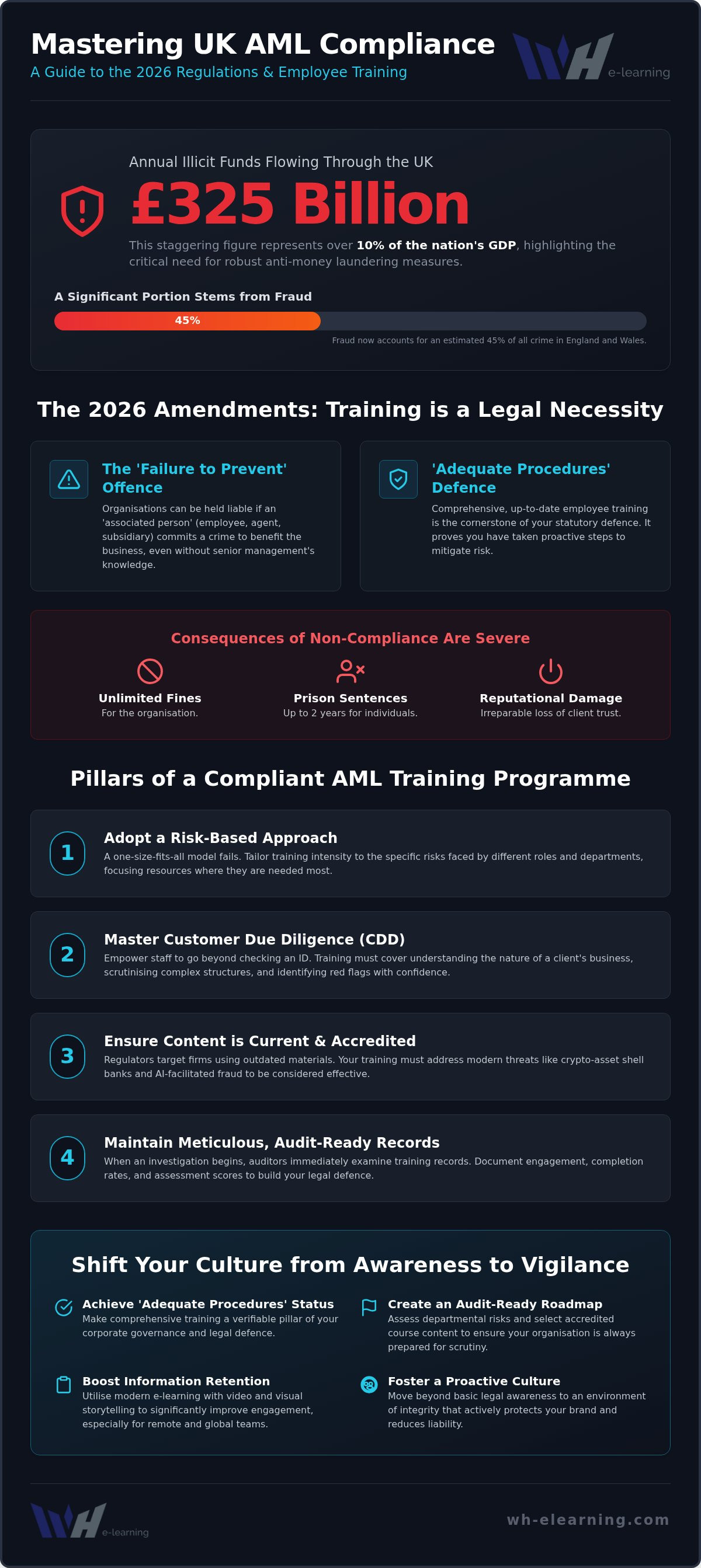
The UK's financial system remains a prime target for criminal activity. With an estimated £325 billion in illicit funds flowing through the country annually, the 2026 regulatory update reflects a zero-tolerance approach. Understanding What is Money Laundering? is the first step in building a resilient business. In the 2026 UK context, this includes the processing of proceeds from crimes like fraud, which now accounts for an estimated 45% of all crime in England and Wales according to the National Crime Agency.
The Money Laundering Regulations 2017, recently strengthened by the June 2026 amendments, mandate that businesses provide regular, relevant training. It's not just a recommendation; it's a legal requirement. Failure to provide effective anti-money laundering training for employees leaves your organisation vulnerable to the 'Failure to Prevent' corporate offence. This means a company can be held liable if an associated person commits a crime to benefit the business, even if senior management was unaware of the specific act.
Consequences for non-compliance are severe. Your organisation could face unlimited fines, whilst individuals responsible may receive prison sentences of up to two years. Beyond the courtroom, the reputational damage is often irreparable, leading to a loss of trust from clients and partners that can take decades to rebuild.
UK AML Regulations vs Global Standards
UK standards align closely with the Financial Action Task Force (FATF) recommendations, but they often include stricter local requirements. Whilst the 2026 amendments narrowed the focus for Enhanced Due Diligence (EDD) to "unusually complex" transactions, the UK remains more rigorous than many international jurisdictions. Businesses with global branches must ensure their training is consistent across borders to avoid weak links in their compliance chain. Consistency ensures that every member of staff, regardless of location, understands the high standards expected by UK regulators.
In the context of AML liability, 'associated persons' include any individual or entity that performs services for or on behalf of an organisation, such as employees, agents, or subsidiaries.
The Role of the FCA and SFO in 2026 Enforcement
The Financial Conduct Authority (FCA) and the Serious Fraud Office (SFO) have intensified their focus on 'Adequate Procedures'. This concept serves as a statutory defence; if you can prove you had robust systems in place, you may avoid liability. High-quality anti-money laundering training for employees is the cornerstone of this defence. It demonstrates that you have taken proactive steps to mitigate risk and educate your workforce.
When an investigation begins, training records are the first items auditors examine. They look for evidence of engagement, completion rates, and the frequency of updates. Recent enforcement actions in early 2026 have targeted firms that relied on outdated, generic materials. These organisations were unable to demonstrate that their staff understood the specific risks associated with modern threats like cryptoasset shell banks or AI-facilitated fraud. Investing in accredited, up-to-date training isn't just about ticking a box; it's about building a culture of vigilance that protects your future.
The Pillars of a Compliant AML Training Programme
Effective anti-money laundering training for employees requires more than a generic slideshow. It demands a structured approach that mirrors your specific business risks. A one-size-fits-all model often fails because it doesn't account for the varying levels of exposure across different departments. By focusing on core pillars, you can build a programme that is both legally sound and practically useful.
A risk-based approach is the foundation of any successful strategy. Not every role carries the same exposure. A front-of-house staff member needs to spot physical cash anomalies, whilst a corporate analyst must scrutinise complex offshore structures. Following guidance on AML Compliance for Firms, you should categorise roles by risk level to ensure training depth matches the potential threat. This ensures your resources are focused where they are needed most.
Training must also empower staff to perform Customer Due Diligence (CDD) with confidence. This involves more than just checking an ID; it's about understanding the nature of the client's business and their source of funds. Employees should know how to identify high-risk clients, such as Politically Exposed Persons (PEPs) or those linked to jurisdictions on the FATF "blacklist". Practicality is key here. Use real-world 'red flags' in your sessions, such as clients who are evasive about ownership or transactions that lack a clear economic purpose. When suspicion arises, the reporting path must be clear. Employees must understand how to submit a Suspicious Activity Report (SAR) to your internal Money Laundering Reporting Officer (MLRO) without delay.
Tone from the Top: Leading an Ethical Culture
Compliance starts in the boardroom. If senior leaders treat AML as a mere checkbox exercise, employees will likely follow suit. Management must actively champion these initiatives, integrating them into a broader workplace compliance training strategy. This creates a unified culture where integrity is valued over short-term gains. Ensure your MLRO is a visible, supported figure who staff feel comfortable approaching with concerns or questions.
Refresher Training: Maintaining Vigilance Over Time
Knowledge fades, and criminal tactics evolve rapidly. Annual refreshers are the industry standard for maintaining a "culture of vigilance". These sessions should adapt to emerging threats, such as the 2026 focus on crypto-asset shell banks and AI-driven laundering schemes. By using data from end-of-course assessments, you can pinpoint specific departments that might need extra support. Our accredited AML modules are designed to make these regular updates seamless and engaging for your entire workforce.
Evaluating Delivery: Online E-Learning vs Specialist In-House Sessions
Selecting the right delivery method for anti-money laundering training for employees is a strategic decision that balances regulatory requirements with operational reality. In 2026, the shift towards video-based learning has become a necessity rather than a preference. Visual storytelling significantly improves information retention amongst staff, making complex legal concepts easier to recall during high-pressure situations. The UK Government AML Training Resources highlight how multimedia tools, such as films and discussion materials, clarify these procedures for a diverse workforce.
Scalability remains a primary concern for modern organisations. Digital platforms allow you to train a global workforce across multiple time zones simultaneously, ensuring every branch meets the same high standards. For SMEs, corporate licensing often proves more cost-effective than per-course enrolment, especially when managing high staff turnover or large-scale recruitment. This approach provides a consistent foundation whilst allowing for rapid updates as new laundering techniques emerge.
The Advantages of Digital Compliance Platforms
Self-paced learning is perhaps the greatest operational benefit of digital delivery. It reduces the impact on daily productivity, as employees can complete modules whilst travelling or during quieter periods. These platforms also provide automated audit trails, offering instant proof of compliance for ISO standards or regulatory inspections. Accessibility is equally vital; modern modules now include multi-language support and closed captions, ensuring that your training is inclusive and easy to digest for every team member.
Specialist-Led Training for High-Risk Sectors
Whilst digital foundations are essential for the wider workforce, certain departments require a more intensive approach. Senior leadership and high-risk sectors, such as real estate or legal services, benefit from specialist-led, in-house sessions. These workshops allow teams to tackle complex ethical dilemmas face-to-face, providing a deep dive into sector-specific risks that generic courses might miss.
The most effective strategy often involves a hybrid model. You can use digital modules to establish a baseline of knowledge across the entire organisation, then supplement this with practical, specialist-led scenarios for those on the front lines. This combination ensures that your workforce is not just aware of the law, but also equipped with the practical skills to identify and report suspicious activity in real-world environments. This dual-layered approach creates a robust defence that satisfies both the FCA and the SFO whilst empowering your team to act with confidence.
Implementing and Scaling Your AML Training Roadmap
Moving from a theoretical understanding of compliance to a practical, scalable programme requires a clear roadmap. Effective anti-money laundering training for employees isn't a one-off event; it's a continuous cycle of assessment and improvement. To build a strategy that withstands regulatory scrutiny, follow these five essential steps.
- Conduct a risk-based assessment: Evaluate different departments and roles to determine their specific exposure levels. A front-line cashier faces different risks than a back-office data analyst.
- Select accredited content: Ensure your materials match the latest 2026 UK legal requirements. Using outdated content can invalidate your 'Adequate Procedures' defence.
- Communicate from the top: Executive leaders must vocalise the importance of the programme. When the board takes compliance seriously, the rest of the workforce follows.
- Deploy via a robust platform: Use a system that automates reminders and tracks individual progress. This removes the administrative burden from HR teams.
- Review assessment data: Don't just file the results away. Use the data to identify knowledge gaps and provide targeted support to departments that struggle with specific topics.
Training Global Teams in Multiple Languages
Clarity is the foundation of compliance. For organisations with international staff, providing multi-language e-learning courses is essential to ensure that complex legal nuances aren't lost in translation. Whilst UK standards must remain the benchmark, training should respect local cultural contexts to improve engagement. Modern machine translation allows for the rapid deployment of AML updates across 25+ languages, ensuring your global workforce stays aligned with the latest UK regulations simultaneously. This approach removes barriers to understanding and fosters a unified culture of integrity across every territory you operate in.
Tracking and Auditing for Legal Protection
In the eyes of a regulator, if it isn't tracked, it didn't happen. Simple participation records are no longer sufficient to prove compliance. You need verified assessments and scores to demonstrate that your anti-money laundering training for employees actually resulted in a transfer of knowledge. High-quality platforms generate detailed compliance reports that are ready for board meetings or sudden regulatory audits. This level of detail is a core component of broader business compliance e-learning strategies. It provides the documented evidence required to protect your organisation from corporate liability and 'Failure to Prevent' charges.
Ready to streamline your compliance journey? Explore our accredited AML training modules and start building your roadmap today.
Achieving Compliance Excellence with WH eLearning
At WH eLearning, we believe that meeting professional standards should be a seamless experience for every organisation. Our 2026 anti-money laundering training for employees is accredited and regularly updated to reflect the latest SFO and FCA guidance. We provide a comprehensive library of modules that strip away the complexity of the June 2026 amendments, ensuring your workforce is both protected and empowered. By choosing a partner that specialises in high-quality, reliable content, you move beyond simple tick-box exercises to achieve genuine corporate integrity.
The power of our platform lies in video-based learning. As discussed earlier, visual storytelling is essential for retention, and we've refined this to reduce the friction often associated with mandatory legal topics. Our videos are designed for high engagement, making it easier for staff to recognise modern threats like AI-facilitated fraud or cryptoasset shell banks. This approach doesn't just satisfy regulators; it builds a culture of vigilance that starts with a clear understanding of the risks.
Scalability is a core feature of our service. We offer flexible licensing models that suit any business size, from individual enrolments for small teams to global corporate access for large enterprises. We are committed to simplifying workplace compliance for busy organisations, providing a high-end experience that is both attainable and effective. Our goal is to be a reliable partner in your development, helping you navigate the 2026 landscape with quiet confidence.
Why Organisations Trust WH eLearning
Our multi-device, accessible learning platform is designed specifically for the modern professional. Employees can complete their training whilst on the move, ensuring minimal disruption to daily operations. We take a partner-led approach, offering the administrative tools you need to track progress and prove compliance during audits without the usual stress. For departments facing the highest risks, we also provide expert-led in-house face-to-face training to ensure a bespoke, high-level compliance experience for your senior leadership.
Get Started with Your AML Strategy
Building a robust training strategy is a long-term investment in your organisation's safety. You can browse our full workplace safety training courses catalogue to see how our AML modules integrate with your wider compliance goals. If you manage a global team, ask us about our machine translation features that support over 25 languages.
Ready to empower your workforce and secure your future? Protect your organisation with WH eLearning’s AML training today and take the first step towards a more resilient, compliant culture.
Secure Your Future with a Culture of Vigilance
Mastering the 2026 regulatory landscape ensures your organisation remains protected and proactive. By focusing on a risk-based roadmap and leveraging modern delivery methods, you move beyond mere awareness toward a verifiable culture of integrity. Effective anti-money laundering training for employees is the cornerstone of this transition, acting as your primary defence against evolving financial threats and corporate liability.
WH eLearning is here to simplify this journey. Our training is accredited by leading UK compliance bodies and trusted by thousands of learners globally. We provide seamless, video-based content that supports 25+ languages with high-quality machine translation, making global deployment efficient and reliable. You don't have to navigate complex legal requirements alone; we offer the tools to track, manage, and prove your compliance with ease.
Empower your workforce with the tools they need to succeed in a demanding professional environment. Our solution-oriented approach ensures that meeting high standards feels like a shared achievement rather than an administrative hurdle. Browse our Accredited Anti-Money Laundering Training Courses and take the first step toward a safer, more resilient workplace today.
Frequently Asked Questions
Is anti-money laundering training a legal requirement for all UK employees?
Training is a mandatory legal requirement for "relevant employees" working in regulated sectors such as finance, legal services, and estate agency. The Money Laundering Regulations 2017, recently updated in 2026, specify that staff must be made aware of the law and trained to recognise suspicious activity. Even in non-regulated industries, providing anti-money laundering training for employees is a vital step in mitigating corporate liability under the Proceeds of Crime Act 2002.
What should be included in an effective AML training course for staff?
A robust course must cover the legal definitions of laundering alongside the 2026 currency thresholds, such as the £800 occasional transaction limit. It should include practical guidance on Customer Due Diligence (CDD), recognising red flags in behaviour, and the internal process for submitting a Suspicious Activity Report (SAR). High-quality modules also address modern risks like cryptoassets and the latest FATF "blacklist" jurisdictions to ensure comprehensive protection.
How often do employees need to complete AML refresher training?
Industry standards and regulatory expectations suggest that employees should complete refresher training at least once every twelve months. This ensures staff remain vigilant and updated on evolving criminal tactics, such as AI-driven fraud or new sanctions evasion techniques. Regular updates are a core component of "Adequate Procedures," demonstrating to regulators that your organisation maintains a continuous commitment to compliance rather than a one-off exercise.
Does the UK Bribery Act overlap with AML training requirements?
Whilst they are separate pieces of legislation, they overlap within a broad corporate compliance strategy. Both the UK Bribery Act 2010 and AML regulations include "Failure to Prevent" offences where a company can be held liable for the actions of associated persons. Since a bribe is often the "predicate offence" that generates illicit funds, integrating these topics helps foster a stronger, more unified culture of integrity.
What are 'Adequate Procedures' in the context of anti-money laundering?
'Adequate Procedures' is a statutory defence that protects an organisation from corporate liability if it can prove it had robust systems to prevent financial crime. These procedures typically include risk assessments, high-level management commitment, and clear reporting policies. Verifiable anti-money laundering training for employees is one of the most critical pillars, providing documented evidence that you took reasonable steps to educate your workforce and mitigate risk.
Can online e-learning count as a valid legal defence for my company?
Accredited online e-learning is a valid and highly effective component of your legal defence. Regulators like the FCA and SFO focus on the quality and relevance of the training rather than the delivery method. To count as a valid defence, your chosen platform must provide verifiable assessments, updated 2026 content, and administrative records that prove every relevant staff member engaged with and understood the material provided.
How long does a typical anti-money laundering online course take to complete?
A comprehensive AML module typically takes between 45 and 90 minutes to complete. This duration allows for a deep dive into legal requirements and practical scenarios without overwhelming the learner. WH eLearning designs these courses to be self-paced, meaning staff can pause and resume as their schedule allows. This flexibility reduces operational friction whilst ensuring that complex topics are fully absorbed and retained by the workforce.
What is the difference between AML training and KYC (Know Your Customer) training?
AML is the broad regulatory framework designed to prevent the processing of illicit funds, whilst KYC is a specific process within that framework. KYC focuses on verifying a customer's identity, source of wealth, and risk profile at the start of a business relationship. Think of KYC as the "who" and AML as the "what" and "how" regarding the detection and reporting of suspicious financial activity across the organisation.


