

Could your organisation withstand a financial penalty of £1 million or 1% of its total annual turnover? With the introduction of the Immigration and Asylum Bill in June 2026, the UK government is shifting from voluntary reporting to a strict, mandatory framework with serious consequences for non-compliance. You likely recognise that maintaining an ethical supply chain is vital for your reputation, but the complexity of spotting red flags across global networks can feel overwhelming. Implementing high-quality modern slavery act compliance training is no longer just a box-ticking exercise; it's a critical shield for your business and a genuine commitment to human rights.
We understand that traditional compliance courses often feel dry and difficult to track for annual transparency statements. This guide simplifies the 2026 legal landscape, helping you move beyond basic statements toward a culture of genuine awareness. You'll discover how accredited, video-based learning empowers your staff to identify risks whilst ensuring you meet the latest Home Office requirements with ease. We'll explore the transition to mandatory reporting, the extension of corporate criminal liability under the Crime and Policing Act 2026, and practical ways to build a more transparent, ethical brand.
Key Takeaways
- Grasp the critical 2026 updates to the Modern Slavery Act, including the move towards mandatory reporting and the introduction of significant financial penalties.
- Utilise modern slavery act compliance training to equip your team with the practical skills needed to identify "red flag" indicators of exploitation within your supply chain.
- Overcome geographical and language barriers by choosing training solutions that offer multi-language support and closed captions for global consistency.
- Balance scalability and depth by evaluating whether video-based e-learning or specialist-led in-house sessions best suit your organisation's specific risk profile.
- Strengthen your brand reputation by transforming compliance from a static annual statement into a proactive, transparent, and ethical business culture.
Understanding Your Obligations Under the Modern Slavery Act 2015
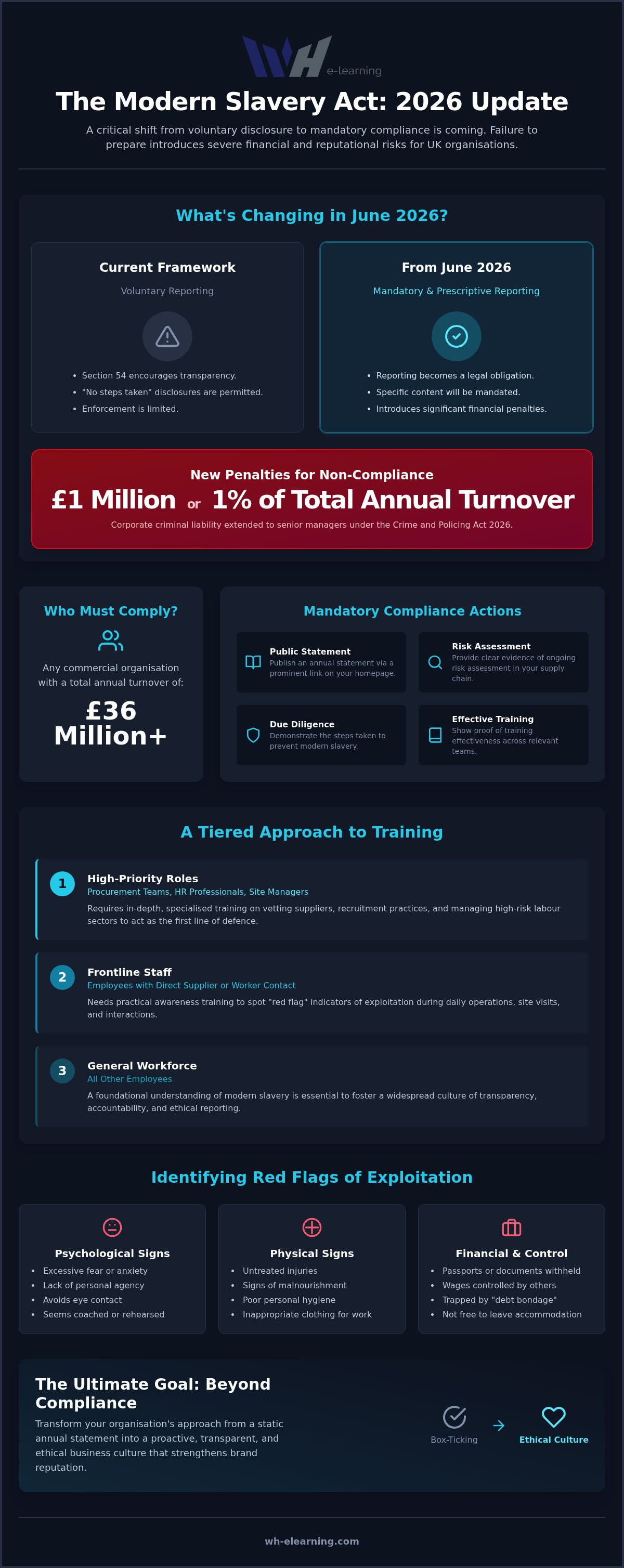
Compliance starts with a clear understanding of Section 54 of the Modern Slavery Act 2015. This Transparency in Supply Chains (TISC) clause mandates that every commercial organisation with an annual turnover of £36 million or more must produce a statement each financial year. Whilst this previously allowed for "no steps taken" disclosures, the 2026 legislative landscape has shifted significantly. The Immigration and Asylum Bill, introduced in June 2026, signals a transition to mandatory, prescriptive reporting. You're now expected to provide clear evidence of risk assessment, due diligence, and, crucially, the effectiveness of your modern slavery act compliance training programmes.
The Legal Requirement for Transparency
Your annual statement must be easily accessible via a prominent link on your organisation's homepage. It isn't just a static document; it's a public record of your commitment to ethical operations. Implementing modern slavery act compliance training serves as tangible proof that your organisation is actively managing risks rather than just acknowledging them. Under the Crime and Policing Act 2026, senior managers can now face corporate criminal liability if modern slavery offences occur within their remit. Failing to meet these standards invites more than just reputational damage. Proposed financial penalties could reach £1 million or 1% of your total turnover, making robust education a vital business safeguard.
Who Needs Training Within the Organisation?
Whilst every employee should understand the basics of modern slavery, certain roles carry higher levels of responsibility. Procurement teams, HR professionals, and site managers are your first line of defence. They need specialised knowledge to vet suppliers and recognise subtle signs of coercion in recruitment. We recommend a tiered approach to education to ensure resources are used effectively:
- High-Priority Roles: In-depth training for those managing global supply chains or high-risk labour sectors.
- Frontline Staff: Practical awareness to spot "red flags" during daily operations or site visits.
- General Workforce: A foundational understanding to foster a widespread culture of transparency and reporting.
Tailoring the depth of your training ensures that those closest to the risk have the most sophisticated tools to combat it. This structured approach doesn't just satisfy legal auditors. It empowers your entire team to act as ethical guardians for your brand, ensuring that your 2026 reporting is backed by genuine, measurable action.
Core Components of Effective Modern Slavery Training
Modern slavery isn't a relic of the past; it's a contemporary crisis involving forced labour, human trafficking, and domestic servitude. Effective modern slavery act compliance training must move beyond dry legal definitions to provide practical, real-world context. This ensures that your staff don't just understand the law but can actively apply it within your specific business environment. Following the latest UK Government guidance on the Modern Slavery Act ensures your curriculum remains aligned with current enforcement standards and expectations.
Identifying the Signs of Exploitation
Detecting exploitation requires a keen eye for subtle indicators that often hide in plain sight. Employees might exhibit psychological signs like excessive fear, anxiety, or a lack of personal agency when speaking to managers. Physical signs often include untreated injuries or poor personal hygiene, suggesting neglected living conditions or unsafe work environments. Financial exploitation is equally prevalent, often manifesting as debt bondage where workers are forced to pay off inflated "travel costs" or have their passports withheld by supervisors. Red flags serve as the primary tool for employee intervention, acting as early warning signs that something is fundamentally wrong.
Reporting and Remediation Procedures
Knowledge is only half the battle; your team must also know how to act when they spot a concern. A robust reporting structure is a cornerstone of workplace compliance training, providing a clear pathway from initial suspicion to resolution. Staff should be encouraged to use internal whistleblowing channels, whilst also being aware of external resources like the Modern Slavery Helpline. Emphasising that legal protections exist for those who raise concerns in good faith reduces the anxiety often associated with reporting. This psychological safety is vital for maintaining an ethical culture where exploitation has nowhere to hide.
To truly embed these complex ethical concepts, video-based learning is highly effective. Static text often fails to convey the human impact of exploitation, whereas video scenarios create an emotional connection that improves information retention across diverse teams. If you're looking to scale this awareness across a global workforce, WH eLearning's video-led modules offer a seamless way to ensure every team member receives the same high standard of education. This consistency is vital for maintaining a unified front against modern slavery throughout your entire supply chain, ensuring that your 2026 compliance efforts are both measurable and impactful.
Overcoming Barriers to Global Compliance
Global supply chains are inherently complex, often spanning multiple continents and diverse cultures. Your ethical standards must remain consistent across these borders to ensure your transparency statement remains robust and credible. If your international partners or site workers don't fully grasp your expectations, your organisation remains vulnerable to hidden risks. Language barriers and cultural differences are frequently the biggest hurdles, preventing workers from understanding their rights or identifying exploitation in their immediate environment.
Training a Multi-Language Workforce
Relying on English-only training for international sites is a gamble that 2026 standards don't support. Deep comprehension is only possible when learners can engage with the material in their native tongue. The UK Government guidance on supply chain transparency emphasises that communication must be effective and accessible to all. This is why multi-language e-learning courses are now a non-negotiable asset for global firms. By offering content in 25+ languages with accurate closed captions, you bridge the gap between your UK headquarters and your global workforce.
Inclusive design isn't just a "nice to have" feature; it's a fundamental requirement for modern slavery act compliance training that actually works. Providing translated content ensures that workers in high-risk sectors can identify "red flags" without the risk of information being lost in translation. This level of accessibility demonstrates a genuine commitment to protecting every individual within your supply chain.
Engagement and Behavioural Change
Real progress requires moving away from a "tick-box" mentality toward genuine behavioural change. Static slides and long blocks of text are rarely effective for retaining complex ethical information. Effective modern slavery act compliance training should instead focus on interactive, video-based assessments that reflect real-world challenges. Storytelling and scenario-based learning build empathy, making the risks of forced labour feel tangible rather than abstract.
Measuring effectiveness through assessment scores and reporting rates provides the hard data needed for your 2026 annual statement. It's not enough to show that staff clicked through a module; you must demonstrate they've understood the material. This evidence-based approach is essential for meeting the Home Office guidance for 2026 reporting deadlines. When employees understand the "why" behind the rules, they're far more likely to act when they see something suspicious, turning compliance into a genuine business strength.
Evaluating Online vs In-House Compliance Training
Choosing the right delivery method for your modern slavery act compliance training is a strategic decision that impacts both your budget and your audit readiness. Whilst some organisations prefer the personal touch of a classroom, others require the rapid deployment that only digital tools can provide. The goal is to find a balance that ensures every worker, from the warehouse floor to the executive suite, understands their role in maintaining an ethical supply chain. Your choice of delivery must be robust enough to withstand legal scrutiny whilst remaining accessible to your entire workforce.
The Advantages of Digital Delivery
Digital platforms have become the standard for large-scale rollouts because they offer unmatched scalability. When you need to train thousands of employees across multiple regions, e-learning ensures that everyone receives the exact same high standard of information. It eliminates the risk of inconsistent messaging that can occur with multiple human trainers. This consistency is vital for legal protection; you can prove through automated logs and video-based assessments that every staff member successfully completed the same accredited module.
For businesses managing remote or hybrid teams, digital delivery offers the flexibility needed for modern work patterns. Employees can complete their modules at a time that suits their schedule, reducing the disruption to daily operations. This makes business compliance e-learning particularly cost-effective, as it removes the need for travel expenses, venue hire, and individual workshop fees. Bulk licensing allows you to onboard new staff immediately, ensuring your compliance never lags behind your recruitment cycles.
When to Choose Specialist-Led Training
There are specific scenarios where specialist-led in-house sessions provide added value that digital modules cannot replicate. Senior leadership teams and executive boards often benefit from facilitated discussions that allow them to explore the nuances of corporate criminal liability in a confidential, expert-led setting. Similarly, procurement teams dealing with high-risk geographical regions may require a deep-dive into specific local labour laws and complex auditing techniques that go beyond general awareness.
Combining these methods often yields the best results for complex organisations. You might use online modules for foundational awareness across the general workforce, whilst reserving face-to-face workshops for those in high-priority roles. This hybrid approach ensures your training is both broad enough for total coverage and deep enough for those managing the highest risks. If you're ready to streamline your 2026 reporting and protect your brand, you can explore our flexible training options to find the perfect fit for your organisation's unique needs.
Modern Slavery Training Solutions with WH eLearning
WH eLearning provides a sophisticated Modern Slavery awareness module specifically engineered to address the 2026 reporting requirements. Our approach moves away from traditional, static learning by utilising high-quality video content that captures the reality of modern exploitation. This modern slavery act compliance training ensures that your team doesn't just read about risks but learns to recognise them through immersive, scenario-based storytelling. Our platform is designed for the modern professional, offering multi-device access that allows for seamless learning on any device.
Scalable Corporate Training for 2026
Large organisations face the unique challenge of coordinating compliance across vast, fragmented departments. Our centralised corporate licensing model simplifies this by allowing you to manage thousands of learners through a single, intuitive interface. You can track progress in real-time, identify any gaps in completion, and automate certification for audit purposes. This level of oversight is vital for meeting the Home Office guidance for 2026 reporting deadlines without the administrative burden of manual tracking.
We understand that modern slavery is often part of a broader health and safety framework. You can easily customise your team's learning path by including occupational safety and health training alongside our compliance modules. Our platform integrates directly with your existing HR systems, ensuring that training data flows automatically into your reporting tools. This integration removes friction from the process, allowing your HR and procurement teams to focus on strategy rather than spreadsheets.
Accredited Excellence and Global Support
Our commitment to quality is reflected in our library of over 100 accredited courses, providing you with the peace of mind that your training meets recognised industry standards. For businesses with international operations, our multi-language support is a transformative tool. We offer machine translation into 25+ languages, complete with closed captions. This ensures that every individual in your supply chain receives the same high-quality education and understands their legal protections.
Getting started is straightforward, whether you require individual enrolments for a small team or a comprehensive bulk license for a global enterprise. Our specialist-led in-house sessions are also available for those who require a more bespoke, face-to-face approach for high-risk sectors. Take the first step toward a more transparent and ethical brand reputation. Enrol your team in modern slavery act compliance training today to secure your organisation's future and empower your staff to act with confidence.
Future-Proofing Your Organisation's Ethical Standards
The shift towards mandatory reporting and significant financial penalties in 2026 makes proactive education a business necessity. You've explored how identifying "red flags" and overcoming global language barriers are the foundations of a truly transparent supply chain. By moving beyond static policy documents to engaging, video-led education, you empower your workforce to become active guardians of your brand's reputation. Choosing the right modern slavery act compliance training ensures your organisation remains resilient against legal scrutiny whilst fostering a genuine culture of integrity.
WH eLearning provides the tools you need to succeed, with courses accredited by leading industry bodies and a platform already used to train over 10,000 employees globally. With content accessible in over 25 languages through machine translation, you can guarantee consistency across every region of your operations. Secure your organisation with accredited Modern Slavery Act compliance training from WH eLearning and take a confident step towards a more ethical future. We're here to help you turn complex legal requirements into a seamless path for professional growth.
Frequently Asked Questions
Is modern slavery training a legal requirement in the UK?
Yes, providing modern slavery act compliance training is now a critical necessity for organisations with a turnover of £36 million or more. Under the 2026 legislative updates, businesses must report on their training efforts as part of a mandatory disclosure framework. Failing to demonstrate that your staff are educated on these risks can lead to significant financial penalties and legal liability for senior managers under the Crime and Policing Act 2026.
What should be included in a modern slavery training programme?
A robust programme must cover the legal definitions of modern slavery, including forced labour and debt bondage. It should focus on identifying "red flags" such as physical signs of neglect or workers having their passports withheld. Additionally, the training must outline clear internal and external reporting protocols. Effective courses often use video-based scenarios to build empathy and ensure that complex ethical concepts are retained by staff across all departments.
How often should staff undergo modern slavery compliance training?
We recommend that staff undergo modern slavery compliance training at least once a year. This annual frequency ensures that your organisation's knowledge remains current with evolving legislative standards and Home Office guidance. Regular refreshers are also vital for new starters and those moving into high-priority roles. Consistent training allows you to provide fresh evidence of due diligence for your mandatory annual transparency statement, protecting your brand's reputation.
Can online training be used as evidence for a Modern Slavery Statement?
Yes, accredited online training is an excellent source of evidence for your annual Modern Slavery Statement. Digital platforms provide automated logs that track completion rates and assessment scores across your entire workforce. This data offers tangible proof of your organisation's proactive approach to risk management and due diligence. Using video-based assessments ensures higher engagement, making your statement more robust when reviewed by legal auditors or the general public.
Which employees are considered "high risk" and need more intensive training?
Employees in procurement, HR, and site management roles are considered high risk because they directly manage supply chains and recruitment. These individuals require more intensive modern slavery act compliance training to vet suppliers and identify subtle signs of coercion. Whilst general awareness is recommended for all staff, those on the frontline of global operations need sophisticated tools to audit international partners and handle sensitive disclosures from vulnerable workers.
What are the benefits of multi-language compliance training?
Multi-language training ensures that your ethical standards are understood by every worker, regardless of their native tongue. Providing content in over 25 languages with closed captions removes the risk of vital information being "lost in translation" across global supply chains. This inclusive approach empowers international teams to identify exploitation and report concerns. It also demonstrates to stakeholders that your commitment to human rights is genuine and reaches every corner of your operations.
How do I track if my employees have completed their compliance training?
Tracking completion is simple when using a centralised corporate training license. Our platform provides administrative tools that allow you to monitor progress in real-time and generate automated reports for your audits. You can easily identify which departments or individuals have yet to complete their modules. This data can also be integrated with your existing HR systems, making it effortless to maintain accurate records for your mandatory annual reporting requirements.
What happens if our organisation fails to provide adequate training?
Failing to provide adequate training can result in significant financial penalties, potentially reaching £1 million or 1% of your total turnover. Beyond the immediate costs, your organisation faces severe reputational damage and the loss of trust amongst consumers and partners. Under the 2026 updates, senior managers can also face corporate criminal liability if modern slavery offences occur within their remit. Robust training acts as a critical shield against these legal and commercial risks.


