

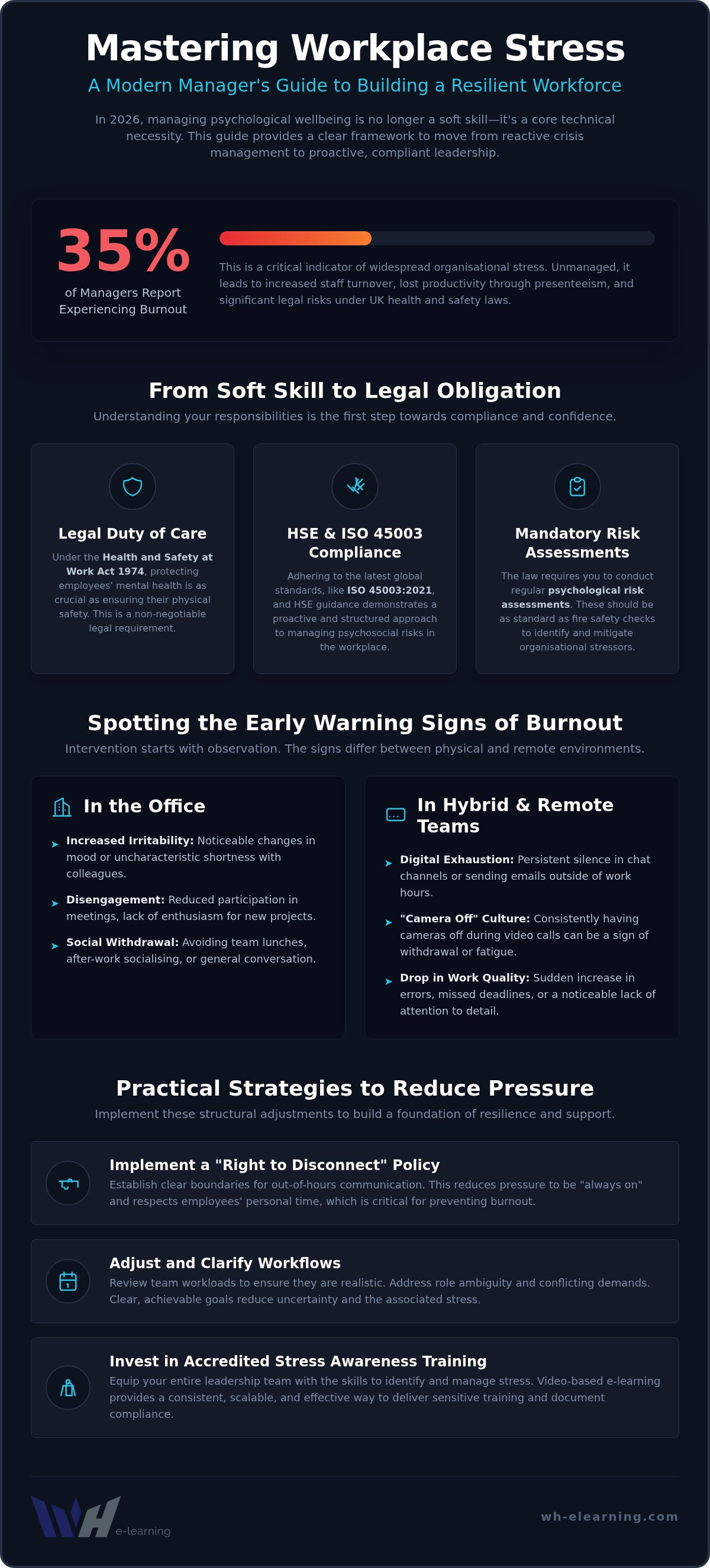
Did you know that 35% of managers reported experiencing burnout in recent years? It's a sobering figure that highlights why mastering the art of managing workplace stress for managers is no longer a soft skill; it's a core technical necessity for 2026. You likely feel the pressure of rising staff turnover and the constant worry about meeting your legal duty of care, especially when "hidden" stress in hybrid teams is so difficult to spot. It's exhausting to feel like you're constantly reacting to crises rather than preventing them.
This guide empowers you to move from anxiety to quiet confidence. You'll learn how to recognise the subtle signs of team burnout before they lead to absenteeism and how to implement accredited stress awareness training that proves your compliance. We provide a clear framework for building a resilient workforce, ensuring you meet the latest global standards like ISO 45003:2021. From understanding your legal obligations to fostering a supportive culture, this is your simplified path to a healthier, more productive workplace.
Key Takeaways
- Define your legal duty of care under the Health and Safety at Work Act 1974 and learn why managing workplace stress for managers is a vital technical skill in 2026.
- Spot the early warning signs of burnout amongst remote and hybrid staff to intervene before stress impacts productivity or health.
- Evaluate the benefits of video-based e-learning for delivering sensitive mental health training that resonates with a modern, tech-literate workforce.
- Implement specific workflow adjustments and a "right to disconnect" policy to reduce daily pressure and build a more resilient team culture.
- Streamline your compliance efforts with accredited training and administrative tools that make tracking progress simple for large organisations.
The Manager’s Role in Managing Workplace Stress and Duty of Care
Managing workplace stress for managers isn't about acting as a therapist or a life coach. In 2026, it's defined as a proactive leadership discipline focused on the identification and mitigation of psychological risks. This represents a fundamental shift in perspective. Stress is no longer viewed as a personal failing or a private issue for the employee to solve alone. Instead, it's recognised as an organisational hazard that requires the same level of rigour as physical safety protocols.
When you ignore these psychosocial hazards, the business pays a heavy price. Absenteeism is the visible cost, but presenteeism, where employees are physically present but mentally disengaged, often causes even deeper financial damage. UK businesses lose billions of pounds annually due to lost productivity and high staff turnover linked to unmanaged workplace pressure. Effective leadership means spotting these bottlenecks before they impact the bottom line.
Legal Obligations and HSE Standards in 2026
Under the Health and Safety at Work Act 1974, your duty of care is absolute. By 2026, the Health and Safety Executive (HSE) has made it clear that protecting mental health is on equal footing with physical protection. The Management of Health and Safety at Work Regulations 1999 require you to assess all risks to your team's wellbeing. If you aren't conducting regular psychological risk assessments, you aren't fully compliant with UK law.
Accredited training plays a vital role here. It provides the documented evidence needed to prove your organisation has taken "reasonably practicable" steps to safeguard staff. By training your leaders, you ensure that managing workplace stress for managers becomes a consistent, repeatable process rather than a series of reactive interventions. This structured approach reduces legal anxiety and builds a foundation of quiet confidence across your leadership team.
The Strategic Value of a Stress-Aware Culture
Beyond meeting legal benchmarks, a stress-aware culture is a powerful tool for retention. Top talent in 2026 prioritises environments where psychological safety is a reality, not just a buzzword. You can reduce the friction of professional requirements by leading with empathy and clarity. When employees feel supported, they're more likely to stay, innovate, and contribute to long-term growth. Stress awareness is a pillar of occupational safety and health training course excellence. It transforms your role from a supervisor into a facilitator of professional development and collective resilience.
Identifying and Assessing Psychological Hazards in Your Team
Effective intervention starts with visibility. Managing workplace stress for managers requires a shift from reactive problem-solving to proactive hazard spotting. You don't need to overstep personal boundaries or act as a counsellor; instead, focus on the structural drivers of pressure: workload, control, and support. When these three pillars are misaligned, psychological hazards quickly follow. By identifying these issues early, you protect your team's wellbeing and maintain the operational rhythm of your department.
Early Warning Signs of Staff Burnout
Burnout is rarely a sudden event. It's a slow accumulation of pressure that eventually breaks a person's resilience. In a physical office, you might notice a colleague's sudden irritability, a lack of engagement in meetings, or their withdrawal from team socialising. However, identifying these signs in hybrid teams requires more nuance. Look for "digital exhaustion," which often appears as a persistent silence in chat channels, cameras being turned off during every call, or a sudden drop in the quality of work. Physical fatigue isn't just a personal health issue; it's a safety hazard that reduces situational awareness and increases the risk of errors. Following professional guidance and tips for employers ensures you can recognise these shifts before they lead to long-term absence.
Conducting Effective Stress Risk Assessments
A psychological risk assessment should be as standard as a fire safety check. By using the HSE Management Standards as your framework, you can evaluate whether your team has the resources they need to meet their targets. Look for triggers such as conflicting roles, unrealistic deadlines, or a lack of autonomy over daily tasks. Even poor office ergonomics can contribute to a sense of being overwhelmed. It's important to document your findings clearly. This creates a transparent workplace safety training courses record that demonstrates your commitment to a healthy, compliant culture.
Regular, low-pressure check-ins are the best way to gather this information without making staff feel like they're being monitored. When you master the process of managing workplace stress for managers, you turn these assessments into collaborative conversations about growth and efficiency. If you want to refine these skills, exploring an accredited stress awareness module from WH eLearning can provide the practical tools needed to lead your team with quiet confidence.
Comparing Training Formats: Why Video-Based E-Learning Wins
Selecting the right delivery method for mental health training is a strategic decision that directly impacts how well your team absorbs sensitive information. Whilst traditional workshops have their place, they often struggle with consistency and scalability across a modern organisation. Managing workplace stress for managers becomes significantly easier when every leader in your company receives the same high-quality, expert-led instruction, regardless of whether they are based in London, Manchester, or a remote home office.
Video-based e-learning stands out because it captures the human element of stress management. It allows for nuances in tone, facial expression, and body language that text-based modules simply cannot replicate. This is essential for empathetic topics where the delivery is just as important as the data. By providing clear stress management tips through an engaging visual medium, you reduce the perceived difficulty of the subject and empower your team to take immediate action.
The Advantages of Online Stress Awareness Training
Digital platforms offer a level of flexibility that traditional in-person sessions lack. Managers can progress through modules at their own pace, which effectively removes the "training stress" of trying to fit a rigid four-hour workshop into a busy schedule. This self-paced approach ensures that the information is digested properly rather than rushed. Bulk licensing also provides a cost-effective way to roll out accredited training across multiple branches, ensuring a unified approach to compliance and wellbeing.
- Consistency: Every employee receives the exact same message and standards, eliminating the risk of mixed signals.
- Retention: Interactive assessments and video-based scenarios improve long-term knowledge through active participation.
- Certification: Instant digital certificates provide immediate proof of compliance for HR records and safety audits.
In-House Specialist Sessions for High-Risk Sectors
In certain high-pressure environments, a hybrid approach might be the most effective solution. You can combine the broad reach of digital modules with targeted, face-to-face interventions for specific industry challenges. This is particularly useful for global organisations that need to bridge cultural gaps. Using multi-language e-learning courses ensures that your global workforce feels included and supported in their native tongue. When you prioritise inclusivity, you strengthen the overall resilience of your company. Managing workplace stress for managers is most effective when it is accessible to everyone, fostering a culture where wellbeing is a shared priority.
Practical Strategies for Managers to Reduce Workplace Pressure
Once you've identified the psychological hazards in your team, the focus must shift to active intervention. Managing workplace stress for managers isn't about asking staff to "be more resilient"; it's about environmental control. You have the power to redesign workflows that cause friction. Look for bottlenecks where work piles up or where role ambiguity creates tension. By streamlining these processes and clarifying expectations, you remove the "invisible" stressors that exhaust your team's mental energy.
A "right to disconnect" policy is a critical standard for 2026. It protects employee downtime by setting clear, non-negotiable boundaries on after-hours communication. When you respect these boundaries, you prevent the digital exhaustion that leads to burnout. Fostering an environment where staff feel safe to report pressure without stigma is equally vital. Integrating Mental Health First Aid principles into your daily management routine ensures you respond to concerns with empathy and practical support rather than just viewing them as a "performance issue" to be fixed.
Effective Workload Management and Delegation
Balancing team capacity requires more than just intuition. Use the reporting data from your administrative tracking tools to identify departments or individuals under excessive pressure. If you see a consistent spike in overtime or a drop in engagement, it's time to intervene. Clear role definitions are essential; they prevent the frustration that occurs when responsibilities overlap. When delegating, match tasks to current capacity rather than just skill sets. Realistic goal-setting ensures your team feels challenged and productive without being over-extended.
Building Resilience through Supportive Leadership
You must lead by example to create a healthy culture. If you don't take your scheduled breaks or disconnect from emails in the evening, your team won't feel empowered to do so either. Modelling healthy habits is the most efficient way to build collective resilience. Provide your staff with the tools they need to manage their own stress, such as access to accredited training modules. This support should be a core part of your broader business compliance e-learning programme. When wellbeing is treated with the same priority as safety compliance, you foster a high-performance team that feels valued and supported.
Ready to transform your team's culture? Explore our accredited Stress Awareness training to give your managers the practical tools they need to lead with confidence.
Implementing Your Stress Management Strategy with WH eLearning
Implementing a robust strategy requires more than just good intentions. It demands high-quality, verified resources that align with your organisational goals. WH eLearning provides a comprehensive suite of accredited stress awareness modules designed specifically to assist in managing workplace stress for managers. Our platform bridges the gap between identifying a problem and executing a solution, ensuring your leadership team has the technical and empathetic skills needed to thrive. By choosing our video-based assessments, you ensure that knowledge retention remains high long after the training is complete.
Accredited Courses for Professional Peace of Mind
Certification from recognised bodies is essential for maintaining a valid compliance audit trail. In 2026, health and safety trends have shifted towards a more integrated approach to mental and physical wellbeing. Our courses are regularly updated to reflect these changes, providing you with the most current guidance available. When managers feel equipped with accredited knowledge, they approach sensitive team issues with a sense of quiet confidence. This empowerment reduces the friction often felt when addressing mental health, turning a complex professional requirement into a simplified, repeatable process. Positioning these modules as a vital component of your broader workplace compliance training ensures that no aspect of staff safety is left to chance.
Scalable Solutions for Modern Organisations
Managing workplace stress for managers becomes a seamless part of your daily routine with our intuitive administrative features. You can track progress, monitor completion rates, and identify areas that may require further intervention across your entire organisation. This level of visibility is crucial for large-scale operations where manual tracking is no longer feasible. We support over 25 languages via machine translation, ensuring that every team member is included in the conversation, regardless of their location or native tongue. Inclusion is a cornerstone of a resilient culture, and our platform makes it attainable for global teams. We offer flexible enrolment options that grow with your business, from individual certificates to enterprise-wide corporate licensing.
Protect your team and your business with our accredited stress awareness training.
Building a Resilient Future for Your Team
Mastering the discipline of managing workplace stress for managers is a vital investment in your organisation's long-term success. By shifting from reactive problem-solving to proactive hazard identification, you fulfil your legal duty of care whilst fostering a culture of psychological safety. We've explored how workflow redesign and a "right to disconnect" can significantly reduce daily pressure; these strategies ensure your team remains productive and engaged in a hybrid 2026 landscape.
Success lies in using the right tools to empower your leadership team. WH eLearning offers over 100 professional compliance courses, including video-based stress awareness modules supported in 25+ languages. Our training is accredited by leading UK health and safety bodies, providing you with a robust audit trail and the peace of mind that your standards are world-class. You don't have to navigate these professional requirements alone. We are here to simplify your path to excellence and professional growth.
Explore our accredited Stress Awareness Training for Managers and start building a more resilient, high-performing workforce today. Your commitment to wellbeing is the foundation of a thriving business.
Frequently Asked Questions
Is managing workplace stress a legal requirement for managers in the UK?
Yes, managing workplace stress is a legal obligation under the Health and Safety at Work Act 1974 and the Management of Health and Safety at Work Regulations 1999. Employers must assess the risk of stress-related ill health arising from work activities. As a manager, you are responsible for implementing these assessments and taking reasonably practicable steps to mitigate psychological hazards. Failure to do so can lead to legal action and significant financial penalties for the business.
What is the best way to train managers in stress awareness?
The most effective approach combines accredited video-based e-learning with practical management strategies. Video content is particularly powerful for sensitive topics like mental health because it captures human nuance and empathy better than text alone. Managing workplace stress for managers requires a consistent message across the organisation. Accredited courses ensure your leaders receive expert-led guidance that aligns with the latest 2026 health and safety standards whilst allowing them to learn at their own pace.
How can I tell if an employee is suffering from workplace stress?
Identifying stress involves monitoring for subtle changes in a staff member's usual behaviour or performance. You might notice increased irritability, social withdrawal, or a sudden decline in the quality of their work. In hybrid teams, "digital exhaustion" is a common sign; look for persistent silence in chat channels or a reluctance to engage in video calls. Early intervention is key to preventing these symptoms from developing into long-term absence or chronic burnout.
Does WH eLearning offer stress awareness training in multiple languages?
Yes, WH eLearning supports over 25 languages through advanced machine translation. This feature is designed to ensure that global teams can access vital safety and compliance information in their native tongue. By removing language barriers, you create a more inclusive environment where every employee understands how to manage their wellbeing. This global reach is essential for modern organisations looking to maintain high standards of care across diverse international branches.
How long does an online stress management course for managers take?
Most of our specialised modules are designed to be completed within 45 to 90 minutes. This concise format ensures that busy leaders can fit essential training into their schedules without causing further "training stress." The courses are self-paced, allowing you to pause and resume as needed. This flexibility ensures that the core principles of managing workplace stress for managers are fully understood and retained rather than being rushed through during a single session.
Can I track my team’s progress through the training modules?
Organisations using our corporate training licenses have access to comprehensive administrative features. You can monitor individual progress, track completion rates, and manage digital certifications through an intuitive dashboard. This visibility is vital for compliance audits, as it provides documented proof that your staff have received accredited training. It also helps you identify departments that might need additional support if completion rates are lower than expected in specific areas.
What is the difference between stress awareness and mental health first aid?
Stress awareness training is primarily a proactive, preventative measure focused on identifying and mitigating workplace hazards before they cause harm. It teaches managers how to redesign workflows and manage pressures. Mental health first aid is more of a reactive, first-response discipline. It equips individuals with the skills to support someone experiencing a mental health crisis. Both are essential components of a robust wellbeing strategy, but stress awareness is your first line of defence against absenteeism.
Are the WH eLearning certificates accredited for UK compliance?
All WH eLearning certificates are accredited by leading UK health and safety bodies. This accreditation ensures that our training meets the high standards required for professional compliance and safety audits. When your team completes a course, they receive a digital certificate that serves as verified evidence of their skills. Using accredited resources gives you the quiet confidence that your organisation is fulfilling its legal duty of care whilst following the latest industry best practices.


