

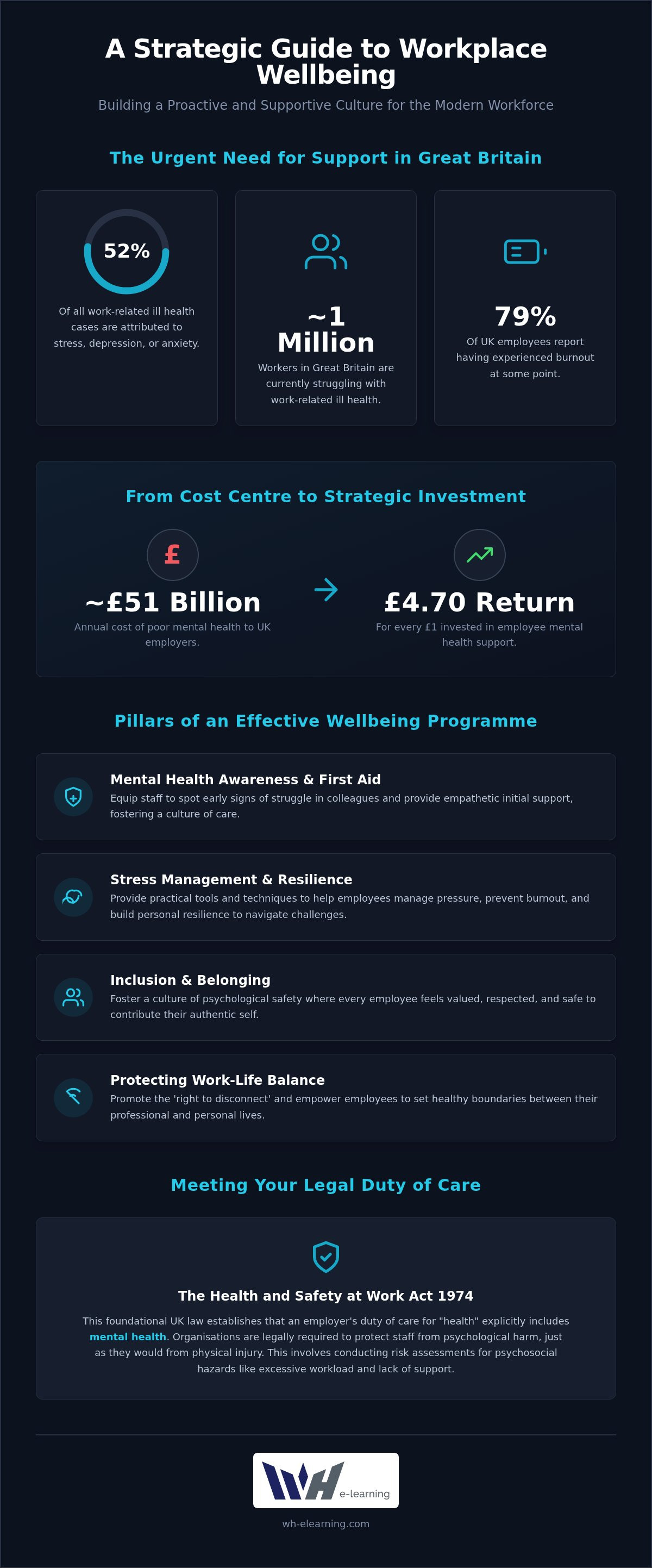
Did you know that work-related stress, depression, and anxiety now account for 52% of all work-related ill health cases in Great Britain? With nearly a million workers currently struggling, the pressure on UK businesses to provide meaningful support through health and wellbeing at work training has never been higher. You're likely already seeing the impact of rising turnover or noticing the signs of burnout amongst your most talented staff. It's difficult to feel confident in your strategy when legal duty of care requirements feel like a moving target, especially when managing remote or hybrid teams.
We believe that protecting your people should be straightforward and empowering. This 2026 guide shows you how to move beyond reactive policies by implementing accredited, high-quality learning programmes. By choosing the right training pathways, you can meet your legal obligations whilst fostering a culture where employees feel genuinely supported. WH eLearning acts as your expert partner, simplifying the path to professional standards through accessible, video-based learning.
We'll preview the latest HSE focus areas, explain how to simplify complex compliance, and demonstrate how a proactive approach leads to a measurable reduction in absences. With research showing an average return of £4.70 for every £1 spent on mental health support, investing in your team's wellbeing is as much a financial priority as it is a legal one.
Key Takeaways
- Move beyond reactive support by adopting a proactive, holistic approach that addresses both the physical and mental health needs of your modern workforce.
- Master the essential components of health and wellbeing at work training to help staff build resilience and spot early signs of struggle in their colleagues.
- Determine the most effective delivery format for your organisation, whether you need to train ten people locally or scale consistent learning to a thousand employees across multiple sites.
- Learn how to secure leadership buy-in and use data-driven insights to bridge the gap between corporate policy and the actual daily experience of your team.
- Ensure full compliance with UK health and safety standards by choosing accredited training solutions that provide measurable results and professional peace of mind.
Understanding Health and Wellbeing at Work Training
Workplace wellbeing isn't just a buzzword; it's a strategic pillar of modern business. In 2026, the definition has expanded from basic physical safety to a holistic model that encompasses mental, social, and emotional health. Leading organisations now recognise that effective health and wellbeing at work training is the most reliable way to transition from reactive crisis management to proactive prevention. By equipping your team with the right tools, you move beyond simply managing ill health to actively fostering a culture of resilience.
The return on investment is clear. Poor mental health costs UK employers approximately £51 billion annually. However, research indicates that for every £1 spent on supporting employee mental health, businesses see an average return of around £4.70 through improved productivity. This makes wellbeing a core component of occupational safety and health training, ensuring that your workforce stays both safe and engaged.
The Legal Framework for UK Employers
The Health and Safety at Work Act 1974 remains the bedrock of UK employment law. Crucially, the term "health" in this legislation explicitly includes mental health. Employers have a legal duty to protect staff from psychological harm just as they would from a physical injury. The Management of Health and Safety at Work Regulations 1999 further requires businesses to conduct risk assessments. These assessments must identify psychosocial hazards, such as excessive workload or lack of support, which lead to stress and burnout. Citing Understanding Occupational Safety and Health provides a useful baseline for how these multidisciplinary standards apply across all sectors. WH eLearning acts as your expert partner, helping you navigate these requirements through accredited, easy-to-digest modules.
Wellbeing vs. Traditional Health and Safety
Historically, safety focused on "hard" hazards like slips, trips, and falls. Today, the focus has shifted toward psychological safety. This means that comprehensive workplace safety training courses must include modules on mental health awareness and stress management. By integrating these topics, you bridge the gap between HR compliance and occupational health. This joined-up approach ensures that managers don't just tick boxes but actually foster an environment where employees feel safe to speak up. Using targeted health and wellbeing at work training creates a culture where wellbeing is woven into the daily routine rather than treated as an annual afterthought. It's a simplified path to meeting professional standards whilst supporting your most valuable asset: your people.
Essential Components of a Modern Wellbeing Training Programme
A modern approach to employee wellness requires more than just awareness; it demands practical, skill-based learning. With 964,000 workers in Great Britain currently suffering from work-related stress, depression, or anxiety, the content of your health and wellbeing at work training must be targeted and actionable. It should empower staff to build personal resilience whilst providing managers with the tools to lead with empathy. By focusing on specific pillars like stress management and inclusion, you create a robust framework that supports every individual in the organisation.
Burnout has become a significant organisational risk, with 79% of UK employees reporting they have experienced it. Effective training programmes now prioritise the "right to disconnect" to protect work-life balance in our increasingly digital environment. When employees understand how to set boundaries and manage high-pressure periods, productivity remains stable. Inclusion and belonging also serve as vital components. A culture where everyone feels they belong is a primary driver of psychological safety and long-term retention.
Mental Health First Aid and Awareness
There is a clear distinction between general awareness and specialist intervention. Whilst awareness training reduces stigma by encouraging open conversation, Mental Health First Aid (MHFA) provides specific individuals with the skills to support colleagues in crisis. Research highlights a "wellbeing paradox" where 77% of employees experience symptoms of poor mental health, yet only 13% seek professional support. Bridging this gap requires managers who are confident in having difficult conversations. You can explore how these initiatives support The Business Case for Workplace Health to see the wider impact on your bottom line. We recommend a balanced approach that combines broad education with deep-dive specialist training for key personnel.
Physical Wellbeing and Ergonomics
Physical comfort is the foundation of mental focus. In a hybrid world, the duty of care extends beyond the office, making DSE assessment training online a fundamental requirement for compliance and comfort. Poorly configured workstations lead to chronic pain, which directly contributes to stress and reduced engagement. Modern programmes should also promote movement and healthy habits amongst sedentary workers to prevent long-term health issues. Implementing these standards doesn't have to be complex. You can easily scale these essential modules across your entire team with the flexible solutions provided by WH eLearning.
Choosing the Right Format: Online E-Learning vs. In-Person Workshops
Deciding on the best delivery method for your health and wellbeing at work training depends on your organisation's scale and structure. Scalability is often the deciding factor. Whilst a small team of ten might benefit from a local seminar, an organisation with a thousand staff across various regions requires a more unified solution. E-learning provides this consistency, ensuring that every employee receives the exact same high standard of information regardless of their location. This removes the risk of training quality varying between different sites or regional offices.
From a financial perspective, the cost-benefit analysis is clear. In-person workshops involve travel expenses, venue hire, and significant downtime for staff. Digital solutions allow for flexible, self-paced learning that fits around daily responsibilities. Retention also improves with modern formats. Video-based content is far more engaging than text-heavy manuals. It uses visual storytelling and real-world scenarios to help learners connect emotionally with the subject matter, leading to better long-term memory of the key concepts.
The Benefits of Video-Based E-Learning
Visual storytelling transforms dry compliance topics into relatable experiences. For busy professionals, micro-learning is the ideal approach. Short, sharp bursts of training are easier to digest and retain compared to day-long lectures. Accessibility is another major advantage. Features like closed captions ensure inclusivity for all learners. This is particularly valuable for global teams through multi-language e-learning courses, which remove communication barriers and ensure your duty of care is met everywhere.
When to Consider In-House Specialist Training
E-learning is the foundation, but some scenarios require a more personal touch. High-risk industries dealing with specific trauma or extreme stressors may benefit from in-house specialist training. These sessions allow for deep-dive strategy discussions amongst senior leadership and provide a safe space for addressing complex cultural issues. Acas offers practical advice on Implementing Wellbeing Strategies that combine online theory with practical, face-to-face skills. WH eLearning supports this blended approach by offering both accredited online modules and expert-led, face-to-face sessions to meet your specific organisational needs.
How to Implement Wellbeing Training That Drives Engagement
Successful implementation starts at the top. For health and wellbeing at work training to be effective, it must be viewed as a board-level priority rather than a peripheral HR task. When leadership actively participates and champions these initiatives, it signals to the rest of the organisation that mental health is a core value. This buy-in is essential for shifting the internal culture from one that merely tolerates wellbeing talk to one that actively practices it. Without this support, even the most high-quality programmes risk being ignored or undervalued by the wider workforce.
Data should guide your strategy. Instead of guessing what your team needs, use existing insights to identify specific training gaps. Absence reports, staff surveys, and exit interviews often reveal recurring themes, such as high stress in specific departments or a lack of confidence amongst middle managers. By targeting these areas, you ensure your investment addresses real-world challenges. This data-driven approach allows you to measure success through clear KPIs, such as a reduction in stress-related absences or improved engagement scores in annual reviews.
Overcoming the 'Box-Ticking' Perception
Employees often view mandatory learning as a chore if the purpose isn't clearly communicated. You must explain the "why" behind every module. Personalising the learning journey also helps; a warehouse supervisor faces different stressors than a remote software developer. Recognising and rewarding participation can further boost engagement. Whether it's through internal certifications or public acknowledgment, making progress visible encourages a continuous learning culture. This ensures that wellbeing becomes a daily habit rather than a one-off annual event.
Tracking Progress and Compliance
Managing a large-scale rollout requires robust administrative tools. Utilising central dashboards allows you to monitor completion rates in real-time and identify teams that might need extra support. Automating renewal reminders is also vital to ensure that certifications don't lapse, keeping your organisation fully protected. These records are invaluable during audits, as they provide a clear paper trail of your commitment to duty of care. Integrating these results into your wider workplace compliance training strategy ensures that health and safety remains a cohesive, manageable part of your business operations.
Building a healthier workforce shouldn't be a complex burden. You can simplify your path to professional standards by choosing a provider that handles the technical details for you. Browse our accredited health and safety training courses to find the right fit for your organisation's needs today.
Accredited Wellbeing Solutions from WH eLearning
Choosing the right partner for your health and wellbeing at work training is the final step in building a resilient organisation. WH eLearning provides a comprehensive library of accredited courses designed to simplify professional development whilst ensuring full compliance. Our library includes essential IOSH Managing Safely Online and IOSH Working Safely Online modules, alongside a broad range of HR and Business Compliance Courses. By selecting accredited training, you gain the professional credibility necessary to demonstrate your commitment to staff welfare to both employees and regulatory bodies.
Our platform is built for the modern, global business environment. With support for over 25 languages, we make it easy to standardise wellbeing expectations across international teams. This multi-language course translation ensures that your duty of care is met with the same high standards in every region you operate. Whether you are a small business or a large corporation, our flexible licensing options allow you to scale your training programme as your workforce grows. This removes the administrative friction typically associated with managing bulk learning requirements.
Why Choose WH eLearning for Your Staff?
We pride ourselves on delivering high-quality, video-based content that is designed by industry specialists. This approach replaces dense, text-heavy slides with engaging visual storytelling that improves information retention. Every course features closed captions for accessibility, ensuring an inclusive learning experience for all. Because our platform is accessible on any device, your staff can learn at their own pace. This flexibility reduces the pressure on their daily schedules. For managers, our seamless administrative tools provide real-time tracking of compliance and completion rates, making it easy to identify and close training gaps.
Getting Started with a Corporate License
Implementing a new training strategy is a straightforward process with our expert guidance. We help you choose the specific health and wellbeing at work training modules that align with your workforce needs, from mental health awareness to physical ergonomics. The onboarding process is designed to be efficient; you can have your entire team set up on the platform in a matter of hours. This rapid deployment means you can begin seeing the benefits of a healthier, more engaged workforce almost immediately. We act as your long-term partner, offering steady support as you invest in the professional growth of your people.
Explore our health and wellbeing course library today and take the first step towards a more productive workplace culture.
Building a Resilient Future for Your Workforce
Prioritising employee wellness is no longer an optional extra; it is a fundamental requirement for any high-performing organisation. By shifting from reactive support to proactive health and wellbeing at work training, you protect your people whilst safeguarding your business from the significant costs of burnout and absenteeism. We have explored how accredited, video-based learning ensures consistency across your sites and how data-driven implementation turns compliance into a genuine cultural asset.
WH eLearning is your dedicated partner in this journey. We offer over 100 accredited courses that are already trusted by global organisations to maintain the highest professional standards. With multi-language support for 25+ languages and intuitive administrative tools, we remove the obstacles to effective learning. It is time to transform your workplace into an environment where everyone can thrive.
Empower your team with accredited wellbeing training from WH eLearning
Take the next step today to ensure a healthier, more productive, and legally compliant future for your entire team.
Frequently Asked Questions
Is health and wellbeing training a legal requirement in the UK?
Yes, employers have a legal duty of care under the Health and Safety at Work Act 1974 to protect both the physical and mental health of their staff. Whilst specific wellbeing modules aren't named in a single clause, the Management of Health and Safety at Work Regulations 1999 require you to assess and manage psychosocial risks. Providing health and wellbeing at work training is the most effective way to prove you're taking these obligations seriously.
What topics should be included in workplace wellbeing training?
Effective programmes should cover a broad spectrum of topics to ensure holistic support. Essential modules include stress management, building personal resilience, and mental health awareness for both staff and managers. You should also include physical aspects like ergonomics and DSE safety. Inclusion and belonging are also vital, as they form the foundation of psychological safety. This variety ensures that every employee finds relevant value in the learning process whilst meeting corporate standards.
How often should employees undergo wellbeing and mental health training?
There isn't a strict legal expiry date, but annual refreshers are considered best practice for maintaining a healthy culture. Regular training ensures that new starters are quickly integrated into your wellbeing standards whilst keeping the topic at the forefront for existing staff. You should also trigger new training sessions if there are significant changes to job roles or if absence reports indicate rising stress levels within a specific department or team.
Can online training effectively teach 'soft skills' like empathy and resilience?
Modern e-learning is highly effective at developing soft skills through immersive video content. By using real-world scenarios and visual storytelling, employees can see empathy and resilience in action rather than just reading about them. This format allows learners to reflect on their own behaviour in a safe, private environment. It provides a reliable and consistent baseline of understanding that you can't always guarantee with varied in-person facilitators across different sites.
How do I measure the return on investment for wellbeing training?
You can measure ROI by monitoring key performance indicators like stress-related absence rates, staff turnover, and engagement scores. According to industry research, businesses see an average return of £4.70 for every £1 invested in mental health support. Comparing your training costs against the reduction in sick pay and recruitment fees provides a clear financial picture. Improved productivity and morale amongst your team are also significant, though less direct, indicators of success.
What is the difference between wellbeing training and an Employee Assistance Programme (EAP)?
Wellbeing training is a proactive, preventative measure designed to equip your entire workforce with skills to stay healthy. In contrast, an Employee Assistance Programme (EAP) is a reactive service that provides clinical support or counselling after a problem has already surfaced. Whilst an EAP is a valuable safety net, health and wellbeing at work training reduces the likelihood that staff will reach a crisis point in the first place by building early resilience.
How can I ensure my remote workers are included in wellbeing initiatives?
Remote workers are easily included through flexible, cloud-based platforms that they can access from any location. Since they don't benefit from daily office-based interactions, providing them with digital resilience and mental health modules is essential for their sense of belonging. You must also ensure they complete remote DSE assessments. This ensures their home working environment is ergonomically sound, fulfilling your duty of care regardless of where your staff are actually based.
Are WH eLearning courses accredited by recognised bodies?
Yes, all WH eLearning courses are accredited by leading industry bodies to ensure they meet the highest professional standards. This includes our IOSH Managing Safely and IOSH Working Safely modules, which are globally recognised for their quality and rigour. Choosing accredited training gives you peace of mind that your business is compliant with UK regulations. It also provides your employees with certifications that hold genuine value for their long-term professional development and career growth.


