

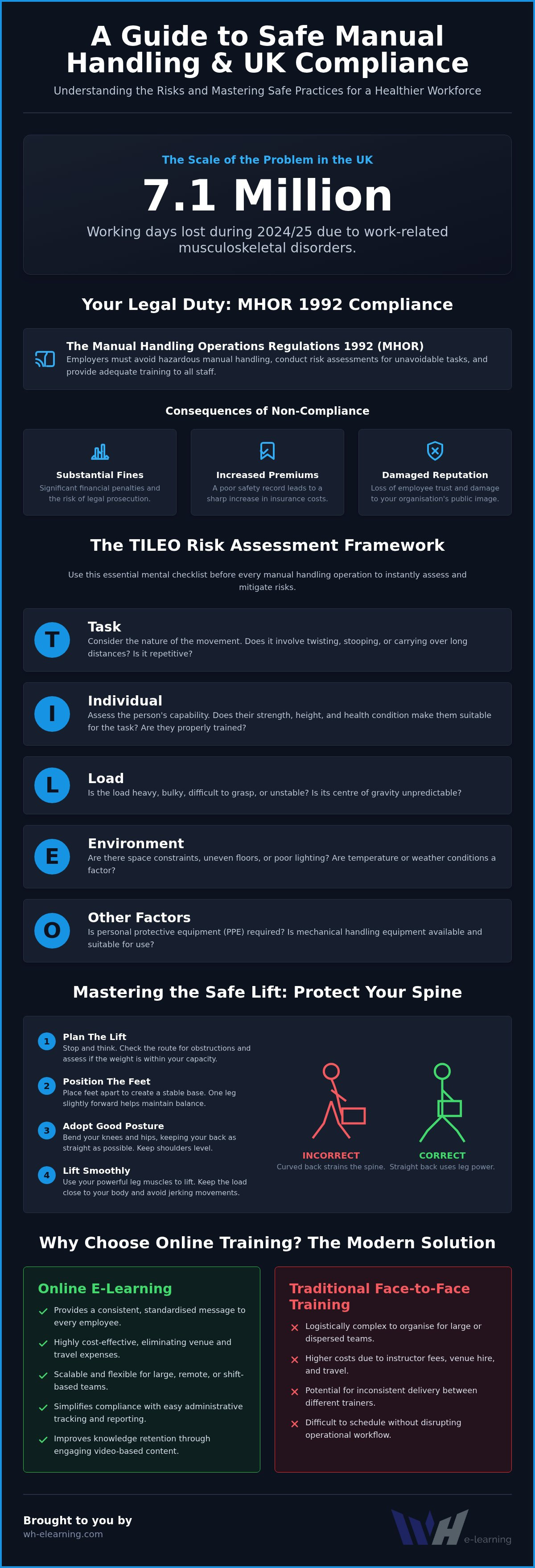
Did you know that 7.1 million working days were lost in the UK during the 2024/25 period due to work-related musculoskeletal disorders? It's a staggering figure that proves why safe lifting and moving is more than just a box-ticking exercise. You likely recognise the challenge of keeping a busy workforce safe, especially when manual handling training online needs to be both effective and easy to manage. We understand that MHOR 1992 regulations can feel complex, and organising face-to-face sessions for large or remote teams often feels like a logistical hurdle.
This comprehensive 2026 guide simplifies the path to 100% UK compliance while protecting your most valuable asset: your people. We'll walk you through the TILEO risk assessment framework, explain how to master essential lifting techniques, and show you why video-based e-learning is the most efficient way to reduce accidents. By the end of this article, you'll have a clear roadmap to creating a safer, more productive workplace that empowers every member of your team to work with confidence.
Key Takeaways
- Understand your legal obligations under the Manual Handling Operations Regulations 1992 to ensure your organisation remains fully compliant.
- Master the essential biomechanics of safe lifting to protect the spine and use leg power effectively during every task.
- Learn to apply the TILEO framework, an industry-standard mental checklist that helps staff assess risks instantly in any environment.
- Discover why manual handling training online provides a more consistent and cost-effective solution for training large or remote teams.
- Implement a scalable safety strategy using video-based learning and administrative tracking to simplify your compliance management.
What is Manual Handling Training Online and Why is it Essential?
Manual handling isn't just about heavy lifting. It covers any activity that requires a person to use bodily force to lift, lower, push, pull, carry, or move a load. To get a foundational grasp of the hazards involved, it's helpful to understand What is Manual Handling and how it impacts physical health over time. When safety protocols aren't followed, even simple tasks can lead to chronic pain or acute injury.
The Health and Safety Executive (HSE) defines manual handling as "any transporting or supporting of a load (including the lifting, putting down, pushing, pulling, carrying or moving thereof) by hand or bodily force." Meeting this definition requires more than just physical strength; it requires knowledge. Implementing manual handling training online has become the preferred choice for modern organisations. It allows businesses to deliver high-quality, video-based instruction to hundreds of employees simultaneously without the logistical nightmare of booking physical venues. This scalable approach ensures every staff member receives the same standardised safety education, which significantly improves long-term knowledge retention.
The Legal Obligations for UK Employers
UK safety law is clear and uncompromising. Under the Health and Safety at Work etc. Act 1974, employers hold a fundamental duty of care to protect their staff from harm. The Manual Handling Operations Regulations 1992 (MHOR) expand on this by requiring businesses to avoid hazardous manual handling where possible and conduct thorough risk assessments for tasks that cannot be avoided. Providing adequate training is a legal necessity, not a suggestion. Failing to meet these standards carries heavy risks:
- Substantial fines and legal prosecution.
- Significant increases in insurance premiums.
- Damaged brand reputation and loss of employee trust.
General Awareness vs. Practical Skills Training
Not every role requires the same level of instruction. For office-based staff or those who handle light loads occasionally, a general awareness manual handling training online course is often sufficient to satisfy legal requirements. It provides the cognitive framework needed to make safe choices. However, high-risk roles in sectors like construction or healthcare often require a blended approach. In these cases, online theory should be supported by on-site practical demonstrations to ensure specific equipment and environments are managed safely. This distinction is crucial; while online modules build the mental habit of safety, practical drills confirm the physical execution. This dual approach ensures compliance while minimising the high rates of musculoskeletal disorders seen in the workforce.
Master the Principles: How to Organise Safe Lifting Techniques
Safe manual handling begins long before you actually touch a load. Preparation is the foundation of every successful operation, yet it's often the most overlooked step in the workplace. Many long-term musculoskeletal disorders amongst UK workers stem from repetitive poor lifting habits rather than a single, dramatic accident. By focusing on biomechanics, you can protect the spine and harness the significant power of your leg muscles. Understanding the Manual Handling Operations Regulations 1992 is the first step, but applying that knowledge requires a consistent shift in physical behaviour. A stable base is the anchor of every safe lift, providing the balance necessary to transition force from the legs through the core without straining the spine.
Using manual handling training online helps teams visualise these biomechanical principles through high-quality video demonstrations. This cognitive framework ensures that when an employee faces a physical task, they instinctively reach for the correct technique rather than the easiest one. If you're looking to standardise these habits across your organisation, exploring accredited health and safety training can provide the structured guidance your team needs to stay injury-free.
Step-by-Step Guide to a Safe Manual Lift
- Plan the lift: Stop and think. Check the intended route for obstructions or slippery patches and assess whether the load weight is within your personal capacity.
- Position the feet: Place your feet apart to create a stable, balanced base. Putting one leg slightly forward helps maintain balance during the transition.
- Adopt a good posture: Bend your knees whilst keeping the back straight. Keep your chin up and shoulders level to maintain the natural curvature of the spine.
- Keep the load close: Hold the object as near to your waist as possible. Every centimetre the load moves away from your body significantly increases the pressure on your lower back.
Techniques for Carrying and Setting Down
Moving the load safely requires total concentration on your body's alignment. One of the most common mistakes is twisting the trunk whilst carrying an object. Instead, you should move your feet to change direction, keeping your shoulders and hips aligned at all times. Maintain a clear line of sight over the load to prevent trips or collisions with colleagues. When it's time for setting down, simply reverse the lifting process. Use your legs to lower the object slowly and avoid the temptation to drop or "fling" the load, which can cause sudden, jarring movements in the spine.
The TILEO Framework: Assessing Risks in Manual Handling Operations
Whilst the physical act of moving a load causes the injury, the mental failure to identify a hazard is almost always the root cause. This is where the TILEO framework becomes invaluable. It's the industry-standard mental checklist that empowers employees to take responsibility for their own safety on the fly. By internalising these five factors, staff don't just follow rules; they develop the quiet confidence to assess any situation before they exert force. Integrating TILEO into your broader workplace safety training courses ensures that risk assessment becomes a behavioural habit rather than a bureaucratic hurdle.
Modern work environments are more varied than ever, making the "O" (Other factors) in TILEO increasingly critical. This category covers anything that doesn't fit into the traditional four pillars, such as the use of Personal Protective Equipment (PPE) or the presence of mechanical aids. When your team engages with manual handling training online, they learn to look for these subtle variables that can turn a routine task into a significant hazard. It's about moving from a "can I lift this?" mindset to a "should I lift this, and how?" approach.
Breaking Down TILE: Task, Individual, Load, and Environment
To perform a quick risk assessment, employees should evaluate these four core areas:
- Task: Does the activity involve repetitive movements, strenuous vertical distances, or unpredictable movements? If you're stooping or reaching upwards, the risk increases.
- Individual: Does the person have the physical capability for this specific lift? You must consider pre-existing health conditions, age, or whether the task requires specialised training.
- Load: Is the object bulky, unstable, or difficult to grasp? A load that shifts its weight, such as a half-full liquid container, requires a different approach than a solid box.
- Environment: Are there floor level changes, poor lighting, or slippery surfaces? Space constraints or extreme temperatures also play a significant role in safe execution.
Applying TILEO to Remote and Home Office Settings
The rise of hybrid work has moved manual handling risks into the domestic sphere. Office workers often underestimate the strain of moving boxes of paper, heavy ergonomic furniture, or even setting up their own workstations. Home environments rarely meet the same strict safety standards as a commercial office, making individual assessment even more vital. Employees must look for trip hazards like loose cables or uneven flooring that wouldn't be present in a managed workspace. For those managing a remote team, combining this knowledge with DSE assessment training online provides a complete safety solution. It ensures that staff remain protected from musculoskeletal strain, regardless of where their "desk" happens to be located.
Why Choose Online Learning for Manual Handling Compliance?
Transitioning to manual handling training online offers immediate financial and operational advantages for growing businesses. By removing the overheads associated with travel, venue hire, and lost productivity during full-day workshops, organisations can reallocate resources where they matter most. Beyond the budget, digital delivery ensures absolute consistency across your entire workforce. Every staff member receives the same high standard of safety information, regardless of their location or the time of day they log in. This level of uniformity is nearly impossible to achieve with a rotating roster of live instructors across multiple sites.
Modern professionals value flexibility and the ability to learn without disruption. Online platforms allow employees to complete their modules at a pace that suits their individual learning style, using any device from a smartphone to a desktop. Adopting business compliance e-learning streamlines corporate safety by consolidating all training data into a single, accessible hub. It replaces scattered spreadsheets with a reliable, real-time overview of your organisation's safety status and legal readiness.
Tracking Progress and Managing Corporate Certification
Administrative dashboards provide a bird's eye view of your workforce, making it easy to identify specific gaps in compliance before they become a liability. You can set automated reminders for refresher training, which guarantees that certificates never expire and your team stays legally protected. This digital record-keeping creates an instant, foolproof audit trail for HSE inspections or insurance reviews. By choosing manual handling training online, you provide your staff with instant digital certification upon completion, allowing them to return to their duties with the documented skills they need.
The Power of Video-Based Training
Video-based learning is significantly more effective than traditional text-heavy slides, especially for physical tasks like lifting and carrying. Seeing a correct lift performed in a realistic environment increases retention and engagement through visual storytelling, making the techniques easier to recall under pressure. To support a diverse, global workforce, video content can be enhanced with closed captions and machine translations into over 25 languages. This inclusive approach ensures that every employee, regardless of their native tongue, can master the essential techniques required to stay safe and productive.
Ready to simplify your workplace safety requirements? Explore our range of accredited health and safety courses to start building a more compliant and empowered workforce today.
Implementing an Effective Training Strategy with WH eLearning
WH eLearning removes the friction often associated with meeting professional standards. We replace complex logistics with a clear, guided path to full compliance that prioritises your time and effort. Our platform allows you to customise a comprehensive training library effortlessly. You can bundle your manual handling training online with other critical modules, such as fire safety training online, to create a holistic safety ecosystem. Whilst our digital modules provide a superior cognitive foundation, we also provide industry specialists for in-house face-to-face training. This blended approach is perfect for teams that require practical, on-site demonstrations for specialised equipment or high-risk tasks.
Scaling Training for Large Organisations
Managing the safety requirements of a large, diverse workforce doesn't have to be a logistical burden. We offer flexible bulk licensing options that allow companies to train hundreds of employees simultaneously without losing administrative oversight. Integrating e-learning into your existing onboarding process ensures that every new starter adopts safe behaviours before they even step onto the shop floor. For teams working in high-risk environments, such as construction or facilities management, we recommend cross-referencing manual handling skills with an asbestos awareness online course. This layered approach to training provides a robust level of protection that meets the highest UK standards and keeps your projects moving forward without delay.
Ensuring Long-Term Safety Culture
Effective safety management moves beyond simple box-ticking to foster a genuine culture of wellbeing and professional growth. We position ourselves as your modern, expert guide, helping you transition from reactive fixes to proactive safety habits. By encouraging your staff to apply the TILEO principles discussed earlier in their daily routines, you turn abstract regulations into practical, life-saving habits that protect your team for the long term. Our administrative tools allow you to track this progress in real-time, ensuring that no one is left behind and that your organisation remains 100% compliant at all times. It's time to replace the difficulty of compliance with the ease of empowerment. Enrol your team in manual handling training today and take the first step towards a safer, more compliant workplace for 2026 and beyond.
Securing Your Workplace Safety for 2026 and Beyond
Protecting your team from musculoskeletal disorders is a long-term investment in both productivity and morale. By mastering the TILEO framework and adopting correct biomechanical habits, you move beyond mere compliance to create a genuine culture of safety. We've explored how manual handling training online provides a scalable, consistent way to meet your legal duties whilst reducing workplace injuries. This modern approach ensures that safety protocols aren't just memorised but are integrated into daily routines.
Our video-based learning approach increases retention, ensuring that safety principles stick long after the module ends. With multi-language support for over 25 languages and accredited digital certification, you can manage global compliance with quiet confidence. It's time to replace the friction of traditional training with a seamless, high-quality experience that facilitates professional growth. This strategy empowers your staff to make safer choices every day, regardless of their location or role.
Browse our accredited manual handling training online and start today. We're here to help you build a safer, more resilient workforce with ease.
Frequently Asked Questions
Is manual handling training a legal requirement in the UK?
Yes, manual handling training is a strict legal requirement for UK employers under the Manual Handling Operations Regulations 1992. You have a duty to avoid hazardous tasks where possible and assess risks for those that remain. Providing adequate instruction ensures your team understands safe techniques and biomechanics. Failure to comply can lead to significant fines or legal action from the HSE, making it essential for every organisation to maintain documented training records.
How long does an online manual handling training course take to complete?
Most learners complete a manual handling training online module in approximately 30 to 60 minutes. This timeframe allows for high-quality video demonstrations, theoretical learning, and a final assessment to confirm understanding. Because the course is self-paced, staff can stop and start as their schedule allows. This flexibility makes it much easier to fit essential safety training into a busy working day without disrupting core business operations.
How often should employees refresh their manual handling training?
There is no fixed legal expiry date, but the HSE recommends refreshing training whenever it's deemed necessary. Industry best practice suggests a refresher every two to three years to ensure safe habits remain instinctive. You should also provide additional training if a worker's role changes, if new equipment is introduced, or if an accident occurs. Regular updates help maintain a strong safety culture and keep compliance levels at 100%.
Can online manual handling training replace practical face-to-face sessions?
Online training is highly effective for general awareness and theoretical knowledge, but high-risk roles often benefit from a blended approach. For staff performing complex or heavy lifts, combining manual handling training online with in-house practical sessions is the gold standard. This ensures they understand the biomechanics via video and can demonstrate the physical techniques under the supervision of an industry specialist in their specific work environment.
What is the TILEO risk assessment in manual handling?
TILEO is a comprehensive mental checklist used to assess risks before any manual handling task begins. It stands for Task, Individual, Load, Environment, and Other factors. By evaluating these five areas, employees can identify potential hazards like unstable loads or slippery floors. This framework encourages staff to take personal responsibility for their safety, helping them decide if a lift is safe to perform or if they need mechanical assistance.
Will I receive a certificate after completing the manual handling course online?
Yes, you'll receive an accredited digital certificate immediately after successfully passing the online assessment. This document serves as permanent proof of your training and can be downloaded or printed for your personal records. For businesses, these certificates are automatically stored in an administrative dashboard. This makes it simple for managers to track staff progress and produce a clear audit trail during internal reviews or external safety inspections.
Can I take the manual handling training in a language other than English?
You can certainly complete your training in various languages. WH eLearning provides multi-language support with machine translations available in more than 25 different languages. This feature is vital for supporting a diverse, global workforce and ensuring that every employee fully understands the safety instructions provided. Providing training in a native tongue significantly improves engagement and ensures that critical safety details aren't lost in translation during the learning process.
Is the manual handling certificate valid for HSE inspections?
Accredited manual handling certificates are fully valid for HSE inspections and insurance purposes. These documents prove that you've provided your employees with the necessary information and instruction required by UK law. During an inspection, the HSE looks for evidence that you've assessed risks and trained staff to work safely. Having a digital, easily accessible record of all completed courses demonstrates that your organisation takes its legal safety obligations seriously.


