

Workplace injuries and ill health cost UK businesses an estimated £22.9 billion annually, yet many organisations still rely on generic, off-site courses that fail to address their specific site hazards. It's common to feel the pinch of high travel costs and the irritation of sessions that don't apply to your specialist machinery. Transitioning to bespoke in-house health and safety training allows you to move away from these generic sessions, ensuring that every lesson is directly relevant to your team's daily tasks and unique environment.
This guide reveals how bespoke programmes transform workplace culture and deliver a superior ROI compared to generic alternatives. We'll explore a strategic case study for 2026 compliance, showing you how to align with the latest HSE updates while addressing your unique site risks. From reducing accidents to simplifying compliance tracking across a large workforce, you'll learn how a tailored approach creates a safer, more efficient environment for everyone. You'll discover that meeting legislative standards doesn't have to be a burden; it's a catalyst for professional growth and operational excellence.
Key Takeaways
- Understand how the Health and Safety at Work etc. Act 1974 drives the need for site-specific instruction to meet 2026 compliance standards.
- Identify specific ways to boost ROI by eliminating travel fees and scheduling sessions to minimise operational downtime.
- Discover how bespoke in-house health and safety training transforms your facility into a living classroom for practical hazard-spotting exercises.
- See how a blended approach of IOSH-accredited courses and specialist-led training can successfully turn around a high-incident safety culture.
- Learn the two-step process for identifying your unique industry risks and matching them with the right accredited specialist trainers.
Why In-House Health and Safety Training is the Gold Standard for Compliance
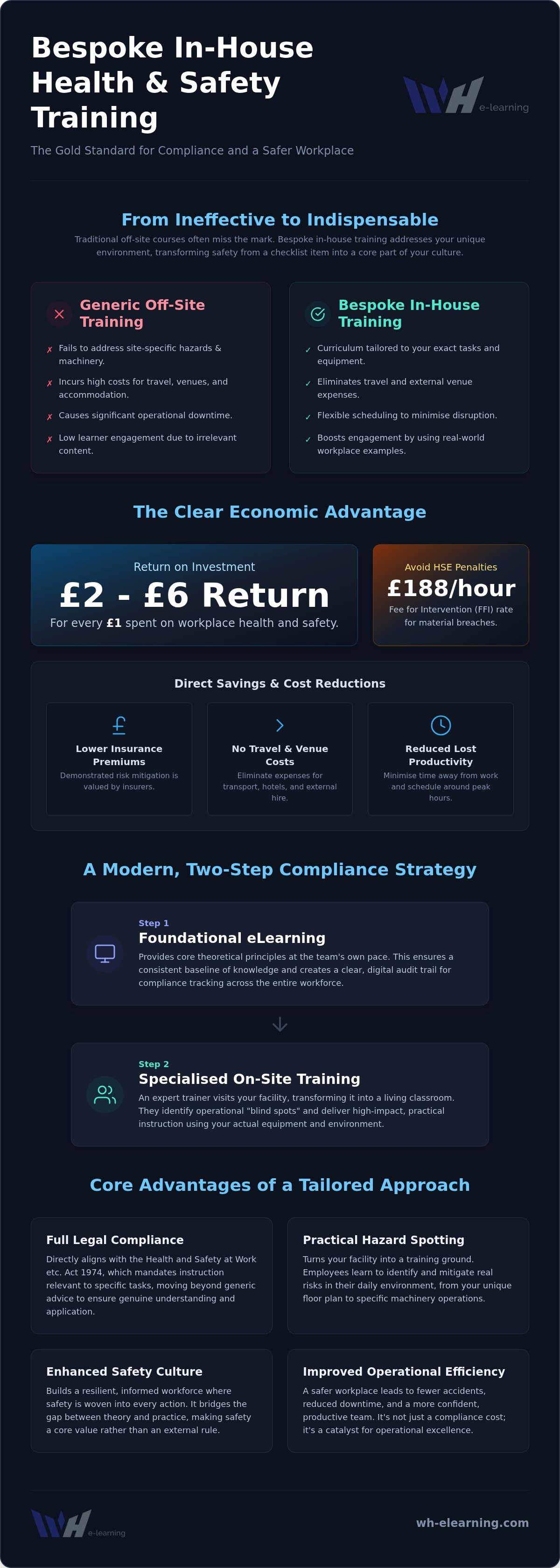
In-house health and safety training is the strategic delivery of bespoke, accredited instruction within your own facility. Rather than sending staff to a generic training centre, you bring industry expertise directly to your site. This approach ensures every module aligns perfectly with the Health and Safety at Work etc. Act 1974. Under this legislation, employers have a legal duty to provide information and instruction that's genuinely relevant to the tasks being performed. A generic course might cover the basics, but it won't address the specific hazards of your unique floor plan or machinery.
This commitment to Occupational safety and health isn't just about avoiding the HSE's Fee for Intervention (FFI) rates, which have risen to £188 per hour in 2026. It's about building a resilient, informed workforce. Generic off-site courses often fail because they lack context. When a specialist trainer visits your premises, they identify "blind spots" that an external instructor would never see. They observe how your team actually moves, how they interact with specific equipment, and where the real risks lie in your daily operations.
Customisation vs Standardisation
Bespoke content significantly increases learner engagement. When staff see familiar workplace examples, like the specific forklift in Bay 4 or the exact chemical storage protocols you use, the information sticks. You can adapt the curriculum to cover your specific machinery, hazardous substances, or layout-related risks. There's also a powerful psychological benefit to training in the actual environment where the work occurs. It bridges the gap between theory and practice, making safety feel like a core part of the job rather than an external requirement. It's about creating a culture where safety is woven into every action.
The Blended Learning Advantage
A modern compliance strategy often starts with business compliance e-learning to provide the theoretical foundations. This allows your team to understand the core principles at their own pace before moving into specialised on-site sessions. Digital tracking ensures no employee misses their specialised training, providing a clear audit trail for regulators. By combining the scalability of online modules with the high-touch expertise of face-to-face sessions, you create a robust safety framework. This dual approach ensures that even as your workforce grows, your safety standards remain unshakeable and fully documented.
The Economic Case: ROI of On-Site Safety Programmes
Investing in safety isn't merely a regulatory hurdle. It's a high-yield financial strategy. Research from 2026 suggests that for every £1 spent on workplace health, organisations can expect a return between £2 and £6 in avoided costs. When you choose in-house health and safety training, you immediately reclaim the budget usually lost to external venue hire, delegate hotel stays, and transport expenses. These direct savings are just the beginning of the economic advantage.
Scheduling plays a vital role in protecting your bottom line. Traditional external courses often require staff to be away for full days, regardless of your production peaks. On-site programmes allow you to organise sessions around your quietest hours, ensuring that essential safety education doesn't throttle your output. This level of flexibility is often missing from standard OSHA training requirements or basic certification routes. Beyond day-to-day operations, demonstrated site-specific risk mitigation can lead to lower insurance premiums, as insurers recognise the reduced likelihood of claims.
Calculating the Cost Per Head
Evaluating the true expense of training requires looking beyond the initial invoice. Sending a large team to an external centre involves significant hidden costs, such as mileage claims and lost productivity during travel time. In contrast, hiring a specialist for a day rate is often far more economical for groups. This scalability makes on-site delivery increasingly profitable as your organisation grows. You pay for the expertise once, rather than paying an individual enrolment fee for every new hire. If you are looking to streamline this process, accredited face-to-face training provides a cost-effective way to scale your safety standards.
Impact on Safety Culture and Accident Rates
The correlation between tailored instruction and a reduction in RIDDOR incidents is well-documented. When training is site-specific, employees are more likely to report near-misses because they understand the direct relevance to their own workspace. This proactive behaviour prevents the average £10,400 cost associated with a non-fatal workplace injury. Investing in a robust safety culture also improves employee retention, as staff feel valued and protected in their environment. Robust safety training serves as a primary defence against the catastrophic financial and reputational damage of workplace litigation.
Tailoring the Curriculum: Beyond Generic Safety Lectures
Effective in-house health and safety training moves beyond the standard slideshow. It integrates your organisation’s specific safety policies and procedures directly into the learning experience. Instead of abstract scenarios, your team engages with the actual risks they face daily. This approach transforms your facility into a living classroom where hazard-spotting exercises happen on the shop floor or in the warehouse. By using real-world examples, you ensure that every staff member understands how to apply safety protocols to their specific environment. It's about making sure your programme aligns with the highest workplace compliance training standards for 2026.
Establishing a strong foundation is vital for any business. Courses like IOSH Working Safely provide an entry-level qualification that ensures all staff share a common language of safety. When this is delivered on-site, the principles of risk assessment and hazard identification become immediately tangible. Staff don't just learn about hazards; they see them in their own workspace. This practical application bridges the gap between theoretical knowledge and daily habits, creating a safer environment for everyone involved.
Specialist-Led Practical Sessions
Industry-specific trainers bring deep expertise from sectors like manufacturing, construction, or healthcare. They don't just talk; they demonstrate. They use your company’s own safety equipment and PPE to show the correct way to handle specific machinery or hazardous substances. This hands-on interaction allows for real-time feedback. If a team member has a dilemma about a specific site hazard, the trainer can solve it there and then. This level of interaction is impossible in a generic off-site session and ensures that the training is 100% relevant to your site's unique layout.
Addressing Diverse Workforce Needs
Modern workforces are multicultural, and clear communication is a legal necessity. You can utilise multi-language e-learning courses to provide the theoretical groundwork in over 25 languages before the specialist arrives. In-house trainers then adapt their delivery style for different literacy or experience levels during face-to-face sessions. This ensures safety messaging is inclusive and understood by everyone, regardless of their background. It's a supportive way to build a unified safety culture across global or diverse organisations without leaving anyone behind.
Case Study: Transforming Safety Culture at a UK Manufacturing Hub
A mid-sized manufacturing hub in the Midlands faced a common dilemma. Despite having a digital training library, incident rates remained stubbornly high. Staff viewed the online-only modules as a "tick-box" exercise rather than a life-saving tool, and engagement was at an all-time low. To address this, the leadership team shifted their strategy toward a blended model of in-house health and safety training. They combined digital foundations with specialist-led sessions delivered directly on the factory floor to make the learning feel immediate and personal.
Logistics often hinder training in 24/7 environments. The hub overcame this by scheduling the specialist-led sessions across three distinct shifts. This tailored in-house health and safety training ensured 100% attendance without halting production or forcing night-shift workers to attend during their rest hours. By bringing the classroom to the workers, the company demonstrated a genuine investment in their well-being. The results were undeniable. Within twelve months, the facility recorded a 40% reduction in minor injuries and a marked improvement in staff safety morale.
Identifying Site-Specific Hazards
During the initial walk-through, the industry specialist identified a critical, overlooked risk in the loading bay involving blind spots during reversing. The training material was modified on the spot to focus on specific forklift safety issues relevant to that exact layout. Senior management also participated in these sessions. Their presence sent a powerful message that safety is a shared priority. This visibility helped break down the "them and us" mentality that often sabotages safety initiatives in large industrial settings.
Measurable Outcomes and Compliance Tracking
The organisation utilised the WH eLearning platform to track post-training assessments and monitor long-term progress. This data-driven approach allowed them to see exactly where knowledge gaps remained. Central to this was understanding the distinction between IOSH Managing Safely vs Working Safely. By putting supervisors through the management course and the general workforce through Working Safely, roles and responsibilities became crystal clear. Staff reported a strong preference for the on-site specialist, noting that the ability to ask questions about their specific machines made the training far more memorable.
Ready to see similar results in your facility? You can book your specialist-led in-house training today to start your culture transformation.
Organising Your In-House Training with WH eLearning
Our four-step process for in-house health and safety training begins with a comprehensive consultation to identify your specific industry risks and compliance gaps. We don't believe in a one-size-fits-all approach; instead, we look at your site's unique operational challenges. Following this, we move to the selection phase, where we match your needs with accredited courses and industry-specialist trainers who have hands-on experience in your sector. The third stage is bespoke curriculum design. Here, we incorporate your specific internal safety protocols and machinery manuals into the training sessions to ensure total relevance. Finally, we manage the on-site delivery and digital integration, using our administrative features to track employee progress and ensure unshakeable compliance records for the years ahead.
Why Choose WH eLearning Specialists?
Choosing our specialists means gaining access to a network of highly qualified industry experts located across the UK. These trainers don't just read from a script; they bring years of practical knowledge to your shop floor or office. We provide a seamless integration between high-touch face-to-face sessions and our vast online library of over 100 video-based courses. This blended approach is particularly effective for diverse teams, as we offer support for multi-language workforces with translated materials and captions in 25+ languages. By removing language barriers, you foster a truly inclusive safety culture where every worker, regardless of their native tongue, understands their role in maintaining a safe environment.
Next Steps for Your Organisation
Taking the next step towards a safer workplace is simple and efficient. You can request a site-specific training quote tailored to your headcount and industry requirements. For many businesses, the most effective strategy involves combining bulk licensing for our digital compliance courses with focused specialist on-site days. This allows you to cover the theoretical foundations at scale whilst dedicating face-to-face time to the most complex or high-risk aspects of your operation. This strategic combination ensures your team remains compliant with the latest 2026 standards whilst keeping training costs manageable.
Enquire about bespoke in-house training today to begin your journey toward a more resilient and safety-conscious organisation. Our team is ready to help you design a programme that protects your most valuable assets and meets your legal obligations with quiet confidence.
Elevating Your Workplace Standards for 2026
Transitioning to a bespoke safety model is more than a compliance necessity; it’s a strategic investment in your people and your productivity. By choosing in-house health and safety training, you eliminate the friction of generic courses and replace it with site-specific expertise that resonates with your team. This approach reduces incident rates whilst fostering a culture where safety is a shared priority rather than a secondary thought. It turns legal requirements into a catalyst for professional growth and operational excellence.
As an accredited IOSH training provider, we offer access to specialist trainers with decades of industry experience. Our integrated learning platform ensures comprehensive tracking of every delegate, making compliance audits simple and stress-free. Whether you're managing a single site or a diverse global workforce, our blended solutions provide the scalability and depth you need to succeed. Take the first step toward a safer, more efficient future for your organisation today.
Ready to transform your safety culture? Book a Specialist In-House Training Consultation to discover how we can tailor a programme to your unique operational needs. We're here to support your growth and help you meet the highest professional standards with quiet confidence and ease.
Frequently Asked Questions
What are the main benefits of in-house health and safety training over external courses?
In-house health and safety training offers superior context by using your actual workplace as the primary learning environment. Unlike external courses, your team practices hazard identification on the very machinery they use daily. This approach builds a unified safety culture because employees learn together in their own setting. You also avoid the logistical headache of coordinating travel and accommodation for multiple staff members, making the entire process more efficient for your management team.
How many employees do I need to make in-house training cost-effective?
Typically, on-site sessions become financially advantageous for groups of six or more delegates. When you factor in the elimination of travel expenses and external venue hire, the day rate for an industry specialist provides a better return. It’s a scalable solution that grows with your organisation. You pay for the expert’s time rather than high per-head fees, allowing you to train more staff for the same total budget.
Can in-house health and safety training be accredited by IOSH or NEBOSH?
Yes, on-site sessions can be fully accredited by recognised bodies such as IOSH. WH eLearning is an accredited provider, meaning courses like IOSH Managing Safely and Working Safely meet identical standards whether delivered online or face-to-face. This ensures your team receives recognised certifications that satisfy both legal requirements and insurance standards. It provides the perfect balance of official accreditation and site-specific practical application for your workforce.
How long does a typical in-house safety training session last?
The length of a session depends on the specific curriculum you choose. For instance, a basic awareness course might only require a few hours, whereas IOSH Working Safely typically lasts one full day. More intensive management-level courses can span three days. We specialise in flexible delivery, meaning we can organise these sessions around your shift patterns to minimise operational downtime and ensure all staff can attend without disrupting your core business activities.
Do we need to provide special equipment for the trainer to use on-site?
You don't need to provide complex teaching equipment, but a quiet room with seating and a power supply is essential. We encourage you to have your standard PPE and specific machinery available for practical demonstrations. Using your own equipment allows the trainer to show staff how to apply safety protocols in their real-world environment. This hands-on approach is what makes on-site delivery so much more effective than learning in a generic training centre.
How do we track the progress of staff who have completed in-house training?
We provide a comprehensive digital platform to monitor and document every learner's journey. This system includes administrative features that track employee progress and store certification records in one central location. It’s an efficient way to manage compliance across a large workforce, ensuring you're always ready for an HSE inspection. You can quickly identify which team members need refresher training, making your long-term health and safety management far more proactive and organised.
Can in-house training be delivered in multiple languages for our diverse team?
Absolutely, we provide multi-language support to ensure your safety messaging is inclusive. Our platform offers machine translation into more than 25 languages, and our trainers can adapt their delivery for diverse teams. This is a critical feature for businesses with multicultural staff, as it ensures everyone understands the high-risk hazards on your site. Providing training in an employee's native tongue significantly improves engagement and reduces the risk of dangerous misunderstandings on the shop floor.
Is in-house training suitable for small businesses or just large corporations?
In-house training is beneficial for businesses of all sizes. Small businesses often find it easier to keep their team on-site rather than losing them to a day of travel. Large corporations use it to ensure a consistent safety message across multiple departments or shifts. Whether you have ten employees or five hundred, the ability to customise the instruction to your specific risks makes it a more effective choice than generic, one-size-fits-all external courses.


