

What if compliance training felt less like a box to tick and more like useful guidance employees could apply at work? Workplace compliance e-learning for employees can support that shift, but only when the content fits each person’s role and is straightforward to complete.
It’s understandable to be unsure which topics different teams need. Busy staff may rush through generic modules, and a record of completions alone won’t show where understanding is missing. A clear plan helps make learning relevant, accessible and easier to follow up.
This practical guide explains how to identify role-based learning needs, choose formats that fit around work and make courses easier to access using features such as video, captions and language translation. You’ll also learn how to track participation, spot gaps and use results to shape future training. The aim is a considered approach that helps employees engage with the material and gives organisations a clearer view of learning progress.
Key Takeaways
- Build workplace compliance e-learning for employees around role responsibilities, existing policies and workplace learning needs.
- Choose relevant topics and realistic examples to help employees connect training with everyday decisions.
- Make online learning easier to follow with concise modules, clear language, captions, device access and language support.
- Explain the purpose of training, allow time to complete it and use progress and assessment results to identify where follow-up may help.
- Review and update learning regularly, combining online courses with practical face-to-face training where it supports the learning plan.
What workplace compliance e-learning for employees should achieve
Workplace compliance e-learning for employees is structured online learning that helps people understand the responsibilities and practices relevant to their work. Its purpose is practical: to build awareness and support safer, more consistent decisions on the job. In short, it is online learning that helps employees understand workplace responsibilities and apply them in everyday decisions.
Training works best as part of a wider system. Clear policies explain expected behaviour, while managers provide guidance and supervision. A course can reinforce both, but it can’t replace them or guarantee that every employee will act correctly. As the overview of Compliance training describes, organisations use different methods, including web-based learning, to address workplace rules and responsibilities.
Completion records show that a learner finished a course. They don’t, on their own, show that the person understood the material or can apply it. Assessment results provide another useful signal; managers may then need to clarify a topic or arrange practical follow-up. The aim is not simply to record participation, but to help learning carry through into everyday work.
Which workplace topics may call for employee training?
Training needs depend on roles, working arrangements and organisational context. Start by identifying employees’ actual responsibilities rather than assigning every topic to everyone.
- Health and safety: safe working practices, hazard awareness or DSE awareness for employees who use display screen equipment.
- HR: respectful workplace behaviour, communication and relevant people-management responsibilities.
- Data handling: appropriate handling of personal or sensitive information as part of an employee’s duties.
- Business conduct: understanding organisational expectations and acting responsibly in work-related situations.
These topics are starting points, not a universal checklist. A manager’s learning needs may differ from a new starter’s, just as office-based and operational roles may involve different situations.
Who benefits from a structured online approach?
Online learning can give employees a consistent starting point across different schedules and locations, while allowing organisations to assign topics by role. Video-based courses, access across devices, captions and language support can make learning easier to follow for a varied workforce. WH eLearning offers more than 100 workplace courses across compliance, HR and health and safety, with closed captions and machine translation into more than 25 languages.
For employers, a structured approach can make it easier to organise relevant learning and monitor participation. For a broader view of how training fits into organisational responsibilities, explore this workplace compliance strategy guide.
How to plan workplace compliance e-learning around employee needs
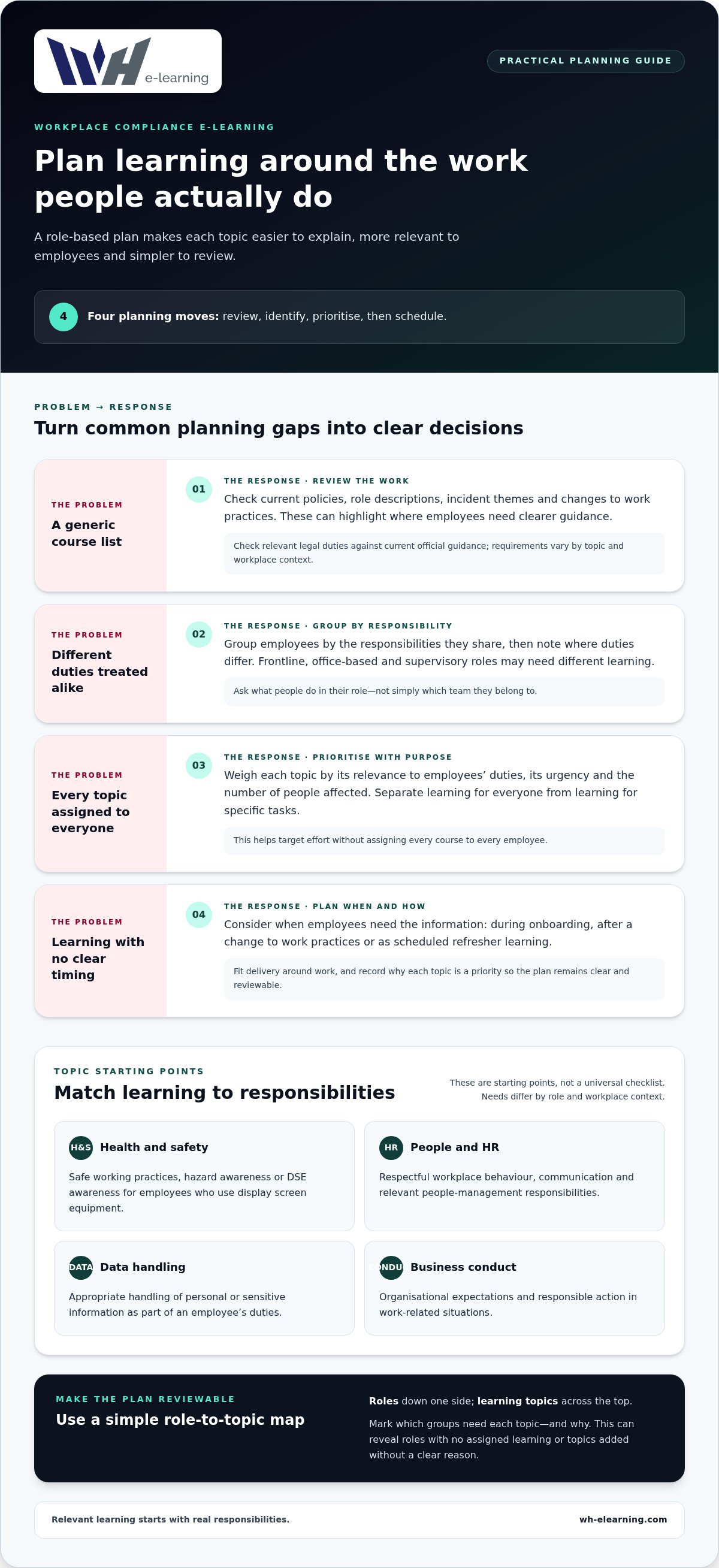
A useful learning plan starts with the work people actually do, not a generic list of courses. This keeps workplace compliance e-learning for employees relevant, avoids unnecessary assignments and gives managers a clear reason for each topic. Keep the process focused on training needs; detailed hazard identification and risk assessment are separate tasks.
- Review responsibilities and existing information. Look at current policies, role descriptions, incident themes and changes to work practices. These can show where employees need clearer guidance. Check relevant legal duties against current official guidance, as requirements vary by topic and workplace context.
- Identify roles and learning needs. Group employees by the responsibilities they share, then note where duties differ. Frontline staff may need learning linked to their work environment, office-based employees may need guidance relevant to their working practices, and supervisors may need additional content about overseeing others.
- Prioritise topics. Consider each topic’s relevance to employees’ duties, its urgency and the number of people affected. Separate learning that applies to everyone from training intended for specific tasks or responsibilities. This helps you target effort without assigning every course to every employee.
- Plan timing and delivery. Consider when employees need the information, such as during onboarding, after a change to work practices or as part of scheduled refresher learning. Decide how learning will fit around work and record the reason for each priority so the plan stays clear and reviewable.
Map topics to roles and responsibilities
A simple role-to-topic matrix can make decisions easier to explain. List roles down one side and learning topics across the top, then mark which groups need each topic and why. For example, a topic may be relevant to all staff, while additional learning may apply only to employees with a particular responsibility. This also makes it easier to spot where a role has no assigned learning or where the same topic has been added without a clear reason. For more health and safety learning context, see this occupational safety and health training reference guide.
Set priorities without overwhelming employees
Start with learning that is most relevant or time-sensitive, then schedule other topics in a manageable sequence. Add a short reason beside each decision, such as “required for this role” or “introduced following a work-practice change”. That record makes it easier to revisit priorities when responsibilities change or new concerns emerge.
Once priorities are clear, explore workplace compliance and health and safety courses as one way to support your learning plan.
How to make online compliance training accessible and relevant
Accessible training is easier to use and follow. For workplace compliance e-learning for employees, consider both how information is presented and whether it reflects the decisions people face in their roles. A course may be online yet still feel difficult if its language is dense, its examples seem removed from daily work or employees can’t readily access it on their devices.
Choose a format employees can use
Video-based lessons can divide information into manageable sections, helping employees work through a topic in stages. Closed captions give learners another way to follow spoken content, whether they need captions for access or find written text useful alongside audio. Check that staff can access learning on suitable devices, and consider shift patterns and work locations when setting time aside for completion.
Language support can also help a diverse workforce engage with course material. WH eLearning courses can be accessed across devices, include closed captions and offer machine translation into more than 25 languages. Translation alone doesn’t guarantee understanding. Use clear terminology, explain unfamiliar phrases and choose examples that make sense in the employee’s working context.
Make examples meaningful to the workplace
Employees are more likely to see the value of learning when scenarios reflect their work. A course for office-based staff, for example, might use situations they encounter at their desks, while a frontline example could focus on a decision made during a routine task. Keep scenarios realistic and connect them to the action an employee should take, rather than relying on abstract rules.
Use plain language instead of dense policy wording. If a technical term is necessary, explain it where it appears. Review course examples when work processes or responsibilities change. An outdated scenario can confuse learners or make important guidance feel disconnected from current practice.
- Break up information: use concise sections, clear headings and a straightforward learning sequence.
- Support different access needs: consider captions, suitable devices and language support.
- Make it relatable: use role-specific situations and explain unfamiliar terms plainly.
- Keep it current: revisit examples when workplace practices change.
For practical ideas on language options and adapting online learning for different employees, read this multi-language e-learning course guide. These choices make training more approachable while keeping the focus on the workplace behaviours it needs to support.
How to roll out employee e-learning and check learning progress
A clear rollout helps employees understand why a course matters and gives managers a practical way to follow up. For workplace compliance e-learning for employees, treat assignment and tracking as the start of the process, not the finish. Completion records show participation, but they can’t guarantee understanding or demonstrate that learning has changed workplace behaviour.
Use a straightforward sequence:
- Explain the purpose. Tell employees why the learning is relevant to their role and how it connects with workplace procedures.
- Assign relevant courses. Match learning to the responsibilities identified in your plan, rather than giving every employee the same set by default.
- Allow time to complete it. Set a clear timeframe that takes work schedules into account, and make it easy for staff to understand what they need to do.
- Monitor progress and follow up. Review participation and assessment results, then respond to outstanding learning or areas that may need clarification.
Track completion and identify learning gaps
Progress records help administrators see who has started or completed assigned learning and where follow-up may be needed. Assessment results add another perspective: if employees struggle with the same topic, revisit the relevant guidance or arrange further explanation. Use these signals to guide support, not as a measure of individual behaviour on their own. Organisational access with employee progress and compliance-status tracking can help coordinate this process. For further planning ideas, read this business compliance e-learning guide.
Reinforce learning after a course
Keep the conversation going. Managers can ask what employees would do in a relevant situation, point them to established procedures or use a brief reminder to bring a key idea into everyday work. These practical prompts connect course content with employees’ decisions. Review learner feedback and assessment patterns too, so future training can address unclear material and changing needs.
Follow-through helps prevent training from feeling like a tick-box task. A record can show that a course was completed; discussion and workplace reinforcement help managers explore whether its ideas are understood and usable. Treat results as one part of a broader approach that includes clear policies, appropriate supervision and ongoing review.
Explore workplace compliance courses with employee progress tracking to support a coordinated learning rollout.
How to put workplace compliance e-learning into practice
Make the learning plan a repeatable cycle: plan, assign, support, review and update. This keeps workplace compliance e-learning for employees connected to changing roles and workplace needs, rather than treating it as a one-off task. Online learning can be a practical option for distributed teams or employees working different schedules, giving staff a consistent course to access across devices. In-person sessions can complement it when employees need practical discussion or face-to-face guidance.
Start with a manageable first training cycle
Begin with one clearly defined employee group and a focused set of relevant topics. Explain why the learning matters, who needs to complete it and how it connects with workplace procedures. Set a realistic completion window that accounts for employees’ work commitments, then offer support if learners have questions.
Before expanding the programme, review participation, assessment results and employee feedback. Look for unfinished courses, recurring areas of difficulty and comments about unclear content. Use those findings to refine the next cycle. A small, well-reviewed start can help identify practical improvements before learning is assigned more widely.
Build a learning plan employees can keep using
As the plan develops, revisit it when responsibilities, processes or learning needs change. Decide which topics remain relevant, which need refreshing and whether a different format would help. Keep course records alongside other workplace measures, such as clear policies and appropriate supervision. Completion supports your records, but it doesn’t prove employees can apply the material or guarantee compliance.
WH eLearning offers individuals access to specific courses and organisations the option to arrange bulk course access. Its workplace courses are video-based, available across devices and include closed captions; machine translation into more than 25 languages can support access for employees who prefer another language. Organisational progress and compliance-status tracking can also help administrators coordinate assigned learning. These tools support a wider learning plan rather than replacing workplace procedures or follow-up.
Choose the next step that fits your team: define the first group, select relevant learning and set a review point. Then explore workplace training courses to find options for your employee learning plan.
Make your next learning cycle more relevant
Effective workplace compliance e-learning for employees starts with the work people do. Match topics to roles, make learning straightforward to access, then review participation and assessment results to decide where support or clarification may help. Completion records are useful, but they’re only one part of a wider approach that includes clear policies and ongoing guidance.
WH eLearning offers more than 100 online courses across workplace compliance, HR and health and safety. Video-based learning, closed captions and machine translation into more than 25 languages can support access for a varied workforce, while organisational access includes employee progress and compliance-status tracking.
Ready to build a practical learning plan for your team? Explore workplace training courses and find options that fit your employees’ learning needs. Start with a clear priority, learn from the results and keep improving your approach.
Frequently Asked Questions
What is workplace compliance e-learning for employees?
Workplace compliance e-learning for employees is structured online learning that helps staff understand workplace responsibilities and practices relevant to their roles. It can cover topics across health and safety, HR, data handling and business conduct. The aim is to build awareness and support sound decisions at work. Courses can reinforce policies and procedures, but they don’t replace clear organisational guidance, appropriate supervision or practical follow-up.
Is online compliance training suitable for all employees?
Online training can suit employees in different roles, locations and working patterns, but it may not meet every learning need on its own. Consider whether staff can access the course on suitable devices and whether its format and language are easy to follow. Some topics may benefit from discussion or practical face-to-face learning alongside online courses. Match the approach to employees’ responsibilities and the way they work.
How do employers decide which compliance courses employees need?
Start by reviewing role responsibilities, workplace policies, changes to work practices and relevant incident themes. Then identify which topics apply to everyone and which are needed only for particular duties. Prioritise learning by relevance and urgency, and check legal or regulatory requirements against current official guidance. Record why each topic is assigned, so managers can explain decisions and review them when roles or workplace needs change.
Can e-learning completion prove that employees are compliant?
No. A course completion record shows that an employee finished the assigned learning, but it doesn’t prove they understood it or can apply it in their work. Assessment results can offer another indication of understanding, while manager discussions and workplace observations may help identify where further clarification is useful. Treat training records as one source of evidence alongside policies, supervision and other appropriate organisational checks.
How can employers encourage employees to complete compliance e-learning?
Explain why each course matters to the employee’s role, assign relevant learning and allow a realistic period for completion. Make access straightforward and send clear reminders before the deadline. Managers can also connect course topics to workplace procedures and invite questions, helping learning feel useful rather than like a tick-box task. Reviewing employee feedback can highlight barriers, such as unclear material or difficulty fitting training around work.
Can employees access compliance e-learning in different languages?
Yes, some online courses include language support. WH eLearning provides machine translation into more than 25 languages, alongside video-based learning, closed captions and access across different devices. Translation can help make course content more accessible, but it doesn’t guarantee understanding. Use clear terminology and examples that fit employees’ work, and offer an opportunity to raise questions about material they find unfamiliar or unclear.
What should employers track beyond course completion?
Alongside completion, review assessment results, outstanding learning and employee feedback. These can help show whether a topic needs clearer explanation, additional support or a place in future training. Consider whether employees can connect course ideas with relevant workplace procedures through manager conversations or practical prompts. Organisational progress and compliance-status tracking can help administrators coordinate learning, but records alone can’t guarantee understanding or compliant behaviour.


