

A routine workplace decision can affect your organisation’s environmental impact. Environmental awareness e-learning helps employees connect shared knowledge with everyday choices, from using resources thoughtfully to handling waste correctly. For that learning to be useful, it needs to relate to the tasks people actually do.
Environmental responsibilities can seem abstract, particularly when staff work in different roles, locations or patterns. A course may introduce important ideas, but learners still need to understand how those ideas apply to their own decisions. Completing a module also doesn’t automatically show whether someone understood it or will use what they’ve learned.
This guide explains what effective environmental awareness training can cover and how to make it practical across your workplace. You’ll learn how to link topics to role-specific activities, choose accessible ways to deliver learning and check understanding through assessments and follow-up. A clear approach can support better-informed decisions and make progress easier to track.
Key Takeaways
- Distinguish everyday environmental awareness from specialist environmental management training, then set learning goals that fit your workplace.
- Choose topics such as resource use, waste prevention, pollution awareness and responsible purchasing according to your organisation’s activities.
- Make environmental awareness e-learning easier to apply with focused sections built around clear workplace outcomes.
- Use completion records, knowledge checks and manager-led discussions to review progress and reinforce learning over time.
- Explore how WH eLearning’s library of more than 100 video-based workplace courses can support wider business compliance, HR and health and safety learning programmes.
What environmental awareness e-learning means in the workplace
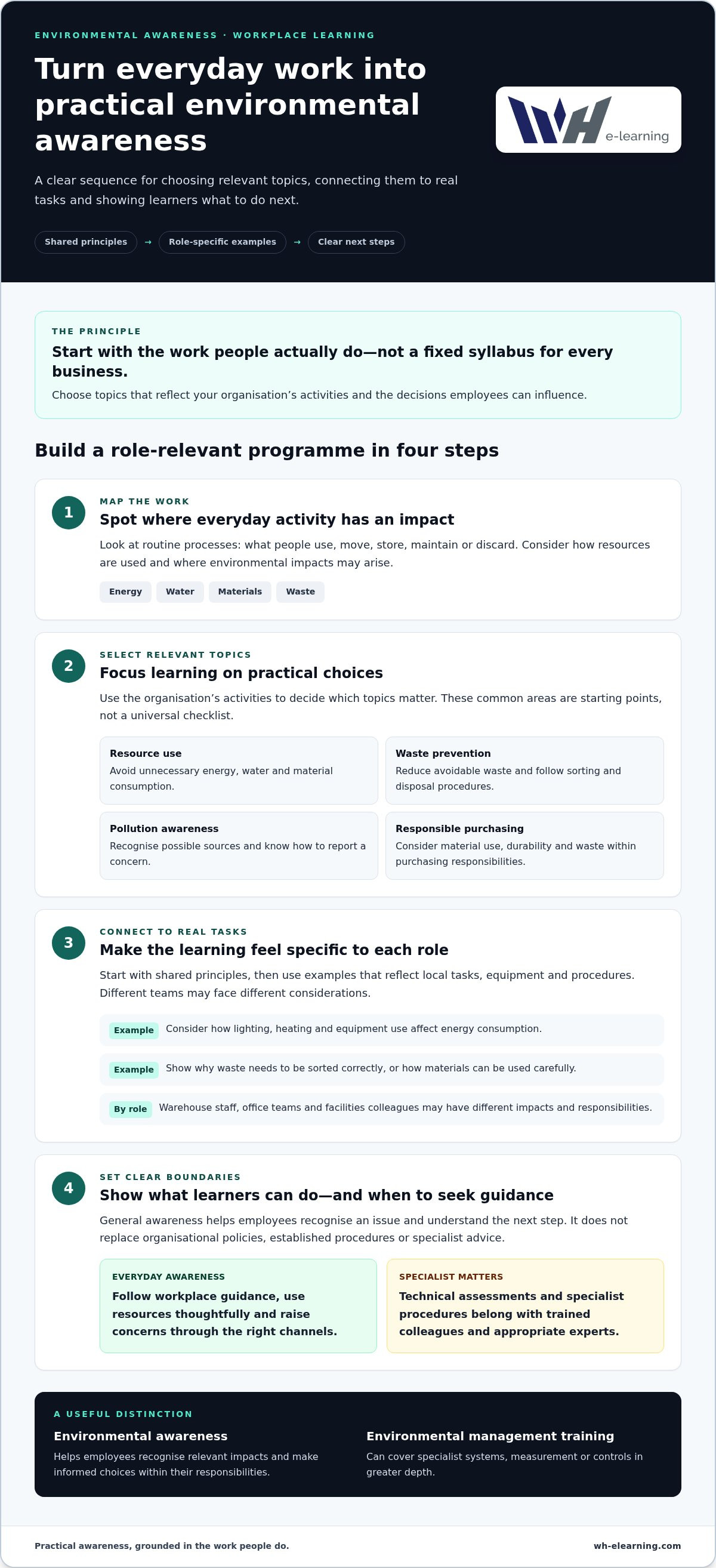
Environmental awareness learning gives people a practical understanding of how everyday work can affect the environment. It differs from technical environmental management training, which may cover specialist systems, measurement or controls in greater depth. A general programme helps employees notice relevant impacts and make informed choices within their responsibilities. It also gives teams shared language for discussing environmental considerations at work.
Environmental awareness e-learning is online learning that helps employees connect environmental knowledge with the routine decisions and tasks that shape their workplace’s impact. For example, learners might consider how lighting, heating and equipment use affect energy consumption, or why waste needs to be sorted correctly. In a purchasing role, they could think about using materials efficiently and following workplace procedures. Examples should reflect what people actually do, rather than present broad concepts without a clear workplace connection.
Learning can support action, but it doesn’t replace organisational policies, established procedures or specialist advice. A course can help someone recognise an issue and understand the next step, such as following a waste-handling process or raising a concern with a manager. It shouldn’t ask staff to make technical assessments outside their expertise. Clear boundaries show learners what they can do themselves and when to follow internal guidance or seek specialist input.
The wider field of Environmental education brings together knowledge, awareness and practical ways to respond to environmental issues. At work, that foundation becomes more useful when learning is shaped around the organisation’s activities. It turns a general subject into a clearer understanding of where everyday behaviour can make a difference.
What should environmental awareness training help learners understand?
Useful training introduces impacts employees can recognise, such as energy use, waste, material consumption and, where relevant, pollution risks. It connects those topics to real tasks: switching off equipment when appropriate, avoiding unnecessary printing, using materials carefully or following site procedures for spills. Shared awareness gives everyone a common starting point, while role-specific responsibilities clarify what particular teams need to do. Specialist questions remain with trained colleagues.
Who can benefit from environmental awareness e-learning?
Employees can learn how routine choices fit into workplace expectations. Line managers can reinforce those expectations in team conversations; facilities teams can connect them to building operations; and training coordinators can organise learning across groups. Online access can help people at different sites or on different shifts take part without bringing everyone together at the same time. Examples should still reflect local tasks, equipment and procedures so the learning feels relevant.
This flexibility is most useful when it supports a consistent message without implying every role has the same impact. Warehouse staff, office teams and facilities colleagues may face different environmental considerations within one organisation. Start with shared principles, then explain how they relate to each team’s working context. This gives learners a practical point of reference while keeping specialist decisions with the people responsible for them.
Which environmental topics belong in an e-learning programme?
A useful programme starts with the work your organisation carries out, not a fixed syllabus for every business. The right topics depend on how resources are used, what materials move through the workplace and where environmental impacts may arise. Course topics should reflect an organisation’s material environmental impacts and the decisions employees can influence. This keeps learning focused on relevant actions instead of a broad list of issues with little connection to people’s roles.
One organisation may prioritise energy and water use across a site. Another may focus on materials, packaging, transport or waste handling. Consider which areas matter to your operations and where staff can make practical changes. Common topic areas include:
- Resource use: avoiding unnecessary energy, water and material consumption through everyday choices.
- Waste prevention: reducing avoidable waste and following the organisation’s procedures for sorting and disposal.
- Pollution awareness: recognising potential sources of pollution and knowing how to report a concern or follow site guidance.
- Responsible purchasing: considering material use, durability and waste implications within an employee’s purchasing responsibilities.
These are starting points, not a universal checklist. Keep general awareness distinct from specialist instruction. A course may explain why pollution prevention matters and how to raise a concern, while technical procedures or regulated duties need accurate, role-specific guidance from the appropriate experts. Don’t present an illustrative topic as a legal requirement unless the applicable rules have been checked.
How can organisations identify relevant learning priorities?
Map routine processes to environmental impacts: what people use, move, store, maintain or discard. Compare that picture with internal policies, operational feedback and suitable risk or impact reviews. Ask managers and employees where confusion or repeated problems occur. Together, these sources can clarify which points belong in shared awareness training, which need team-specific examples and which require specialist instruction.
How can examples make environmental concepts more memorable?
Build short scenarios around decisions learners could genuinely face. For example, ask what an employee should do if a labelled waste container is unavailable, or how a team should respond to a suspected leak under its site procedure. Let learners choose a response, then explain the likely consequence and the correct reporting route. The National Environmental Education Foundation offers environmental education resources that can inform learning design, but workplace scenarios should be grounded in your own procedures.
Check every example for accuracy before it reaches learners. A realistic scenario identifies the role, gives enough context to make a decision and avoids implying that one action suits every site. Apply the same principle to environmental awareness e-learning: adapt the content to the organisation’s activities, then give learners a clear next step. Teams planning wider learning can also explore workplace training courses as part of their training programme.
How to design environmental awareness e-learning people can apply
Effective environmental awareness e-learning starts with workplace decisions, not a collection of facts. Work backwards from the actions learners should be able to take, then build concise content and realistic checks around those outcomes. This makes the learning easier to follow and gives coordinators clearer evidence than a completion record alone.
Use this process to shape a practical programme:
- 1. Define outcomes. Describe what learners should recognise, explain or decide after training. For example, they might identify the correct next step when a workplace procedure flags a potential environmental concern.
- 2. Identify the audience. Note where roles share expectations and where tasks differ. A general introduction can establish common principles, while examples reflect the work of specific teams.
- 3. Select and sequence content. Start with essential concepts, then move to relevant workplace situations. Keep each section focused on one main idea, use plain language and avoid unnecessary detail.
- 4. Build in decisions. Present realistic scenarios and ask learners to choose a response. Explain why it fits the situation and what could happen if a different action is taken.
- 5. Review evidence. Check knowledge-check responses as well as completion. Look for patterns in incorrect answers to identify concepts that may need clearer explanations or further discussion.
How should learning objectives and content be structured?
Write observable objectives rather than broad aims such as “understand the environment”. Be specific about what a learner should recognise, explain or decide. Arrange material from a core concept to a workplace example, and avoid introducing several new ideas in one section. Captions, clear visuals and accessible language can support different learning needs. They should clarify the message, not carry essential meaning on their own.
For example, a section might introduce a relevant workplace procedure, then show a brief scenario in which a learner chooses what to do next. The US EPA Environmental Education describes environmental education as supporting exploration, problem-solving and action. That progression is useful in workplace learning too: explain the issue, invite a considered choice and make the practical next step clear.
How can e-learning check understanding without overloading learners?
Place a brief knowledge check after a key concept instead of saving every question for a final quiz. A scenario question can ask learners to select an appropriate response, then explain the reasoning in feedback. This helps learners correct misunderstandings as they go. Keep questions focused on the stated outcome, and distinguish completion data, which shows participation, from correct responses, which offer an indication of demonstrated understanding.
For a wider view of how structured learning supports workplace practice, the occupational safety and health training guide offers related context. Apply the same design discipline here: state the outcome, connect it to a relevant choice and review what learners’ answers reveal. This gives you a basis for refining content and deciding where managers may need to reinforce a topic.
How to introduce environmental awareness e-learning and assess progress
A considered rollout helps learners understand why training matters and gives managers a practical way to support it. Start by identifying who needs the learning, including differences in role, location and working pattern. Explain its purpose in workplace terms: what employees will learn, how it relates to their work and where to find relevant procedures. Assign the learning with clear access instructions and a realistic completion window, then review participation and results.
Keep communication straightforward. A short message from a manager can connect the course to current workplace priorities, while reminders can point staff towards a relevant procedure or reporting route. After completion, invite teams to discuss one useful takeaway and how it applies to their work. These conversations help make learning part of normal practice rather than a standalone online task.
How can learning be made accessible across a workforce?
Before launch, consider whether learners can access the course on suitable devices and fit it around their working patterns. Captions can help people who prefer or need text alongside spoken content. Machine translation may support learners with varied language needs, but it doesn’t guarantee that every phrase will be understood as intended. Check translated meaning for clarity, and give learners simple instructions for signing in, resuming a module or getting help with access.
For teams spread across locations or shifts, flexible online access can make it easier to organise learning without gathering everyone at once. WH eLearning courses are accessible across devices and include closed captions; machine translation is available in more than 25 languages. Organisations can also use administrative progress tracking to coordinate learning. Teams considering language access can explore multi-language e-learning courses as part of their planning.
What evidence can show whether training is useful?
Review several indicators separately rather than treating one figure as proof of success. Enrolment shows who was assigned learning; completion shows who finished it; assessment results offer evidence of responses to course questions; and learner feedback can reveal whether examples felt clear and relevant. None of these alone demonstrates that behaviour has changed.
Operational feedback adds context. Managers might note recurring questions in team discussions, while relevant workplace observations or measures can highlight areas for further attention. Compare these carefully: changes may have several causes, so avoid claiming that training alone produced an operational result. Use findings to refine examples, improve launch communications or identify where further learning is needed.
To make environmental awareness e-learning part of a coordinated staff development plan, explore WH eLearning’s workplace training options for flexible learning across teams.
How WH eLearning can support workplace learning programmes
Environmental awareness e-learning is most effective when its content, delivery and follow-up fit the organisation’s needs. WH eLearning supports workplace training across business compliance, HR and health and safety, with a library of more than 100 video-based courses. These options can sit within a broader staff learning programme and help training leads coordinate learning across roles and locations. Match any environmental learning objectives to your organisation’s own priorities and workplace procedures.
What can organisations expect from WH eLearning’s training approach?
Video-based courses can be accessed on different devices, giving learners flexibility in where they complete workplace training. Organisations can arrange individual enrolment or use corporate licensing for a wider staff programme. Closed captions and machine translation into more than 25 languages are available as accessibility supports. They can help learners engage with course material, but don’t guarantee comprehension. In-house face-to-face training delivered by industry specialists is another option for learning needs that benefit from direct, in-person delivery.
These features address practical coordination needs as well as access. Training leads can consider whether staff share suitable devices, whether different working patterns affect scheduling and whether captions or translated material could support learners. Corporate licensing and administrative progress tracking can help organisations coordinate enrolment and review participation. They don’t, by themselves, show that learners have understood or applied what they’ve studied, so pair progress information with knowledge checks, feedback or workplace follow-up.
How can teams take a practical next step?
Before assigning learning, training leads can set out three points: who needs it, what learners should take away and how the organisation will review progress. Clear objectives connect a course to a real workplace need. Agreeing review measures in advance also makes it easier to distinguish access and completion from evidence of understanding. Once learning is assigned, administrative tracking can help coordinators see participation and completion across the programme.
Keep the process supportive. Explain why the learning has been assigned, give straightforward access instructions and tell learners where to raise practical questions. Managers can reinforce relevant ideas through team discussions or reminders linked to workplace procedures. Review feedback and assessment information alongside participation records, then use what you learn to refine communications or identify areas for further development. This is more useful than treating a completed module as the only measure of progress.
If you’re planning a wider staff development programme, Explore WH eLearning courses and consider how flexible online learning, organisational options and other training formats could support your team’s learning needs.
Make your next learning step count
Choose one practical workplace objective to focus on first. It could be helping a team recognise an environmental concern, follow an existing procedure or make a more informed everyday choice. Agree how you’ll support that learning after the course, then use staff feedback and relevant observations to decide what to strengthen next.
This steady approach helps environmental awareness e-learning become part of how people think about their work, rather than a one-off task. Set a clear purpose, make learning relevant to the people taking it and leave room to improve as your organisation’s needs develop.
WH eLearning’s workplace training library includes courses across business compliance, HR and health and safety, with flexible online and organisational learning options. Explore WH eLearning courses to find learning that can support your wider staff development plans.
Start with a useful next step, and build from there. Practical progress is within reach.
Frequently Asked Questions
What is environmental awareness e-learning?
Environmental awareness e-learning is online learning that helps employees recognise how work-related choices can affect the environment. It can give staff a shared starting point, such as understanding why a workplace procedure exists or knowing where to find guidance. It isn’t a substitute for technical instruction when a role involves specialist environmental tasks. Its value lies in making relevant information easier to access and apply during everyday work.
Why is environmental awareness training important in the workplace?
It helps employees make better-informed choices and recognise when an environmental concern needs attention. For example, someone who understands a site’s reporting route may raise a concern promptly instead of assuming another person will handle it. Shared awareness can also help teams use workplace procedures more consistently. Training works best alongside clear organisational guidance, so people know what action is appropriate and who is responsible for specialist decisions.
Who should complete environmental awareness training?
Training is relevant to employees whose routine tasks can influence environmental impacts, but the right audience depends on the organisation’s activities. New starters may need an introduction to workplace expectations, while existing staff may benefit from learning tailored to changed tasks or procedures. Managers can also take part so they’re prepared to discuss the subject with their teams. Assign learning according to role and relevance, rather than assuming everyone needs identical content.
How do you make environmental e-learning engaging?
Give learners something active to do, not just information to read or watch. A short decision activity can ask them to choose between possible responses, then explain the reasoning behind the preferred option. Invite learners to submit questions or suggest situations they find unclear, and use that feedback when reviewing the material. Familiar language and a clear connection to workplace expectations help sustain interest without adding unnecessary complexity.
Can environmental awareness e-learning be completed on a mobile device?
WH eLearning courses can be accessed on any device. Before assigning a course, consider whether learners can read the text comfortably, hear audio or use captions, and complete activities on a smaller screen. If staff have limited access to suitable devices during work, plan how they can complete the learning using an available device. Clear joining instructions can prevent simple access issues from disrupting participation.
How can an organisation measure environmental awareness training effectiveness?
Look beyond whether learners finished the course. Review which questions are commonly answered incorrectly, then check whether the wording or explanation could be clearer. A follow-up conversation can test whether staff remember the correct reporting route or know where to find a relevant procedure. Compare findings across teams carefully, as different roles may face different situations. Use the evidence to decide what needs reinforcement, not to claim training caused an operational change.
How often should environmental awareness training be refreshed?
There isn’t one suitable refresh interval for every organisation. Review the learning when workplace activities, equipment, internal procedures or relevant guidance change, and when learner feedback reveals gaps. Organisations can also set a regular review point based on their own needs and policies. A brief refresher may be useful after a change, while a more substantial update may be needed if the content no longer reflects how work is done.


