

What if the most useful food hygiene training is the learning staff can apply on their very next shift? Choosing food hygiene training online UK can seem straightforward, until you need to match the right learning to each role, understand how assessment works and keep clear completion records.
A specific food hygiene certificate isn’t a legal requirement in itself, but food businesses must ensure staff are appropriately supervised, instructed or trained for their work. Online learning can fit around shifts, but it works best alongside workplace procedures and ongoing supervision.
This practical guide explains what food hygiene training covers, how to distinguish food-handler learning from management responsibilities, and what to look for in online assessment and completion records. You’ll also learn how to organise individual or team learning, track progress and put training into practice without disrupting day-to-day operations. The aim is to help you choose relevant learning for each person and make completion records part of a clear, workable approach to food safety.
Key Takeaways
- Match food hygiene learning to each person’s food-handling duties and level of responsibility.
- Use food hygiene training online UK to organise learning flexibly around shifts and workplace needs.
- Compare course content, assessment and completion evidence to find learning that suits each role.
- Pair course completion with workplace procedures and supervision to support safe, competent practice.
- For team learning, plan who needs training and use progress tracking to keep completions organised.
Food hygiene training online UK: who needs it and what does it cover?
Food hygiene training online UK is structured learning that helps people understand safe food handling and good hygiene at work. It can introduce core principles, build role-specific knowledge and give staff a shared foundation, whether they work in catering, retail, hospitality or community food provision.
Food hygiene learning teaches people how to handle food safely; a workplace food-safety system sets out the procedures, checks and responsibilities used to manage risks in a particular business. Training can support those procedures, but it doesn’t replace them or the instruction and supervision staff need to apply them correctly. For a broader overview of the principles behind global food safety standards, see the food safety reference.
What do food hygiene courses usually teach?
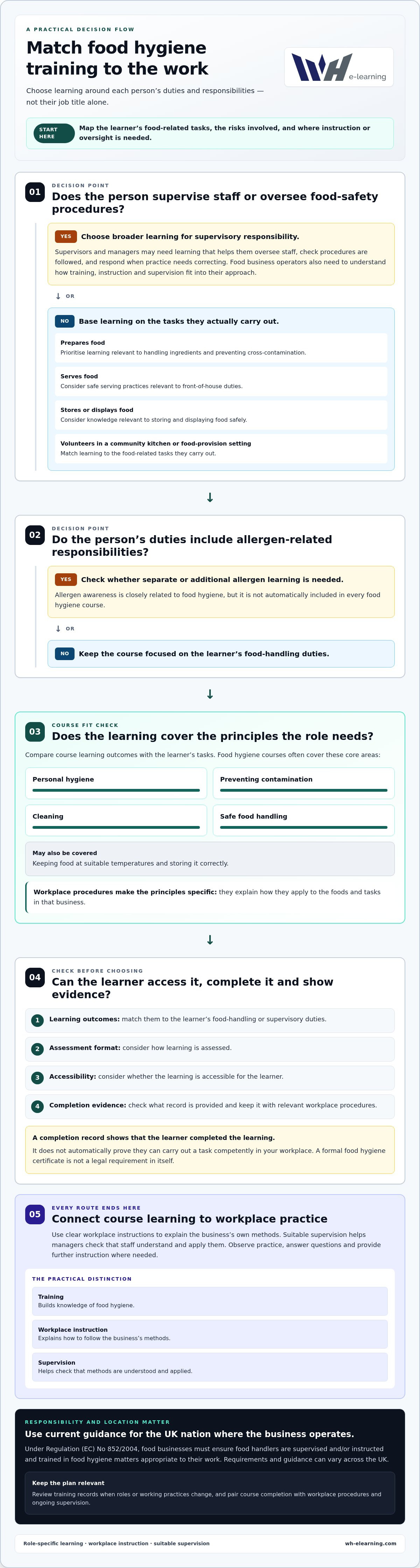
Course content often covers personal hygiene, preventing contamination, cleaning and safe food handling. It may also cover keeping food at suitable temperatures and storing it correctly. Workplace procedures explain how those principles apply to particular foods and tasks.
Allergen awareness is closely related, but it isn’t automatically included in every food hygiene course. Consider whether staff need separate or additional learning to carry out their allergen-related duties safely.
Who may benefit from online food hygiene learning?
Consider what each person does, not just their job title. Someone preparing meals needs learning relevant to handling ingredients and preventing cross-contamination. Front-of-house staff may need to understand safe serving practices, while retail workers may need knowledge about storing and displaying food. Community kitchens and other food-provision settings should consider the tasks volunteers carry out too.
Supervisors and managers may need broader learning because they oversee staff, check that procedures are followed and respond when practice needs correcting. Food business operators also need to understand how training, instruction and supervision fit into their approach to food hygiene. An entry-level food-handler course alone doesn’t show that someone can carry out every task competently in a specific workplace.
Start by mapping food-related duties, considering the risks involved and identifying where staff need instruction or oversight. Then choose learning that matches those needs and take account of current guidance for the relevant UK jurisdiction. The approach should be role-specific: people who prepare, serve, store or supervise food may need different learning, even when they work in the same business.
UK food hygiene responsibilities: how training supports safer practice
Completing a course is a useful step, but it doesn’t by itself show that someone can follow safe procedures in a particular kitchen, shop or service. Connect training with clear workplace instructions and suitable supervision, so staff can apply what they’ve learnt to the food, equipment and tasks they handle.
Food hygiene training is one part of workplace food-safety management, alongside suitable procedures, instruction and supervision. Under Regulation (EC) No 852/2004, food businesses must ensure food handlers are supervised and/or instructed and trained in food hygiene matters appropriate to their work. The practical plan depends on the operation and each person’s responsibilities.
How do food hygiene rules relate to training?
Training provides knowledge; workplace instruction explains how to follow the business’s own methods. Supervision helps managers check that these methods are understood and applied. For example, a course may explain why cleaning matters, while local procedures specify what needs cleaning, how often and who is responsible.
For England, the English food hygiene regulations form part of the relevant legal framework. Requirements and guidance can vary across the UK, so use current advice for the nation where you operate rather than assuming one set of arrangements applies everywhere.
Where do UK food-safety bodies fit in?
The Food Standards Agency (FSA) covers England, Wales and Northern Ireland, while Food Standards Scotland (FSS) is responsible for food safety in Scotland. Local authorities carry out food hygiene controls, with Environmental Health Officers involved in inspecting food businesses and assessing hygiene standards. The Food Hygiene Rating Scheme gives consumers public-facing information about a business’s hygiene standards; it is not a training course accreditation.
Course completion is evidence that a learner has completed that learning. It doesn’t automatically prove they can carry out a task competently in your workplace. Managers can build confidence by observing practice, answering questions and providing further instruction where needed. Keep training records alongside relevant workplace procedures, and review them when roles or working practices change.
For employers, flexible online workplace learning can help staff fit learning around operational schedules. Use it as part of a wider approach that links learning with day-to-day expectations, not as a replacement for workplace oversight.
How to choose online food hygiene training for your role
Start with the work the learner actually does. A suitable course should match their food-handling or supervisory duties, rather than relying on job title alone. Compare the learning outcomes with those tasks, then consider the assessment format, accessibility and evidence of completion. The UK government food safety training responsibilities guidance explains the expectation for appropriate staff training. A formal certificate isn’t the only way to assess whether learning meets workplace needs.
What training is suitable for food handlers and supervisors?
For staff who prepare, serve or store food, look for relevant foundations such as personal hygiene, contamination prevention, cleaning, safe handling and temperature control. Supervisors may need broader learning to help them oversee procedures, guide staff and recognise when practice needs attention. HACCP and allergen awareness can require additional or distinct learning, depending on the person’s responsibilities. There isn’t one course level or duration that suits every role.
Use this table as a starting point, then tailor learning and follow-through to your workplace:
| Learner role | Learning focus | Workplace follow-through | Record needed |
|---|---|---|---|
| Food handler | Safe handling, hygiene and contamination prevention | Show how procedures apply to their daily tasks | Completion evidence and any relevant instruction |
| Food server or store worker | Practices relevant to serving or storing food | Explain local handling and storage procedures | Completion evidence and role-specific guidance |
| Supervisor or manager | Oversight, procedures and relevant food-safety controls | Observe practice and guide staff where needed | Completion evidence and follow-up records |
How can you assess an online course’s suitability?
Check that the stated outcomes cover the learner’s duties and understand how assessment works. It might use questions, a final assessment or another format. Confirm what completion evidence is issued and how your organisation will record it. A completed assessment shows participation and learning; workplace instruction and observation help establish whether the person can apply that learning to your procedures.
Practical access matters too. Consider whether staff can view the material clearly on the devices available to them, and whether captions or language support would help them engage. WH eLearning provides video-based courses across workplace topics, accessible on different devices, with closed captions and machine translation features. These platform features aren’t a specification for every course. For wider workplace learning context, explore occupational safety and health training courses.
How to put online food hygiene training into practice at work
Make food hygiene training online UK part of a clear workplace routine, not a one-off task to tick off. Map who prepares, serves, stores or supervises food, then match learning to those duties and any gaps in staff knowledge. This avoids assigning identical training to everyone when responsibilities differ.
How can employers organise staff training?
Group staff by role and set a realistic completion window for each group. Stagger learning around shifts so essential duties remain covered, and check that learners can access a suitable device and follow the course content comfortably. If your training platform provides administrative progress tracking, use it to see who has started or completed learning and follow up where needed.
A simple sequence keeps the process manageable:
- Identify roles and relevant learning needs.
- Assign suitable online learning and plan time around shifts.
- Check device access and explain how staff can complete the training.
- Review progress and follow up with anyone who needs support.
Assign suitable learning, support completion, record progress and reinforce key practices at work.
What should happen after learners finish?
Use course learning as a starting point for workplace practice. Show staff how your site’s procedures apply to their tasks, demonstrate relevant processes and provide appropriate supervision. For example, a learner may complete training about safe food handling, then need instruction on the specific checks and routines used at your workplace.
Record completion and any relevant follow-up, such as additional instruction or practical support. A record helps you manage training, but a certificate or course result alone doesn’t prove someone can carry out every task competently. Managers should observe how procedures are followed and address questions or gaps as they arise.
Review records when someone changes role or takes on new responsibilities, and plan refreshers when workplace needs or guidance change. For wider context on building safe workplace practices, read about workplace safety training courses.
WH eLearning supports workplace learning with online courses, bulk training licences and administrative progress tracking for organisations. Explore flexible workplace learning with WH eLearning to see how online training can fit into your team’s development plans.
Choose flexible online workplace learning with WH eLearning
Good workplace learning needs to suit both the learner and the working day. WH eLearning provides more than 100 video-based online courses across workplace topics, giving individuals and organisations a flexible way to organise learning. When assessing food hygiene training online UK, focus on how the course content fits the learner’s duties and how you’ll reinforce that learning at work.
What makes flexible learning easier to manage?
Video-based learning lets staff work through course material around operational schedules, rather than requiring a whole team to gather at one time. Courses are accessible on different devices, which can help when learners don’t all have access to the same type of equipment.
Accessibility features can also help a diverse workforce engage with learning. WH eLearning’s online courses include closed captions and machine translation into more than 25 languages. These are platform features, not a guarantee that every feature or language option applies to every individual course. Consider what will help your staff follow the material, alongside the relevance of the learning itself.
Individuals can enrol, while organisations can use bulk training licences and administrative progress tracking. This gives employers a way to organise learning across a team and review progress, without treating course tracking as a substitute for workplace supervision. WH eLearning provides training, not standalone learning-management software.
How can organisations take the next step?
Before arranging learning, identify who needs it, what each person does and how team schedules affect access. Then decide how you’ll record completions and connect learning with site procedures, instruction and day-to-day practice. This keeps the focus on useful development, rather than simply assigning a course to every employee.
Online learning works best as one part of a wider workplace training plan. Managers can complement it with relevant instruction, demonstrations and supervision, then review progress to identify where staff may need further guidance. Individuals can apply the same principle: choose learning that relates to their responsibilities and consider how to put it into practice.
Explore WH eLearning’s online training options to find workplace learning that can support your organisation’s development plans.
Make food hygiene learning part of safer everyday practice
Choosing food hygiene training online UK is only the starting point. Match learning to each person’s duties, then support it with clear workplace procedures, suitable instruction and supervision. Course completion provides a record of learning, while observing staff at work helps managers identify where further guidance may be useful.
Flexible online learning can help individuals and teams fit training around work schedules. WH eLearning offers more than 100 video-based online courses across workplace topics, accessible on different devices. Platform features include closed captions and machine translation into more than 25 languages. Organisations can also use bulk training licences and administrative progress tracking to help manage team learning.
Build a practical plan around your staff’s roles, access needs and training records, then reinforce learning through everyday practice. Explore WH eLearning’s online training options and take the next step towards a confident, well-supported team.
Frequently Asked Questions
Is online food hygiene training recognised in the UK?
Online food hygiene training can help demonstrate that a person has received relevant learning, but the online format alone doesn’t determine whether it’s suitable for a particular role. UK law doesn’t require staff to hold one specific food hygiene certificate. Choose learning that matches staff duties and keep completion records alongside workplace instruction and supervision. A certificate records learning, but doesn’t by itself prove competence at work.
Can I complete food hygiene training online?
Yes, you can complete food hygiene training online, often working through digital learning materials and an assessment at your own pace. Food hygiene training online UK can be a practical option for individuals or teams fitting learning around work schedules. Before enrolling, consider whether the course content fits your duties, how assessment works and what evidence of completion is provided. You’ll still need to follow your workplace’s procedures.
Who needs food hygiene training?
Anyone whose work involves handling food may need suitable food hygiene instruction or training. This can include people who prepare, serve or store food, as well as staff in catering, hospitality, retail and community food settings. Supervisors and managers may need broader learning to oversee procedures and guide staff. Match training to each person’s tasks and responsibilities, then provide appropriate instruction and supervision in the workplace.
What does online food hygiene training cover?
Course content commonly covers personal hygiene, preventing contamination, cleaning and safe food handling. It may also address storage and temperature control. Compare the learning outcomes with the tasks the learner performs, as the exact scope varies. Allergen awareness is related but isn’t automatically included in every food hygiene course. Staff with allergen-related duties may need additional learning relevant to their responsibilities and workplace procedures.
How long does an online food hygiene course take?
Course duration varies by content, format and learner pace, so there isn’t one duration that applies to every online course. Check the course information before starting and plan a suitable completion window around work and shift patterns. Online learning can help staff study flexibly, but they still need enough time to engage with the material and complete any assessment the course includes.
Does a food hygiene certificate expire?
Food hygiene certificates don’t have a legal expiry date. However, training should remain relevant to the person’s work, and knowledge should be refreshed when needed. A three-year refresh cycle is a commonly cited industry recommendation, rather than a legal expiry rule; some providers suggest a shorter interval. Employers can review training records and workplace practice to decide when further learning or instruction is appropriate.
Is HACCP training the same as food hygiene training?
No. Food hygiene training covers safe handling and hygiene practices, while HACCP focuses on identifying and controlling food-safety hazards through procedures based on its principles. The topics are connected, but they aren’t interchangeable. Food businesses need suitable food-safety procedures, and staff learning should match their responsibilities within them. Supervisors or managers overseeing these procedures may need more detailed learning than staff with limited food-handling duties.


