

Choosing video-based training for employees UK organisations can use is about more than finding a polished video. The course needs to be accessible, easy to follow and realistic to complete around employees’ work. That can be challenging when roles, shifts and learning needs vary across a team.
This guide compares common training formats and explains how to choose a practical, trackable solution. It covers course relevance, device access, captions, language support and assessments, so you can judge whether a course will work for the people expected to take it.
You’ll also learn how progress tracking can help managers coordinate training, and when in-house face-to-face instruction can complement online learning. WH eLearning’s library of more than 100 video-based courses covers health and safety, HR and business compliance. Use the guidance below to find a suitable balance of flexible learning, assessment and practical support.
Key Takeaways
- Choose video-based training for employees UK teams can access across devices and working patterns, while matching courses to each role.
- Compare video, face-to-face and blended learning to balance flexibility, interaction and practical instruction.
- Review accessibility, learning checks and progress reporting before introducing a course across your organisation.
- Use a clear rollout plan to assign learning, set expectations and follow up on incomplete training.
- Explore how WH eLearning’s library of more than 100 courses can support workplace learning across health and safety, HR and business compliance.
What is video-based training for employees, and when does it fit UK workplaces?
Video-based employee training is structured learning delivered through video, often supported by course materials and an assessment to check understanding. It may be self-paced, allowing learners to work through content at a suitable time, or form part of a scheduled live virtual session. That differs from face-to-face instruction, where a trainer and learners meet in person. Video learning is one part of the wider field of Educational Technology, which uses technology to support teaching and learning.
Employers often consider digital courses when teams work across locations, follow varied shifts or need a consistent introduction to a topic. Learners can access course content on different devices, and a shared course can give employees the same core information. Convenience alone, however, doesn’t make a course suitable. The right format depends on the learning outcome, employees’ responsibilities and the amount of practice or feedback required.
Which employee learning needs can video training support?
Video courses can support learning in workplace compliance, health and safety, HR and business topics. They can introduce key concepts, explain procedures and reinforce shared expectations. This can be useful when employees need the same core learning but complete it at different times or locations.
Video may not be enough on its own for a practical skill. Employees may also need a demonstration, supervised practice or an assessment of how they apply the skill. Consider the risks involved and what employees must be able to do afterwards. Video can form one part of a broader programme, alongside face-to-face instruction or on-the-job learning.
What should a UK employer expect from a video course?
A typical learner journey starts with course access. The employee watches the video content, works through any supporting materials and completes an assessment where one is included. Features such as closed captions and language support can make learning more accessible. For video-based training that employees across your organisation can complete in different locations, check that the course format suits their devices and working routines.
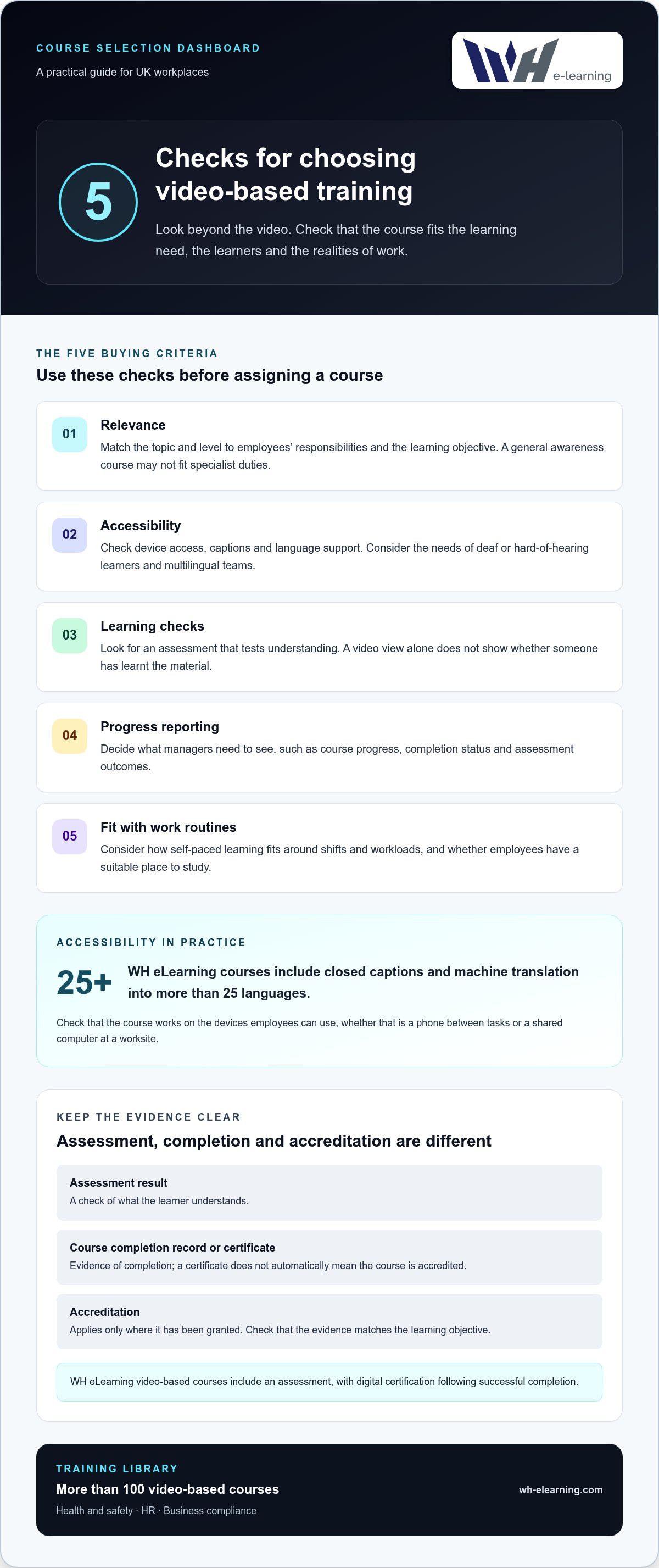
Look closely at what successful completion means. An assessment result, a course completion record and an accredited qualification are not interchangeable. Accreditation applies only where it has been granted, while a certificate may simply record successful completion. WH eLearning’s video-based courses include an assessment, with digital certification following successful completion. Confirm what evidence the course provides and whether it matches your learning objective.
How to assess video-based employee training: five buying criteria
Use a clear set of checks before assigning a course. A suitable course should address a real learning need and work for the people taking it, not merely offer an easy-to-play video. The House of Commons Library outlines the scale of the UK digital skills gap, underlining why training should build useful knowledge, not just record participation.
Check relevance, accessibility, learning checks, progress reporting and fit with work routines before selecting a course. Apply these five checks to each option:
- Relevance: Match the topic and level to employees’ responsibilities and the learning objective. A general awareness course may not suit someone with specialist duties.
- Accessibility: Consider whether employees can use the course on their available devices and whether captions or translated content would help.
- Learning checks: Look for an assessment that tests understanding. Video views alone don’t show whether someone has learnt the material.
- Progress reporting: Decide what managers need to see, such as course progress, completion status and assessment outcomes.
- Work routine fit: Consider how self-paced learning will fit around shifts and workloads, and whether employees have a suitable place to study.
Are the videos accessible and practical for your workforce?
Assess the learner experience against real working conditions. One employee may use a phone between tasks, while another relies on a shared computer at a worksite. Captions can support learners who are deaf or hard of hearing, and translated content may help multilingual teams engage with course material. Explore these considerations in our guide to multi-language e-learning courses. WH eLearning courses include closed captions and machine translation into more than 25 languages.
Can you assess learning and monitor completion?
A video being viewed doesn’t show whether an employee has understood or retained its key points. Assessments provide a clearer check of learning, while progress and completion records help managers see who has finished and where follow-up may be needed. Check the wording on any certificate, too: it should accurately describe the course and its requirements. WH eLearning provides digital certification following successful completion of a video-based assessment.
To compare video-based training courses against these criteria, start with the learning objective. Then consider how each course supports access, assessment and progress tracking.
Video training vs face-to-face and blended learning: which format fits?
Start with the learning outcome when choosing a format. Video courses can deliver shared information consistently, while face-to-face training allows direct discussion and demonstration. Blended learning combines the two, balancing flexible access with opportunities to practise and apply learning.
Use this comparison to decide which approach fits each training need:
| Format | Flexibility | Interaction | Consistency | Practical demonstration | Progress evidence |
|---|---|---|---|---|---|
| Video course | Often self-paced, which can suit varied schedules and locations. | Usually limited to the course materials and learning checks. | Can give learners the same core content. | Can explain or show a process, but may not let learners practise it. | Course records and assessment results can show progress and completion. |
| Face-to-face training | Requires learners and a trainer to attend a scheduled session. | Supports live discussion, questions and feedback. | A trainer can deliver shared learning, with discussion shaped by the group. | Can include demonstration and supervised practice where appropriate. | Evidence depends on how attendance and learning are recorded or assessed. |
| Blended delivery | Combines flexible digital learning with scheduled in-person elements. | Offers online learning alongside direct discussion and guidance. | Video can establish common knowledge before group sessions. | Face-to-face time can focus on practice and application. | Digital records can be supplemented by evidence from in-person learning. |
When does self-paced video training work well?
Self-paced video can deliver foundational learning to employees working across sites or on different schedules. A course assessment checks understanding after the content, while progress records help managers see who has completed it. Completion data alone, however, doesn’t prove that someone can apply a skill safely or competently at work.
When should video learning be combined with face-to-face support?
Choose a blended approach when employees need to practise a task, discuss role-specific situations or receive feedback on how they apply learning. For example, a video course could introduce safety principles before an in-house session explores how they apply to employees’ work. Explore workplace safety training courses as part of a broader learning plan.
Online courses can give employees across your organisation a shared foundation. Add face-to-face instruction where demonstration, discussion or observed practice is needed. The formats can work together rather than compete.
How to introduce video-based training across a UK employee team
A clear rollout helps employees understand what they need to learn, how to access it and what managers will review. Use course records to support follow-up, and keep assignments connected to employees’ actual work.
- Identify the learning need. Consider roles, responsibilities and relevant workplace risks. For compliance topics, connect the learning plan to your organisation’s duties and consult current HSE guidance to identify relevant training.
- Select suitable courses. Match the content and level to the learning objective. Decide whether video learning is appropriate on its own or should sit alongside practical instruction.
- Assign the right learners. Specify which employees need each course instead of assigning every topic to the whole team by default.
- Set expectations. Explain why the course matters, how learners can access it and what they need to do to complete its assessment.
- Review progress. Check course records at agreed points and follow up on incomplete learning or assessment results that need attention.
For wider programme planning, see these workplace compliance training strategies. A clear plan helps keep training relevant to staff needs instead of turning it into a one-off administrative task.
How can employers make training easier to complete?
Plan learning around shift patterns and workloads. Make sure employees have access to a suitable device and a reasonable opportunity to complete the course. Explain what the training is for and whether learners must pass an assessment. Captions can support access, while translated learning can help employees engage with course content in another language.
What should managers monitor after assigning courses?
Use available records to review enrolment, progress, completion and assessment outcomes. If someone hasn’t completed a course, a timely reminder or discussion may reveal a scheduling, access or support issue. WH eLearning bulk access includes employee progress and compliance-status tracking to help organisations coordinate follow-up.
These records show participation and learning checks, but don’t establish by themselves that an employee can apply a skill competently at work. Add observation or practical assessment where the learning objective requires it. Review course choices when roles, risks or workplace processes change, so assigned learning continues to reflect current needs.
Build your team’s programme with video-based workplace training courses and use course-progress records to keep assignments organised.
Choosing video-based employee training with WH eLearning
Connect course choice with employee needs: select relevant content, make learning accessible, check understanding and plan how to review progress. WH eLearning’s library includes more than 100 video-based online courses across business compliance, HR and health and safety, giving organisations options for different workplace learning objectives.
Learners can access courses on different devices, use closed captions and access machine translation into more than 25 languages. Video-based assessments provide a learning check, with digital certification following successful completion. For organisations training teams, bulk access includes employee progress and compliance-status tracking. These features support an organised programme without requiring every employee to learn in the same place or at the same time.
How can organisations match courses to employee roles?
Start with what each group needs to know or do. Consider employees’ responsibilities, the learning objective and the workplace topics relevant to their roles. Health and safety or compliance learning may fit a team’s plan, but course selection should reflect the organisation’s needs rather than assume one course suits everyone. For further context, explore this guide to occupational safety and health training.
Then consider how the course will work for its intended learners. Think about whether employees can access it on their devices, whether captions would help and whether machine translation could support understanding across a multilingual team. If the learning outcome involves practical demonstration or observed skill, plan additional instruction rather than relying on course completion alone.
What are the next steps for planning team training?
Before assigning courses, map out learner groups, suitable topics, accessibility needs and the progress information managers will use. Set clear expectations for course completion and assessment, then review records to identify unfinished learning or results that may need follow-up. This gives managers a practical way to coordinate learning while keeping course choices connected to employees’ roles.
Video learning can also sit alongside in-house face-to-face training. Use online courses to deliver shared knowledge, then add an in-person session where discussion or practical instruction will strengthen learning. Together, these options can help create a flexible programme for different employee needs.
Explore WH eLearning courses to find video-based training for employees UK organisations can use for individual or team learning.
Build a training plan that works for your team
Effective video-based training for employees UK organisations choose starts with a clear learning need. Match each course to employees’ roles, check that the format is accessible, and use assessments and progress records to support learning. Where employees need hands-on practice or direct discussion, combine video with face-to-face instruction rather than expecting one format to do everything.
WH eLearning offers more than 100 workplace courses across compliance, HR and health and safety. Organisations can use bulk access with employee progress and compliance-status tracking to coordinate team learning and follow up on incomplete courses.
Ready to find courses that fit your employees’ needs? Explore video-based courses for your team and take a confident next step towards organised, accessible workplace learning.
Frequently Asked Questions
Is video-based training effective for employees?
Yes, video-based training can be effective when the course matches the learner’s role and learning objective, and includes a useful way to check understanding. An assessment can show whether key points have been understood, while workplace discussion or practical observation can help employees apply them. Course completion is useful evidence of participation, but it shouldn’t be treated on its own as proof that someone can perform a task competently.
Can video-based training meet UK workplace compliance needs?
It can support compliance learning when the course content is relevant to employees’ responsibilities and your organisation’s training plan. Identify the topics and learning outcomes needed for different roles, then select suitable courses and decide how understanding will be checked. A video course alone won’t establish that every workplace requirement has been met. Keep training relevant to your organisation’s activities, risks and processes, and review it as these change.
How do employers track employee video training?
Employers can use course records to monitor enrolment, progress, completion and assessment outcomes where these are provided. Records help managers identify incomplete learning and plan reminders or support. WH eLearning’s bulk training access includes employee progress and compliance-status tracking, helping organisations coordinate team learning. Treat tracking as an administrative and learning aid, not a substitute for checking whether employees can apply knowledge or demonstrate practical skills at work.
Are video training courses accessible on mobile devices?
WH eLearning’s online courses can be accessed on different devices, which can help employees learn across varied working patterns and locations. Before assigning a course, consider whether employees have suitable devices and a workable place and time to study. Closed captions can support access for learners who are deaf or hard of hearing, while machine translation into more than 25 languages can assist multilingual teams.
Can video training replace face-to-face employee training?
Not in every situation. Video can deliver consistent course content and support self-paced learning, but may not provide the interaction, demonstration or supervised practice required for some learning outcomes. Use face-to-face instruction when employees need to practise a skill, discuss role-specific situations or receive direct feedback. A blended approach can pair online learning with in-house sessions, giving employees shared knowledge and practical support where needed.
Do employees receive a certificate after completing video training?
That depends on the course and its completion requirements. Check whether the certificate records attendance or successful assessment, and distinguish course certification from accreditation. WH eLearning provides digital certification after learners successfully complete the video-based assessment. The certificate relates to that course and its assessment, so employers should consider whether it provides the evidence their training plan requires. Completion records alone don’t demonstrate practical competence.
How should a UK business choose video-based training for employees?
Choosing video-based training for employees UK organisations can use starts with the learning objective and employees’ responsibilities. Compare courses for relevance, accessibility, assessment, progress reporting and fit with working routines. Consider device access, captions and language needs, then decide whether practical learning also requires face-to-face support. WH eLearning offers more than 100 workplace courses across compliance, HR and health and safety, with bulk access and progress tracking for organisations.


