

The most useful hospitality training plan isn’t the one with the longest course list. It’s the one that matches learning to each role and fits around service. Choosing hospitality staff training online can feel complicated when front-of-house, kitchen and supervisory teams have different needs, and staff work varied shifts.
Look for training that is practical, accessible and straightforward to manage. Start with the tasks and risks staff encounter in their day-to-day roles, then consider how they’ll access learning and how managers can monitor progress.
This guide explains how to compare course relevance, accessibility and delivery options, so you can build a manageable plan for frontline, customer-facing and supervisory staff. You’ll also find ways to make learning easier across devices, shifts and language needs. WH eLearning offers more than 100 online courses across workplace compliance, health and safety, HR and other business topics. Video-based courses, closed captions, machine translation into more than 25 languages and progress-tracking features can help organisations support learning across a team. Match each course to a specific workplace need to keep the plan relevant.
Key Takeaways
- Match courses to the tasks and learning needs of each hospitality role, rather than choosing by course title alone.
- Use hospitality staff training online to build role-relevant learning across frontline, kitchen, housekeeping and supervisory teams.
- Compare course outcomes, accessibility, assessment and progress visibility before assigning learning.
- Plan training around shift patterns and consider device access, captions and language needs to make participation easier.
- Start with a specific workplace need, then assign individual courses or organise team training and review staff progress.
Hospitality staff training online: what should it help your team do?
Hospitality staff training online is structured learning that employees access digitally to build knowledge and skills relevant to their work. It can help teams develop everyday service skills, learn about health and safety, complete workplace compliance training and understand organisation-specific procedures through induction.
These learning needs sit alongside the broader field of hospitality management studies, which covers formal academic learning. For workplace training, focus on helping each person understand the knowledge relevant to their role and how it connects with the way your organisation operates.
Which hospitality roles need different training priorities?
Front-of-house and other customer-facing staff may benefit from learning that supports guest communication, professionalism and customer understanding. Housekeeping and facilities teams may need to focus on safe handling, slips, trips and falls, or ladder awareness where these subjects relate to their tasks. Kitchen teams have distinct day-to-day responsibilities, so select learning that matches their work rather than assuming one general course covers every need.
Supervisors and managers may need additional learning in areas such as risk assessment, incident reporting and respectful workplace behaviour. The right mix depends on role, workplace risks and organisational procedures. A course can build useful knowledge, but it won’t by itself show that someone can apply it confidently in a real situation.
What can online staff training support?
Digital learning gives employees across different locations and roles access to consistent course content without requiring everyone to attend at the same time. That flexibility can help managers organise learning around varied shifts. Short, focused subjects also make it easier to stage training, prioritising immediate needs before adding further learning.
WH eLearning offers video-based courses across health and safety, workplace compliance, HR and other business topics. Staff can access courses on different devices, with closed captions and machine translation into more than 25 languages to support different access needs. When selecting a course, compare its stated learning outcomes with the team’s actual duties and the workplace need you want to address.
Course completion is evidence that a learner has completed the course and its assessment; workplace competence is the ability to apply the learning safely and effectively on the job. Online learning supports delivery, but it doesn’t replace local procedures, practical instruction or appropriate supervision. Managers can connect course learning to these workplace supports, then reinforce it through day-to-day guidance.
How to compare online hospitality staff training courses
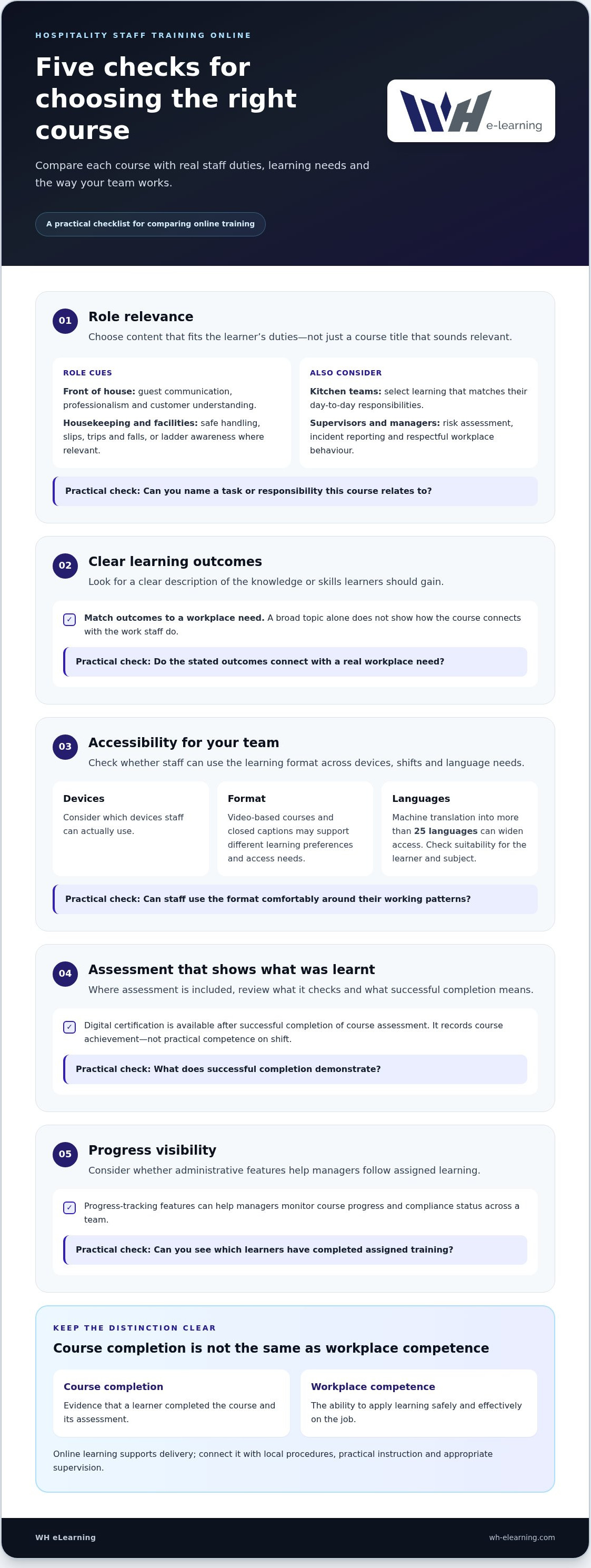
A course title can sound relevant without preparing someone for the work they actually do. When choosing hospitality staff training online, compare the stated outcomes with a real task or responsibility, then check whether staff can access the learning and whether managers can see completion.
| What to compare | What to look for | Practical check |
|---|---|---|
| Role relevance | Content suited to the learner’s duties, whether they work in guest services, housekeeping, the kitchen or supervision. | Can you name a task or responsibility the course relates to? |
| Learning outcomes | Clear descriptions of the knowledge or skills learners should gain. | Do the outcomes connect with a workplace need, rather than just a broad topic? |
| Accessibility | Device access, captions and language support that suit your team. | Can staff use the format comfortably across their working patterns? |
| Assessment | A clear way to check learning, where assessment is included. | What does successful completion demonstrate? |
| Progress visibility | Administrative features that help managers track course progress and compliance status. | Can you see which learners have completed assigned training? |
Which course features matter for a hospitality team?
Video-based learning may suit staff who prefer to watch and listen, while closed captions can support learners who benefit from reading along. Access across different devices can make it easier to fit learning around shifts, but consider which devices your team can use in practice. Machine translation into more than 25 languages can widen access. Check that the format and translated content work for the learners and subject involved.
Check the course’s stated outcomes before enrolling staff. A subject that sounds useful is not enough; look for a connection to a recognisable task. If assessment is included, review what it covers. Digital certification is available after successful completion of course assessment, but this records course achievement, not practical competence on shift.
How should managers judge relevance and accessibility?
Use a simple role-to-course matrix. List roles down one side and training needs across the top, then mark which needs are shared and which apply to specific groups. This helps avoid assigning every course to every employee. For broader safety-course selection, see the occupational safety and health training course guide.
For supervisors, compare focused courses with broader leadership learning. The Cornell Hospitality Leadership Certificate is an example of a programme centred on leadership skills for hospitality organisations. WH eLearning’s individual course access can help address specific learning needs. See the hospitality training options as part of your comparison.
Which online training subjects fit common hospitality needs?
Choose learning by the task or workplace need it relates to, not simply because a subject sounds relevant to hospitality. A housekeeper, kitchen worker and supervisor may share some safety priorities, but their day-to-day responsibilities differ. This table offers a starting point for matching hospitality staff training online to practical situations.
| Work situation | Learning subject | How it may be relevant |
|---|---|---|
| Moving supplies, linen or equipment | Manual Handling Training | Builds awareness of safe carrying and lifting in relation to workplace tasks. |
| An incident or near miss occurs | Accident Reporting Training | Supports understanding of how incidents are reported and why clear reporting can help identify recurring issues. |
| Wet floors, walkways or other trip hazards | Slips, Trips & Falls: Global (Best Practice) | Develops awareness of common slip, trip and fall risks across workplace settings. |
| Staff work together and interact with guests | Professionalism in the Workplace | Provides a learning opportunity focused on workplace behaviour and professional conduct. |
| Employees want to strengthen inclusive awareness | Disability Awareness & Inclusion Training | Introduces disability awareness and inclusion as a topic for employees at different levels. |
Which courses can support safer day-to-day work?
Manual handling learning is relevant where staff carry or lift items as part of their duties. Review the course outcomes to understand what learners will cover, then connect that knowledge with the equipment, loads and procedures used at work. Accident reporting learning can help staff understand the importance of recording incidents, giving managers information to review patterns and consider ways to prevent a repeat.
Slips, trips and falls awareness can be relevant in different areas of a hospitality workplace, from service spaces to staff-only areas. Apply the learning to the hazards employees may encounter in their own environment, and use it alongside local procedures.
Which courses can support service and team culture?
Professionalism in the Workplace can support conversations about expected behaviour and how colleagues work together. Disability Awareness & Inclusion Training gives employees and managers a shared subject for building awareness. These topics can contribute to team learning, but don’t assume a course guarantees a particular guest-service outcome. Consider them alongside your organisation’s standards and guidance.
For additional context on hospitality education and training, explore the American Hotel & Lodging Educational Institute. Use the same practical test for any course: does its stated subject connect with a real workplace need, and can learners apply the learning within your organisation’s procedures?
How to organise online training around shifts and staff roles
A clear rollout helps staff complete learning without pulling a whole team away from service. Plan hospitality staff training online around role needs and operational demands, then make responsibilities and follow-up easy to understand.
How can managers plan training without disrupting service?
Start with a simple sequence. Group employees by role and shared learning needs, then assign only the learning relevant to each group. Stagger access so staff can fit courses around service periods, handovers and other operational demands. Make clear how learners access their courses and who to approach for workplace guidance.
- Identify roles: List teams and the tasks or responsibilities that shape their training needs.
- Prioritise needs: Decide what learning is most relevant now, distinguishing immediate priorities from subjects that can follow later.
- Assign learning: Match courses to roles and set a practical schedule that works across shifts and locations.
- Monitor progress: Review participation and completion using the administrative features available to managers.
- Review and follow up: Discuss relevant learning with staff, reinforce workplace procedures and adjust the plan as needs change.
Use manageable stages rather than assigning every subject at once. For example, a team with different shift patterns can be given a shared course and a completion window that allows each employee to access it at a suitable point in their working routine. Where a topic needs practical application, include time for a supervisor to discuss how the learning connects with local procedures.
How can teams monitor participation and learning?
Organisational administration features can help managers review employee progress and compliance status. Use this information alongside a straightforward record of assigned courses, completion and any follow-up required. A completion record shows participation in the course; it doesn’t by itself demonstrate that someone can apply the learning at work.
Keep oversight connected to your organisation’s own procedures. Managers can use progress information to identify who may need a reminder, where a team has completed its assigned learning and where workplace discussion or supervision could reinforce it. For practical monitoring ideas, see the guide to tracking staff training progress online.
Organisational training licences and individual course access support different rollout needs, while tracking features give managers visibility across assigned learning. The hospitality training courses can be used to plan learning around your team’s roles and shifts.
Choose hospitality staff training online that fits your team
The best course plan isn’t necessarily the biggest one. Choose hospitality staff training online by matching four things: the learner’s role, a real workplace need, the course’s stated outcomes and how staff can access the learning. This keeps selection focused and helps avoid assigning courses that don’t support your team’s day-to-day responsibilities.
When should a team choose individual courses or organisational access?
Individual course access can suit a focused need, such as enrolling selected employees in learning relevant to their duties. Organisational training licences can help coordinate learning across a workforce, while administrative features support managers who need to track employee progress and compliance status.
Consider the scale of your plan and the administration it requires. If you’re addressing one specific learning need, individual enrolment may be a practical fit. If you’re assigning different courses across teams and want oversight of progress, organisational access may better support coordination. Either way, assign learning by role rather than assuming every employee needs the same course.
What should managers do before selecting courses?
A short planning check can make course selection more straightforward. Before assigning learning, map out:
- Roles: Which teams or job responsibilities will the training support?
- Workplace tasks: What activities or situations should the learning relate to?
- Priority needs: Which subjects matter most now, and which can be scheduled later?
- Course outcomes: Do the stated outcomes connect with those roles and needs?
- Learner access: Can staff use the available device, captions or language support comfortably?
- Administration: How will you monitor assigned learning and follow up on progress?
WH eLearning offers courses across workplace compliance, health and safety, HR and other business topics. This breadth can help managers build a mix around different learning needs. Read each course description and relate its outcomes to the work your team performs. For more context on planning safety learning, see the workplace safety training courses guide.
Once you’ve identified the roles, needs and access considerations, you’ll have a clearer basis for choosing relevant learning. Explore the hospitality training courses as part of your planning.
Build a training plan your team can use
Effective hospitality staff training online starts with a clear workplace need. Match each course to the learner’s role and real tasks, check that its outcomes are relevant, then consider how staff can access the learning around their shifts. Course completion is useful to track, but reinforce learning through your own workplace procedures and supervision.
A manageable plan can combine individual courses for focused needs with organisational access for wider team learning. WH eLearning offers more than 100 online courses across workplace subjects, with closed captions and machine translation into more than 25 languages to help make learning accessible to varied teams. Organisational features also help managers track employee progress and compliance status.
Start with one priority, such as a shared learning need or a subject relevant to a particular role. Then build from there as your team’s needs evolve. Browse hospitality training courses to explore learning options for your team.
Frequently Asked Questions
What is hospitality staff training online?
Hospitality staff training online is structured workplace learning that employees access digitally to develop knowledge relevant to their roles. It can cover subjects such as health and safety, workplace compliance, HR and professional behaviour. The most useful plan connects each course’s learning outcomes to actual tasks, whether learners work in guest services, housekeeping, kitchens or supervision. Online learning supports training delivery, but it doesn’t replace workplace procedures or supervision.
Which online training courses should hospitality staff take?
Choose courses according to staff responsibilities and workplace learning needs. Health and safety subjects such as manual handling, accident reporting, and slips, trips and falls may suit relevant operational roles. Professionalism in the Workplace and Disability Awareness & Inclusion Training can support people-focused learning. Supervisors may need different subjects from frontline employees. WH eLearning offers more than 100 courses across workplace topics, so compare course outcomes with the roles and tasks in your team.
Is online hospitality staff training suitable for shift workers?
It can suit shift-based teams because learners can access video-based courses on different devices rather than needing everyone to attend at once. Managers can assign courses by role and organise completion around operational demands, helping staff fit learning into their working routines. Device access, closed captions and machine translation into more than 25 languages can support different access needs. Plan learning time clearly, and provide workplace guidance where a subject needs follow-up.
Can online staff training help hospitality businesses track completion?
Yes. Organisational training access includes administrative features that can help managers track employee progress and compliance status. Use these records to see which assigned courses have been completed and where follow-up may be needed. A completion record shows that a learner has finished the course and any included assessment; it doesn’t prove they can apply the learning on shift. Connect online records with your own workplace procedures and supervision.
How do I choose between online and in-person hospitality training?
Choose online learning when staff need digital access to structured course content that can be scheduled across roles or shifts. In-person training may be useful when the learning requires direct discussion or practical workplace instruction. WH eLearning provides online courses and specialist in-house face-to-face sessions. Consider the learning outcomes, team’s working patterns and how the subject needs to be applied, then select the format or combination that best supports those needs.
Does online hospitality training include a certificate?
Digital certification is available after successful completion of a course assessment. Check the course description for details of the assessment and completion evidence. A certificate can document successful course completion, but it isn’t the same as proof that a learner can apply a skill competently in the workplace. Managers can reinforce learning through relevant procedures, discussion and supervision.
How much does online hospitality staff training cost?
The cost depends on the course selected and whether access is arranged for an individual learner or through organisational training licensing. Individual enrolment is available for specific courses, while organisations can arrange training access for staff. Since the course and access requirements shape the purchase, first identify the subjects and learners in your plan. Then compare the relevant course options and organisational access approach to find a suitable fit for your team.


