

Choosing on-site training for businesses UK-wide means weighing the value of face-to-face learning against the time needed to coordinate staff cover, schedules and a suitable venue. It can be a good fit when employees need practical, relevant instruction, but bringing everyone together is only useful if the course supports clear learning goals.
Start by checking that the content reflects the work people actually do, that the trainer has relevant experience and that the arrangements fit day-to-day operations. These details help you decide whether an in-person session is worth organising and what to ask a provider before booking.
This guide explains how to compare delivery options, assess providers and plan training around your workplace. It covers course content, trainer experience, accreditation, practical arrangements, staff availability and follow-up. WH eLearning offers in-house face-to-face training at clients’ locations, delivered by industry specialists, with practical skills and sector-relevant content. Use the guidance below to assess whether that format suits your learning objectives and make an informed choice.
Key Takeaways
- Choose on-site training for businesses UK-wide by matching the delivery format to your team’s learning goals and workplace needs.
- Compare providers on course relevance, trainer experience and practical learning, then ask for evidence to support their claims.
- Set clear learning outcomes and identify operational constraints before requesting proposals to make planning more manageable.
- Check venue, staff availability and course requirements early to reduce disruption on the day.
- Explore whether WH eLearning’s in-house face-to-face training, delivered by industry specialists, suits your sector and learning needs.
What does on-site training for businesses in the UK involve?
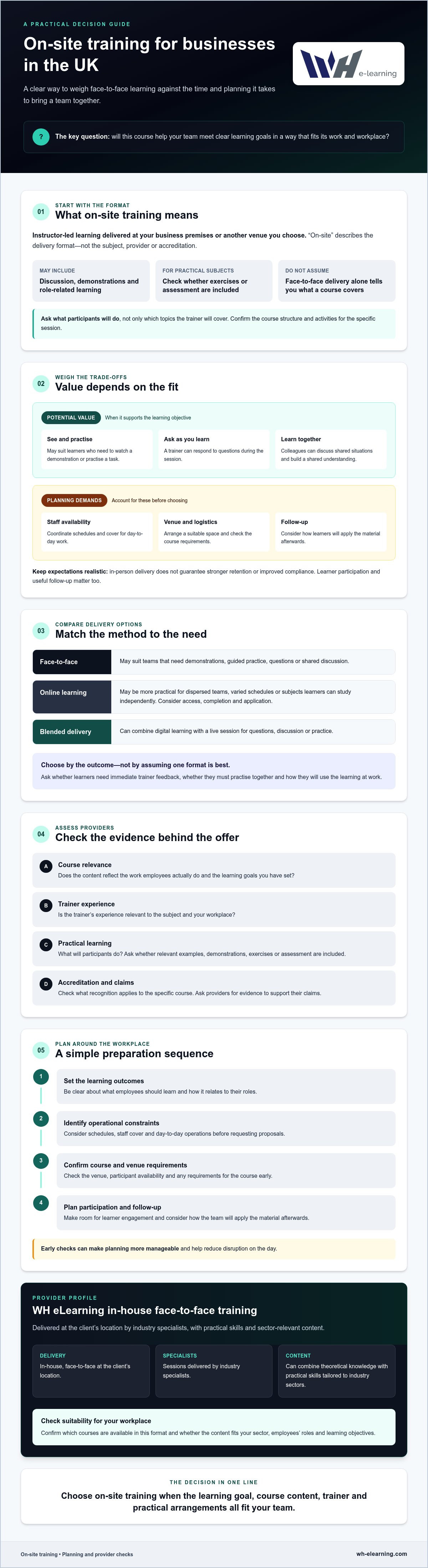
On-site training is instructor-led learning delivered at a business’s premises or another venue it chooses. The term describes the delivery format, not the course subject, provider or accreditation. Businesses may use it to develop practical skills, support team learning or address workplace safety needs. If you’re researching “on-site training for businesses UK”, remember that face-to-face delivery alone does not tell you what a course covers or what recognition it carries.
Depending on the course and provider, a session may include discussion, demonstrations and learning related to employees’ roles. On-site training can overlap with workplace learning, but the terms are not always interchangeable. For a broader introduction to workplace-based learning, see On-the-job training.
What happens during a typical on-site training session?
A session may start with a briefing, followed by trainer-led learning, activities and a review of key points. The structure depends on the subject and provider, so ask what participants will do, not only which topics the trainer will cover. Workplace examples can help connect ideas to employees’ roles. Discuss in advance how the provider will include relevant examples.
For practical subjects, check whether the session includes demonstrations or exercises and whether there is an assessment. Do not assume these are included. Confirm the arrangements for the specific course so you can judge whether its format supports your intended outcomes.
Which UK businesses might consider face-to-face delivery?
Face-to-face learning may suit organisations that want colleagues to explore a topic together, practise a skill or discuss shared workplace situations. A small employer might value the chance to work through examples relevant to its team, while a larger organisation may want a consistent learning experience across a group. Suitability depends on the learning objective, not simply the size of the workforce.
Consider the subject, too. A team that needs demonstrations or guided discussion may benefit from an instructor-led format, while another group may learn effectively in a different way. For health and safety subject options, explore occupational safety and health training courses. Check that the course content, trainer experience and practical activities suit employees’ roles.
WH eLearning’s in-house face-to-face training is delivered at the client’s location by industry specialists. It can combine theoretical knowledge with practical skills tailored to industry sectors. Before making arrangements, confirm which courses are available in this format and whether the content fits your workplace.
What are the benefits and limitations of on-site business training?
On-site training can bring colleagues together for shared discussion and practical learning. It also requires you to coordinate staff availability, a suitable venue and day-to-day cover. Its value depends on the fit between the course and your needs, as well as learner participation and useful follow-up. When choosing on-site training for businesses UK-wide, weigh these requirements against the outcomes you need.
When can face-to-face training add practical value?
Face-to-face delivery may suit learners who need to watch a demonstration, practise a task or ask questions as they work through a topic. A trainer can respond to questions, while group discussion can help colleagues in relevant roles build a shared understanding of processes or expectations.
That interaction is useful when it supports the learning objective. A session should give participants opportunities to engage, rather than simply put them in the same room. In-person delivery does not guarantee stronger retention or improved compliance. Consider how learners will apply the material afterwards and what follow-up may help.
When might another training format suit better?
Online learning may be more practical for dispersed teams, people working varied schedules or subjects that learners can study independently. It can reduce the need to bring staff together at one time, but you’ll still need to consider access, completion and how employees will apply what they learn. Blended delivery can combine digital learning with a live session for questions, discussion or practice.
Compare formats against the outcome you need rather than assuming one is best. Ask whether learners need immediate trainer feedback, whether they must practise together and how easily staff can attend. The workplace compliance training guide can help you consider how a course fits into a broader programme.
This comparison can help you weigh the main trade-offs:
- Face-to-face: consider it for demonstrations, guided practice and shared discussion. Plan for attendance and venue needs.
- Online: consider it for flexible, individual learning. Check that employees can access and complete the course.
- Blended: consider it when learners need independent study as well as time to explore questions or practise together.
Whichever format you choose, plan how learning will be followed up. Review what learners can now do, where they may need support and how the material applies at work. For practical, sector-relevant face-to-face learning, explore WH eLearning’s in-house training and check whether an available course matches your objectives.
How should you compare on-site training providers in the UK?
Compare providers against the same criteria, not just their course titles or claims. The right on-site training for businesses UK should connect learning objectives to employees’ roles and give you clear answers about delivery, trainer expertise, assessment and records. Use the questions below when requesting proposals, then check the evidence before booking.
| Criterion | Questions to ask | Evidence to request |
|---|---|---|
| Course relevance | How do the objectives fit our roles, experience levels and workplace context? | A course outline showing objectives, topics and intended audience. |
| Trainer expertise | What experience does the trainer have with this subject and our industry? | A relevant trainer biography or summary of experience. |
| Practical learning | What activities, demonstrations or workplace examples are included? | A session plan and details of any materials or equipment required. |
| Assessment and records | How is learning assessed, and what completion record will we receive? | Written confirmation of assessment arrangements and documentation. |
| Accessibility | How can language needs or access requirements be accommodated? | Details of available adjustments and any arrangements you need to make. |
| Quality and recognition | What feedback is gathered, and what accreditation or certification applies to this course? | Course-specific evidence of recognition, plus details of evaluation and follow-up. |
What should you ask about course content and trainer expertise?
Tell the provider who will attend, what they already know and which tasks or challenges the training should address. Ask how the learning objectives relate to these needs rather than accepting a generic outline. Request information about the trainer’s experience in the subject and relevant industry, and ask what learners will do during the session. These details help you judge whether the proposed content suits the group.
How can you check quality, accessibility and outcomes?
Ask how the provider gathers feedback and whether learning is reviewed after delivery. Check the assessment method, completion documentation and any access or language arrangements before agreeing a date. Treat claims about accreditation, certification and regulatory relevance as course-specific. Ask what applies to the course you’re considering and request supporting evidence. For safety-related options, compare topics using this guide to workplace safety training courses.
Record each provider’s answers in the same table, noting anything still to confirm. For wider business learning resources, you can also explore the UK government’s Business Academy. A consistent comparison helps you spot gaps early and assess whether each course is relevant, accessible and straightforward to evaluate.
How do you plan on-site training without disrupting business operations?
Good planning starts before you request proposals. Define who needs training, what they should be able to do afterwards and which workplace situations the session should address. This gives providers a useful brief and helps you plan around operational demands instead of treating training as a separate event.
- Assess the need. Identify the roles involved, current skills or knowledge gaps and the workplace context the training should reflect.
- Set observable outcomes. Describe what employees should know or be able to demonstrate after the session. Use these outcomes to guide course selection and later evaluation.
- Request and compare proposals. Share your objectives, audience and practical requirements. Confirm the proposed content, session structure and any assessment arrangements.
- Agree dates and logistics. Consider staff cover, shift patterns and business-critical periods. Confirm venue access, room capacity, equipment, accessibility needs and requirements for practical activities with the provider.
- Brief learners and coordinators. Explain why employees are attending and what the session aims to achieve. Assign someone to manage attendance, questions and coordination on the day.
- Review and follow up. Record attendance, gather learner feedback and agree how understanding will be checked. Note any follow-up actions, such as additional guidance or opportunities to apply the learning.
What should your team prepare before the trainer arrives?
Check that the room is accessible and suitable for the planned activities, and test any equipment the provider has asked you to supply. Tell learners where to go, what to bring and who to contact with questions. A named coordinator can welcome the trainer, handle last-minute arrangements and help the session start smoothly. Confirm responsibilities with the provider in advance, particularly if practical activities need specific space or materials.
How can you measure whether the training worked?
Keep evaluation proportionate to the objectives. If the aim is to understand a process, use the agreed method to check knowledge. If learners need to practise a task, consider how that skill can be observed afterwards. Gather feedback, record completion and compare the results with the outcomes set before booking. Attendance shows who took part, but not what they learnt.
Planning on-site training for businesses UK teams can manage is easier when responsibilities and practical details are clear from the outset. To discuss whether in-house face-to-face training fits your needs, discuss in-house training options with WH eLearning.
How can WH eLearning support on-site training for your business?
WH eLearning offers in-house face-to-face training delivered at the client’s location by industry specialists. The sessions combine theoretical knowledge with practical skills and content tailored to industry sectors. This may suit organisations looking for learning related to their workplace. Whether it fits your on-site training needs depends on the available course, your learners and the outcomes you want to achieve.
Face-to-face training is one part of WH eLearning’s wider offer. Its library includes more than 100 online courses across workplace compliance, HR and health and safety. Online learning may complement an in-person session where appropriate, but check course availability and fit rather than assuming they are suitable. Corporate licensing is a separate option and includes tools for monitoring staff progress and compliance status. It is not standalone learning management software.
What should a business confirm before discussing an in-house session?
Prepare a clear outline of the training need before making an enquiry. Include the subject, learner roles, their experience and what you’d like them to learn or practise. Note your preferred delivery location and relevant workplace context, such as tasks or examples that could help make the session useful.
Then confirm the details directly with WH eLearning. Ask whether the specific course is available in-house, what the session covers, who will deliver it and what experience the trainer has. If accreditation or certification matters to your organisation, check what applies to that course and request confirmation. Discuss scheduling, session capacity, venue requirements and any assessment activities before booking.
What is the next step towards arranging business training?
When you enquire, share your team size, scheduling needs, preferred location and any venue or accessibility considerations. This gives WH eLearning context to discuss whether a course may fit and what arrangements need confirmation. Make sure the proposed scope, delivery details and course-specific requirements are clear before committing.
A focused enquiry turns a general training requirement into a practical conversation about course fit. Explore training options for your business and discuss in-house face-to-face training alongside relevant online learning options.
Make your next training decision with confidence
Effective on-site training starts with clear learning outcomes, a course that fits employees’ roles and a delivery plan that works for your workplace. Compare providers, check course-specific details and arrange staff cover, venue and follow-up before the session. The right approach to on-site training for businesses UK-wide depends on practical fit, learner participation and how the training will be applied afterwards.
WH eLearning offers in-house face-to-face sessions at the client’s location, delivered by industry specialists. The training combines theory with practical skills and content tailored to industry sectors. Its library of more than 100 online workplace training courses may also complement in-person learning where appropriate. Confirm course availability, accreditation, trainer details and delivery arrangements directly before booking.
Ready to explore an option that suits your team? Explore training options for your business and take the next step towards relevant, well-planned learning.
Frequently Asked Questions
What is on-site training for businesses?
On-site training is instructor-led learning delivered at a business’s premises or another agreed venue. A provider may adapt examples or activities to the organisation, but the degree of tailoring and session format varies. Before booking, confirm the objectives, trainer experience, practical elements and assessment arrangements. On-site describes where and how learning is delivered. It does not guarantee accreditation, certification or a particular learning outcome.
Is on-site training better than online training for businesses?
No format is automatically better. Face-to-face sessions may suit teams that benefit from discussion, demonstrations or shared practice. Online learning can be easier to organise for staff working across locations or shifts. Compare options against the subject, learner needs, workplace constraints and intended outcomes. A blended approach may also work, combining online study with a live session. Ask how each part supports the learning objectives.
How much does on-site training for a business cost in the UK?
The cost of on-site training for businesses UK-wide depends on the course, provider, delivery requirements, location and any preparation or assessment involved. Request a written proposal that sets out what’s included and whether additional arrangements may apply. Compare the full scope, not just a headline figure, and check that the learning objectives and delivery details suit your team. Confirm current costs directly with each provider.
Can on-site training be tailored to our business?
Examples, activities or the emphasis of a session may be adaptable, but the scope depends on the course and provider. Explain your industry, learner roles, workplace context and intended outcomes when asking for details. Check what can be tailored and what remains standard. If accreditation or certification matters, confirm whether proposed changes affect approval, assessment or certification, and get agreed adjustments recorded in writing.
How many employees can attend an on-site training session?
There is no single suitable group size for every course. Capacity may depend on the subject, activities, venue, trainer and assessment requirements. Ask the provider for its recommended group size, especially if participants need individual practice or feedback. Share the expected number of attendees, then check that the room, layout and equipment can accommodate the group before confirming the session.
Does on-site training count towards UK workplace compliance?
It depends on the subject, course content, employees’ roles and the duties that apply to your organisation. Training may support workplace competence, but attendance alone may not show that every relevant requirement has been met. Check applicable guidance from the Health and Safety Executive, and verify course-specific accreditation or regulatory claims. For advice on your circumstances, consult a competent professional rather than relying on a general course description.
What should we ask an on-site training provider before booking?
Ask about the course objectives, trainer experience, suitability for your workforce, practical activities, assessment, accessibility and completion records. Confirm the proposed date, venue requirements, recommended group size and what the fee includes. If accreditation or certification matters, request confirmation for the specific course. Agree how feedback and learning outcomes will be reviewed afterwards so you can connect the session to workplace practice and any follow-up needed.


